America’s Samurai Myth
Reconsidering Obama’s Syria red line and its lessons for Iran.
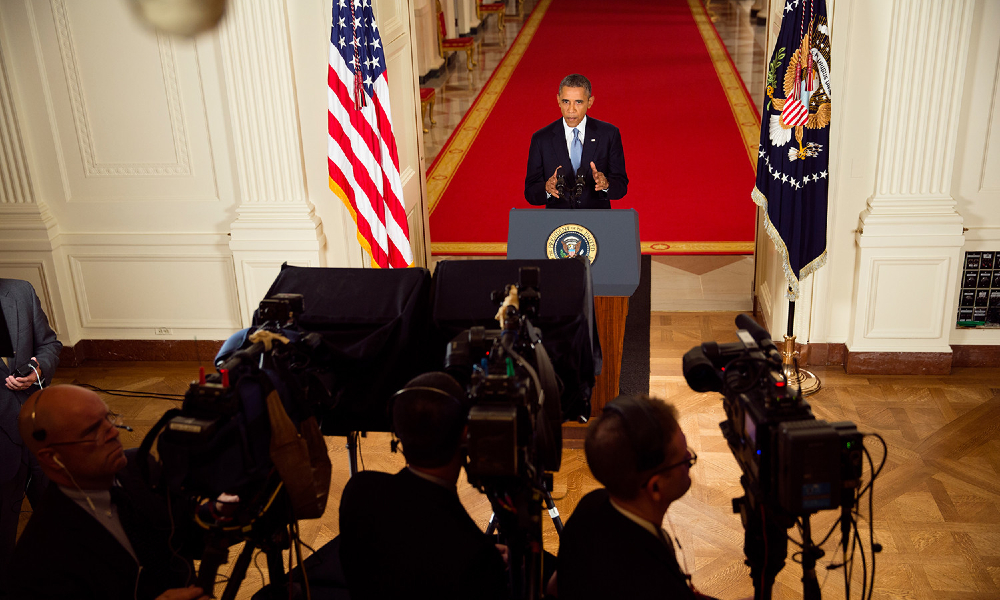

Editor’s Note: Obama was excoriated for putting forth a “red line” warning against the Assad regime’s use of chemical weapons and then, after a sarin attack that killed more than 1,000 people in 2013, not using force. Jeremy Shapiro of the European Council on Foreign Relations argues that the conventional wisdom—that Obama damaged U.S. credibility and Trump later restored it by striking Syria after another chemical attack—is wrongheaded. Obama’s decision led to the destruction of most of Syria’s chemical weapons arsenal through a negotiated agreement while Trump’s later strikes did nothing.
Daniel Byman
***
In January, with the Trump administration considering war with Iran, the Foundation for Defense of Democracies (FDD) published a piece under a headline that produced, for me at least, a post-traumatic flashback to 2013. “Don’t make the mistake Obama did, Mr. President,” FDD’s Ahmad Sharawi warned, “enforce your Iran ‘red line.’” Obama’s 2013 “failure” to enforce a red line over Syria that he himself had drawn, the argument ran, shattered American credibility and emboldened Moscow and Tehran to become yet more aggressive. In other words, having threatened war with Iran, Trump now had no choice but to follow through.
The red line incident, to mangle William Faulkner, is thus not dead; it is not even past. Obama’s refusal to use force against Syria is still weaponized to promote wars today and probably always will be. The lesson of September 2013 has become America’s version of the samurai myth: A U.S. military sword once unsheathed must taste blood or the nation loses its honor.
As we wade through our current quagmire in Iran, we should understand how that red line lesson emerged and why misunderstanding it has at times crippled U.S. diplomacy and led us into pointless wars.
The Making of a Myth
In August 2012, Barack Obama somewhat suddenly declared that Syrian government use of chemical weapons in the civil war there would cross “a red line” and “change my calculus.” I was working on Syria in the State Department at the time and thought I understood the policy, but I was startled by his vehemence. Reporting later established that I was not alone. The phrase surprised Obama’s closest advisers, who had agreed on something more vague.
A year later, Syrian President Bashar al-Assad crossed that line, killing more than 1,400 people with sarin nerve gas in the suburbs of Damascus. A U.S. attack seemed imminent. U.S. destroyers deployed to the eastern Mediterranean. Planners drew up targets. Secretary of State John Kerry gave a thundering speech.
Then Obama took a walk around the White House South Lawn with his chief of staff, Denis McDonough and decided to ask Congress for an authorization he knew they would never grant. In the end, the United States never fired a shot. American credibility, we are told, died that weekend. Russia took Crimea a year later because of it. The Gulf countries gave up on America as a result. In Middle America, grandmothers wept for our country’s lost greatness.
The story enjoys remarkable bipartisan support, even among many of the people who were in the room where it happened. Leon Panetta, defense secretary until early 2013, later wrote that the reversal damaged American credibility and sent a mixed message to the world. Chuck Hagel, Panetta’s successor, who spent Aug. 30, 2013, approving strike plans, said there was no question it hurt the credibility of the president’s word. Susan Rice, national security adviser in 2013, arrived at the same conclusion from the opposite direction. The administration, she concluded, should never have drawn a red line that raised expectations for actions that might not serve American interests. Even Obama eventually gave ground. In an interview in 2017, he allowed that if you put all the weight on that particular phrase, the complaint was a legitimate one.
The only problem with this consensus is that none of that is right. The red line incident is in fact a triumph of American diplomacy, a shining island of U.S. diplomatic wisdom amid a sea of stupid wars. The fact that even many of those responsible for the decision see it otherwise tells us something genuinely unpleasant about how the American strategic community thinks about military force.
The Real World Matters
Let’s start with what actually happened. Faced with a credible American threat, Assad surrendered nearly his entire chemical arsenal. Inspectors hauled 1,308 tons of agent and precursor out of an active war zone. They finished the job by June 2014. The Syrian regime gave up a capability it had spent three decades building.
We should understand what that meant in Damascus. The stockpile was not a regime hobby. It was the Assad family’s answer to Israeli conventional and nuclear superiority, the poor man’s deterrent, the one asset the regime believed could prevent Israeli domination. To get them to give it up, the Russians, who wanted to avoid U.S. intervention in the Syrian civil war, had to lean on the Assad regime hard and make plain that continued Russian protection depended on compliance. Assad handed over his crown jewels while fighting for his life. This was an extraordinary achievement.
But that is only the beginning of the victory. Imagine next what never happened. In 2014, the Islamic State overran a third of Syria. In 2015, the regime came close enough to collapse that Russia intervened to rescue it. Then came the sieges, the barrel bombs, the destruction of Aleppo, and eventually, in 2024, the fall of the Assad regime. What might we have expected from a desperate leader with so many tons of nerve gas at such moments? The regime fired nerve agent into the suburbs of its own capital in 2013, when it was holding its own in the war; what do we think it would have done in 2015 or 2024, when it was on the brink of losing?
It is only a counterfactual. But any sober estimate of the lives that the deal saved runs into the tens of thousands. A threat of force followed by a diplomatic breakthrough produced that at a cost of zero casualties and zero munitions.
What would have happened if the United States had used force in 2013? Again, a counterfactual, but we can have a pretty good idea. In September 2013, the United States had no military option that would have destroyed Syria’s chemical arsenal. Specialists warned that bombing chemical stockpiles might release a lethal cloud that could spread across Syria and beyond. It would have risked killing the civilians the operation claimed to protect.
Pentagon planners designed the strike package accordingly, around the stockpiles rather than at them. Chairman of the Joint Chiefs of Staff Martin Dempsey had already told the Senate that eliminating the weapons by force would require a no-fly zone plus thousands of troops to assault and secure sites, with Pentagon estimates running past 75,000. No one was interested in that after the debacles of Iraq and Libya.
Of course, the deal was incomplete. Assad’s declaration omitted material, he continued to use readily available chlorine, and he retained enough undeclared nerve gas to attack the town of Khan Shaykhun in 2017. But those caveats indict the military alternative more heavily than the agreement. The proposed 2013 strike would have left not only the residual capacity Assad concealed but also the 1,308 tons the agreement removed. The choice in 2013 was never between perfect disarmament and imperfect diplomacy. It was between either incomplete disarmament or a punitive strike that disarmed Syria not at all and had no lasting deterrent effect.
The attack on Khan Shaykhun, in fact, produced the closest thing available to a real-world test of the alternative. In April 2017, after the Syrian regime attacked the town with chemical weapons, President Trump responded with military force, firing 59 Tomahawk cruise missiles at a Syrian airbase. The strike killed some Syrian soldiers, wrecked some aircraft shelters, prevented no chemical attacks, and—most importantly—changed no Syrian calculation. Syrian aircraft flew from that field again the next day. A year later, Assad gassed the city of Douma.
The Value of Performance
Regardless, Washington loved Trump’s performative show of force. Fareed Zakaria, who had once called Trump a cancer on American democracy, told CNN the next morning that “Donald Trump became president of the United States last night.” On liberal MSNBC, Brian Williams called the launch footage beautiful three times and reached for a Leonard Cohen lyric to give voice to his joy (“I’m guided by the beauty of our weapons”). Bret Stephens, another reliable Trump critic, saluted him in the Wall Street Journal and told him to go further and destroy the Assad regime for good. In the days after the strike, the five top American newspapers ran 18 editorials and op-eds about it, and not one of them opposed it.
Commentators who had spent four years lamenting American weakness reveled in the return to muscular stupidity. The applause outlasted the operational effect by at least a week.
It’s the Credibility, Stupid
So, why did the U.S. strategic community record the operation that eliminated much of Assad’s arsenal as a humiliation, and the operation that didn’t even close an airfield for a full day as a restoration of American power?
The stock answer is credibility. Of course, a country’s credibility matters. But the more difficult questions are what causes credibility and under which conditions does it matter. Washington implicitly assumes that credibility reduces to a given leader’s reputation. That theory assumes that adversaries keep a ledger of a president’s past resolve and consult it before their next adventure. Political scientists have spent decades searching for that ledger, combing crisis archives for a case in which a leader who backed down in one place was tested for it in another. They keep coming home with thin gruel.
Instead, scholars find that a country’s credibility is quite local: States read the interests and capabilities in the case in front of them, not character references from old crises. Every state, after all, believes that it is special (or exceptional). Russia, thus, did not seize Crimea because Obama declined to bomb Damascus; the Russians invaded because Ukrainian President Viktor Yanukovych fled Kyiv and their fleet at Sevastopol suddenly sat in a country turning west. They calculated the likelihood of a U.S. reaction based on U.S. relations and capabilities with regard to Russia, not based on Obama’s behavior in the distant backwater of Syria.
Russia, after all, had seen fit to dismember Georgia in 2008, a much closer partner of the United States than Ukraine, while the White House was occupied by a man who had already invaded two countries. The evidence is clear that adversaries judge the case and the capabilities before them. They do not audit a president’s soul and apply the lessons of his conduct from Syria or Iraq to Ukraine or Taiwan.
But reputational arguments have huge currency within Washington. The town graded the process when the bombs failed to fall and never reopened the file when the results of the diplomacy came in. Derek Chollet later asked why the foreign policy establishment insists on filing a massive success under failure. The apparent answer is that the effect on a president’s reputation, which in turn is judged by his eagerness to use force, is practically the only metric people in Washington use to measure success.
That disturbing conclusion has three clear consequences that illuminate the current U.S. troubles in Iran.
First, a political scoring system that rewards ordnance and ignores outcomes makes violence cheap and diplomacy expensive. Fifty-nine Tomahawks buy a week of admiring coverage. Removing most of an arsenal of mass destruction buys a decade or more of sneering. Presidents can do that math, even Trump.
Second, allies also learn the currency of force and denominate their demands in it. The Gulf states were not grieving over American reliability regarding Iran in the autumn of 2013. They wanted the United States to eliminate their Assad problem, and the threat of chemical weapons gave them their best lever for the job. Obama’s deal did not destroy their faith in American protection—it frankly told them nothing about what the United States would do to protect them if, say, they were attacked by Iran. What it did instead was take the lever of chemical weapons away as a reason for a forceful U.S. intervention in the Syrian civil war.
The idea of credibility as reputation is a weapon for U.S. allies in U.S. domestic debates about foreign policy, and they use it skillfully. If an allied leader wants a U.S. attack on his regional adversary, he knows to frame it as a test of American credibility. So, Polish Prime Minister Mateusz Morawiecki flew to Washington in April 2023 to warn that a Russian victory in Ukraine would send Chinese President Xi Jinping the message that using military force against U.S. allies works. Expect a Chinese invasion of Taiwan “the next day.” Similarly, NATO Secretary General Jens Stoltenberg told the Council on Foreign Relations in 2023 that if Russia wins in Ukraine, “the message to President Putin but also to President Xi is that when they use military force, when they violate international law, when they invade another country, they get what they want. So if the United States is concerned about China … then you have to ensure that Putin doesn’t win in Ukraine.”
None of these leaders was offering inside information about Chinese war planning. All of them were telling the U.S. president that his reputation was at stake and that failure to support the cause of the moment would create instability that would eventually wash up on American shores. True to form, current commentators assert that somehow it is necessary to fight a war with Iran in order to prove we will defend Taiwan. So, more consequentially, does the officer who would fight that war: Adm. Samuel Paparo, head of U.S. Pacific Command. He wants Beijing to see that “the United States employs capability and will in response to aggression.”
Third, the establishment teaches presidents to make cheap commitments and only later bills them for the consequences. Obama’s real error was never restraint. He blurted out a threat he had not thought through, then won the resulting confrontation more completely than any airstrike ever could have, then refused to celebrate his own victory. He won the war but lost the press conference.
None of this means the credibility talk carried no cost. It cost Obama plenty. He spent the rest of his presidency arguing about it with his own cabinet, and the label has followed him into the histories. The red line damaged him in Washington. But that is a fact about Washington. It is not a fact about Syria, and it is certainly not a fact about American power.
The lesson for the war in Iran is that credibility is not a blood debt. Washington may believe that once a president unsheathes his sword, the objective automatically becomes drawing blood rather than obtaining the result for which the sword was drawn. But the more important question remains what course of action best advances American interests. If negotiation, a limited settlement, or simply declaring victory and going home can deliver more than the next military strike, then refusing continued war is the very soul of statecraft. At the moment, Trump’s attachment to this macho code and his fear of looking weak by abandoning force options in Iran seems to be keeping him (and us) in a pointless war.
A version of this piece was originally published in the Blue Blaze substack.