Congress’s Options for Ending the Iran War

In the eyes of many, the historic victory that Democrats secured in the recent midterm elections has left them with one overwhelming policy mandate: to bring an end to the unpopular Iran War initiated and still being pursued by the Trump administration. Executing on this mandate, however, will be easier said than done.
While Democrats will control both chambers of the incoming 120th Congress by comfortable margins, they will still lack the votes to overcome a Senate filibuster on their own. Nor will they come close to the votes needed to override a possible veto by President Trump. As a result, congressional Democrats who wish to limit or end the Iran War will have to wait for legislative opportunities that give them leverage over the Trump administration’s willingness to use the veto—and even then, Democrats are likely to need at least some Republican votes.
In this article, I look ahead to the end of this year and into 2027 to identify what opportunities Democrats in Congress might have to pass legislation limiting the Iran War over the Trump administration’s objections. After examining why freestanding legislation is likely to remain vulnerable to a presidential veto throughout the 120th Congress, I identify what “must-pass” legislation might serve as a vehicle for Iran War-related restrictions. Finally, I discuss steps Congress could take to set certain limits on the Iran War without legislation, and thus would not be vulnerable to a presidential veto.
One thing I do not do, however, is tackle the difficult question of what exact restrictions Congress should impose and why. Which of the three ongoing elements of the Iran War to limit or end—escort missions through the Strait of Hormuz; the blockade on Iranian trade; and the escalatory strikes repeatedly threatened by Trump—and how to account for such contingencies as kidnappings and terrorist attacks is undoubtedly complicated enough to warrant separate discussion. In this piece I focus on on Congress’s procedural options for ending the Iran War, not its substantive ones.
For the many Americans who voted for Democrats to bring an end to the Iran War, the key takeaway should be this: be patient. Congress can bring real pressure to bear on the executive branch over the use of military force. But even the historic margin of victory secured by Democrats is not enough for them to overcome many of the barriers our political system presents to such action. Like most actions by Congress, an end to the Iran War will instead need to be negotiated, both between Democratic and Republican legislators and with the Trump administration itself. The final resolution of the conflict is likely to be as much political as it is legal—and either way, arriving there will take time.
Freestanding Legislation
No freestanding legislative measures aimed at limiting or ending the Iran War are likely to see a floor vote in both the House and Senate in the current Republican-controlled 119th Congress, which will remain in place until January. The majority leadership sets the legislative agenda in each chamber, meaning even measures that might earn the support of a majority of legislators generally will not receive a vote without the leadership’s acquiescence.
The limited exceptions to this rule—such as the discharge petition process in the House—work too slowly and require too high a threshold of support to be realistic options in the remaining weeks before the 119th Congress adjourns. And the only relevant expedited procedures—a set of provisions associated with the War Powers Resolution that allow certain joint resolutions to be debated and moved through the Senate by a simple majority, even without leadership support—only apply in the Senate, not the House.
Separate procedures for concurrent resolutions do apply in both chambers, which Democrats have used frequently in the 119th Congress. This includes to adopt H. Con. Res. 86, the concurrent resolution instructing Trump to remove U.S. armed forces from hostilities with Iran. But concurrent resolutions do not have the independent force of law.
These conditions flip, however, once Democrats take control of the 120th Congress on Jan. 3, 2027. At that point, Democratic leaders will control the floor in both chambers, allowing them to bring up whatever legislation they choose—including legislation aimed at limiting or ending the Iran War.
Doing so will most likely require at least one of two types of legislation. The first is a statutory directive requiring that the president end the use of military force against Iran, subject to whatever exceptions, limitations, or timelines Congress chooses to impose. The second is a funding cut-off prohibiting the use of any appropriated funds, past or present, for the same. In theory, the two types of measures—statutory directives and funding cut-offs—should have equivalent legal effects, as the Supreme Court has made clear that Congress cannot use its power of the purse to accomplish what the Constitution otherwise bars it from doing directly. In practice, however, each presents certain advantages and disadvantages.
A funding cut-off has been the most discussed type of provision, in part because Congress took that approach when ending the Vietnam War. The main advantage of a funding cut-off is enforceability. The executive branch has sometimes cast doubt on the extent to which Congress can direct how the president uses the armed forces without infringing on his or her constitutional authority as commander in chief. But even the executive branch’s broadest articulations of presidential authority over the use of military force have generally accepted Congress’s authority to withhold funds for military activities at some level.
A knowing and willful violation of a funding cut-off can also be criminally prosecuted under the Antideficiency Act. Trump’s control of the Justice Department and pardon power likely limit the practical significance of such enforcement efforts. It may also be easier for Congress itself to sue over the violation of a funding cut-off: In 2020, the U.S. Court of Appeals for the District of Columbia Circuit held that the House had standing to sue the executive branch over spending that violated the Appropriations Clause, though not over mere statutory violations—a decision later vacated as moot, but whose logic likely still reflects the views of at least that court. For all these reasons, a funding cut-off may be more effective and enforceable than a more straightforward statutory directive.
A statutory directive, however, may be easier to enact. Since 1983, the Senate has maintained expedited procedures that allow a joint resolution “requir[ing] the removal of United States Armed Forces engaged in hostilities” to be introduced, debated, and adopted with a simple majority, effectively bypassing the filibuster. If Senate Democrats struggle to secure the 60 votes normally needed to pass cloture and end a filibuster, these expedited procedures may be their only option for enacting such a provision. And that situation is entirely possible: Even with the 56 Senate seats they will hold, Democrats will need four Republican votes (plus a fifth if Democratic Sen. John Fetterman (D-Penn.) continues to oppose Iran-related restrictions, as he has throughout the current Congress). And only two of the four Republican senators who voted for H. Con. Res. 86 in June—Lisa Murkowski (R-Alaska) and Rand Paul (R-Ky.)—will still be in office come January 2027.
Importantly, Senate precedents allow legislators to introduce germane amendments to such joint resolutions without disqualifying them for expedited consideration. In practice, this means expedited joint resolutions can include certain relevant collateral provisions beyond an instruction to terminate hostilities. Yet it has never been tested whether this allows such joint resolutions to include a funding cut-off without losing their filibuster-proof status. If not, then Democrats may be able to only use these expedited procedures to adopt a statutory directive, not a funding cut-off.
All else being equal, if Congress wants to increase its likelihood of success, it would be well advised to pursue a belt-and-suspenders approach and adopt both types of provisions. But whatever path congressional Democrats pursue, the real challenge will come after Congress votes. At that point, any passed legislation Congress will go to Trump for a likely veto. Overriding that veto will in turn require the support of two-thirds of those voting in each chamber—a threshold that has proven extraordinarily difficult to meet in our current, deeply partisan era.
The Iran War may well buck this trend, particularly if the conflict grows more intractable, the economy continues to suffer, the Trump administration decides to escalate, or congressional Republicans otherwise come to see the war as an albatross around the neck of their collective political future. Notably, incoming Democratic Speaker of the House Hakeem Jeffries (D-NY) has indicated that Democrats intend to adopt a joint resolution directing an end to hostilities with Iran early in the 120th Congress (presumably through the War Powers Resolution’s expedited procedures) and that he thinks Trump may not veto it, or that enough Republicans may join Democrats to override that veto if he does.
Perhaps this is right—but it would be a big shift for Republican members of Congress, the vast majority of whom have stuck by the Trump administration on Iran thus far. This is likely to be especially true in the new House, where many Republicans who lost their seats were moderates, leaving a smaller, more conservative conference that is, if anything, more closely aligned with Trump than its predecessor. Regardless, unless and until a significant number of congressional Republicans choose to join Democrats in ending the war over Trump’s express opposition, any freestanding legislation is likely to end here.
Riders on “Must-Pass” Legislation
To get past the presidential veto, Democrats will likely need to pursue a different, tried-and-true legislative strategy: incorporating one or both types of Iran War provisions into broader “must-pass” legislation. While Trump remains free to veto such legislation, doing so would also upend other authorizations and appropriations that the Trump administration wants or needs. This gives Congress more leverage to demand that the Trump administration accept some provisions it might otherwise oppose, including potential Iran-related restrictions.
The challenge of using riders on must-pass legislation, however, is that Congress doesn’t fully control when such legislation arises and thus has to wait for an opportunity; indeed, it is often a hard, external deadline that makes something “must pass.” Each type of must-pass legislation is also shaped by its own special rules and committee processes, which can sometimes affect the types of provisions that can be included. In addition, a Congress controlled by the opposite of the president’s party likely has lots of items they want as riders on such legislation, meaning some measures will inevitably be compromised or left out.
More fundamentally, such legislation is generally considered “must-pass” because it’s important—not just to the Trump administration, but to the country as a whole. Fights over disputed provisions can thus become a stand off between Congress and the president over who has a higher tolerance for the political harm that not enacting such legislation causes to the country. This may be a challenging showdown for congressional Democrats to win because many congressional Democrats simply place a higher premium on a functional federal government than Trump does.
The political incentives may be complicated, too: Democrats’ new House majority rests heavily on members who flipped districts Trump carried in 2024, many of whom may be particularly wary of being blamed for a shutdown or a lapse in military pay heading into 2028—even as the war’s unpopularity gives them reason to want it over.
Regardless, looking out through the end of 2027, at least six possible vehicles for Iran War-related riders are visible on the horizon. Several are set to arise before the end of the 119th Congress but may extend into the 120th Congress, after Democrats take control of both chambers. The timeline below summarizes them, along with when they might be enacted and the procedures likely to govern each:
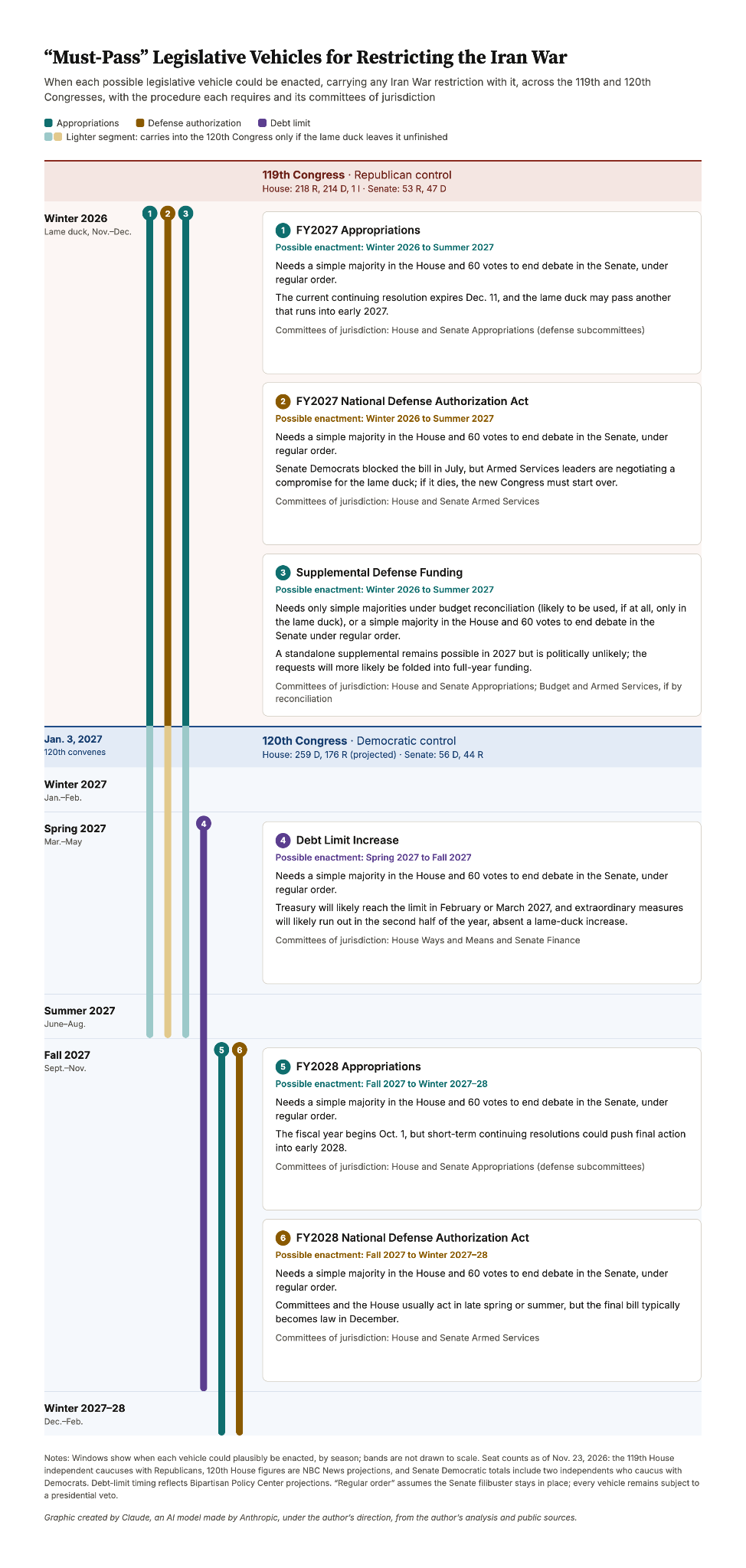
At least two legislative vehicles are likely to be debated before the end of the year, during the current Republican-controlled 119th Congress’s lame duck period. First, the continuing resolution currently funding the government expires on Dec. 11, meaning Congress will need to enact another continuing resolution or otherwiseappropriate funds for the federal government for 2027 on or about that date to avoid a shutdown.
Second, Congress has also failed to adopt a National Defense Authorization Act (NDAA) for 2027 in part because Senate Democrats have withheld the votes necessary for the bill to proceed, citing its lack of limits on the Iran War. If the NDAA fails to move by the end of the year, then various authorities used by the Defense Department—including some relating to pay for service members and other politically sensitive topics—will lapse. It would be the first time Congress has failed to enact an annual NDAA in more than 60 years, marking a potential end to one of Congress’s last remaining points of consistent bipartisan collaboration.
Both types of legislation require 60 votes to end debate in the Senate, meaning that Republicans in the current Congress need at least seven Senate Democrats to join them in supporting the legislation. By credibly threatening to withhold these votes, Senate Democrats may be able to persuade Republicans to accept certain statutory provisions, including Iran War-related limitations. This appears to be the strategy of some Senate Democrats, who reportedly hope to insert an Iran War limitation into the continuing resolution for 2027 funding set to be debated before Dec. 11.
However, if Senate Republicans refuse—or House Republicans refuse to accept that provision in conference—then Senate Democrats must decide whether they are willing to shut down the government or not pass the NDAA without such a restriction. Of the two potential outcomes, the former is likely more politically fraught, especially as a continuing resolution could likely extend several of the NDAA’s expiring authorities at least temporarily. Some may instead pursue other compromises, such as a short-term continuing resolution keeping the government open only until early 2027, when the new, Democratic-controlled 120th Congress can debate it. Notably, Democratic leaders on the appropriations committees have reportedly floated this possibility. And as few as seven Senate Democrats need to embrace such a compromise for it to move forward.
A third possible vehicle in the lame duck Congress is the Trump administration’s outstanding requests for additional defense funding: an $87.6 billion supplemental appropriations request sent in June and a separate $350 billion in defense spending the administration wants Congress to provide through budget reconciliation. Both would help cover costs and equipment shortages associated with the Iran War, among other priorities.
Republicans have discussed providing at least some of this funding through the budget reconciliation process, a set of expedited procedures that bypass the Senate filibuster and allow the current Republican leadership to move forward on a simple majority basis. Whether this is feasible, however, is far from clear, as House fiscal conservatives have insisted on offsets for any new spending The narrow House majority has also struggled to get its members to simply show up.
Tellingly, majority leader Sen. John Thune (R-S.D.) has called it an “open question” whether Republicans have the votes to pass another party-line package. If Republicans need60 votes in the Senate—and thus the support of at least seven Democrats—or if they cannot muster the numbers to pass under reconciliation, Republican leadership may be forced to seek Democratic votes. This could give Democrats another chance to seek Iran War-related concessions in exchange for helping the Defense Department recoup some of the war’s costs.
More likely, however, if additional defense funding can’t move forward through reconciliation, the president’s requests simply won’t be acted on, and debate over additional funds will be rolled into the broader debate over 2027 (or 2028) appropriations. This appears to be the direction the debate is headed, with Thune recently suggesting that parts of the Trump administration’s request—relating to munitions funding—could be horsetraded for some Iran War-related limitations as part of a broader appropriations package. Senate Republican appropriators have already moved in this direction, as the fiscal 2027 defense spending bill they released on Nov. 16 shifts roughly $69 billion of the administration’s reconciliation request, including munitions funding, into regular appropriations. Thune, for his part, paused the party-line push on Nov. 18 to explore whether a bipartisan deal is possible.
The 120th Congress will sit on Jan. 3, 2027, with Democrats assuming control of both the House and Senate. If Democrats negotiate a short-term continuing resolution to cover 2027 appropriations in the 119th Congress—or simply suffer through a shutdown—then the 120th Congress may have the opportunity to debate appropriations legislation for fiscal year 2027 early in the year. The 120th Congress may also need to debate a 2027 NDAA if Democrats ultimately decline to pass one with Republicans during the 119th Congress (though with negotiations on a compromise bill for the lame duck under way, this currently seems unlikely).
In either case, the new Democratic leadership will hold the pen in drafting both pieces of legislation. But some challenges are likely to persist. The NDAA process, for example, is managed by the armed services committees, which have historically been more reticent to impose hard restrictions on the military compared to others in Congress, regardless of which party is in control. The appropriations committees have similar institutional concerns and equities—including a traditional aversion to policy riders that could jeopardize their bills and a premium on the bipartisan deal-making that full-year spending bills require—that may not give Iran War-related provisions the priority that other Democrats in Congress may want.
More fundamentally, both measures will also still need 60 votes in the Senate to pass. In the Democratically controlled 120th Congress, this means that Democrats will need support from at least four Republican senators. In an inverse of the dynamics during the 119th Congress, this could allow unified Senate Republicans to obstruct either piece of legislation—or it could give Senate Republicans willing to work with Democrats the ability to demand concessions in the legislation, including any Iran War-related provisions.
If the 2027 NDAA and government funding bills don’t come up again early in the 120th Congress, legislation to raise the debt ceiling—the statutory limit on the amount the federal government can borrow—will likely be the next possible legislative vehicle. The Republican-controlled 119th Congress already raised this limit once in 2025 through the One Big Beautiful Bill Act and there are rumors it may do so again as part of another party-line reconciliation package before the end of the year. That said, reservations among Republican fiscal hawks in Congress—who have forced Republican congressional leaders to seek Democratic votes when raising the debt limit in the past—and resistance to using budget reconciliation to bypass the filibuster among Senate Republicans may make this difficult.
If the 119th Congress does not raise the debt ceiling again, the Trump administration will need to turn to the 120th Congress at some point, or risk a default on U.S. debt that could have disastrous consequences for the U.S. economy. When exactly is unclear: the Bipartisan Policy Center projects that the federal government will hit the limit in February or March 2027, after which the Treasury Department can use cash on hand and various “extraordinary measures” to keep paying bills for roughly six to nine more months.
Regardless, whenever the Trump administration has to turn to Congress, Democrats will be in a strong position to dictate the terms. While Democrats could, in theory, raise the debt ceiling on their own through the budget reconciliation process as Republicans did in 2025, they seem likely to take the more traditional route of passing legislation through regular order. This would avoid the constraints of the budget reconciliation process and make it procedurally easier to include Iran War limitations, so long as Democrats can secure at least four Republican senators’ support.
Yet Democrats have also historically criticized congressional Republicans for brinkmanship over the debt ceiling to extract political concessions. Hence, Democrats may be hesitant to do something that appears similar here.
If Democrats get to mid-2027 and still need vehicles for Iran War-related legislation, then they are likely to have two more natural options in front of them: one or more appropriations bills to fund the government through fiscal year 2028, which will become necessary starting Oct. 1 (though this date may get pushed back through agreement on short-term continuing resolutions); and the NDAA for 2028, which is traditionally debated throughout the year and voted on in the late fall or winter.
Democrats will hold the pen on both through their control of the appropriations and armed services committees, respectively, and will be in a good position to write in Iran War-related restrictions. As discussed above in relation to the 2027 NDAA and government funding legislation, committee dynamics may limit and shape what sorts of restrictions can be attached to each legislative vehicle. The greatest limitation, however, will stay the same: the need for support from (at least) four Republican senators to secure cloture on that legislation with those provisions intact.
Securing those votes is not impossible. Murkowski and Paul voted for H. Con. Res. 86 this past June and are the most likely Republican senators to support Iran War restrictions in future legislation. Other Republican senators—like Sen. Mike Lee (R-Utah), Josh Hawley (R-Mo.), Jerry Moran (R-Kan), and Todd Young (R-Ind.)—have supported measures restricting the president’s authority to use force without congressional authorization in the past, just not in relation to the current Iran War. (Murkowski and Moran may also have unusual sway over the appropriations process, as the two are currently vying to become the top Republican on the Appropriations Committee.)
Still others, such as Sen. John Curtis (R-Utah), have made statements sympathetic to congressional authority over the Iran War even if they haven’t voted that way yet. Moreover, five of these seven senators—everyone but Curtis and Hawley—will be up for reelection in 2028, giving a possible incentive to work with Democrats to end the politically unpopular war. In exchange, however, they will have an outsized voice in shaping the legislation. And that includes any constraints it may impose on how the Trump administration continues to pursue the Iran War.
Of course, congressional Democrats have one more highly controversial option available to them:: they could bypass the filibuster altogether and pass legislation through a simple majority of the Senate. While amending the Senate rules usually requires supermajority support, a simple Senate majority has previously used points of order to create exceptions to the filibuster—a practice often described as the “constitutional” or “nuclear” option.
If Senate Republican support proves to be a major barrier to ending the Iran War, talk about ending the filibuster will likely increase. In this case, though, removing the filibuster —something the War Powers Resolution’s procedures for joint resolutions already do in a narrow way—might help with enacting legislation, but it would not help that legislation get past a likely presidential veto. Indeed, the controversy of bypassing the filibuster might even make securing Republican votes in support of overriding a veto less likely. In this sense, ending the filibuster seems ill-suited for this particular purpose.
Nonlegislative Options
The 120th Congress can also take certain steps to limit or constrain the Iran War that don’t require legislation. These are unlikely to be as effective as legislation, making them a secondary option at best. But if the 120th Congress feels pressure to act at a pace faster than the legislative process allows, then it might see reason turn to these alternatives. Moreover, as they do not involve legislation, none are subject to a possible presidential veto. Several, however, still require some Republican support in the Senate for adoption.
The first nonlegislative option would be for Congress to adopt a concurrent resolution clearly stating its opposition to the Iran War. Such a resolution would articulate why Congress believes the continued pursuit of the Iran War violates the 1973 War Powers Resolution and other relevant provisions of law, and expressly direct the president to stop. This sort of resolution would lack the legal force of a statute, but could still have legal effects.
Under the Youngstown framework that federal courts use to assess presidential actions in areas of uncertain or shared constitutional authority, expressions of congressional opposition may limit or undermine the president’s ability to act in areas of shared or uncertain constitutional authority, including the use of military force. Expressions of congressional opposition can also counteract perceptions of congressional acquiescence, which can sometimes create an aggrandizing historical “gloss” on the president’s constitutional authority over time.
Federal courts have also frequently suggested that a contrary resolution by Congress—or possibly just the House or Senate—can create the sort of interbranch impasse that federal courts have generally wanted to see before adjudicating war powers and other interbranch foreign relations law disputes, overcoming potential political question doctrine and ripeness concerns that might otherwise bar adjudication.
Notably, the 119th Congress did something like this in June, when narrow bipartisan majorities in the House and Senate leveraged special expedited procedures under the 1973 War Powers Resolution to adopt H. Con. Res. 86. But because of the procedural context in which that concurrent resolution was adopted, it was limited in content, stating only that Congress “directs the President to remove United States Armed Forces from hostilities” against Iran, except when “necessary to defend the United States or an ally or partner of the United States from imminent attack.”
The 120th Congress could adopt a more detailed concurrent resolution articulating where it disagrees with the Trump administration’s actions and which need to end in its view. Indeed, Democratic congressional leaders will likely want to pass a resolution soon after the new Congress sits on Jan. 3 in order to make clear that the new Congress remains as opposed to the president’s actions as the old one, if not more so.
The only challenge with adopting a concurrent resolution under the War Powers Resolution still requires 60 votes in the Senate. If this proves impossible, Senate Democrats could fall back on the War Powers Resolution’s expedited procedures, which allow a concurrent resolution to pass on a simple majority basis in both chambers. But those procedures exist only for a concurrent resolution directing the removal of U.S. forces from hostilities, so anything else Democrats want to say would need to be built around that core directive. This most likely still leaves room for something more robust than H. Con. Res. 86, as Democratic control of the floor and majority would put them in a good position to push and define the (thus far untested) limits of that procedure. But it wouldn’t be open ended. Alternatively, the House could act independently and adopt its own simple resolution, though this would inevitably carry less weight than a statement by Congress as a whole.
The second nonlegislative option Congress could pursue is more controversial: it could authorize litigation on its behalf, either by acting as plaintiff or intervening in other Iran War-related litigation (currently limited to one case, National Iranian American Council (NIAC) Action v. Trump). While each litigates individually to enforce subpoenas and defend certain other institutional equities, the House and Senate have rarely, if ever, litigated collectively as Congress. Each could authorize such litigation through regular order by adopting a simple resolution. The House’s Bipartisan Legal Advisory Group, or BLAG, could likely do the same on the House’s behalf. By contrast, the Senate Legal Counsel is statutorily authorized to intervene or appear as amicus on the Senate’s behalf when directed by a Senate resolution, but not to bring affirmative suits other than to enforce subpoenas. This might allow the Senate Legal Counsel to represent the Senate in participating in NIAC Action v. Trump (or House-initiated litigation), but the Senate might require outside counsel (or new statutory authority) to bring a suit of its own. The challenge will once again be the need for 60 votes in the Senate, which will require support from at least four Republican senators.
That said, it’s not clear that both chambers need to sue. As discussed above, the D.C. Circuit held in 2020 that a single chamber could sue on its own over spending that violated the Appropriations Clause; that decision was later vacated as moot, but its reasoning would likely still hold sway, at least in that court. And the current appropriations law—enacted in February and carried forward by the continuing resolution Congress adopted in September—provides that none of its funds “may be used in contravention of the War Powers Resolution.” Assuming this limitation carries forward into future appropriations (as it likely would with any further continuing resolution), this gives either chamber a colorable argument that it has standing to sue over aspects of the Iran War that are inconsistent with that law and the use of such funds.
Of course, litigation carries its own risks. The Supreme Court has expressed reservations about Congress suing the executive branch and may reject the D.C. Circuit’s view of when the House and Senate have standing to sue. Congress could also lose on the merits, further undermining its authority over the use of military force. And federal courts are likely to resist moving quickly to resolve the dispute, given that it would raise unprecedented separation of powers questions. For all these reasons, it may not be the first direction Congress (or the House) moves in—or at least not one it pursues in isolation if other options are available. But if they find other avenues foreclosed, then congressional Democrats may see no other choice but to go to the courts.
* * *
For better or worse, control of the 120th Congress does not give Democrats a clear route to ending the Iran War. Any legislation they enact will still be subject to a veto by Trump, and the substantial number of Republican votes needed for an override will likely remain out of reach. Democrats may be able to deter a veto by tying statutory limits and funding cut-offs to must-pass legislation. But to do so, they are going to have to wait for a ripe opportunity—and secure the support of at least four Senate Republicans to pass that legislation in the first place.
For students of history, these challenges won’t be a surprise. After all, Congress didn’t just end the Vietnam War in a single act. Instead, it took 10 different funding restrictions over six years, each negotiated between factions in Congress and (after a failed veto override) in dialogue with the Nixon administration.
So long as the Trump administration remains opposed, ending the Iran War will similarly require more of the politics that drive Congress and our broader political system—an iterative process that is likely to play out over the course of the 120th Congress and potentially beyond.