Dispatch: In ‘Fake News’ Ban Hearing, Trump Is His Own DOJ’s Worst Enemy

“The First Amendment in action!” says U.S. District Judge Timothy Kelly when proceedings in Cable News Network, Inc. v. Trump are interrupted by the courtroom’s audio system loudly reconnecting to the public access line: “Please enter your PIN. That PIN is incorrect. You are entering the meeting now.”
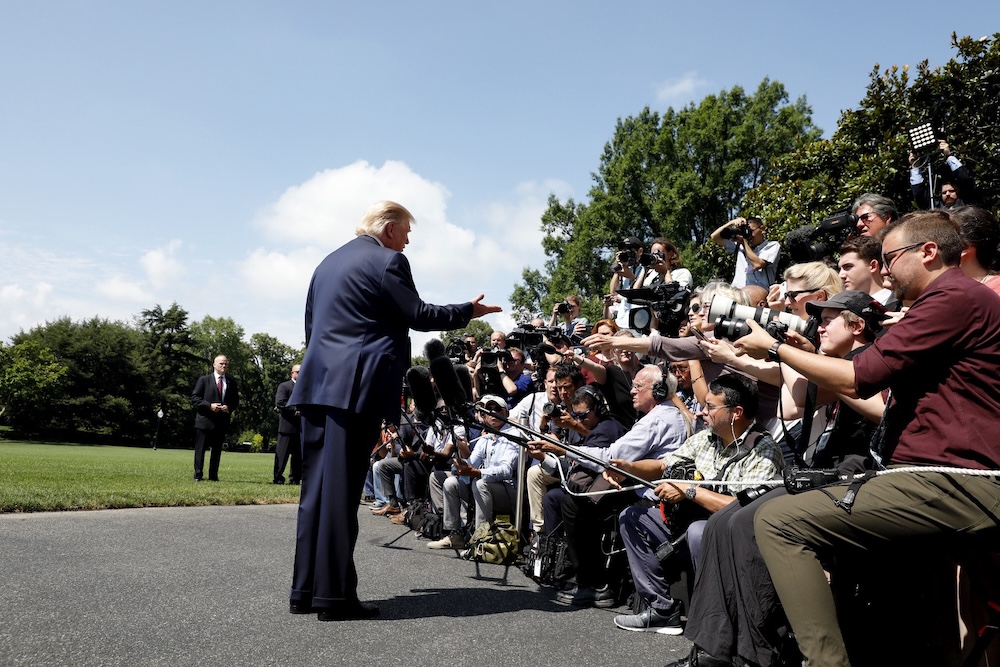
The First Amendment has been very much in action this morning already, with reporters from all manner of outlets filling the courtroom’s gallery. There are, after all, no restrictions on who can cover this motion hearing—which itself is about whether there can be restrictions on who can cover the White House from its grounds.
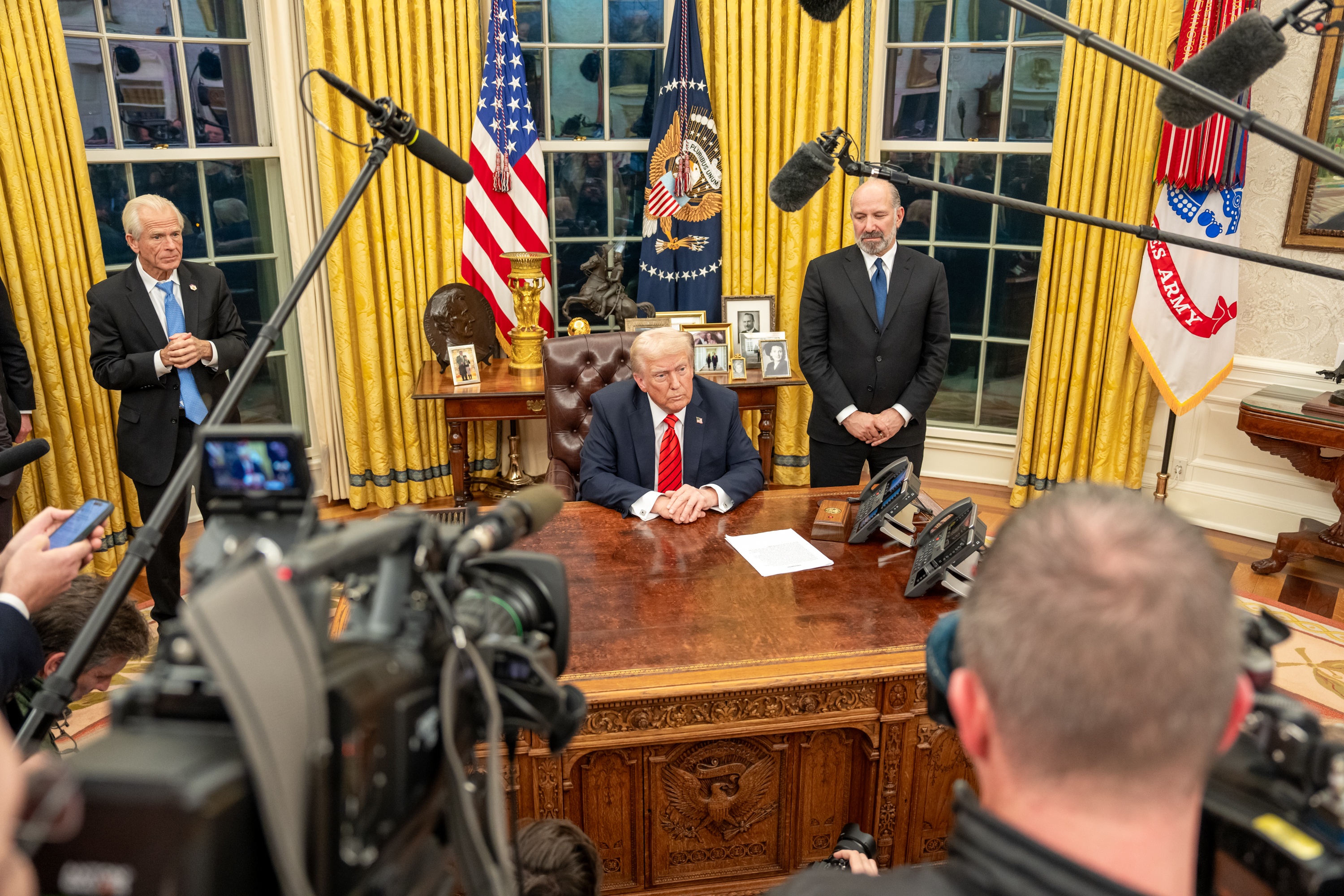
Judge Kelly granted a temporary restraining order (TRO) last month to CNN, MS NOW, and Politico after the administration attempted to revoke the hard passes that give them access to, as President Trump called it, “my—” then, correcting himself, “the People’s House.” Now, those plaintiffs are asking Kelly to convert that order.
Kelly ruled in his TRO that the plaintiffs were likely to succeed “at least” on their due process claims under the Fifth Amendment. He didn’t rule on their First Amendment arguments alleging retaliation for protected speech and viewpoint discrimination. But in weighing the equities, he expressed skepticism that the Justice Department’s asserted national security rationale really explained the bans. “Certainly,” he wrote, “that is not what President Trump said.”
Witness in Chief
Theodore Boutrous, for the news organization plaintiffs, refers to the TRO so often that at one point he almost apologizes for it. “That’s what I’d be arguing, if I were you,” Judge Kelly half-jokes. This focus makes particular sense because Boutrous also argues that, effectively, nothing has changed since the order was issued: The government hasn’t even submitted any new declarations or evidence to support its interpretation of the purpose of the bans but instead relies on a TRO record that Kelly already found deficient.
Meanwhile, says Boutrous, Trump has conveniently acted as a “lead witness” for the suing organizations’ case. Sitting for an interview with Time magazine, the president was asked squarely, “What was the impetus to doing this at this moment in time?” He replied, “Well, it’s just bad story after bad story.” The government may have filed letters citing national security concerns that purport to represent the president’s considered determination. But, says Boutrous, these are merely “pretextual.”
Kelly homes in on two other concepts ostensibly justifying the government’s decision: one, whether their reporting was false and, two, whether their reporting wasn’t necessarily false but simply was negative toward the president. These may overlap, “but they’re not the same thing.” Are these justifications treated the same under law? Are they both unlawful viewpoint discrimination?
It will surprise no one—and presumably doesn’t surprise Judge Kelly—to hear from renowned First Amendment lawyer Boutrous that both are indeed unlawful viewpoint discrimination. Falsity, says Boutrous, “is a form of viewpoint discrimination particularly” where the issues at play are debatable. Kelly replies that “if someone says the vibes were bad at an event” (as Politico did in reporting on the Republican National Convention this summer in Dallas that the government cited as one basis for its punishment), “opinions may vary.” Less so, however, if someone says “the sky is red, not blue.” So, would a policy based on an outlet landing on the wrong side of the red versus blue debate constitute viewpoint discrimination?
Yes, Boutrous answers, but it would be a “much closer call.” The problem here, he says, is that in nonpublic fora such as the White House’s press areas, access restrictions must meet a reasonableness standard—which they necessarily fail if they evince unfettered or “unbridled discretion.” To simply “declare something false or negative” doesn’t cut it. Boutrous will eventually answer Judge Kelly’s query about truthfulness more directly in his rebuttal. For now, however, Boutrous returns to the core of his argument, which is that the president has made it clear what he dislikes. The publishing of information it wants to keep secret is what the government objects to, “but it’s what the First Amendment enshrines.” The Time magazine interview, Boutrous insists, was the “coup de grace” in laying bare this reality.
Next, Boutrous addresses due process—the core rationale of Kelly’s TRO—read through precedent that the U.S. Court of Appeals for the D.C. Circuit established in cases such as Sherrill v. Knight and Karem v. Trump. The former confirms a Fifth Amendment “liberty interest” in a White House press pass, and the latter spells out a notice and standards requirement for depriving reporters of that interest.
Here, says Boutrous, the unarticulated “standards of professionalism” mentioned in the White House’s letters to the outlets are insufficient for due process. Existing laws around the disclosure of classified information, similarly, don’t cut it. They haven’t traditionally been applied to reporters. (Actually, says Kelly, that notion is “fuzzy.”) And, according to Boutrous, the statute the Justice Department leans on regarding publishing classified information reaches only narrow categories focused on “cryptography,” which even the government doesn’t argue the plaintiffs’ stories fall into.
Kelly says the Justice Department doesn’t need to prove that these outlets have clearly violated the law. If he were the government—at least at the preliminary injunction stage—he would focus on how national security concerns tip the balance of equities in the government’s favor. If a reporter published classified information that was very harmful to the country, could the government not turn around and say it was taking that reporter’s hard pass?
As long as the information was lawfully obtained, Boutrous says, such a move would still constitute unlawful retaliation based on the content of the speech. It would also still be a due process violation, assuming no additional standards or notice existed. Another way the government failed in this instance, Boutrous says, is by neglecting to warn the press about the magnitude of the sanctions that ended up affecting 78 journalists across three news organizations.
Finally, Boutrous addresses the government’s argument that the White House provided the plaintiffs an “opportunity to be heard” in its letters, and that they declined this opportunity when they failed to contest the revocations by the stated deadline while the TRO was in place. This was still a postdeprivation process, explains Boutrous—the letters arrived after the passes were initially revoked—and postdeprivation process of a liberty interest demands extraordinary circumstances. White House communications director Steven Cheung is “no shrinking violet,” but even he didn’t submit a declaration to suggest there was an emergency need to yank away the passes.
Boutrous wraps up by returning to the First Amendment to stress the “potent chilling effect” of denying reporters what they need to do their jobs if they don’t produce the “positive coverage” the president himself has indicated he wants to coerce: The New York Times, Trump said in the Time magazine interview, might “be next.” If Judge Kelly finds viewpoint discrimination, Boutrous says in response to his inquiry, that’s the “end of the road”—and it dovetails with “unbridled discretion,” which is per se unreasonable and therefore impermissible in a nonpublic forum.
(The TRO hasn’t stopped the White House from excluding reporters at CNN and MS NOW from a state dinner with Chinese President Xi Jinping, or keeping CNN and Politico off Air Force One even when they were the assigned press poolers for those trips. But the plaintiffs ultimately said in their briefing that, absent a formal policy targeting specific areas, the court needs only to address the constitutionality of the total ban in a preliminary injunction for now. The subject doesn’t surface at the hearing.)
Nothing has changed, Boutrous says again, when it comes to irreparable harm and balancing the equities. The president, in this regard, has defeated his own Justice Department’s arguments.
Justifications From A to Z
“There are many cases,” says Judge Kelly, where many people sit at the government’s table and only one attorney sits at the plaintiffs’. “This isn’t one of those cases.” Indeed, representing the Justice Department in the courtroom today is a lone Michael Velchik.
“I’m sure you’ll do a great job nonetheless,” the judge says. He also urges Velchik not to spend too much time arguing that the D.C. Circuit precedent was wrongly decided—a contention the attorney can “take up with people with more authority.” Kelly, for his part, is bound by those rulings.
“The White House is a sacred place,” begins Velchik, before implying that the plaintiffs have violated that sacredness with “indefensible conduct” they’ve “chosen not to defend.” This is the “opportunity to be heard” point: Velchik says that the plaintiffs’ failure to respond by the deadline means they’ve forfeited all their due process arguments. Kelly—seemingly appreciating the inventiveness of the argument that, when his TRO restored the status quo before the deadline to contest the revocations had passed, postdeprivation process turned into predeprivation process—says that even if he agrees with the notion, it “doesn’t get you all the way home.” The government would still have to show that it gave adequate notice of the precise standard applied and the punishment associated with breaching it.
Velchik responds that the plaintiffs were on notice about publishing classified information, essentially because it ought to have been obvious that doing so was verboten—especially in light of public statements averring “zero tolerance” for leaks. If a reporter published the nuclear codes tomorrow, he notes, the White House shouldn’t be helpless. Nor should it have to allow Julian Assange onto its premises merely because he self-identifies as a journalist. The outlets were also on notice, Velchik asserts, “that they were fake news.”
Either way, he says, there’s Supreme Court precedent that blesses taking “immediate action” with only a postdeprivation process when national security concerns are at play. If those concerns are enough to justify revoking someone’s passport, surely they’re enough to justify revoking their hard pass. Kelly says that those cases covered “hair-on-fire” situations in which there existed an “urgent need” to protect national security. This case has a more “attenuated nature,” in which it’s unclear whether removing the hard pass from one reporter because of reporting done by another reporter meaningfully resolves national security concerns. Is that fair, he asks?
Apparently not: “I understand the point and appreciate the opportunity to strongly object,” answers Velchik—who says these “line-drawing questions” sound like an Administrative Procedure Act review of an agency but that the president himself is entitled to discretion. It’s “inappropriate,” argues Velchik, to demand that the executive “bear the burden” of proving a specific individual published information based on their access to the White House grounds.
Kelly doesn’t seem to buy the argument about discretion—the government, he says, doesn’t need to prove beyond a reasonable doubt that a crime was committed, but postdeprivation due process does require a fact-intensive finding that urgent action was required to avert irreparable harm—but Kelly also notes that it may not matter. The government has now provided an opportunity to be heard. The “biggest hurdle you’ll have,” the judge reemphasizes later, is that adequate notice includes a clear description of the standards that will apply under D.C. Circuit precedent.
Turning to viewpoint discrimination, Velchik explains that “the president”—meaning the letters from the White House Press Office that attribute their determination to the president—identified two concerns: journalistic standards and national security. The matter of falsity returns here. Velchik says that discriminating on the basis of untrue reporting (which he interprets as relying on anonymous sources or splicing quotations out of context) is separate from viewpoint discrimination. Kelly seems amenable to this argument, but on retaliation he gives Velchik a harder time: This is a case where the decision maker seems to have said, “I’m taking this action because of X and Y,” and the government is coming to court and saying, “No, it was actually Z.” Is there any case “even remotely similar,” where a decision maker has said “A and B”—the judge has now embarked on a journey through the entire alphabet—and the court said, “Yeah, it was C”?
Velchik cites the travel ban case Trump v. Hawaii and the TikTok ban case but also insists the letters amount to evidence that the policy was based on the two concerns he mentioned. Besides, Trump did say—in two Truth Social posts after the outlets announced they planned to sue—that “the FAKE NEWS, something that has grown like Cancer in our beloved United States of America … is a threat to our National Security, and must be stopped, NOW!” The government has never claimed the basis was only national security, or shied away from its worries about journalistic standards. What’s more, he says, the president “does distinguish between legitimate news organizations and fake news,” where outlets are "trafficking in verifiable falsehoods.” In short, Trump doesn’t mind negative news stories “if he deserves them.”
Kelly asks how the overlapping concerns of national security and journalistic standards map onto two other concepts at play: unfair news and false news. “Lots of concepts,” he says, have been “emitted into the air” to justify the government’s ban. “Is it a violation of minimum journalistic standards to portray the administration in a truthful but negative light?”
Velchik obviously will not answer that question with a “yes.” Instead he says that, while accuracy may matter more than neutrality when evaluating adherence to minimum journalistic standards, what is true and what is false is less relevant in the national security sphere. Kelly asks Velchik to walk him through what in the record could lead him to conclude that, one, the government’s motivation was to protect national security and, two, the revocation of the hard passes would accomplish that goal. His answer is the letters, the Truth Social posts, and a declaration from Pentagon Press Secretary Kingsley Wilson testifying to the effectiveness of the Department of Defense’s press escort policy—all of which were in the record before the TRO, where Kelly evidently didn’t find them satisfactory.
Kelly inquires next about irreparable harm: Is he right, he wants to know, that in this type of case, if he finds the plaintiffs are likely to succeed on the merits, he also necessarily finds irreparable harm? The theory here is that the constitutional violation is the harm. Velchik says what he has said several times now: He does not concede. Irreparable harm, he argues, must be a separate showing. CNN hasn’t demonstrated that its revenues or viewership have declined. The press pool, Velchik says, also coordinates to share information. So how can you say the harm is irreparable?
Ministry of Truth
Easily, according to Boutrous. The opportunity to be heard that the government refers to, he begins in his reply, was a “sham process.” Trump had already made up his mind and explained his decision to punish speech he doesn’t like; sending a letter after the fact signed “White House Press Office” does not, by some “reverse unitary executive theory,” turn staffers’ stated reasoning into the president’s stated reasoning. Indeed, in the Time magazine interview, Trump didn’t even seem to realize that there had been an order to restore access.
Boutrous also notes that no precipitating act apparently triggered the immediate ban. The only exigency here, says Boutrous, appears to be that Trump “got up on the wrong side of bed.” After restating that the government gave the organizations no notice and no clear standard, violating the Fifth Amendment, he explains that nonpublic forum First Amendment doctrine requires reasonable standards, too.
Boutrous now returns to the falsity question, this time with real force. The Supreme Court has never said that the First Amendment’s speech protections evaporate because of fraud, he says. Quite the contrary: Justice Anthony Kennedy, in his 2012 plurality opinion in United States v. Alvarez striking down the Stolen Valor Act of 2005 that criminalized falsely claiming to have received military honors, referenced “1984”: “Our constitutional tradition stands against the idea that we need Oceania’s Ministry of Truth.”
Hackneyed as comparisons to George Orwell’s imagined dystopia have become in the 21st century, this one is difficult to dismiss. The administration hasn’t argued today that war is peace or that freedom is slavery. It does, however, seem to believe that ignorance is national security.