Grokipedia Stopped Reviewing Edits in April. It Didn’t Tell Anyone.
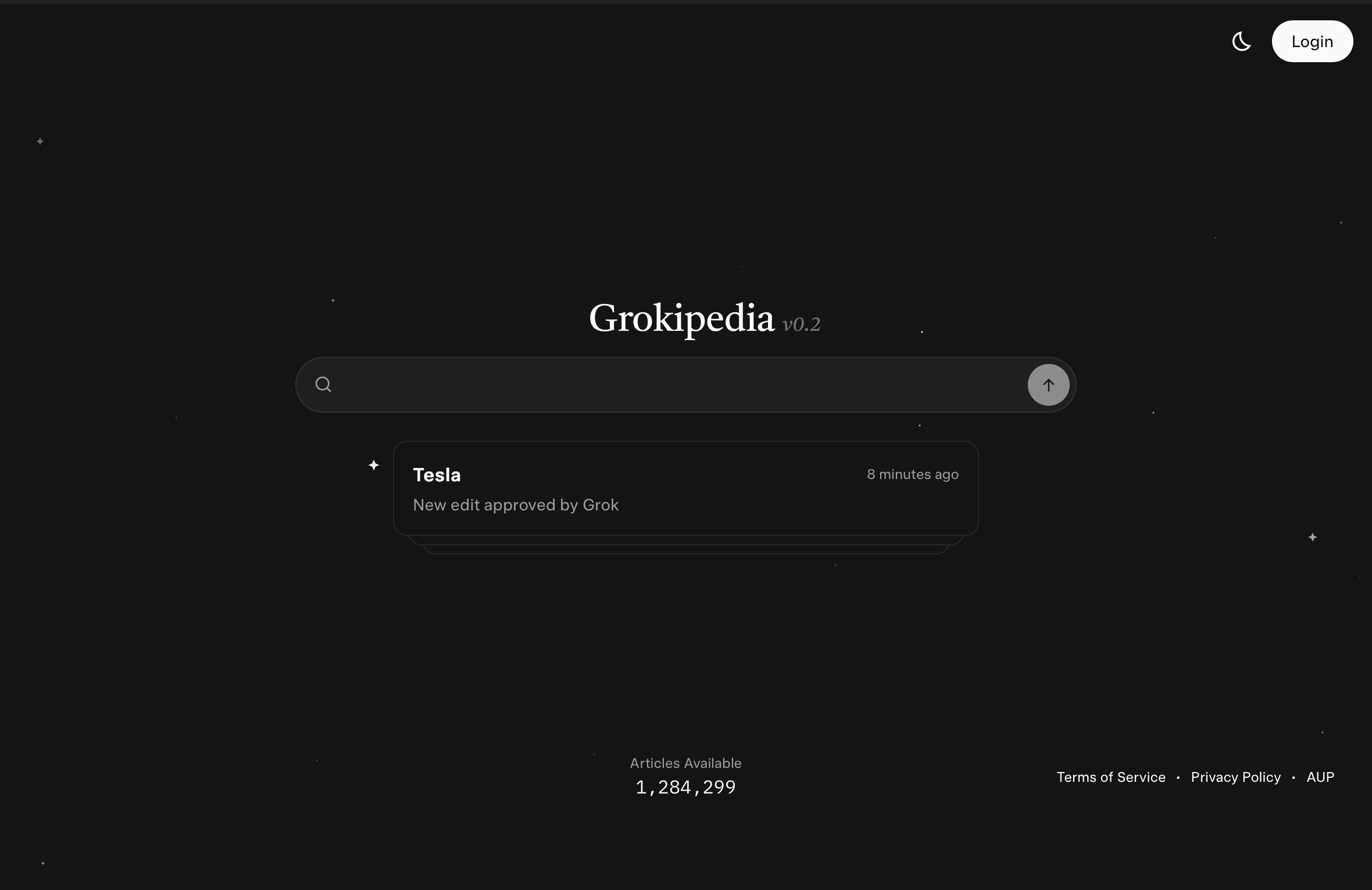


Artificial intelligence (AI)-generated reference systems are on their way to becoming a significant part of the infrastructure of public knowledge. Grokipedia, the encyclopedia xAI launched in October 2025 as a machine-written alternative to Wikipedia, is the clearest current example: Its entries are drafted and maintained by a large language model that decides not only what to write but also when to edit itself.
That is why it matters that Grokipedia appears not to have updated any articles since April 24. The encyclopedia stopped editing itself and processing suggested edits from humans. As far as we can tell, no entry has changed in more than three months.
What’s Happening With Grokipedia?
Grokipedia launched on Oct. 27, 2025, with roughly 885,000 machine-generated articles.
Elon Musk positioned it as a competitor to Wikipedia with a Musk-inflected approach to reputable sources. Today, according to its landing page, it has over 6 million articles.
Readers can suggest changes to Grokipedia’s AI-authored articles through a form on the site. The model is supposed to review each submission, which then moves through a visible queue: beginning with “in review,” followed by “approved” or “rejected,” and finally “implemented.” Each article includes a public log of suggestions and their dispositions. Earlier this year, the Tow Center for Digital Journalism documented that Grok increasingly edits its own articles, with model-authored changes overtaking human ones around January 2026
As one of us was observing change requests submitted to the site, we noticed that some edits had been sitting in the “in review” queue for more than six weeks. Grokipedia had previously made decisions quite quickly—sometimes in minutes, according to the Tow Center’s data.
At first, we wondered whether the AI was avoiding sensitive topics. To test that possibility, we submitted an uncomplicated factual update: SpaceX has recently launched its initial public offering (IPO). Grokipedia had not added this extensively sourced, indisputable fact to the SpaceX page. We observed that other users had suggested this edit as well; their requests were also “in review,” some since the day after the June 12 IPO.
We then examined the most popular pages, reasoning that if anything moved through the queue, we would likely see it there. Because Grokipedia provides view counts on individual pages but offers no site-wide ranking leaderboard, we approximated one using the site’s own search-suggestion (typeahead) feature, which returns, for any queried word, the most-viewed pages whose titles contain it. For example, if you type “The ” into the search bar, the first two suggestions are “The Beatles” and “Alexander the Great,” both of which have over 4.7 million views. Using the 10,000 most common words in Grokipedia page titles (obtained from the 5.9 million pages listed in the site map) gave us over 300,000 pages. Like many websites, its individual pages have a steep popularity curve. High-traffic entries on topics such as Elon Musk, ChatGPT, Donald Trump, Taylor Swift, World War II, and Bitcoin draw millions of views, while millions of minor pages sit in a zero-visit long tail.
But neither popular nor unpopular pages seemed to be updating. On ChatGPT’s entry, 12 edits submitted on April 24 were approved the same day, and every edit submitted afterward—May, June, and July—remains “in review.” The same pattern holds across topics and traffic levels; the largest political entries on the site (across both parties) and a second-division football club are both stalled, which is difficult to reconcile with a content- or topic-specific explanation.
In our subsequent analysis of 34,519 pages with at least one suggested edit in our sample, containing a total of 225,496 recommended edits, we found no accepted or rejected corrections dated within the past three months.
We also revisited the Tow Center’s report, which documents edits on the encyclopedia from October 2025 through January. Comparing edit requests recorded during the center’s study to the same pages today reveals a second issue: a large set of edits that were once listed as “accepted” now appear as “rejected.”
A mass rewrite of the encyclopedia seems to have happened on March 14. Because user suggestions are anchored to specific text selections (“Highlighted sections”), the rewrite appears to have broken the anchors. Grokipedia’s logging system retroactively reclassified previously accepted edits as rejected, attaching the error message, “Highlighted section not found.” However, in several cases that we reviewed, the textual changes appear to have been incorporated into the articles anyway. For example, the 10 launch-week edits to the entry for the actress Prunella Scales are recorded as approved in the Tow archive; nine of the edits now display as rejected on the live site, despite their contents appearing to have been incorporated into the article.
The edit log, in other words, is not entirely stable or reliable. This is potentially confusing for users who made suggestions and might have seen their valid contribution accepted with a “rejected” message nonetheless. It is also not ideal from an auditing standpoint.
Grok’s logs are the only substantial public window into how the automated system governs its own content. The edit logs analyzed by Tow are a mixed record. They contain genuine corrections alongside spam, vandalism, and attempts to bias an entry politically; persuading the machines is a high-stakes game these days. Tow also found that Grok had authored a growing share of the edits (rather than the users) by December 2025. According to Tow, in the first few months after the launch, the pipeline was fast: The median suggestion received a decision in roughly three minutes.
And around April 24, that stopped.
Charted by week, the volume of accepted and rejected edit decisions across the pages falls to essentially zero after April 25. Across the pages examined, submissions from human users continue at a reduced volume—averaging 216 per week post-April. Today, 13,002 total suggestions sit unresolved, trapped “in review.”
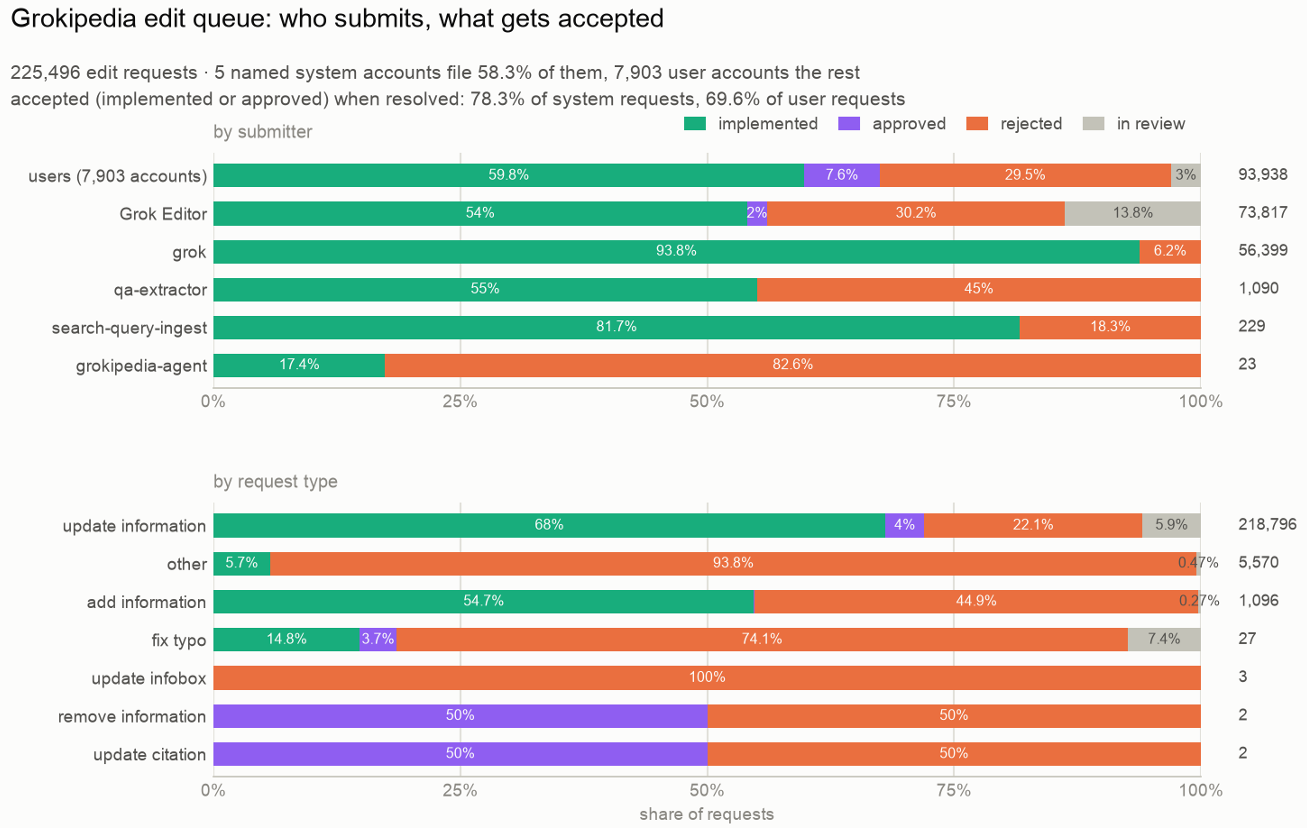
Our data suggests the shutdown began internally before users encountered the dead-end queue. Grokipedia’s automated background systems, “grok” and “Grok Editor,” account for a combined 57.8 percent of all edit requests and stopped submitting model-generated edits in stages between March and mid-April. Since late April, 100 percent of submissions have come from human users and landed in a dead-end queue that no automated system is monitoring or resolving.
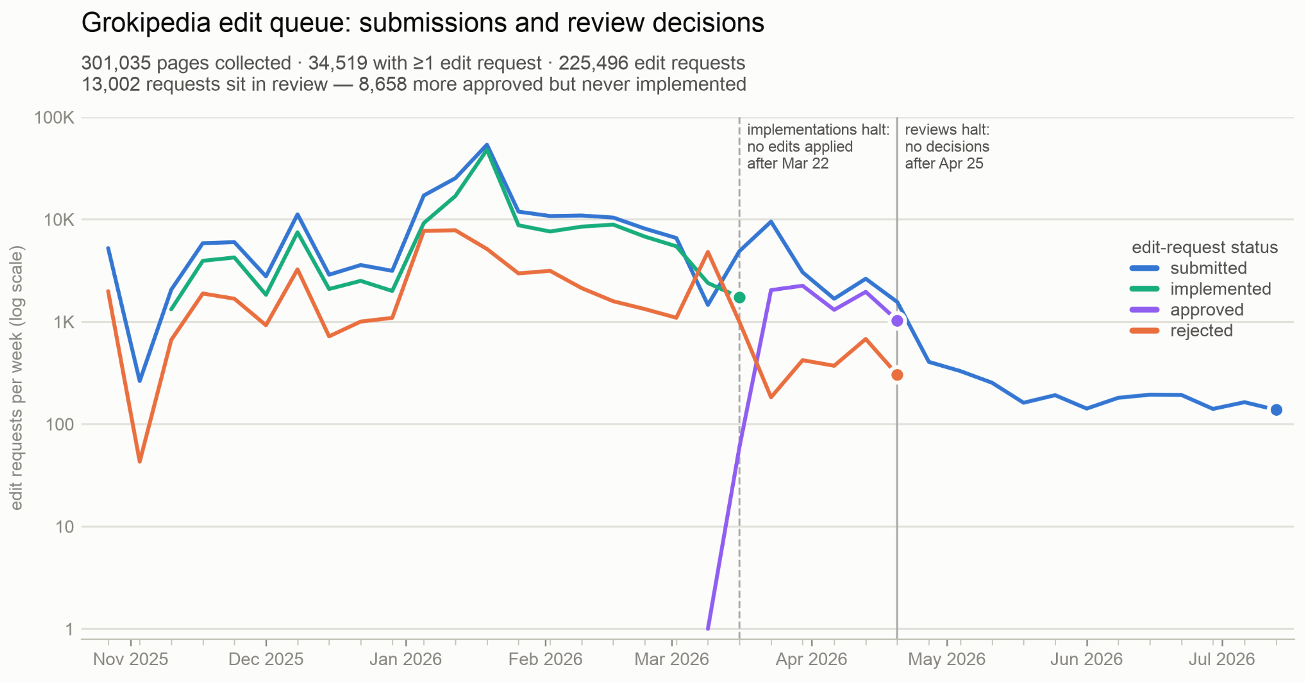
The halt in processing edit requests also cannot be explained as an influx of low-quality spam or vandalism. Factual corrections (tagged “UPDATE_INFORMATION”) make up 97 percent of all submissions in the dataset. Prior to the April freeze, the system routinely approved or implemented 76.5 percent of the factual edits. The pipeline was not overwhelmed by junk; it was actively processing and accepting updates right up until the moment it was turned off.
A public feed that once showed the editing process at grokipedia.com/live—a stream that the Tow Center had scraped to assemble its dataset—stopped functioning between mid-January and early March. A Wayback Machine capture from Jan. 12 shows the feed fully operational, with a running count of approved edits, while a capture from March 5 returns an error page.
Finally, we tested whether only the visible queue had frozen while Grokipedia continued making changes. We collected archived snapshots of the site from the Wayback Machine. Among approximately 480 pages with snapshots from both before and after April 24, none showed a change to the body text.
Altogether, what we found was that the “live” change feed is gone, past decisions were retroactively reverted without explanation, new decisions are not being issued, and article text appears frozen (and, in some cases, outdated). We do not know whether xAI is preparing a major revision or has altogether abandoned active development of the project.
Contributors Are Left in the Dark
Some Grokipedia users have noticed the pause. In the weeks after late April, users on Reddit (r/grokipedia, r/antiai) and X commented that suggested edits were piling up “in review,” that the site’s aggregate edits feed had disappeared from the home page, and that the project appeared frozen or abandoned.
A small, highly committed group has invested substantial effort in improving the site. While more than half of all contributors suggested only a single edit, a tiny cohort of 13 power users accounts for 42.6 percent of all human edit requests (nearly 40,000 edits). The most prolific contributor submitted over 8,000 corrections across 4,000 pages.
One self-described frequent contributor reported in mid-June that the review system had been stuck for more than 50 days. That places the onset in late April, consistent with our data. He also wrote on X that someone he identified as an xAI team member had acknowledged the complaint but could not provide a status update.
For these power contributors, Grokipedia went from a platform with rapid review times to a black hole.
Musk has not tweeted about Grokipedia since February.
So What?
The significance here extends beyond one internet encyclopedia. Grokipedia is not just a small xAI side project. The web traffic analytics firm Similarweb estimates that Grokipedia received 6.7 million visits in June 2026 and ranked 11,022nd among websites globally—substantial reach for a site launched less than a year earlier. Individual high-profile entries command significant readership: Grokipedia’s page-statistics API—which serves per-article view counts that are not displayed on the front-end website—records over 83 million views for President Obama and 16 million lifetime views for its Musk entry since October 2025.
Grokipedia’s contents also do not remain confined to Grokipedia. An Ahrefs analysis published in March 2026 found the site surfacing in roughly 356,000 citations across AI systems—most often in ChatGPT and Google’s AI Mode, and at lower volumes in Gemini, Copilot, and AI Overviews. That remains a small fraction of Wikipedia’s roughly 25 million such citations, but it is not trivial.
A reference work whose contents are silently frozen and whose editorial record is inaccurate could propagate incorrect or outdated information into answers that people encounter elsewhere. There are also potential reputational consequences for individuals with unreliable Grokipedia biographies who can no longer appeal to the AI for an edit.
Grokipedia contains many well-structured and thorough articles. It is not an inherently bad or flawed endeavor. Done well, an AI-assisted encyclopedia—particularly one with humans in the loop—could more broadly and deeply cover meaningful events and notable people.
But the contrast with Wikipedia is worth noting. As a recent analysis in the Proceedings of the National Academy of Sciences put it, Wikipedia’s openness “renders bias visible and contestable through edits, disputes, and deliberation,” whereas AI-generated reference “replaces this process with opaque, automated authorship, embedding potential biases within model behavior rather than exposing them to scrutiny.”
Wikipedia’s contestability occurs at multiple levels: The edit history, reversions, and talk-page arguments are public, and readers who disagree have a mechanism for intervening. For better or worse, it blocks AI submissions. Grok is a closed, top-down system; readers can submit a request in the interface, but now nothing is behind it.
As agentic AI systems begin to generate and maintain reference knowledge independently, the question is not only whether their output is accurate at a given moment. It’s whether their behavior over time is observable, and their record stable enough to be accountable for their contributions to the public information ecosystem. At the moment, Grokipedia is neither.
.jpg?sfvrsn=6a13c957_5)