ICE’s Unconstitutional Double Standard for Protesters
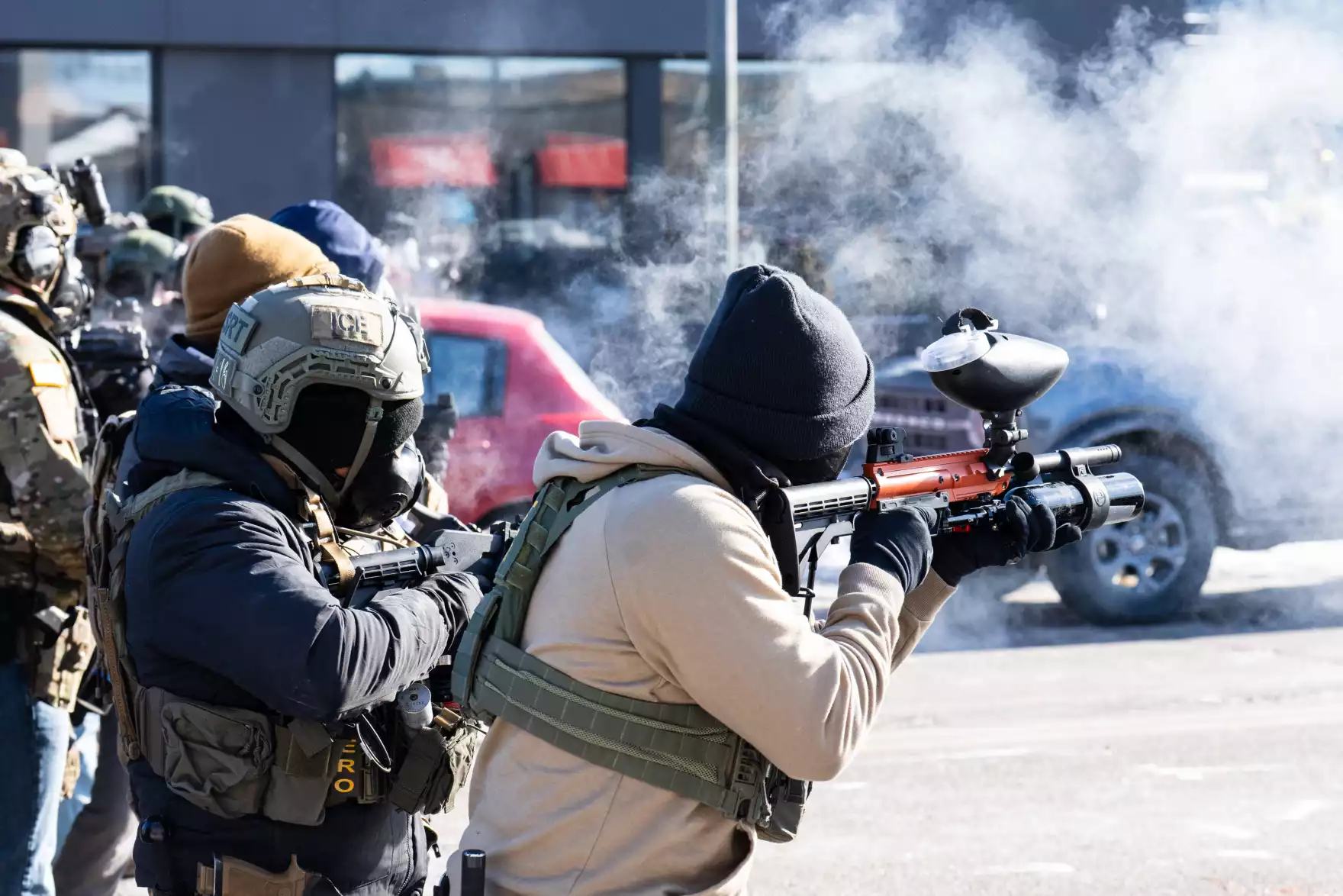


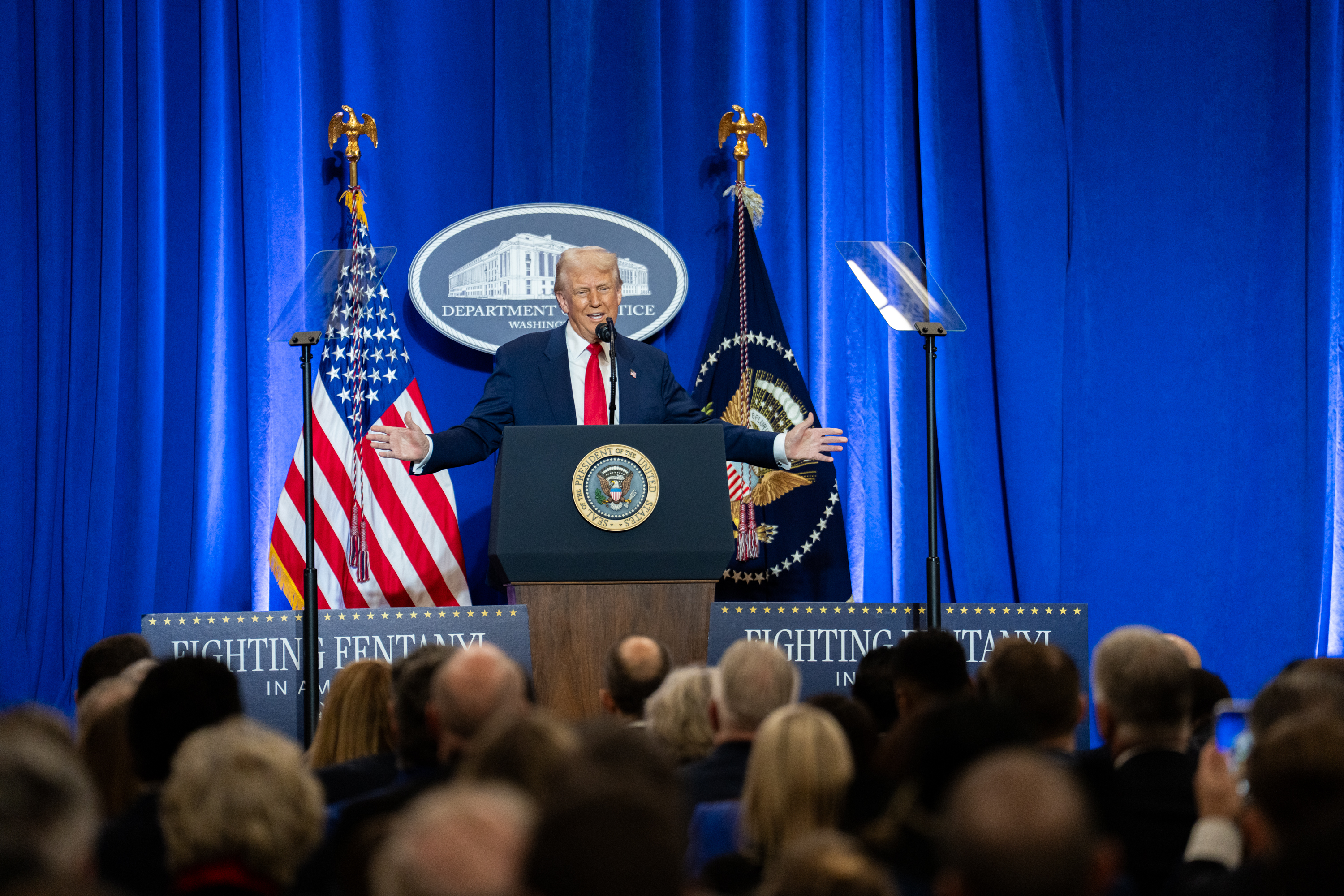
On Jan. 15, White House Border Czar Tom Homan told Laura Ingraham during a Fox News interview that he is “pushing for” the federal government to create a “database” of people arrested during demonstrations against Immigration and Customs Enforcement (ICE). In Homan’s words, “we’re gonna make them famous. We’re gonna put their faces on TV. We’re gonna let their employers, and their neighborhoods, and their schools, know who these people are.”
Reporting suggests that Homan’s database may already be a reality—and not just for people whose protest activity leads to arrest. On Jan. 23, an anti-ICE protester captured an ICE agent on video explaining that he was taking pictures of the protester’s car, “’cause we have a nice little database and now you’re considered a domestic terrorist. So have fun with that.” Ken Klippenstein reported that a federal official directly involved with the program confirmed that the database exists and that the Department of Homeland Security (DHS) has ordered immigration officers to collect information about anyone filming their activities.
However, DHS spokesperson Tricia McLaughlin subsequently disavowed the existence of the database, while other reporting suggests that the “database” may be decentralized and disorganized at this point.
Regardless of its current status, the intent behind such a database is troubling: to strike back against recent efforts to film, follow, and monitor ICE agents and publicize their identities. As Homan said, “If they want to broadcast the ICE officer that was nearly killed all over the internet [presumably referring to the ICE agent who shot and killed Renée Macklin Good in Minneapolis], we’re gonna broadcast every one of these people we arrest.”
Homan is drawing a false equivalency between what protesters are doing—filming law enforcement officers doing their duties in public, following them to monitor those activities, and publishing recordings that disclose agents’ names, faces, and badge numbers—and what the government is doing: arresting people for this activity, creating a government-controlled list of ICE protesters, and preparing to use this information to lean on private parties in hopes that the private parties will then punish the protesters in ways the government cannot.
But the law does not treat these two sets of actions the same way. The First Amendment clearly protects much of the protesters’ activity against unreasonable government interference while it prohibits much of what the government is doing and intends to do. While there are some limits (discussed below), recording, observing, and posting about federal law enforcement activity generally constitutes quintessential First Amendment-protected expression that ensures government accountability and transparency. Following law enforcement to engage in such activity may well be protected, too.
Homan’s plan, by contrast, seeks to improperly wield the power of the state to shut down and punish that protected expression, and could constitute unconstitutional coercion, retaliation, and compelled disclosure. It could also give rise to claims under other constitutional amendments and statutes. For the scope of this piece, we primarily address First Amendment concerns.
The First Amendment Generally Protects Recording and Posting About ICE Agents
There is a well-established First Amendment right to record and observe public officials’ public activity, including public law enforcement activity, as many others have noted. Every circuit court to have considered the question, without exception, has found such activity constitutionally protected. And the rights to observe and record would mean little without the concomitant right to follow law enforcement as they carry out the activity being recorded or observed.
The U.S. Court of Appeals for the Eighth Circuit, for example, treated the right to observe police conduct as a “necessarily included” aspect of the right to criticize the police in a case where the plaintiff followed a police officer as she made two traffic stops. Other courts have reflected the same principles in recent cases invalidating laws that functionally prohibit recording or observing, such as a California law that prohibited “spectating” sideshows from within a certain distance and an Indiana statute that allowed police to arbitrarily impose large “buffer zones” around law enforcement activity.
There are limits to this First Amendment protection, of course. The First Amendment does not protect those who engage in violence against ICE agents, even in the context of protest. The Trump administration may be able to deter and prosecute activities that physically interfere with or assault law enforcement officials, within the bounds of the law.
But crucially, Homan and other officials like DHS Secretary Kristi Noem and Assistant Secretary for Public Affairs Tricia McLaughlin have made clear that they are also setting their sights on those who are merely observing, “videotaping,” and posting photographs of agents online. Such activities are clearly protected by the First Amendment, and, contrary to Homan’s claims, they do not generally “interfere” with law enforcement within the meaning of the relevant federal prohibition.
Homan is likely referring to 18 U.S.C. § 111, a statute that criminalizes “forcibly assault[ing], resist[ing], oppos[ing], imped[ing], intimidat[ing], or interfer[ing]” with a federal officer, which the administration has used to prosecute dozens of individuals—many of whom do not appear to have “forcibly” done anything. Force is a key provision in the statute: Every federal court of appeals that has considered the issue has found that “forcibly” modifies all the listed prohibited acts. To be sure, there is some dispute between circuits over the reach of the law, and threats of force may be sufficient for certain convictions under the statute if they objectively cause “a reasonable apprehension of immediate bodily harm”—an area of law that will surely be contested in cases involving clashes between protesters and ICE agents. But broadly speaking, the federal interference statute properly covers forcible, physical interference and imminent threats—not peaceful protesters following, filming, and observing agents.
Nor does the fact that ICE agents may be publicly identified as a result of this conduct strip it of constitutional protection as a general matter. The First Amendment provides a right to publish truthful information, lawfully obtained, on issues of public concern. Photographs and videos of ICE agents that reveal their names and badge numbers are just that—at least as long as they are being disseminated in an effort to protest ICE’s activities; to spread a political message condemning ICE’s activities; and/or to advocate in favor of accountability for agents who allegedly act improperly. In fact, federal law enforcement officers are statutorily required to identify themselves when responding to “civil disturbances,” and immigration agents must identify themselves as such at the time of any arrest, “as soon as it is practical and safe to do so.”
The First Amendment would not protect any disclosure of personal information that rises to the level of a “true threat” or “incitement to imminent lawless action.” And hard questions certainly remain about the limits on the right to disseminate personally identifying information, and about the proper balance between that right and the right to privacy. But publishing the names, faces, and badge numbers of public officials who are undertaking public law enforcement operations does not present those hard questions. Instead, it serves as a critical check on the actions of law enforcement officers who are—theoretically—operating on behalf of the people. As ICE and its agents have threatened, subpoenaed, promised to prosecute, used excessive force against, and even killed multiple members of the public, documentation of their activities is vital to keep the public informed, organize additional collective action, contribute to vital news reporting, provide evidence for ongoing and future lawsuits challenging officials’ actions, and scrutinize official narratives of arrests and other encounters.
The administration’s claims that such recordings and photographs constitute “violence,” “doxing,” and “domestic terrorism” are hyperbolic and carry dangerous consequences. Officials have thrown around these imprecise terms without defining them. They have clearly used “doxing” to refer not only to the publication of personal information like home addresses but also to the mere revelation of agents’ “identity.” Publishing the name and face of a federal agent, discovered as a result of that federal agent’s public law enforcement activities on public streets, is not doxing—and treating it as such runs counter to the presumption that government activity should remain open to public scrutiny.
Publishing an “ICE Interferers” Database Likely Runs Afoul of the First Amendment
The Constitution almost certainly does not allow federal officials to assemble a database of those who film ICE officers and to use it as Homan proposes. Those swept up in such actions could bring—and potentially prevail on—several different kinds of constitutional claims. Fourth Amendment claims, for example, might be available to challenge the kinds of warrantless searches that are powering DHS’s investigative efforts. The First Amendment, however, has an especially important role to play in protecting the expressive activity DHS is reacting to, and plaintiffs should not overlook it as a way to push back against Homan’s proposed overreach.
Most fundamentally, the government apparently plans to burden protected First Amendment activity (namely, protest) in a blatantly viewpoint-discriminatory way, surveilling and shaming those who speak out only on one side of the debate about ICE’s enforcement tactics. But several other First Amendment claims may be available as well, including claims for retaliation, coercion, and possibly even compelled disclosure.
Retaliation
Government officials may not punish people for their protected expression, even by taking adverse actions that they might otherwise be empowered to take. To demonstrate retaliation, a plaintiff must show that they engaged in protected activity, that the government took some action against them, and that the government’s action was motivated by a desire to retaliate. Publicly shaming anti-ICE protesters in explicit retribution for their constitutionally protected anti-ICE advocacy, therefore, may well amount to unconstitutional retaliation.
Retaliation claims can be difficult to bring as a pre-enforcement matter, and the government has recently taken to arguing that there is no such thing as retaliatory investigation; but a retaliation claim should become straightforward the moment that a federal official “broadcasts” a protester’s identity as payback for their protest activity or contacts a protester’s employer, neighborhood, or school. After all, Homan has already explained that his motives for “broadcasting” protesters’ faces and “making them famous” are to give protesters a taste of their own medicine. And being publicly labeled a “domestic terrorist” by the federal government is almost certainly sufficient to satisfy the requirement for adverse action, which typically requires a showing that the action would be sufficient to deter a person of ordinary firmness from exercising their rights in the future. The Supreme Court has suggested that even an act as minor as “failing to hold a birthday party” can satisfy the standard if it is done in retaliation for protected expression. What Homan contemplates is far less festive and far more ominous.
Coercion
Alternatively, one might conceptualize Homan’s threats to create a database of anti-ICE “domestic terrorists” as a kind of unlawful coercion. Just two terms ago, the Supreme Court reaffirmed the fundamental rule that “a government official cannot do indirectly what she is barred from doing directly: A government official cannot coerce a private party to punish or suppress disfavored speech on her behalf.” This has been the rule since at least Bantam Books v. Sullivan, where the Court held that a state commission could not send letters to booksellers informing them that certain book titles were disfavored and could attract attention from law enforcement. Since the state could not constitutionally prohibit the booksellers from selling the books, it likewise could not accomplish that end by coercive means. Recently, in NRA v. Vullo, the Court clarified that the government can neither coerce the speaker themselves, “a conduit for the speaker,”—like the booksellers in Bantam Books—or a “third-party associate of the speaker,” like the business associates of the NRA in Vullo (or the employers of anti-ICE protesters).
Although the exact contours of the Vullo test are somewhat contested, it suggests that it would be unconstitutional for Homan or other federal government officials to carry out the threats he proposed during the Ingraham interview. As Homan himself acknowledged, the government cannot punish people for protesting ICE. Thus, it cannot punish them indirectly, either by intimidating them into abandoning their protest or by coercing their employers and other associates into exacting that punishment on the government’s behalf.
There are complicated lines to draw here. The government, of course, is entitled to engage in a certain amount of naming and shaming as it exercises its own speech rights. The key question a court will have to answer is whether the shaming at issue crossed the line from permissible persuasion to unconstitutional coercion. The Vullo Court suggested a number of factors that might serve as “helpful guideposts” to answer that question, including “(1) word choice and tone; (2) the existence of regulatory authority; (3) whether the speech was perceived as a threat; and, perhaps most importantly, (4) whether the speech refers to adverse consequences.”
Homan’s statements demonstrate why the Vullo factors are an ill fit for the current political environment and why this might be one of the situations, posited by Justice Neil Gorsuch, where the factors may not come into play. The president’s campaign of retribution has been so effective that every instruction from the government comes with an “or else” that doesn’t need to be spoken to be understood. And the limits on ICE and Customs and Border Protection agents’ “regulatory authority” have not stopped them from punishing, threatening, tackling, detaining, and even killing multiple ICE monitors, even though they are U.S. citizens. ICE protesters who are on the receiving end of the government’s promises to surveil them and label them “domestic terrorists,” in this environment, could make a plausible argument that they “reasonably understand” such communications to be threats to stop protesting.
Compelled disclosure
Finally, protesters swept up in Homan’s proposed web of surveillance and disclosure could argue that they’ve been subjected to unconstitutional compelled disclosures that infringe on their rights to anonymity and associational privacy. Such a claim would apply familiar and well-established case law to a uniquely modern context: the broad suite of government surveillance tools that now “compel” disclosures by simply ... taking them.
The Supreme Court has long held that compelled disclosure laws raise significant First Amendment concerns, because forcing speakers to identify themselves to the government carries with it a chilling effect that effectively suppresses speech. Crucially, the Court has been careful to note that the chilling effect does not necessarily come from just any disclosure of someone’s identity; it specifically comes from disclosure to the government. For example, the Court invalidated a rule that required petition circulators to register with their names, even though the circulators necessarily needed to appear in public in order to gather signatures. And it specifically rejected the argument that the government could compel nonprofit organizations to disclose their donor lists merely because many donors spoke publicly about their donations (or because they were already known to the nonprofit itself, and to the Internal Revenue Service).
These cases fit into a long line of precedents invalidating rules that required speakers to disclose their identities and associations to the government, including rules that required leaflets to bear the names of their authors and registration requirements for door-to-door solicitors. The Court has looked with particular skepticism on regulations that enable the government to maintain rolls of disfavored speakers (or those who listen to disfavored speech). It has invalidated efforts by the state of Alabama to require the local NAACP chapter to disclose its member list, a federal statute that allowed the government to assemble a list of mail customers who solicit “communist propaganda” from abroad, and an Arkansas law that required public school teachers to disclose all of their organizational memberships to their employers.
Most recently, in Americans for Prosperity Foundation v. Bonta, the Court struck down a disclosure regulation that required nonprofits to identify their donors to the California state government, applying at least heightened scrutiny to the regulation. Notably, the Court rejected the notion that the regulation was necessary to investigate potential donor fraud, concluding that there was a “dramatic mismatch” between the dragnet scope of the state’s collection efforts and the actual likelihood that the state would use a given disclosure in a fraud investigation.
Given these precedents, protesters could bring a compelled-disclosure-like claim if Homan makes good on his threats to share the identities of anti-ICE protesters with their schools, neighborhoods, and employers. As the Supreme Court stressed in Shelton v. Tucker (in which Arkansas sought to compel teachers to disclose all of their associations), disclosures like these raise particularly strong First Amendment concerns because employers exercise “absolute will” over their employees’ continued employment. Practically speaking, the government would be doing the very same thing here that the Court forbid in Shelton, but it would be cutting out the middleman: Rather than requiring protesters to disclose their participation in anti-ICE protests to employers, the government would make the same disclosure for them, and it would do so only for the subset of protesters the government disfavors. The Constitution does not permit that kind of circumvention.
Last, the “anti-ICE database” might separately give rise to a Bonta-style claim, even if the government never publicizes protesters’ identities to the public. After all, Homan’s anti-ICE database appears to constitute the exact same kind of disfavored-speakers list that the Court held the government could not compile without satisfying heightened scrutiny in Bonta. The major difference, of course, is that the government is not using rules to compel protesters to give their identities to the government, it is simply taking that information by using technology to collect identifying information in ways that protesters and activists, practically speaking, can neither avoid nor refuse.
These sweeping and involuntary data collection efforts are well documented and take many forms, including photographing protesters’ license plates, subpoenaing third parties to unmask anonymous social media accounts, using facial recognition technology to capture biometric scans that are kept for 15 years and that subjects may not refuse, and using advanced geolocation and data aggregation tools to locate individuals whose cell phones were in a certain area at a certain time—for example, during an anti-ICE protest—and then to follow these phones to their homes, workplaces, and schools. By using these technologies, the government effectively nullifies the First Amendment right to anonymity, compelling protesters to disclose their identities just as effectively and surely as the disclosure rule did in Bonta.
Taking Bonta at its word, then, the government should need to show at minimum that collecting, compiling, and maintaining the identities of ICE protesters bears “a substantial relation” to “a sufficiently important governmental interest” (the Court was split over whether the even higher standard of strict scrutiny should apply). The government’s only currently articulated rationale for compiling Homan’s database is to retaliate against protesters and activists for their expressive activity of opposing ICE, which clearly falls short of a “sufficiently important governmental interest.” But even if ICE put forward a more substantial rationale—for example, the possibility of investigating misconduct—Bonta suggests that it cannot justify sweeping data collection of this variety. As the Supreme Court put it in Shelton v. Tucker, even a “legitimate and substantial” government interest “cannot be pursued by means that broadly stifle fundamental personal liberties when the end can be more narrowly achieved.”
The government would undoubtedly argue that there is no constitutional harm in collecting the identities of protesters engaged in public dissent. And to be fair, the Court in 1972 rejected a First Amendment claim along these lines, stressing that the plaintiffs themselves had not demonstrated any actual chilling effect. But Bonta appears to have cut back on that old precedent, as Justice Sonia Sotomayor acknowledged in her Bonta dissent. After Bonta, there’s reason to believe that courts must recognize the outsized chilling impact that broad government surveillance has in contemporary society, especially in cases where plaintiffs assert that they have actually been chilled.
To be sure, the First Amendment is not the only constitutional (or statutory) protection that can and should prevent the government from seizing and warehousing protesters’ personal information. The Fourth Amendment is meant to protect against unreasonable searches and seizures, and the Privacy Act is meant to prevent the government from secretly amassing Americans’ identifying data. If the Fourth Amendment provided more meaningful protection against mass data collection—for example, by closing the existing loophole for governments to bypass its protections by buying comprehensive datasets from third parties—or if the United States finally adopted stronger privacy laws, then perhaps plaintiffs would not need to rely on the First Amendment to push back against this kind of government overreach. But First Amendment interests are deeply intertwined with Fourth Amendment interests, particularly where the government is surveilling mass protest activity. The First Amendment still provides robust protections for anonymity and associational privacy, and the erosion of similar protections in other contexts is no reason to discount them here.
* * *
At first glance, it may seem a strange double standard that protesters are free to monitor ICE agents and disclose their activities, but that the government is not free to do the same for protesters. This kind of double standard, however, is both common and entirely consistent with the law—as well as with the fundamental principles of democratic government. The First Amendment, to state the obvious, restricts only the government, not private individuals. And public officials give up a degree of their privacy interests when they undertake their duties in public, and on the public’s behalf. These trade-offs are intended to ensure that public officials remain accountable to those they serve. As the actions of ICE agents become increasingly violent and erratic, preserving that accountability mechanism is more important than ever.