Lawfare Daily: Serhii Plokhii on the History of the Nuclear Arms Race




Lawfare Contributor Mykhailo Soldatenko sits down with Serhii Plokhii, Harvard History Professor and a leading authority on the history of the Cold War and Ukraine, to discuss his new book, "The Nuclear Age: An Epic Race for Arms, Power and Survival," that tells a history of nuclear proliferation and international efforts to tame it. They discuss the role of fear and prestige in a country's decision to acquire nukes, nuclear strikes on Hiroshima and Nagasaki, preventive wars against nuclear aspirants, Ukraine's decision to give up nuclear weapons it inherited from the Soviet Union, and more.
- "Filling the Security Void of the Budapest Memorandum," by Mykhailo Soldatenko
- "Ukraine's Nuclear Moment," by Eric Ciaramella
To receive ad-free podcasts, become a Lawfare Material Supporter at www.patreon.com/lawfare. You can also support Lawfare by making a one-time donation at https://givebutter.com/lawfare-institute.
Click the button below to view a transcript of this podcast. Please note that the transcript was auto-generated and may contain errors.
Transcript
[Intro]
Serhii Plokhii: In each of these cases, there is the general narrative that the world is coming to an end. If that particular country, if Communist North Korea gets nuclear weapons, that will be the end of the world. If the Muslim government in Pakistan will get nuclear weapons, that will be the end of the world. Well, it didn't happen.
Mykhailo Soldatenko:
It's Lawfare Podcast. I'm Mykhailo Soldatenko, Lawfare legal fellow.
Today I have a great pleasure to be joined by Serhii Plokhii, a Harvard history
professor, a leading authority on the history of the Cold War in Ukraine, and
author of many great history books.
Serhii Plokhii: It's not
so much about culture. It's about the basic instinct of fear and the fact that
other countries, more powerful countries, have more nuclear weapons than you
have.
Mykhailo Soldatenko: Today,
we discuss his new book “The Nuclear Age: An Epic Race for Arms, Power and
Survival,” which tells a history of nuclear proliferation and efforts to tame
it.
[Main episode]
Mykhailo Soldatenko:
Professor Plokhii, could you please briefly tell us what is the main argument
of the book? What story does it tell, and what motivated you to start this
project?
Serhii Plokhii: Hello. Thank you so much for inviting me on
this podcast. It's a real pleasure. And this is my first podcast of the book
that will be out in October.
I will start answering your question from the end, starting
with the motivation. And the motivation was very much in the events that we all
are living through and witness as well. And this is the Russian aggression
against Ukraine, the largest war in Europe and potentially in the world since
World War II, which goes already in its fourth year.
And many people believe, and I think we can talk about that
later, that that war would not happen if Ukraine capped the nuclear arsenal,
the third largest arsenal in the world, that it inherited after the collapse of
the Soviet Union. And the question for me was about, first of all, I started
with Ukraine, why Ukraine decided to give up––it didn't have operational
control, but it had physical control over the weapons.
And a broader question of why, really, countries and nations
acquire nuclear weapons and why they give up. So, what came out of that was
really a story of the nuclear age written through the 11 cases.
Nine cases are the countries that acquired nuclear weapons that
are recognized as nuclear powers today. Israel, in terms of the official
recognition, is sitting on the fence, but everyone believes that Israel has
nuclear weapons. And then I'm looking at two cases where the countries decided
to give up nuclear weapons.
Ukraine is one of them, and it stands to a degree also for
Belarus and Kazakhstan, who gave up nuclear weapons around the same time. And
another case, it's South Africa. And those two cases of denuclearization were
happening around the same time.
When I was researching that book, I didn't think that I was
really writing a history of nuclear age. It turned out that that's exactly what
I was doing, given that the nuclear age, despite all the expectations that
people had around the arrival of nuclear power, in terms of all sorts of
benefits that it can bring to the society––global society––at the end, ended up
to be the age of a bomb, or actually two bombs: one atomic, another, hydrogen
bomb.
And writing that period, through the history of the bombs and
the ways of how countries acquired them, why they did that, I thought was
probably the most effective way that at least I could think about a project
like that.
Mykhailo Soldatenko:
And so, one of the main themes going through a book, and I think a part of the
answer or one of the main answers that you provide, is you think that fear is a
driving motivation behind this desire to acquire nukes and to keep them.
Could you please unpack that? And is that similar to the neorealist
view of the world where they explain, like Mearsheimer, where they explain that
there is no 9-1-1, and that makes states paranoid about their security. And
they want to grow their power.
Is that similar or is that something different, when you talk
about fear?
Serhii Plokhii: I
arrived to the importance of fear, in particular in the international relations
around nuclear weapons, by reading Churchill, who famously in the 1950s talked
about the “balance of terror.” And for me, it was very important that it wasn't
just a balance of terror, but a balance of fear, in a sense that fear as
something, as a threat––real or potential or imagined threat––that societies,
political elites that make decisions, that they really acquire, and then act on
that.
Once I formulated that and started to read literature,
including on the international relations, it turned out that I, certainly, am
not the first one to write about fear in terms of either historians or
political scientists, but also that fear was very much on the mind of
policymakers back in the 1950s, in the way how the American political elite was
trying to handle the nuclear weapons and trying to sell the nuclear weapons to
the American public.
On the one hand, trying to get American public support for the
development of the nuclear weapons. So, for that, you have to scare the public
enough. On the other hand, you can't scare it too strongly, so in the case of
the nuclear attack on the United States, they shouldn't be paralyzed by fear.
So, at the end, I had my own way to that subject. But certainly the space was
already populated before me.
And I think that it certainly contributes to this view of the
world in which the world is chaotic, in which really the only way to protect
yourself is to rely on your own power, and that the international institutions
and international law really don't work and are unable to protect you.
That being said, the entire period covered by the nuclear age
from 1945 on, and even before 1945, was full of attempts of how to use this fear,
really to build a more regulated, more orderly, more secure world, from the
global government to the use of the United Nations to achieve those goals.
So really you can look at fear and through fear at the nuclear
age, and find, find attempts really to use it to make the world safer and more
regulated. But also, there is a tendency of suggesting that actually you can't,
there is no global policeman. It's like debates today in the United States,
whether to be safe means that every household has to have at least 10 guns in
every room, in every basement, or the vision should be different. No guns, and
there should be a police, and there should be law enforcement.
So, the same debate, on a different level, it seems to me is
happening in the world as a whole.
Mykhailo Soldatenko:
So, what I’m hear––you are even going beyond structural reasons but also
combining them with the psychological nature of fear that drives everything not
only at the state level, but also at the personal level, how you do public
relations in respect of nuclear weapons and everything else.
And so going back to the like personal level––level of
individual leaders––so earlier realists like Morgenthau, they talked about the
desire for power, animus dominandi, in people.
And I think several examples that you describe in the book
could be explained not only by fear, but the desire to be important, to have
national prestige, to call shots in international diplomacy, to be a great
power. And I think the description about France and Britain are good examples
of that.
Do you think that's also part of the story, and could you
provide several examples where maybe fear is more important in your story and
where the desire for power or supremacy is more important?
Serhii Plokhii:
Political scientists who write on the subjects of nuclear weapons, they talk
about the concerns about security as one of the key driving forces for
acquiring nuclear weapons.
And what they call security, with some variations, really fits,
also, what in my story and my narrative are covered by the category of fear.
But there are also other cases, and you mentioned UK and France, where security
is present, but especially in the French case––but in UK case as well––it's
also about the great power status. It is also about prestige and maybe first
about prestige and then about security.
We have these ideal types that this is about security, and this
is about prestige, and this is something else about national interest,
understood in different ways. As always, in real life, ideal types––you can't
find them. Almost you can't find them. There is a combination of many things
and it's a cocktail, and the best you can do is just to figure out what the
recipe was, what went, how much ‘hard alcohol’––called security issues or
concerns or fear––went into that. Or the hard alcohol was presented by something
else.
And what you see with the UK and France acquiring nuclear
weapons––and UK does that in the 1950s, becoming the third nuclear power after
United States and the Soviet Union, and then France follows after that––atomic bomb,
British bomb, and French bomb are as much quote unquote “anti-American” as they
are anti-Soviet. Because––I cite in my book––Ernest Bevin, the Foreign
Secretary of the UK who really cast a decisive vote in the cabinet meeting of
whether UK should develop nuclear weapons or not.
And he said, let's put the British flag, the Union Jack on that
damn thing. I don't want anybody who would succeed me in this position to have the
sort of conversation that I had with Americans just earlier today. So, it's
about not just protecting UK from a possible Soviet attack, which was a very
real concern, but it was also about the equality or degree of equality in
relations with the United States.
And that issue of relation to all of the U.S., equality, great
power status––you take this UK model, and you multiply this at least by five,
and that's how you get to the French bomb. Because France is really in very
tense relations with the United States from the start-go. Really from the Yalta
conference, where de Gaulle was not invited, if not earlier than that. So,
these are the cases where fear is present, but it's more about pride, especially
in the French case.
Speaking about my approach, when I talk about fear, when I talk
about pride, this is the way also to talk about people's ideas and perceptions,
that really the realist school doesn't allow for that. So, that's my
intervention with the choice of terms, but also choice of approach in the
current discussions about the nuclear weapons.
Mykhailo Soldatenko:
Yeah, and I, and I totally agree with that, and I think what history adds to,
you know, just structural international relations concepts, it that it provides
context. And it provides human factor. Those are very important for
understanding events and unpacking them fully.
So, talking about the United States. So, the impetus to develop
nuclear weapons was kind of a fear that Nazis would be first during World War
II to develop it, in a way, but then it transpired into, you know, other
motivations, like being the only nuclear power in the world, which meant a
nuclear monopoly.
And so you describe in some detail the nuclear strikes on
Hiroshima and Nagasaki. And recently there was 80th Remembrance Day of
Hiroshima. And it's still vivid in the memory of the current generation. And,
you know, policymakers refer to it, President Trump referred to it after
strikes on Iran––that that's in order to end war––Putin referred to either the precedent
of using nuclear weapons in war in order to end war.
And so, for a long time, I think, in the U.S. discussion, that
was a forced move in order to end the war and save lives. But I think you
describe in your book that there were other potential factors.
So Soviets potentially claimed a sphere of influence in Asia,
and that was a variable in the calculus of the United States in addition to
ending the war. So, do you think that the fear was the motivator to use the
nukes, meaning to save lives of American soldiers? Or that was also like––there
were other ways to end the war, but there was a need to project power and the
need to remove Soviet sphere of influence in Asia.
Serhii Plokhii: The
decision to start developing the bomb, and commit enormous amount of money by
the standards of the 20th century into that project––enormous resources––was
really motivated by fear, which possessed different groups in the American
society and in the international community.
The British who were first to get scared and start to develop a
nuclear project, they just didn't have resources at that time during the war.
But they passed that concern and that fear also to the American establishment.
But the people who really provided the brains for the project––or at least I
would say 60%, 70% of the people who worked on the project in the key positions––like,
for me, like Szilard, Einstein at the end, who was instrumental in convincing
the American government to develop the bomb––they were refugees, very often
Jewish refugees, or, for me, was married to a Jewish woman, refugees from
fascism refugees from Nazis in Europe.
And they really were concerned––and this is an understatement––about
Hitler acquiring the bomb. And once in 1944, some of these people realized that
the Germans actually took a wrong turn and were not producing the bomb anytime
soon, that the bomb would be used against somebody else. That's where the concerns
of a different type started.
And some of those people left the Manhattan Project. But by
that time it was already too late. The bomb that was in the making was now the
property of the government that put all of those resources together, which was
the American government.
And Truman, who made the decision about bombing Hiroshima and Nagasaki,
basically believed on many levels––and I think that that was not delusional in
any way, that was very real––that he would not be forgiven if U.S. would
continue the war and lose hundreds of thousands of American lives. That was the
estimate in case there would be a landing on the, quote unquote, “Japanese
mainland,” having this wonder weapon in his back pocket.
He didn't think that American public, American people, would
forgive him for doing something like that. He also thought that the American
taxpayer would not forgive him that so much money was spent and then nothing
came out of that and he didn't use it. So, political pressures were already
there.
And concerns of the scientists––and scientists were divided in
their opinions, but scientists of those who were saying, okay, we can't use the
bomb were dismissed. But once the bomb became already a reality, suddenly the
United States government started to discover that there were some benefits,
other benefits that could be drawn from having the bomb and specifically using
the bomb.
They saw what happened after Yalta conference in Eastern
Europe. When the Soviet Union really installed its own governments, communist
governments, and they didn't want the repetition of the same story in the Far
East. With regard to China, for example, Manchuria in particular, that was sort
of gifted to the Soviet Union by Roosevelt during the Yalta conference, they
didn't want to allow the Soviets to occupy part of Japan, like they, that
happened with Germany.
And the bomb was the way to finish the war before the Soviet
Union would enter in that war. And the Soviet Union, of course, realized what
was going on and expedited the entrance into the war when they were not really
ready, were not prepared.
Because of not being prepared, the casualties on the Soviet
side were enormous, but, with the Soviet Union like today with Russia, of
course, that was of minor concern for people like Stalin. So it looks like you
acquire appetite for certain things once you start already consuming them and
discover all sorts of additional benefits and also side effects of becoming
dependent on things nuclear.
Mykhailo Soldatenko:
Following up on that.
So, when you have this power, there is, you know, some
motivation to use it. And so, you mentioned this historical debate whether
Japanese surrendered because of the nuclear attacks or because Soviet entered
the war, and they actually wanted Soviets to be like mediators with the United
States.
And some people made an argument that without the nukes, there
would be just negotiations without total surrender. And so, one of the concerns
of the scientist was that having nuclear power in just one state, that that can
be abused. You never know who will be the leader, who will decide what.
And then, during the Korean War, there was a similar incentive
to end the war with the nukes. And the United States didn't do it. Neither
Truman nor Eisenhower. What was the reason, and did it prove those scientists
who were concerned correct or no?
Serhii Plokhii: Yes.
Between the scientists there were multiple splits, but one of the most
important ones was between people like Leo Szilard, a refugee from Nazi-controlled
Europe, who was really, in a good way, paranoid enough to go through the walls
and get eventually to FDR and convince him to start nuclear research. And he
was, by 1944, 1945, he was against use of nuclear weapons.
And then there was Robert Oppenheimer, who really at the end
shared the idea that, well, we really have to demonstrate how disastrous the atom
bomb is, because if you don't demonstrate that, the countries will be
developing nuclear weapons, and at the end we will end up in the nuclear war.
So, we have to really scare to produce fear in––enough fear for the humankind
as a whole to find the way of how to control the nuclear weapons after that.
And then there was another group and they, to a degree, their
thinking was shared by the so-called Atomic Spies, who were spying for the
Soviet Union. Many of them were of communist persuasion, so there was
ideological reason for that. Others were just straight spies. But also, there
was the idea that you can't really allow monopoly of nuclear weapons to be
there.
So, in that sense, let the Soviet Union have nuclear weapons as
well. And then that will be a guarantee that the United States would not use
nuclear weapons again. And on a certain level, that's exactly what happened in
Korea, because the U.S. threatened use of nuclear weapons, given how badly the
war was going for the United States once China decided to enter it.
The reasons why they didn't use nuclear weapons, there were
multiple. One of them was that in Korea there were no targets for the nuclear
bombs––big cities, big military installations that can be destroyed as the
result of the bomb.
But most important reason was that the Soviets had already the bomb.
They maybe had one or two bombs, but that was enough to scare, not the United
States, but U.S. European allies.
The Soviet Union, first of all, had very few bombs. Second, it
had no means of delivering them to the shores of the United States. But it had
more than enough means to deliver them to Central Europe and to Western Europe,
and there was a pressure of the European allies on the United States not to use
the nuclear bomb.
To a degree, it's almost like what we recently saw with the
European leaders descending on Washington and trying to persuade President
Trump to take a position in negotiations with President Putin that would not
jeopardize the interests of Europe in the first place.
So, we didn't have that sort of pictures. People were not as
easily flying at that time from one place to another. But the overall scenario
was the same––the pressure of the allies not to do certain things because those
allies felt threatened.
Mykhailo Soldatenko:
Just to complete a thought about the scientists, I think that your book shows how
important role they played, not only about technical side, but also they tried
to go into policy questions. And that Hitler, Stalin, and to some degree
Roosevelt, they were all skeptical about the nuclear weapons. And it took some
efforts, including from scientists, to explain both that that can be used in
war and how disastrous it can be and why you need to limit it.
So I think that's a very interesting story that is often
missed. And so this, you say that Soviets had only several bombs, and so then
we go to some sort of deterrence and you have this quote from Churchill that
safety is the sturdy child of terror, survival is the twin brother of annihilation.
And a short summary of the Cold War deterrence. Could you
please explain how it started? What is the concept of mutually assured
destruction? And probably fear is at the center of it.
Serhii Plokhii: Yes,
indeed. In very general terms the Cold War would be divided into two parts.
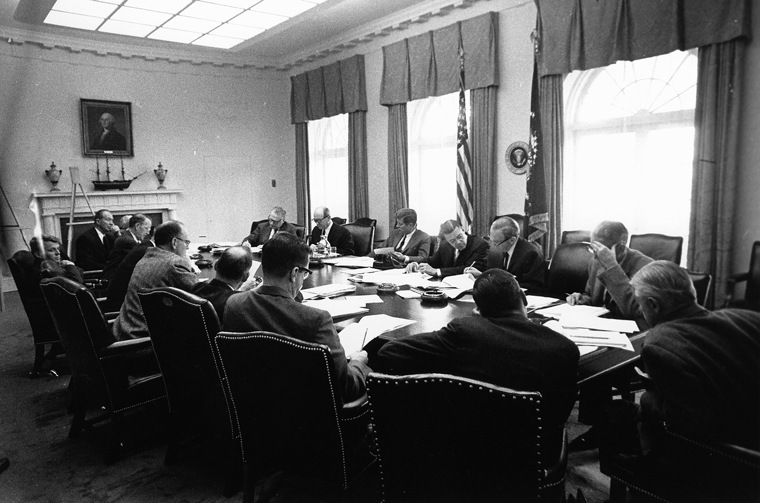
The first part would be before the Cuban Missile Crisis. And
the second one would be after Cuban Missile Crisis. And what you see before the
Cuban Missile Crisis, it's like people are rushing to get the first cars, like
Ford cars, and get on the road. And there is no rules yet for driving the cars,
and there is no lights on the intersections.
And there is a just wild race. And the intersection happens to
be Cuba in 1962. And the realization is that on the side of two nuclear
superpowers, by that time, UK has already the bomb. The French have the bomb.
But clearly the two nuclear superpowers are the United States and the Soviet
Union, that they were really a few inches away from a nuclear catastrophe. From
war.
And that some sort of regulations and arms control is needed.
And also, they start with the same people who confronted each other in the
Cuban Missile Crisis, Kennedy and Khrushchev. One year later, they signed the
first agreement that really the mother of all arms control agreement of the
future, or at least the precursor to those agreements.
This is control over the tests, nuclear tests, which threatened
everyone in the world. Once they started to test the hydrogen bombs, the
nuclear fallout that was going in stratosphere, and that then would come with
the precipitation, with rain, with snow, in any part of the world. So, the
entire world was really concerned about that and applied pressure also on
superpowers.
And the scientists, including the atomic scientists, were the leaders
in this mobilization of the public opinion. So, and slowly in the 1960s you
have the non-proliferation treaty, and then you have arms control under Nixon
and Brezhnev in the 1970s, and eventually under Gorbachev and Reagan and Bush,
you get also the reduction of the nuclear weapons.
But what happened there around Cuban missile crisis and a
little bit later, there came realization that, well, we can spend enormous
amount of money and resources on this arms race, which will go forever, which
would not actually improve the chances of any of the countries winning in the
war or surviving in the nuclear war.
And maybe it's actually wiser to introduce some sort of a
system where we would keep the balance of terror, as Churchill said––or the
balance of fear, as I'm saying––there, by controlling the amount and the kind
of the weapons and the sort of missiles, the vehicles for delivering of those
weapons that each country has, on that level.
And that's about the arms control, nuclear arms control, and
then eventually nuclear arms reduction. So that happens really after this nuclear
war scare of 1962.
Mykhailo Soldatenko:
So, that's an alternative scenario from what initially was envisioned, for
example, in the novel of H.G. Wells, “The World Set Free,” where there was like
people, when they imagined how there would be risks of nuclear Armageddon, they
thought that the only answer is the world government.
And so this management and having a limit on how many weapons
we can have and how many powers will possess them, it's kind of an alternative
scenario. And then other people—it's a minority view—suggested that you would
just need to allow the proliferation and everybody would have nukes and there
would be a total deterrence.
So, could you explain––what's your explanation, why the history
went this way and not to others?
Serhii Plokhii: It
really was a big, big discovery, revelation, and big surprise for me to see,
first of all, something that we already discussed: how influential were the
scientists in terms of thinking about the nuclear weapons, and how they turned
out––at least some of them turned out––to be right during the Korean War.
And another revelation was to what degree those scientists were
influenced by the novelists like Wells, who in 1913, 1914, was imagining the
world with the nuclear weapons. And saying that, okay, you have to scare the
world enough by those weapons to convince them that there has to be a world
government, global government.
And people were acting on that, believing in that back in the 1930s
and then in the 1940s. And there was a big hope that the United Nations would
become such a world government. And there were negotiations going on in the
late 1940s that the Americans would actually turn the nuclear weapons to the
United Nations body, that it would be under the international control and the
access to the uranium ore would be under international control, and so on and
so forth.
That was an option. That was seriously discussed. And for U.S.
to get out of that and to maintain at that time monopoly on the nuclear weapons
they had to suggest––and a little bit late, in particular, President Eisenhower––they
had to suggest this idea about atoms for peace: not to deny the world the
benefits of the nuclear power by allowing them to get to the technology, to
produce electricity with the help of nuclear and so on and so forth.
So, what happened by the 1950s was that this push for the
international control over the nuclear weapons, if not the world government,
was really defeated in 1950s. And the illegitimate child of that clash became
our today's nuclear energy facilities, which now account for 10% of the
electrical––of the production of the electricity in the world, and which no one––in
terms coming from the business environment and business thinking about that––no
one wanted to touch nuclear energy and reactors, foreseeing what can happen in
cases like Chernobyl or Fukushima, where the lawsuits against the damage that
was done, especially in the Japanese case, are now enormous. So it is enough to
kill, to destroy any business that was not wise enough to go into the nuclear
industry and development of the nuclear energy. So that's why the American
government and then others were really putting in money, revising their laws on
the insurance and other things, and pushing this.
But again, that was really a way to somehow compensate the fact
that the expectations of those people who wanted to keep nuclear weapons under
the international control were really dismissed and ignored.
Mykhailo Soldatenko:
And one of the tools that the powers that have nuclear weapon, that they used
in order to stop proliferation, was a either a threat or an action of
preemptive war in order to deter a would-be nuclear state from development,
developing anything.
And that brings me to recent events and strikes on Iran, on its
nuclear facilities. And when I read your book, I found particularly interesting
an example of China, how the United States wanted, and considered it, to do a
preventive war, at least through Taiwanese commanders.
What is your conclusion based on the historical record? Is that
a good policy tool, to do a preventive war? That's totally illegal under
international law if you don't have a threat, or if you don't have an armed
attack, imminent armed attack, there is no reason to use. But from a policy
perspective, is that useful?
Serhii Plokhii: Yes,
the Americans certainly considered operations not only against China, but also
against Israel, trying to stop the development of the nuclear program in those
two countries. On China, they also tried to get the Soviets on board, given how
bad the relations between China and the Soviet Union became in the 1960s.
The Soviets decided not to join in. So at the end that didn't
happen. And the only case where we have not just strikes on the nuclear
facilities like the Americans did and the Israelis did in the Middle East, in
the 1970s and then later as well.
But the actual war, that was the Iraq War. The official reason
for that put forward was to preclude Iraq from developing the weapons of mass
destruction, mostly chemical, but the nuclear war in the mix as well. They
didn't put too much emphasis on that, but that was, that was also part of the
discussion. And we know what happened as the result of that war.
It was a technically preventive war, and it was one of the most
disastrous wars for the country, including that was trying to make that
prevention, and for the region as a whole, destabilizing the whole region for
generations to come. So, we have one example of that war, which is a complete
disaster. And we have, on the other hand, numerous, now, cases of the countries
that are considered to be really international pariahs acquiring nuclear
weapons.
North Korea is one example of that. Pakistan is another
example. India, before that, people were concerned about that. And in each of
these cases––China, China, before that.
In each of these cases, there is the general narrative that the
world is coming to an end. If that particular country, if Communist North Korea
gets nuclear weapons, that will be the end of the world. If the Muslim
government in Pakistan will get nuclear weapons, that will be the end of the
world.
Well, it didn't happen. We are here. The reason why did it
happen was that North Korea and Pakistan, they're not the only nuclear powers.
As Macron recently said with regard to Putin, that Russia is
not the only country that has nuclear weapons. So I, looking at that historical
record, I can say that preemptive wars bring disaster and destruction. And
still allowing and controlling the process of acquiring nuclear weapons, even
by the countries that you don't want to acquire, actually come at a lesser cost.
And that applies to a Muslim bomb, to communism bomb, to any bomb that you can
imagine.
Because it's not so much about culture, it's about the basic
instinct of fear. And the fact that other countries, more powerful countries
have more nuclear weapons than you have.
Mykhailo Soldatenko:
I think another potential reason, and that I think applies to China that China
was scared by U.S. threats, which can motivate––so, your threats, they can
motivate and encourage countries to go nuclear instead of taming the
non-proliferation.
Serhii Plokhii:
Exactly. And the nuclear bomb, it's basically anything but cutting-edge
technology. And it's not as expensive as it used to be for the United States
back in the 1940s when the U.S. was the first to build it.
If, isolated and really besieged by sanctions, North Korea can
build atomic bomb and then hydrogen bomb, anyone who is scared enough can build
a bomb.
So that's a lesson that, certainly the lesson of the 21st
century already. The lesson of poor countries like North Korea acquiring bombs.
Mykhailo Soldatenko:
And so, moving forward to what we started with, that something that motivated
your project, and that Ukraine gave up: its right in physical possession of the
nuclear weapons in the ’90s following the collapse of the Soviet Union.
At that point of time, probably the Ukrainian population, write
large didn't expect the war with Russia, but there were serious signals that
there were, you know, declarations of the Russian Duma about, claiming
sovereignty of a Crimea.
There were these imperial statements even back then. So,
policymakers should have understood, especially in considering history, that
there are threats. And there were people in the west, Mearsheimer, who many
Ukrainians don't like, who actually said that the only deterrent that Ukraine
can have is the nukes.
And so my question is how that happened, and why that was
different, how that is different from the story of Israel? And are there any
similarities?
Serhii Plokhii: The main
reason how it, why it happened was that Ukraine was new state. And the state
that actually was looking for the ways to maintain its independence and to be
recognized in the world.
And the logic of many people in the Ukrainian political elite
was that the best way, the easiest way to achieve those goals, to become
independent, and then to stay independent, was by giving up nuclear weapons.
That position was taken by the anti-communist opposition in the Parliament by Rukh,
the movement for independence of Ukraine, not by people who were certainly
involved with Russia, with the Soviet Union, with the Communist Party.
And their argument was––in particular, Dmytro Pavlychko,
prominent writer, but also the head of the parliament's Commission for International
Relations––the idea was that if we keep nuclear weapons in our territory,
Russia and the international community would never allow us to leave the Soviet
Union and go.
We have to get rid of that, which is something that enshackles,
weight that doesn't allow us to fly, to become independent. And that was also
the American condition from the start-go back in 1991, that the nuclear weapons
stay under the central control, which meant Russian control.
The Americans made the decision very early on that the fact
that the nuclear weapons ended up to be located in, not in one Soviet Union,
but now after 1991 in four independent states––Russia, Belarus, Ukraine, and
Kazakhstan––they decided to treat that as proliferation. And in reality, in
geographic terms, it wasn't. And the reason why they decided to do that,
because they didn't know who were these new leaders in the republics.
They were concerned, for good reason, that they don't really
have any experience, technological, political and otherwise, to handle nuclear
weapons. So, let's deal with the Russians, who are former Soviets and who have
already the experience of 40 or 50 years of dealing with things nuclear.
So that was the American decision. And pressure was applied by
Russia––regional power at that time––and the United States––global power––on
Ukraine to give up nuclear weapons. Given that also in Ukraine, many believed
that to give up nuclear weapons, that's the way to stay independent, to also
get U.S. interested in Ukraine and provide assistance, in particular economic
assistance, and start trade and so on and so forth.
So, the national interest, how it was defined and understood at
that time in Ukraine, and the national interest, how it was understood in the
United States, produced that result. Many in Ukraine were concerned about
Russian threats. The nuclear weapons were taken away from Ukraine––and, to add
insult to injurym was sent to Russia.
That was happening at the time when the Russian government, and
Duma in particular, but government as well, were making claims against Crimea,
Ukrainian territory. When I'm talking about government, I mean the Vice President
of Russia General Rutskoy at that time, and of course the nationalist elements
in the Russian Duma, in the Russian Parliament at that time.
So, Ukrainians were trying to get security guarantees. What
Ukrainians are trying to do now, they were trying to do that as well. And they
were provided those security guarantees, which was a piece of paper called, at
the end of the day, Budapest Memorandum. It was a little bit more complex, there
were other agreements as well, but generally the Budapest Memorandum symbolizes
what happened there.
And those were not guarantees that were assurances, which at
the end of the day––and we all know now that, today––were worth nothing. People
involved in that process, people like President Clinton, are publicly talking
today that they regret what they did.
And there were other ways of––if you take nuclear weapons from
Ukraine, you create really, you remove deterrence, you create a security vacuum
in center of Europe that attracts certain aggression. And that's what we got.
So U.S. removed one nuclear umbrella and refused to replace it
with another one, which could be the NATO nuclear umbrella or anything else.
And that is, that is what happened.
And this is also lesson for today as we try now to deal with
the consequences of the shortsightedness. Not just of the Ukrainian politician,
but American politicians in the first place, because they were the ones who
were first of all pushing Ukrainians in that directions.
Russians were trying to do that. They couldn't do that on their
own. They needed American help. Americans got to yes with the Ukrainian
leadership at that time, which was concerned, was trying to get guarantees, but
couldn't get what they wanted, what they needed out of them––not just them, but
the, the Europe and the entire world as well.
Mykhailo Soldatenko:
I think this point about the Budapest Memorandum and security vacuum is crucial
because I see obviously there were weak security commitments, but I see it as a
deal, as a package deal, as a quid pro quo. So, Ukrainians believed, they were
made to believe, that they were guarantees, and they thought that they're
receiving guarantees.
And so at the end of the day, you have your territorial
integrity in tatters, you have discussions about, like, recognition of
territories that is contrary to Budapest Memorandum, and you don't have nukes.
And so I think that that's an important point to highlight because that needs
to be filled with something.
And the point that you mentioned about treating Ukraine as a
case of proliferation, that was a creative interpretation of NPT. If we read
NPT, it says countries who tested and exploded nuclear weapons in 1967. So the
Soviet Union tested and exploded. Ukraine was a republic, a successor.
So I think, you know, that was a, a bit of a creative
interpretation of the NPT.
Serhii Plokhii: Let
me add a linguistic element to your legal analysis, because Ukrainians got “guarantees.”
That was the word in the Ukrainian version, Ukrainian original of the
memorandum. And guarantees were in the Russian as well.
Mykhailo Soldatenko: And
equally authentic versions, not just translation.
Serhii Plokhii: Equally
authentic. Right. So the Ukrainians got guarantees at least in those two most
important languages. So that's just adding to your argument a little bit. Yeah.
Mykhailo Soldatenko:
And our parliament conditioned the NPT ratification on the security guarantee
in a legal document.
Serhii Plokhii: Mm-hmm.
Mykhailo Soldatenko: So
that's something that it's important to remember. And so then we have the
Russian aggression, where, actually, a nuclear state not only starts in
aggression, but also threatens a non-nuclear state with nukes, despite the
Budapest memorandum and everything. What are the consequences of that?
What are the lessons and where are we going with that?
Serhii Plokhii: Well,
this is an enormous blow to non-proliferation process and non-proliferation
philosophy. It's not that it is completely dead, but it is really on its deathbed,
and the only way to really bring this process back to life––and in general, I
think that it did a lot of good, not only bad in the international relations––the
only way to bring it back is to really now protect Ukraine from the aggression
that would not happen if Ukraine would not be admitted to the non-proliferation
treaty regime in the way how it happened.
So really, the future of NPT very much depends on the outcome
of the current war in Ukraine and what will happen with the Russian aggression
there. But unless there is some serious, really, remedy, you have to be really
highly irresponsible politician or leader in any country, after what happened
to Ukraine, to accept any sort of assurances or guarantees from the United
States, Russia, China, Britain, France, Israel, you name it––the members of the
nuclear club.
So, at least the NPT process had been damaged. And we will see,
really, attempts and actions on the part of many countries to be ready to
become nuclear if the need arises. And at this point we have 40, maybe more
than 40 countries that can become nuclear within two-year period. Again, as I
said, this is not prohibitively expensive undertaking anymore. And you can
learn most of the science with artificial intelligence, or even just before
that by googling certain things.
So we can really end up, within a very short period of time,
with not nine countries having nuclear weapons, but 30 or 40 if Ukrainian
situation is handled in the way that will not send any sort of reassurance to
the rest of the countries.
Mykhailo Soldatenko:
In conclusion, what is the key lesson, key short thought that you want the
readers to get out from this book?
Serhii Plokhii: Well,
I really try to say there that the idea that the nuclear age was in the past,
that it was a phenomenon of World War II and now it's an allegedly new nuclear
age is really a misreading of history.
The nuclear age started. It continues today. And to a degree,
the lessons that were learned from the first nuclear arms race––not nuclear
age, nuclear age continues––are applicable today in these new conditions.
And those lessons are that, first of all, you need to establish
control over the nuclear weapons. You need to go back to the negotiation table
and really get back to the process of the nuclear arms control and eventually
reduction. And you also have to fix the cases like Ukraine which came out of
really very unfortunate uses of non-proliferation treaty clauses to make sure
that this non-proliferation treaty is alive.
So really, really, my argument is that history matters. That we
are not in completely uncharted waters. But we are in the situation where the regulations
and streetlights that were there during the Cold War, the treaties that
regulated nuclear weapons, are now gone. And we have more drivers on the
nuclear highway than we had before. And potentially there can be an explosion
in terms of the number of those drivers without really rules and without
regulations.
So we have to fix already things that we’d drawn, and we have
to bring back people to negotiate some sorts of nuclear arms controls. Without
that, we are heading towards new Cuba, and we don't know whether we would be
lucky the next time on the same level as we were during the Cuban Missile
Crisis.
Mykhailo Soldatenko: I encourage everybody to buy and read Professor Plokhii’s great book to get the full and nuanced pictures of the nuclear age, the history of nuclear proliferation. Professor Plokhii, thank you for joining Lawfare Podcast.
Serhii Plokhii: Well,
thank you. I really enjoyed our conversation.
Mykhailo Soldatenko:
The Lawfare Podcast is produced in cooperation with the Brookings
Institution. You can get ad-free version of this and other Lawfare
podcasts by becoming a Lawfare material supporter through our website, lawfaremedia.org/support.
You'll also get access to special events and other content available only to
our supporters.
Please rate and review us wherever you get your podcasts. Look
out for our other podcasts, including Rational Security, Allies, The
Aftermath, and Escalation, our latest Lawfare Presents
podcast series about the war in Ukraine. Check out our written work at lawfaremedia.org.
The podcast is edited by Jen Patja and our audio engineer for this episode was Cara Shillenn of Goat Rodeo. Our theme song is from ALIBI music. As always, thank you for listening.