
Lawfare Daily: The Trials of the Trump Administration, Dec. 19



Published by The Lawfare Institute
in Cooperation With

In a live conversation on YouTube, Lawfare Editor in Chief Benjamin Wittes sat down with Lawfare Senior Editors Anna Bower, Molly Roberts, and Eric Columbus and Lawfare Public Service Fellow Loren Voss to discuss the government’s failure to re-indict New York Attorney General Letitia James, a jury finding Judge Hannah Dugan guilty of obstructing immigration agents, a legal challenge to the White House ballroom construction, and more.
You can find information on legal challenges to Trump administration actions here. And check out Lawfare’s new homepage on the litigation, new Bluesky account, and new WITOAD merch.
To receive ad-free podcasts, become a Lawfare Material Supporter at www.patreon.com/lawfare. You can also support Lawfare by making a one-time donation at https://givebutter.com/lawfare-institute.Click the button below to view a transcript of this podcast. Please note that the transcript was auto-generated and may contain errors.
Transcript
[Intro]
Benjamin Wittes: It
is the Lawfare Podcast. I'm Benjamin Wittes, editor in chief of Lawfare
with Lawfare Senior Editors, Anna Bower, Molly Roberts, and Eric
Columbus, and Public Service Fellow Lauren Voss.
In the December 19th episode of the Trials of the Trump
Administration, we talked about the government's failure to re-indict New York
Attorney General Letitia James. We talked about a jury finding that Judge
Hannah Dugan is guilty of obstructing immigration agents. We talked about legal
challenges to the White House ballroom construction, and so very much more.
[Main Podcast]
It is Friday, the 19th day of December, 2025. It is 4:00 PM in
Washington. You are watching Lawfare Live. I'm Benjamin Wittess, editor
in chief of Lawfare, and I am here with four-, three Lawfare
senior editors and one Lawfare public service fellow: Anna Bower, Eric
Columbus, Molly Roberts, and Lauren Voss.
And we are talking, this is our, our last Lawfare Live–regularly
scheduled anyway–Lawfare Live of the year. We will not be having
a show next week. We will probably be having a show on January 2nd, but we
don't know that for sure.
So we may actually go three whole weeks without a a Lawfare
Live. We are gonna start with Dan Richman who has had a better week than
Lindsay Halligan has. Anna Bower, we're gonna talk about both of their weeks.
But we're gonna start with Dan Richman. Anna bring us up to speed. He kind of,
pulled off a bit of a stunt.
Anna Bower: Yeah, I
mean, it, it's honestly fascinating. And I'm looking forward to, I know OrinKearr
is I think planning to write on this at some point about the Fourth Amendment
stuff. It's a really fascinating area of law. But I, you know, beyond that it
has major potential implications for the Comey case.
As we discussed last week, Richman sought the return of his
property under rule 41(g) of the Federal Rules of Criminal Procedure. And that
property is data that was seized many years ago that now much, some of it forms
much of the government's evidence in the now dismissed Comey case.
And where we left off last week is we were waiting for Judge Kolley
Kotelly to rule on whether Dan Richman would succeed in this argument that
under Rule 41(g), he should not only get those, that data back, but also that
the government should have to delete copies of it. And presumably that would
mean that it would, it would really hinder their case against Comey if they're
still trying to bring that case because they'd have to go and get a new warrant
to, to seize those materials and search them.
So sure enough, Judge Kolley Kotelly rules and she finds that
she, the government did violate Dan Richmans constitutional rights that they
had callous disregard for his Fourth Amendment rights in the way that over a
variety of in a variety of ways. They treated his materials by keeping it and
then going back in, searching through it without obtaining a warrant.
And she ordered the return of that property and the deletion of
the materials, and she said that she, that the government would be allowed to
make a copy of the materials and deposit it with the court in the Eastern
District of Virginia. So she issues this ruling, the net end. She gives a
deadline of, I think it was December 15th, for the government to comply, you
know, make the copy, deposit it, give the materials back to Richman.
The government, however, files a motion to clarify the court's
order in which ,Ben, they make a number of arguments that are to me, sounded
really wild. So one of them, for example, is this idea that by ordering the
government to place these materials with the east, the court in the Eastern District
of Virginia, which the government could then reaccess if they were to secure a,
an actual lawful warrant for them.
That, that by doing so Judge Kolley Kotelly was intruding on
the functions of the executive branch related to chain of custody and evidence
preservation. And so they make this like really bonkers argument about, you
know, why they think they they think that Judge Kolley Kotelly got it wrong in
terms of filing this copy.
They, they say they wanna provide best practices for the court
for chain of custody matters and evidence preservation, which I just find to be
so bizarre that you're telling a court that deals with sensitive materials all
the time. Like, oh, we need to tell you how to preserve this evidence. And then
they, you know, also make the argument that the order would require them to
violate federal records laws, which again, is a very interesting argument
coming from an administration that is known to use disappearing messages and
has a very well documented habit of doing that.
But they say that, you know, by deleting these copies those are
some things that we might be required to preserve under federal records keeping
laws. So they make this argument. Judge Kolley Kotelly, what she does is give
them a little bit of extra time to comply with her order. And she says, you
know, I'll allow you to give me some additional briefing on like what you've
got.
And also, you know, if you wanna file these this best practices
for chain of custody, you can. So over the course of a few days, there's been
new briefing on this where the government has filed an increasingly to me
bizarre number of, of responses to the court's order in which they do things
that frankly just make no sense to me.
You know, for example, they, and Judge Kolley Kotelly just
earlier today kind of called this out. They said that they would not they would
continue to comply with the court's order not to access the materials or to
distribute them to anyone else without, for, without permission of the court.
But it turns out that they already had made a copy of it and provided it to the
court's classified information security officer. Which Judge Kolley Kotelly noted,
you know, you're not, you weren't supposed to give these materials to anyone
else. So where we have, have left it for now been is that the government has
filed its, you know, best practices response to Judge Kolley Kotelly about
chain of custody.
And in that motion, they claim that they think it's better to
deposit the materials, not with the court, but with do litigation security
group. And, and Judge Kolley Kotelly is like, wait a second. This is new. I,
you, you were supposed to make this all about what, how the court would keep
these materials.
Benjamin Wittes: That’s
not the order.
Anna Bower: That's
not the order. And so now she's ordered further briefing on this change that
suddenly DOJ has made in terms of saying it's better to keep it with the
litigation security group. So that's where we stand right now. And the go and
the government remains under its obligation not to access the Richman materials
in the interim.
Benjamin Wittes: So I
have a, a question. We are about to turn to Molly Roberts about the problems
that Lindsay Halligan has had in bringing a new case against Letitia James. She
has not tried to bring a new case against Jim Comey, which is I think why no
grand jury has no true billed it yet, let alone serially and should, should we
understand the Richman litigation as what is preventing even that from
happening?
I mean, you can't go to a grand jury and get the thing no true
billed if you're not allowed to use the material at all. Or is that a function
of the fact that the statute of limitations has run in the Comey case, but not
in the Letitia James Case? Or is it simply that they are thinking better of the
Comey case? Do you have a sense of what, what the relationship is between the
Richman litigation and the fact that there has not been any further action on
re indicting Jim Comey?
Anna Bower: I think
that we don't know Ben. You know, the Richman, there was one window when there
was not a TRO in the Richman case.
There was not anything preventing them from going ahead and
going to the grand jury. That typically sits on Thursday, as I understand it,
in the Eastern District of Virginia, which is the one that they seem to use.
Last time with the Comey case, there was, I believe, one of those Thursdays
where there was a window, and they tried that same day with Tish James and
failed.
But so, so they missed that window with Comey and apparently
didn't try. And then there was the Richman TRO, and then now there's this
complication where they can't access the materials. You know, I, that said, I,
I actually, there's kind of an interesting thing where like the rules of
evidence don't apply in grand jury with grand jury practice.
So even if they can't get these materials the, the actual
original copies they would need for for trial. You know, could they use the
things that are already in the public record to go before a grand jury? I don't
know the answer to that. Go ahead, sorry.
Benjamin Wittes:
Yeah, you, you can't do that because you can't authenticate them.
Well, I think, I mean, you, you can pull them off of Lawfare
and, but the most that you can do with that right, is establish that you.
Introduced this, right. In a previous thing, you, you can't get somebody, you,
you, you can't prove that you took it off of Dan Richman's computer. Right.
Because you're not allowed to show that.
Anna Bower: Right.
But you'd have to do that at trial. Like you, you in grand jury practice. Am I,
I'm maybe, am I incorrect that the rules of evidence and authentication and all
that, like you could still try maybe
Benjamin Wittes: I, I
suppose but you wouldn't be able to represent Yeah. To the grand jury that you
would be able to use this.
Anna Bower: Right.
And the law enforcement witness, who you would presumably use to introduce this
wouldn't be able to say like. This is the thing we got off of Dan Richman's
computer.
Benjamin Wittes: And,
and also you wouldn't be able, that, that law enforcement witness wouldn't be
able to say, if a grand jury asked, grand Juror asked, would you be able to
introduce this at trial?
Now, a grand juror might not know to ask that, but but you
know, I mean, it is true that you're not you're not obliged to follow the rules
of evidence, but you do have to believe you have evidence, the adequate
evidence to convict at trial. And, and in the absence of a. Of some ruling that
you are going to be able to use or, or access this stuff.
I just don't see how you could believe that.
Anna Bower: Right.
So, so the other thing that, that I will say in, in response to your original
question, Ben, is I, I don't think that it's a statute of limitations thing. I
think if the government really wanted to pursue this case, they would move
forward with it and then worry about the statute of limitations argument after
they have it indicted.
But one option that I, you did not raise that. I have wondered
about, so this is just speculation, but I wonder if, unlike the Tisch James
Case, if there's not someone who is not Lindsay Halligan, who's willing to take
the Comey case before a grand jury because of perhaps their concerns about the
ethics of it all.
Benjamin Wittes: Although
we did see Tyler Lemons and Gabrielle, I forget his last name you know, they
were willing to litigate it at trial. So I,
Anna Bower: They were
willing to litigate it after it was already indicted. And I, we did see Tyler
Lemons. There were times when Tyler Lemons stood up and said.
James Comey isn't indicted because he is James Comey. He is
indicted 'cause he lied to Congress. Like, you know, he was willing to get up
and say that. But there were other times where, for example, you know, Tyler
Lemon seemed a bit uneasy about some things that he was being asked to
represent to the judge.
And he's on the record now in court admitting that he knows
about the declination memo or the declination decision. You know, he, he, he
might very well be someone who after he got involved in the case would have
reservations about going and presenting it to a grand jury and being the guy
who who you know.
Secures or tried to secure an indictment against Comey, but I
don't know. I I, I I'm just raising some.
Benjamin Wittes: No,
it's a very, it's a very fair point. I mean, it's a bit of a mystery at this
stage why we've had two subsequent efforts to indict Letitia James and none on
Jim Comey. And there are a few possible explanations for that.
One is that there one is that the Richman thing is really
holding them up. The second is that the statute of limitations thing is really
holding them up. The third is that the the ethics of presenting this case
against Jim Comey is even worse than the ethics of, of on the Letitia James
matter, though, honestly, I don't know why it would be worse.
They're both, they, they, they are. Rough cases of roughly
comparable negative merit for quite different reasons. But but it is possible,
you're right, that that is a personnel matter. And then there's a fourth
possibility, which is that they are planning to appeal the decision in the
Comey case. Although we have not yet seen a notice of appeal, is that right?
Anna Bower: Yes, that
is correct. And they, and they have I forget when the clock runs out for them
to appeal, but they have time, so, right.
Benjamin Wittes: That's
a, I believe a 60 day clock if memory serves. All right, well, let's talk let's
switch gears. Same prosecutorial team. Same similar ethical issues and yet a
different source of unremitting failure.
Which is to say multiple grand juries saying in, in grand
juries. Are you freaking kidding me? And now one of them has taken an extra
step. Molly Roberts give us the latest and I will draw everybody's attention
to, for people who want to go into the detail of this. Molly has a detailed
piece.
Doing the side by sides of the various Letitia James
indictments. So, where, what, what has the latest grand jury had to say about
Lindsey Hooligan's a ha and efforts to nail down Letitia James?
Molly Roberts: Yeah,
so the latest grand jury, as far as we know, was last week's grand jury in
Alexandria. There was a grand jury the week before that in Norfolk.
This grand jury made a pretty unusual decision, which was to
present the indictment that it rejected in open court and the government. It
seems like the government realized this the following day, and the following
day requested to have the records sealed, but already this indictment had
appeared on the public docket and ultimately the magistrate Judge William
Porter issued an order denying the request to keep the records sealed.
So that means that we and everyone else are able to look at the
failed indictment and see how it's the same, how it's different from the
indictment that Lindsay Halligan managed to secure back in October.
Benjamin Wittes: And
and so, so help me out with this. I look at this and I say, alright, this
indictment, indictment's a little bit different, but it's not very different.
And if I were a prosecutor and I thought the prior one sucked.
I wouldn't look at any of those differences and say, well, this really gets me
over the hump. You know, like I, I thought she was, she was gonna skate on that
last one, but now we've got it nailed down. Sorry, go ahead.
Molly Roberts: No, I,
I agree with that, and I've been chatting with a few people who've asked me,
well, is this a stronger indictment or a weaker indictment?
And the answer's kind of yes. It, it's, it's stronger in that I
think it plays a little less fast and less loose with the facts, so it feels a
little more legitimate what they're presenting to the grand jury.
Benjamin Wittes: But
it's, it's, it doesn't have that she, she got thousands of dollars in rents.
Only the thousands are really $1,300. And it's the, and, and by the way, she
spent that exact sum of money in utilities. Right.
Molly Roberts: It
doesn't have that at all. And it doesn't exactly because, because as the New
York Times reported soon after the first indictment, it turned out that it was
her grand niece and her children who were living there, and they were living
their rent free.
And it really appeared that only that one year they had paid
this money in utilities that she reported. But because this indictment doesn't
say, hey, she rented this out. It was an investment property, not a second
home, and investment properties would attract higher interest rates. The case
actually reads kind of weaker and I, I at least think it would to a reasonable
grand juror because what they have to prove is the same thing that they had to
prove the first time around.
They've alleged violations of the bank fraud law, and a law
prohibiting false statements to a financial institution. So that means the
government has to show that James knowingly made a false statement that was
intended to deceive a bank and also that it would've been likely or that it
possibly would've influenced the bank.
And so they have to show, not just this wasn't a second home,
which they don't do any more successfully than they did in the first
indictment. They also have to say, well, what was it? And they don't really
spend much time arguing that she viewed this as an investment property because
they don't spend a lot of time talking about the rental money like the first
indictment did.
They've shifted their focus instead. Only to this question of
occupancy saying she did not occupy the home. The facts don't necessarily
support that. And again, I'm drawing a lot on the New York Times' reporting
here, but just saying she didn't occupy it doesn't necessarily get you all of
the way there. You have to show that the property was more reasonably an
investment property and that's why she would've made money off the alleged
misrepresentation.
Benjamin Wittes:
Alright, so I'm gonna ask you now the same question I asked Anna Bauer about
Jim Comey, which is there's a bit of a overdetermined variable in, in Comey's
case about why they haven't tried to re indict him here.
There's a bit of an overdetermined variable in why the grand
juries keep saying no, though they said yes to Lindsey, Lindsey Graham, Lindsay
Halligan the first time, sorry, freudian slip. And Lindsay Halligan pushes
through gets it done the first time. Since then, two grand jurors have said,
two grand juries have said no.
And I can think of, and you list in your piece four possible
reasons why reasons grand juries may be balking now. And so first of all, talk
me through those four possible reasons. Obviously the grand jury doesn't get to
say that prior grand jury is full of shit. We're saying no. They just get to
answer the question, do you want to issue a true bill here?
And they say no. But how should we understand the fact that the
first time Lindsay Halligan herself presented this case a grand jury indicted
and subsequent two times Mr. Keller presents substantially similar case and the
grand jury says no. How do you understand what, what are the range of
possibilities for the reason for that?
Molly Roberts: Yeah,
sure. So you mentioned Mr. Keller. That's assistant US attorney, Roger Keller,
who came in from Missouri to take charge of the case. And he was always going
to be the one who argued it in court, but now he's also taken charge of the
presentation of the indictment to the grand jury after the improper appointment
debacle.
So I think that point 1 goes along with what I was discussing
earlier about the contents of the indictment, which is essentially the
government has put together a case that in a lot of ways looks weaker because
it's been less willing to distort the factual record. I think connected to that
point 2 is, how did Keller present this to the grand jury?
We know that Lindsey Halligan, we know this from the record in
the James Comey case. We know that she didn't exactly follow the rule book
there, that she made some misstatements of law and the defense in the Letitia
James Case back when it was active, submitted a motion that asked for the
disclosure of grand jury materials, thinking that possibly she could have
infected the grand jury proceedings there with similar instructional error.
We knew of some other irregularities too. We knew that the
grand jury in Norfolk had heard testimony from Letitia James's grand niece and
the grand jury that returned the indictment was seated in Alexandria. She took
a trip to to present to the grand jury, and that niece hadn't been asked to
testify again.
Another weirdness, we know that the Inspector General for a key
housing agency involved here was ousted after he reportedly tried to provide constitutionally
required information to the Eastern District. So that suggests there may have
been exculpatory evidence, Brady evidence that prosecutors should have had that
maybe the grand jury didn't see.
So if Roger Keller followed the rules, then maybe the case
doesn't look as strong because the case really isn't strong, never was strong.
So that's sort of one set of reasons. The most innocent reason would just be
different. Grand juries are different. The people here might not have been
persuaded because they were less persuadable or for some other reason.
It feels a little weird to say that because grand juries are
supposed to be fairly easy to persuade, just generally of probable cause. It's
a low standard, but it's possible. And then the final explanation would be that
these grande jurors have been reading the news. This is a highly public case,
and in the news it's plain that President Trump has directed the Justice
Department.
We know this from the Pam Bondi tweet to punish a political
opponent and reported in the news are, is the dismissal of the case, are the
failed, is the failed first indictment. The judge said he was not going to
speculate as to why the grand jury did what it did, but he said that he was
denying the order to seal this failed indictment because making it public
serves the interest of transparency.
When Letitia James had already suffered the stigma of public
criminal charges from the charges that were filed against her in the
indictment, that's now been dismissed. And so the grand jury maybe thought kind
of the same way. They knew what was going on and they wanted to reduce the
stigma. So if you decide that that's what the grand jury was thinking, then
that obviously allows you to understand a little better what may have
influenced the decision to, and then I think, you know, it could of course be
some combination of those three or four reasons.
Benjamin Wittes:
What's your instinct? I mean, I know what my instinct is and I'm, I'm, I'm. I,
I like, I look at it and I say, grand jurors are not sequestered. They–
Molly Roberts: Yep,
that's mine too. They have a, yeah, I, I think they've read the news. These are
in Alexandria, and also, you can correct me if I'm wrong, but my understanding
is it's odd for the grand jury to present the indictment in open court, and
that suggests, again, that they wanted to, they wanted this to be public, and
so it kind of suggests a level of savviness to me as well. And that makes me
think–
Benjamin Wittes: Yeah,
that's, that's exactly my read on it. So the first time you do it, you get it
through. The second time you do it, you don't get it through. The third time
you do it, you don't get it through and they out you. You know, the fourth time
you do a new deal, you talk that they try.
Molly Roberts: again
this week, so maybe they've given up, I don't wanna speak too soon.Any Thursday
is grand jury day, so Right.
Benjamin Wittes: I I,
it just seems to me that every time they try it, it gets worse for her.
Molly Roberts:
Definitely.
Benjamin Wittes: And
for, for Keller and that, that trajectory is unlikely to be a coincidence.
It's, it's what happens when there is a relatively fluid information
environment, which of course there isn't in pet, with pet jurors who can be
instructed not to look at the news and who can be sequestered.
But you can't do that with grand jurors because you don't know
which ones who, who are gonna end up hearing the case. And so there's an a, a
fairly fluid information environment and some number of them are aware that
this is an office that is not playing with a normal set of dice and. And so
every time they do it, there's a little bit of a whispering thing going on with
a certain segment of, of, of grand jurors and the outcome gets worse for them.
And that is of course, one of, of very many reasons why
responsible prosecutors don't behave this way.
Molly Roberts: Way.
Yeah. I'm with you. I-no notes.
Benjamin Wittes: Alright,
let us shift gears and talk about domestic deployment of the military. Lauren
Voss, when we last met the D.C. Circuit was as per their usual want annoyingly
sitting on a motion to for an emergency stay on a Friday afternoon.
And I believe they issued the administrative stay while we were
chatting. Is that right?
Loren Voss: I dunno
if it was while we were chatting, but it was sometime during then, like that
day.
Benjamin Wittes:
Yeah, it was right in there. And it was, you know, the, again, showing the D.C.
Circuits contempt for Lawfare’s scheduling and that sort of thing.
If we could hold them in contempt, we would. But now we have
actually had a chance to read. Figure out what exactly they've done. This is
with respect to Judge Jelani Cobbs ruling that the deployment of the National
Guard in D.C. is unlawful. I believe you or Scott, or maybe both were fairly
confident that there would be a stay.
There is a stay now. So what's going on and what is the state
of play with regard to all those D.C. National Guard who are, you know,
cleaning up flower beds and learning to play chess? I watched a whole bunch of
them over standing over a chess table in Dupont Circle with one of the local
chess hustlers.
They were clearly getting a lesson. It was kind of beautiful to
watch. What are they going away anytime soon?
Loren Voss: So if you
go out this weekend, you will still see them playing chess. Is, is the takeaway
here. So, the Court of Appeals, it was a panel Millet, Rao, Katsas. So the
administrative stay is now a stay pending appeal. This decision came out on the
17th. And just to be clear-
Benjamin Wittes: I
misspoke, this is Jia, Judge Jia Cobb, not Jelani Cobb. My apologies.
Loren Voss: Oh yeah.
Thank you. So stay pending appeal. This is a Cobb's ruling on November 20th,
right? And remember she did a preliminary injunction that stopped the DOD
defendants from deploying or requesting a deployment of any members of the
National Guard in D.C. pursuant to, and she listed all of the letters, orders,
memos, like everything, right?
So she was saying you can't deploy any National Guard in D.C. under
any of those authorities. Granted though, she remember she only ruled on the a
PA contrary to law claims that applied to the Home Rule Act, EMAC in Title 32.
Right. And she made no ruling on the rest. So I wanna flag that because as the
panel points out, we're not talking about whether or not the National Guard is
doing law enforcement activities that would implicate the the posse com act.
And we're not talking about the other issue, which is, is the
federal government exercising command and control over state guards in Title 32
because they're in charge of the D.C. National Guard. So none of that is talked
about here, which is very strange should not be talking about how the guard is
being used, but instead we're really just focused on that initial, you know,
mobilization of them.
So we have a stay pending appeal. I, you know, when we talked
about the 20 November decision, we did talk about how we thought this was gonna
happen, right? So I wanna remind people of 502(f). We talk about it all the
time, right? We're always talking about 502(f). But specifically it says a
member of the National Guard may be ordered to perform training or other duty.
And that training or other duty may include the following
support of operations or missions undertaken by the member's unit at the
request of the president or Secretary of defense. So the panel basically says,
on its face, 502(f) appears likely to authorize the deployment of the D.C.
Guard and the state guards.
In this instance, there's no dispute that they're supporting a
mission that was undertaken at the request of the president and the SecDef. And
the text leaves room open for operational missions such as a public safety
support mission. Granted whether or not they're doing public safety here is an
open question, but you know, that type of mission and the limitation is that
the governors of the state guards have to authorize the deployment, but there's
no claim that that didn't happen either.
It seems like all of these governors are okay with it. Remember
defendants say 502(f) is just about training drills or other things that are
equivalent to that. The panel says no, you know, the text says operations or
missions. As I read you that quote, right, it does not have training as a
qualifier, president, SecDef type missions, that's likely not training. You
know, they wouldn't be talking about training of National Guard. This is
operational missions and that the phrase training or other duty, you know,
other duty means more than training. So we talked about this when we discussed
Cobb's decision, right?
Defendant's interpretation here is weak. There's explicit
references in Title 32 including section 904, that states operational missions
will occur under 502(f). There are operational missions that it can occur in
this status. But I don't wanna say that that means that. The court of appeals
decision.
Here are the government's, you know, interpretation is correct,
either it's actually kind of novel. 502(f) has traditionally been read just as
a mobilization authority, not a mission authority, right? And that, so these
operations and missions undertaken at the request of the president or the SecDef.
You have to find that mission authority elsewhere. So we talk
about in Title 32, section 1 1 2, the drug interdiction counter drug. We talk
about Homeland Defense Missions section 9 0 4, which literally says if it's a 904
mission, or it's in, it's in Title IX or a section nine it will be under 502(f),
right?
So why do these provisions exist? Why do, are they in law and
why does DOD use them? If 502(f) can covers any and all missions, right? And so
it doesn't quite, doesn't quite square that. So Judge Cobb said that really
what you wanna look at to for 502(f) is she agreed it wasn't a mission
authority, but she thought that it should encompass all missions that are
authorized under state law.
And I previously said this part of her opinion was confusing
because she's right that the governors have to approve deployment of troops
right under Title 32. And they can't authorize something that isn't allowed
under state law. So yes, that is a requirement, which, but what's missing here
is that in a hybrid status like Title 32, it's a federal mission.
You need a federal authority for that mission as well. And the
panel appears to be reading Federal Mission Authority into 502(f) and kind of
ignoring all of those other sections that were for specific missions. And so,
you know, under this 502(f) could be anything, anything you want it to be. The
Court of Appeals though does also say under Cobb's reasoning.
So that you need state law authority, defendants are likely to
succeed on the appeal because you have D.C. law that allows it, and then they
go into the D.C. analysis, right? And that's when we turn to the D.C. National
Guard. And to me, this was the stronger argument in, in her decision. And I
would say that what we have from the panel here is some selective reading of
the D.C. code to put it nicely.
So we've discussed these provisions before, right? We've looked
at 49 dash 102 and 49 dash 103. 102 is the one that allows the commanding
general to call out the National Guard for drills, inspections, parades,
escorts, or other duties. Right? And then we have 103, which is the one that
allows three individuals, the mayor the United States Marshal for the District
of Columbia, or the National Capital Service Director to call on the commander
in chief to aid them if there's violence and enforcing the laws in cases of
riots and other types of violence.
Right. The panel here makes an argument that the D.C. code
provides that the president as commander in chief of the D.C. Guard can order
out the D.C. guard whenever it shall be necessary. And it cites not to those
provisions that we just talked about in chapter one, which is the operational
chapter, but in chapter four of the code, which is composition, organization
and control, which is like the administrative chapter.
And so it cites to provision 4 0 5, which basically says if
you're called to, if, if you're mobilized and you don't come, you can be
arrested, right? And it, so it's about those kind of like administrative
things. And then it cites to 4 0 9, which is the commander in Chief Clause. So
you know that the president is commander in chief of the D.C. National Guard,
even in malicious status.
So it also though points out that the D.C. guard can be ordered
to aid the civil authorities in the execution of the laws under 49 dash 1 0 3,
which is what we talked about, if it's one of those three individuals to make
the decision. The panel argues though that this specific provision is permissive,
not limiting, and it doesn't limit the president's statutory authority over the
D.C. Guard.
And its commanding general. It's not clear why it thinks that
when Chapter one dictates, like, here are the reasons you can deploy forces.
And it's similar to the way that other states do the same thing when you're,
you know, deploying a National Guard in a state status. So, and under the
reasoning they've given you here, there's no mission limitation for deploying
the D.C. National Guard.
The president is the commander in chief. If that, if those
examples that are in there are just permissive and not limiting of the
president's authority, he could, he could do this however he wants. The other
point that they make is that the president could have just ordered his
subordinates to make such a request, right?
So two of the three people in that provision, 1 0 3 are
directly underneath the president. And, and he appoints them. So they say,
well, he could have just told them to, to make such a request. And the language
of what counts is quite broad, right? So we're used to like insurrection act
type things, or 12 4 0 6, but this specific provision in 1 0 3 is enormously
huge.
So if there is a tumult riot mob, or a body of men acting
together by force with attempt to commit a felony or to offer violence to
persons or property or when such a tumult riot or mob is threatened, right? So
like if there are more than one person that might commit a felony or offer
violence to people, you could use this provision.
So, I mean, that's quite, quite expansive, but it overlooks the
facts here. The president didn't order his subordinates to do so. The mayor
didn't ask, the factual predicates aren't met. So, and the deployment order
from the commanding general didn't include this provision. It included other
provisions including that more general drills and other duties.
One. So this is arguably easily fixable, right? But you can't
overlook that procedural requirement just because there's an obvious way to fix
it. The panel doesn't really worry about this because they've determined that
those vague other provisions in the administrative chapter authorized the
president as commander-in-chief to use the, to use the D.C. guard however they
see fit.
They also do address the district court's reasoning that title
32 requests have to be under the emac. We previously discussed this after that,
after that decision, and, and I think the panel is right, it's one avenue for
requesting support, but it's not the only one. So the EMAC gets thrown out.
And then they, they say that, you know, but even if a governor
had violated state law, the remedy in those cases is a suit against the
governor, not an a PA claim against the federal government. Right? So that's
kind of where we are. I will flag, there's also a concurring statement by Rao,
joined by Casso which says the federal government's likely to succeed on the
merits for another reason, which is that D.C. may lack Article Three standing
to challenge the deployment of the National Guard.
And they basically say like, there can't be sovereign injury
here. The district is not a sovereign you know, long, they've long recognized
D.C. as no sovereign status. That's separate from the federal government. And
Congress is indeed the district's government. I think that doesn't deal or
address the issue that by law, the, the District of Columbia has a law
enforcement power, right?
And that is, so that isn't fully talked about in that
concurrence, but I do expect this issue to continue to come up potentially as
we see Judge Cobb deal with the PCA or Title 32 later. So we'll see later.
Benjamin Wittes: All
right, well, speaking of issues that continue to come up, there is the ninth
Circuit where I, I can, like once a week I have this conversation with you
that's like, so explain what's going on in the ninth Circuit and every week you
do it, and then enough changes that I am completely lost again. And that is
where it is today. So, help me out. What's going on in the Ninth Circuit?
Loren Voss: Well, I
mean, even the parties are confused, right? Where they like file something at
the circuit court and the circuit court says, no, no, that's not, that's not
us. Go back to the district court. So, remember we had Judge Breyer's decision
out on the 10th, right?
And so he grants a preliminary injunction. He enjoined the
government from deploying members of the California National Guard in LA and he
directed them to return control of the California National Guard to the
governor. And this was about, remember the additional federalization orders. So
we had, we have all the stuff still going on on that initial federalization
order and on the PCA, but this is about federalization order two, extending it
to November, and the third one going all the way to February.
And like whether the conditions still met those additional
federal federalization orders. So what we have happening on December 12th, late
Friday night is our favorite Ninth Circuit panel, right? So Bennett Miller and Sung
back again they received the government's emergency motion for stay pending
appeal, and they granted the administrative stay in part and denied it in part.
So basically what they did is they they stayed the portion that
said you have to give control back to the state and the governor, but they did
not stay the part. And join them from deploying members of the California
National Guard in la. So as of as of now as of late Friday night and confirmed
by a couple press reporting, there are the less than a hundred California
National Guard troops that were in Los Angeles are off the streets.
They've been pulled out of the city and they're conducting
training instead. So we have this administrative stay from the ninth circuit
that did not return the control back to the governor, but did stop the troops
from being deployed any longer.
Benjamin Wittes:
Alright, so, we are gonna switch states now, and we're going to go, we've been,
we've been very focused on, on coastal elites here.
And now we are going to go to the state of Wisconsin, where
Anna Bauer, I believe we have the first conviction of a judge for interfering
with ice. Remind everybody who Judge Dugan is, or Duggan. I'm not sure how she
pronounces it. And what happened yesterday night?
Anna Bower: Yeah, so
Judge Dugan is the judge state court judge in Wisconsin who was arrested and
charged with impeding two counts one being impeding an official proceeding
which is a felony count, and then another that is a misdemeanor in which she
was accused of concealing a person who was the subject of arrest, that person
being a misdemeanor criminal defendant who appeared before her at a time when
federal immigration authorities were in the courthouse seeking to arrest this
person on an administrative warrant. These were ice officials seeking this man
for immigration detention.
The accusation is that by directing this man and his attorney
to a non-public door in the courtroom she essentially assisted him in inva, in
evading arrest. He was of course arrested that that day by immigration
authorities outside the courthouse on the street, I believe. But nonetheless.
Judge Dugan is charged. There was a trial this week. I, I did
not go. And, and none of us at Lawfare were there to cover in person. So
I gotta say shout out to Adam Feld at All Rise News, who did an excellent job
this week of covering this trial in great detail. So I encourage people to
check out his reporting because he did really, it was super helpful.
But based on what I know from that reporting over the course of
several days this trial occurs. And it seems to me that, you know. There some
of, one of the kind of really big moments for the government came through the
testimony of a fellow judge who was at the courthouse that day and who had some
interactions with Judge Dugan surrounding this issue with the warrant and what
was going on in the courtroom.
And at one point the government even elicited a statement from
that judge in which the judge said, something to the effect of judges shouldn't
be helping people evade arrest. But as I understand it, there was no objection
to that testimony. And, and it as a result, you know, came into the trial and
seemed to be one of the more damning moments for the defense.
However, on the other hand, the defense seems to have listed
testimony that Judge Dugan, you know, didn't know that the arrest warrant from
ICE officials was actually for this particular person. You know, the warrant
was never showed to her. You know, they're, they, they really seem to focus on
that, that like.
You know, there was not a knowledge that the person that ICE
officials were seeking was this, this particular guy that she directed to a
certain door. There was also testimony by the court reporter by the defense
attorney who represented the man who is known in the indictment as EFR. So
after all of this testimony there the jury goes to deliberate and within the
course of several hours, a verdict comes back.
It comes back after two questions that I think ended up being
quite consequential. The jury, because there's these two counts. They asked
specifically, what does Judge Dugan need to know about whether this warrant was
for EFR. And on the first count, which was the misdemeanor, the judge gave an
instruction in which he said that she did need to know the identity of the
person, who the warrant was for.
But then on the felony count, it was more about what did, did
she need to know about the official proceeding? And the instruction was just
that she needed to kind of have sufficient knowledge of the nature of the
proceeding. Not that as the defense argued, she needed to know who the
proceeding was for.
So as a result, jury comes back and it is an acquittal on the
misdemeanor count and a conviction on the felony. I, it, it may well be that
that instruction made all the difference and that may be a grounds for appeal
in the future. And I think that there, there may, it seems to me that there are
likely other grounds as well for appeal.
But for now what we know is that Judge Dugan has been convicted
on one felony count and, and is now awaiting sentencing.
Benjamin Wittes:
Alright, so I have an uncomfortable question about this case, which is on the
one hand I think a lot of people feel like. There was something sympathetic
about what she did, which is to say that ice is suddenly showing up in state
courts which is a bit of a intrusion on the autonomy of state courts.
And they are you know, you're a local trial judge. Your try,
you wanna get people to show up for proceedings and all of a sudden there are ICE
people wandering around, sort of snatching people and, and using the fact that
you've compelled them to attend for purposes of their proceedings to detain
them.
And on the other hand, you know, you're not supposed to be
helping people evade law enforcement. Right. And there, there is something
about like getting outta your lane as a state judge here. And so my question is
is this a situation where you think she is factually guilty of the charges, but
there's a sort of ameliorating quality to her motive?
Is this a situation where you have any doubt as to her actual
guilt? Is this a situation in which we should just say, hey, judge screwed up
here and violated federal law, and that's, you know, being a state court judge
is not a license to impede law enforcement. How should we think about a case
like this?
Anna Bower: Yeah. I
mean, look, I, I will say, I, I don't make, I don't feel comfortable making
pronouncements about this type of thing without having read the transcripts or
having watched the trial. I, I, I've followed the coverage pretty closely, but,
you know, you know, as well as I do, Ben, that like, it really makes a
difference to sit through a trial and or to read the transcripts and to know
exactly what the evidence was.
Yep. So, so I'll start with that, but I, but I will also say,
you know, I don't know, like, like, again, putting that preface, preface aside
for now, I don't know, you know. Did, did Judge Dugan, because part of this is
that you have to do something corruptly, right? You have to corruptly, obstruct
the proceeding.
And I don't know, based on the, the defense argument and some
of the evidence that seems to be presented that I've read in the reporting, you
know, it seems like there really was confusion around what the court's policy
was with the authority of federal law enforcement to be operating in the
courthouse, in the courtroom, and that the judge was.
Under the impression and rightly so, that there should be a ju
that they needed to have not just an administrative warrant but a judicial
warrant as well. There, there was a lot of testimony to that effect. And so if
I were a juror on that on that jury panel, I don't know that I would have
believed that she is factually guilty based on the idea of, you know, the
element of corrupt obstruction.
I also though was not, like I said, I don't know the full
extent of the evidence and I would want to read it. And it's clear that 12
jurors did believe. That she was guilty, and I don't think that we should
discount a jury to be so quick to put aside a jury verdict. Were the
instructions correct? I would need to look into that issue of law as well
because I don't know. All right. What do you make of it?
Benjamin Wittes:
Well, I'm, I'm kind of in a similar position. I did not even know the trial was
going on yet when I got a news alert from the New York Times at around 11:30
last night that she had been convicted.
And I was surprised to know that the trial had even begun,
which and so I am also in a position where I'm a little bit scratching my head
about this. I kind of expected this to be. A little bit more, not in the
Sandwich Guy department, where there's a real element of comedy to it, but more
in the department like the congresswoman in New Jersey who's been charged with
you know, I do not expect her to be convicted, and I kind of did not expect a
conviction to result from this.
And so I was surprised by it and therefore intrigued by the
question of what did the jury hear that I have not heard. All right. So, the D.C.
Circuit, at least one panel of it also seems to have questions about what it is
proper for a judge to do, but in this case it is Judge Boasberg and they seem
to have questions about whether it is proper for him to investigate questions
of contempt of court outside his presence or whether he should just refer the
matter for possible prosecution if he suspects it.
I frankly, this one took me by surprise as well. Anna, I have
never heard it. I've always thought of it as a quite normal thing that if a
judge thinks there may have been a contempt, you issue a show cause order, why
I shouldn't hold you in contempt, and you do whatever investigations you have
and then you do or don't issue the order. But judges, Rao, and Childs and
Katsas seem to have a more restrictive sense of at least the indirect contempt
than my instinct. So tell me what we know about what's going on here.
Anna Bower: Yeah. Is
it Roa, Childs, Katsas or is it Roa, Childs, Walker? It's
Benjamin Wittes: I
believe
Anna Bower: it's
thought it was
Benjamin Wittes:
Katsas, but maybe it's Walker.
Anna Bower: It's
Walker. I'm
Benjamin Wittes:
sorry.
Anna Bower: Yes.
Every getting
Benjamin Wittes: walk
of judges' names wrong today. I got Jia Cobbs name wrong today, and I'm
confusing Katsas and Walker, you know, it's just not my Friday.
Anna Bower: Yeah. So
I, I also found this unusual because my understanding is that judge, a judge
has. A has historically and traditionally had a lot of latitude to investigate
contempt.
But it seems that perhaps Judge Walker and Judge Rao do not
think that to be so, and particularly with indirect contempt that doesn't
occur, you know, in front of a judge. It, it occurs in this case where planes
that have been that are outside of the United States fail to return back. And
they're sent on to El Salvador to where many men are put in a gulag.
But so there's additional briefing that's been ordered on this
question. I think one thing that's going on here, and you can kind of, it, it's
interesting because in. This order for briefing one of the part of the language
is quite interesting in which they say they wanna know on what legal basis may
a district court investigate possible grounds for indirect contempt, and two,
delay a referral for prosecution until it finds probable cause that indirect
contempt occurred.
So there's kind of an accusation within that question itself in
that Judge Boasberg initially found. He that there was a probable cause to hold
the government in contempt. He did not specify who exactly in contempt but just
the government. Then there's the whole thing where it goes up to the D.C.
Circuit you know, part, he, he eventually, his original order to hold the
government contempt gets vacated.
So it's kind of starting at back at square one, but it seems
like maybe what the unspoken thing that is, that is, making Rao and Walker kind
of angry here, is that they think that Boasberg is basically by starting at
square one to do this, this finding of fact he's doing something. He already
found that there's probable cause for, right?
Like he's, he's using this, these this process of, oh, I need
more information before I find probable cause to hold the government contempt
to make some additional factual finding when in fact he doesn't, in their view,
I think, need to go through that. And so they see it as a kind of delaying,
Benjamin Wittes: I
also think there's an element.
I mean, they, they both, they took the view, or, or, or I think
this was Katsas, Katsas and Rao took the view that. There was no basis for his
show cause order. And
Anna Bower: Katsas
took, Katsas took that view in terms of he didn't think that, he didn't think
this could ever amount to a prosecution for contempt. Right, 'cause the
language was ambiguous.
Rao took the view that it was inappropriate for Boasberg to use
that contempt order to try to force the government to purge its contempt,
right? By returning the men.
Benjamin Wittes: And
so they, they both took the view in different, very different ways that Boasberg
had crossed a line by proceeding with this contempt proceeding.
And then Boasberg turns around and continues to proceed with
the contempt proceeding. And I think part of what this is, is the D.C. Circuit
saying to a district judge we told you to cut it out. And yeah,
Anna Bower: they,
that's, that seemed to be the implicate. We discussed it at the time. It seemed
like the implication of the Rao and Katsas opinion the first time it went up
was, stop now please.
Like, we're, we're not necessarily telling you to stop, but
like, you need to stop. That was the tone of it. And then he
Benjamin Wittes:
didn't and, and he didn't and now they're upset at him. That seems to be the
subtext of it.
Anna Bower: Yeah.
Alright. And, and so we'll see. We're waiting for the briefing. I, I think
that, keep in mind this could very well be the kind of thing where we get one
order from this three judge panel and then there's an en banc rehearing and we
get something completely different.
So, and it
Benjamin Wittes:
could be something that the Supreme Court cares about too, actually. Yeah.
Anna Bower: But it
seems just genuine, like, I mean to make it such that a court can't investigate
can, you know, indirect contempt by holding an evidentiary hearing. It really
just completely it really hinders a court's ability to enforce in any
meaningful way, especially,
Benjamin Wittes: Especially
when the contempt is in part a contempt on the part of the Justice Department,
right, to which they would want the matter referred if for possible
prosecution.
All right. Speaking of Judge Jia Cobb she ruled in favor of
some Congress people who were seeking to overturn ice limits on their access to
detention facilities. Eric Columbus and, number one what'd she do? And how big
a deal is it? And number two, what is its half-life?
Eric Columbus: So,
what she did was there's a, so to back up, there's an app, there's a what's
known as an appropriations rider that says that in the DHS money used in the
DHS appropriations bill cannot be used to require a member of Congress to
provide prior notice of the intent to enter a facility immigration facility for
the purposes of, conducting oversight and that no money can be used to prevent
members of Congress from entering for the purpose of conducting oversight of,
of immigration facilities. So basically, and it's a little bit weird, perhaps,
that members of Congress can go into an immigration facility at anytime they
want to conduct oversight.
This is not the general rule. I mean, sometimes members of
Congress kind of show up at the steps of a, of a, a federal office building and
saying, they're not letting us in. They, we, we want the right to go in and let
us know what's going on. And, you know, broadly speaking, whatever. Right. A
member of Congress has to conduct oversight and maybe to physically examine
the, the.
Trash doesn't mean they can just literally walk in the door at
any moment. But this appropriations rider, this language and appropriations
bill says that literally they can do that. So the, the in the, in, in the
immigration detention facility context, so the, the main battle here is whether
or not a member of Congress has standing to standing at a cause of action to
enforce this language in court.
And the government says no, and Judge Cobb says yes. Basically
one, the, the, the major issue here is whether or not the Supreme Court has
said in a case called Rains V Bird, that generally speaking, legislators do not
have standing to enforce the law. Like if, or rather, to challenge or, or to
challenge a law.
And that case the members of Congress sued to overturn the line
item veto act, which they said diluted by giving the president the ability to
strike out specific parts of legislation diluted and, and, and hindered their
ability to, to make law themselves. And the court said, no, no, no.
You, you're just a member of Congress. Your interest is no
different from anyone else really. You have institutional interest. You don't
have a, a personal one. And government made the same argument here, pointing
out correctly that the ar, the, the, that is harmed, belongs to each member of
Congress, to all 535 members.
But the court said, well, that may be true. That is true, but
it is still a personal interest that they have that they have the individual
right to go in and conduct oversight. And that Congress has given to each and
every one of them that ability. And in that case, it's kind of analogous to
cases, some of which I worked on, in which, when I was working for the House
officer, general counsel in which Congressional Committees had standing to at
least at the D.C. Circuit level to try to get, to try to enforce subpoenas
that, that they had issued.
Now the question of whether this will, will hold up, higher up.
It's, it's a good question. I think that it could go either way at the, at the
level of the higher courts. I, I don't know. I'm not sure how to what extent
the government cares enough about this to press it all the way up to the
Supreme Court.
And the extent was they were today, as of today, they were
complying with it. Dan Goldman walked into facilities in New York, unimpeded.
But I, I don't know to what extent which the government really cares enough
about to take it all the way up. Interestingly, the government could have
pressed a harder constitutional argument saying that the, the writer itself is
unconstitutional because it really kind of, makes it harder for the government
to do its job and impedes with the executive's power to just get things done.
But they seem to have pressed that. I've not read the briefed,
but they seem to pressed that only to a extent.
Benjamin Wittes:
Alright. Meanwhile, again, leaving the coast, let us not be accused of coastal
elite bias on Lawfare Live this week. The Sixth Circuit has upheld
federal law criminalizing firearms possession by immigrants who are not here
lawfully.
I would not have known this to be a controversial point,
honestly, Eric. It seems to me if you're, if you're not here lawfully that
seems to be an easy sell, at least to me as an intuitive constitutional matter
that you don't have Second Amendment rights to carry bear firearms or or own
them. What am I missing here? Why is this even a, a, a real question?
Eric Columbus: It's a
real question. The, you're right, everything you said. I, I agree with the
question though, is how you get to that conclusion. And there was a dis, the,
the panel's conclusion was, was unanimous, but they got there in, in different
ways.
The majority consisting of two judges appointed by looked at
it. So, sorry, lemme back up. What the Supreme Court has said in, in case
called Bruen, is that there's a kind of a, a, a two step method to
determining Second Amendment claims. And the first step is determining whether
the Second Amendment's plain text covers the, what the, the defendant did.
And if so, then the Second Amendment presumptively protects
that conduct. And the government then must quote, justify its regulation by
demonstrating that it's consistent with the nation's historical tradition of
firearm regulation. So what the majority did is uphold the statute At the
second step, the court said, well, if you read it you know, we, the, if you
read the Second Amendment which says a well-regulated militia being necessary
to the security of a free state, the right of the people to keep in bare far
arms shall not be infringed.
They said, well, that seems to cover what he did, but let's
look and see if there's a real tradition of, of historical tradition of
regulating firearms by regulating people who are, are in some sense not here
lawfully. And they said, yeah, I mean, like.
Benjamin Wittes: You know,
if you think about we didn't recognize Pancho’s riht to bear arms. We sorry, we
recognized his right. Or not. No, we didn't recognize we didn. Yeah, exactly.
Like we didn't say, well, you know, he is raiding over the border. Yeah. It's
totally illegal, but you know, we got the second amendment. He's like,
Eric Columbus: what's
even the argument that e Exactly. Well, exactly.
And again, what's interesting here is not the result, but the
split among the judges and how to and how to get there. So I just described
what the majority did, what the concurring Judge, judge Thapar said. Was very
different. And Judge, the par is interesting that he is one of the, maybe the
half dozen or so people who are considered strong contenders for the next
Supreme Court vacancy.
And Judge Rao is another one of them. And basically I think
presumptively, anything that they do should be considered as an audition for
the Supreme Court. And so it's interesting to see the approaches that they take
with that in mind. And what he said was that okay, he said, whoa, whoa, whoa.
This is an even easier case than the majority makes it out to be.
'cause all I have to do is I, I read the Second Amendment,
which protects the right of the people to to, to bear arms. And I need, and I
conclude that illegal immigrants, people without who are not lawfully present
here are not part of quote the people. And so that is arguable and some
circuits have came, come to that conclusion.
But he seems to go even further and says, you know what?
Non-citizens are not part of the people for the purposes of the Second
Amendment. And so it seems that he would basically say that the Second
Amendment does not extend to anyone who is not a citizen, so it would not apply
to lawful permanent residence.
And then he goes one step even beyond that by analyzing the o
other constitutional amendments that reference the people, which is the first
and fourth Amendment, and suggesting that those rights do not apply to illegal
every person's unlawfully present and quite possibly might not extend to the to
even people who are lawfully present, but, and but who are not citizens.
And he goes. He basically butts up in the First Amendment
context, basically suggests that the Supreme Court has been misreading First
Amendment precedent and misreading the original meaning of the fir public,
meaning of the First Amendment. Going back a ways, and this is an issue that is
going to come up and we'll hit the Supreme Court, I would guess at some point
in the next couple of years regarding the First Amendment rights of people who
are not citizens.
That's what you called me about. Yeah.
Benjamin Wittes: I
mean, I, I, I gotta say that ship sailed a long time ago and and I, I mean the
First Amendment and the Second Amendment are pretty different from one another.
One is framed as an affirmative, right, of the people. The other is framed as a
restriction on Congress, right?
And I, I do, I do think it's a little bit glib to say, well,
illegal immigrants are not part of the people. And by the way, non-citizens are
not part of the people. Therefore, all of First Amendment law vis-a-vis
non-citizens is wrong.
Eric Columbus: He's,
Benjamin Wittes:
yeah, I mean, he's
Eric Columbus:
suggesting that at least some of it is wrong and possibly a lot of it, I mean,
as we've seen a lot of ships that have already sailed have been kind of coming
back to Harbor over the past year or so.
Right. So, but I, I think he's basically appealing to you know,
the great meers and whoever will have the ear of President Trump in trying to
decide who the next justice nomination will be.
Benjamin Wittes:
Alright. So, we, I wanna go detour a little bit here for just a second because
last week we had an audience member question about whether it was possible or
to, with.
For an alien to obtain a withholding of removal without also
getting asylum. And I believe we now have an answer to that question. Eric?
Yes. Well,
Eric Columbus: I
actually to to be precise. It was, it was you Ben, who asked me that question.
You asked me whether, you know, we were talking about, I think Pablo. Pablo,
and that's right.
I mentioned he had, he had withholding of removal from
Guatemala, and you said, if he's got withholding of removal, if we can't send
it back to his home country, then why, why doesn't he just have asylum? And I
thought your
Benjamin Wittes:
answer at the time was that the that the. Withholding of removal is country
specific, whereas asylum is a sort of more general status.
Eric Columbus: It is,
it is. But the, the, I I got a a note from a former colleague of mine named
Scott Chukar, who I worked with a DHS and who after we, he was at the, the
Civil Rights and Civil Liberties office of DHS for a long time, and then
subsequently served as a political appointee, the Biden administration in ice.
And you know, immigration law is, is terrifyingly complex. He
is an expert. He pointed out that there are, that asylum has a lot of kind of
statutory provisions that, that. A person needs to comply with and that
typically one needs to, is ineligible for if you wait more than one year to
file for asylum.
And he didn't know what was the precise issue in that case. But
it, it, that, that, that's one possibility. Another possibility is that they,
they, they, a con they've been convicted previously that may disqualified them
from obtaining asylum or whether they, they may have been previously removed,
which also may have, have disqualified them.
And it was in, although third party, third country removal is
an option now, it was not, is not something that was done in a. That frequently
back in the day. And this is an issue also with, with, in the Abigail Garcia
case who, that he has, he has withholding of, of removal from El Salvador, but
he does not having an asylum claim or, or does not have asylum obviously, which
is why they're, they are trying to, you know, kick him out to, to various
places around the world.
And I think, and Scott pointed out that he, the, the issue
with, with AOR Garcia was probably he waited too long to file for asylum and
he's now trying to, AOR Garcia is now trying to get permission to file a
subsequent asylum claim and do, which is a, a loophole due to other very
strange aspects of the Immigration Nationality Act, which is, you know, I know
a little bit about, I know enough about it in order just to kind of make
mistakes when I talk about it, but hopefully what I said was mostly correct and
I'm sure Scott will catch me if it wasn't.
Benjamin Wittes:
Excellent. Thank you. Anna Bauer, I have a question for you. Who is the
administrator of DOGE?
Anna Bower: Well,
Ben, we still don't know, but we are getting so much closer to finding out
thanks to the D.C. Circuit. I know it's been a while since we've done a WTO
segment. So, just to refresh memories there is a case that was filed in D.C. District
Court that in which crew is arguing that DOGE is subject to foia and trying to
get documents related to that.
And as a part of that litigation, this question arose as to
whether DOGE is an agency under the meaning of that term, pursuant to foia. So
there was discovery that was ordered on this question that included. Potential
deposition of Amy Gleason and a number of different interrogatories in which DOGE
was supposed to respond with various recommendations that it had made to
federal agencies.
That went up to the Supreme Court. And Supreme Court said we
don't think that this is appropriate to require that these recommendations be
disclosed because whether something is an agency under FOIA doesn't depend on
its power to persuade. They then sent it back down to the D.C. Circuit Court of
Appeals to decide how what else might need to be cut out of the District
Court's order for discovery.
The D.C. Court of Appeals then said basically like you can have
all the things you want except for a little bit, and, and these interrogatories
about the recommendations needs to be cut out. And DOGE challenged that and
sought an en banc rehearing. Now, the D.C. court of Appeals has said, sorry,
we're not gonna rehear it.
And, and so it seems that we might very well get an Amy Gleason
deposition and a number of, of other things related to the discovery in this
matter. But discovery is currently stayed for 90 days in case the government
wants to appeal up to the Supreme Court. So we will see, but for now, I'll just
leave it at, it looks like we could actually get some insight into who is the
administrator of do at some point.
Benjamin Wittes:
After DOGE has ceased to exist after,
Anna Bower: After DOGE
has maybe ceased to exist. Although it's unclear if it has. And and, and it's
unclear if Amy Gleason is, is even still the purported administrator of DOGE.
Benjamin Wittes:
which may or may not exist,
Anna Bower: DOGE, which
may or may not exist.
Benjamin Wittes: So
true that Amy Gleason exists.
Anna Bower: Yeah, I
think Amy Gleason does exist, and I will note that on her most recent LinkedIn
update when the news reports came out that DOGE is dead, Amy Gleason updated
and said, I'm alive.
Benjamin Wittes: I love,
I loved that. For her it was great. Alright meanwhile Judge Richard Leon has
denied a temporary restraining order preventing.
The construction of the White House ballroom, Molly Reynolds
Molly Reynolds. Molly Roberts. See, I'm getting everybody's names wrong
tonight. It's not even just judges.
Molly Roberts: The
chat was talking earlier about how the Molly R's are confusing, so well,
Benjamin Wittes:
Molly R's are con, I mean, that is just a true fact. But and I've been saying
Molly Reynolds' name on podcasts much longer than I've been saying your name.
And so I, I think that one's more forgivable than the, the
judge confusion that said Judge Richard Leon, whose name I'm getting correctly
did not issue a TRO. So are we going to have a sprouting of a giant ballroom
where the east Wing used to be?
Molly Roberts: Well,
I can't answer that question definitively.
I can say that what the National Trust for Historic
Preservation was suing over was. The construction that's going on now and
future construction, but the construction that's going on now is largely below
ground construction. So essentially what the judge said here was there's no
irreparable harm that's going to happen if the government continues doing the
below ground construction for now, which is partly because it, the judge
interpreted the relevant laws fairly similar to how the White House seemed to
interpret them when it said, we believe these laws only cover vertical build.
We don't believe they cover raising of the structure. The
underground construction obviously falls kind of somewhere in between there.
And the government had also said that there were national security reasons and
it did a classified filing to the court about why it had to continue, at least
for now the underground construction.
Because there is it, it has been publicly known for decades. I
believe that there's a presidential emergency operation center located beneath
the Old East Wing. So. What we know is that they can continue doing their below
ground construction right now, which,
Benjamin Wittes:
which may be a good reason not to destroy the, not to destroy the east wing
without maybe, maybe they weren't too worried about that when they were getting
rid of it.
Now they're worried. Let's leave that aside. Yeah.
Molly Roberts: Well,
yes, exactly. And so. So the judge said that he would hold the government to
its promise that it wasn't going to begin any above ground construction until
it submitted the plans to the relevant committees. But one of the committees,
Trump has fired all the members of and not replaced them.
And the other, he has replaced most of them with allies to him,
including the White House staff secretary who's running it, that's the National
Capital Planning Commission. So we'll see the government has until the end of
the month to submit the plans. Of course, the, as the plaintiffs argued, the
plans that the government initially has submitted anywhere have changed and
court filings here also revealed that the ballroom is getting bigger and bigger
all the time.
And when Trump thanked the judge for his order, he said the
ballroom would cost 400 million, which I believe is about a hundred million
more than the last number that we'd heard.
Benjamin Wittes:
Alright, speaking of the East Wing. The debris from the East Wing I learned
today over lunch with a learned source has been dumped on a golf course.
Molly Roberts: And
your learned source is right? Well, I'm, I'm saying that I'm right and I am.
The debris from the East Wing has been dumped on the East Potomac Golf Course.
On Haynes Point, and this is an interesting subject for a number of reasons.
One of the reasons is that Trump wants to take over DC's municipal golf
courses, particularly he's interested in the East Potomac property, and he is
been explicit about this.
He believes it can be a championship golf course, a tournament
golf course, and he wants to renovate it accordingly, kind of in the style of
the Trump golf courses, which would presumably make it a lot accessible to the
public. But it's also interesting because of this debris, the White House. When
it demolished the East Wing alarmed a lot of asbestos safety advocates because
the building was built around the time that asbestos was widely used in
building materials.
And it seemed that the White House might have dodged some of
the necessary processes. When asked about it, the White House said, we've done
this full remediation and abatement, and any hazardous materials were removed.
But they didn't say whether there were hazardous materials and they didn't say
where they were removed to.
And it's possible that where they got removed to some of them
at least, was this golf course. So there's a big pile of dirt there. Now, the
Benjamin Wittes:
giant pile of debris on top of the east Potomac Golf course contains large
quantities of asbestos.
Molly Roberts: It's
possible, we don't know, national Links Trust, which is the nonprofit that is.
In the process, according to a 50 year lease that it got from
the Department of Interior in 2020 of revitalizing these golf courses for
public use. Said that it hasn't seen the test results yet. It said that to the
Washington Post, but that the National Park Service had assured it, that
everything was fine basically.
And there've been no further answers as to whether it does or
does not contain asbestos.
Benjamin Wittes:
Alright, one last building question that does not involve asbestos, but is
arguably even weirder than the asbestos question. Are we gonna paint the old
executive office building white and why?
Molly Roberts:
There's a lawsuit about this one too. So, and that one's from the D.C. Preservation
League and the law firm Cultural Heritage Partners. So, yeah, Trump wants to
paint it white. Why he thinks it'll look great. Laura Ingram even. Asked
whether it would look like a big white blob. So not even, even people generally
friendly to the Trump administration policies are skeptical of this one.
The lawsuit is over similar stuff to all the lawsuits about the
changes Trump is making to dc, which is basically did you go through the
appropriate processes, particularly as they regard historic buildings. So that
is still going on. The government said it wasn't going to do anything for a
number of months, so the case is still pending and it'll take a while for us to
hear the arguments and learn what's going to happen.
But in the most recent hearing. There was a declaration from a
woman named Mina Wright, who worked for the GSA for many years doing
preservation related stuff, and she said that she had learned that the
administration also is the trying to demolish four of the buildings that it
indicated it wanted to get rid of in order to conform with Trump's vision for a
classical D.C. There are four brutalist buildings downtown, and she said that
the White House is doing an end run around the typical GSA process for that
too.
So it's just another example of kind of not following the law
when you're trying to get rid of buildings, don't know whether the answer of
what would be better for D.C. from a policy perspective is whether the building
should be removed or not, or what the outcome of the appropriate processes
would be.
There are some important, historically important artistically,
important new deal murals in some of them. So the question is going to be
whether you can preserve those. But the White House doesn't want that question
asked. It wants to, it seems, offload these buildings to developers and
developers won't be interested in doing that if they can't easily demolish the
right.
So that that's, that's what advocates believe is happening
here.
Benjamin Wittes:
Well, I just wanna say, if you're gonna destroy any of these buildings and
there's lots of asbestos, don't just paint it white. Because that will not seal
the asbestos. You gotta do full asbestos remediation. And that generally does
not mean dumping it on a golf course.
Alright Eric you are our contestant this week on everybody's
favorite game show who wants to deconstruct a federal agency? And this week's
agency is the CFPB and our contestant, you are our, our commentary contestant,
and our live contestant in the dismantling is the D.C. Circuit. How are they
doing with dismantling the CFPB?
Eric Columbus: You
may recall a while back Elon Musk tweeting delete CFPB making it quite clear
where, what he thought of the issue and what, district court had ruled in favor
of, I believe it was a union plaintiff that was challenging what was going on
with CFPB and the union. Basically, it was a dispute over, substance and
shadows in that the administration has kind of denied that they're eliminating
CFPB, but they're basically hollowing it out in a way that makes it quite clear
what they are doing.
And the, the union plaintiff said that this violates the law.
The district court agreed the D.C. Circuit the administration lucked out with,
as it so often has with a conservative majority panel that basically accepted
the more formal arguments of the administration that there was in fact no
policy, no formal plan to dismantle the agency despite what the district court
had said.
This is kind of an issue that has come up in other contexts as
well, such as in the context of, battles over the deport attempts to deport
Palestinian activists who are lawfully present in the United States, that the
administration has a policy of targeting and trying to remove such people.
And that's something that goes beyond individual cases. And it
goes, and the question then becomes to what extent you can litigate over that
policy. The district today, or, or maybe yesterday, the D.C. Circuit decided to
grant en banc review here suggesting either that they think this is something
that they, where they can win and will not be reversed by the Supreme Court or
that there is some value in at the very least, delaying the death of the CFPB
for some time.
I'm sure the D.C. Circuit is somewhat strategic, in which cases
it decides to take on banc where the Supreme Court is more aligned with the
panel than with them.
Benjamin Wittes:
Right. It at least buys time. All right. Finally while we have been talking,
the Justice Department has released the Epstein files or so it was required to
do by law.
Eric, you have done a crash course over the last hour when not
speaking, learned about a variety of subjects about the release. What do we
know at this stage? Has the Justice Department fully complied with the law that
the president signed, or are we now going to have the next stage of the Epstein
Files saga?
Eric Columbus: They
have not fully complied. And Todd Blanche, deputy attorney general said earlier
today that they would not fully comply by the end of the day. That it would, it
would take a a lot of time, or he said rather that at le at the very least for
next two weeks, they would still be uploading files.
This is, I I should say far from the first time that Congress
has mandated the Department of Justice to meet a deadline or to produce
documents. And that deadline has not been met. In this, this is of course, a
far more high profile instance of that spot checking.
Benjamin Wittes: And
to be fair to the administration, that is not a creature of this administration
that is a creature of sometimes administrations in general treat congressional
deadlines as advisory Yes. Or, or aspirational.
Eric Columbus: Well
said. Yes. And it, it looks that these are, these files are largely, perhaps
exclusively photographs. So far. Some of the materials are materials that
people have already seen, but some are not.
There seem to be a decent number or notable number of
photographs involving Bill Clinton which just happens to be aligning with a
Republican talking point that the embrace of Epstein was, was bipartisan. Of
course, bill Clinton while once having been a president, is not currently the
president.
And his fraternization with, with Epstein followed his
presidency. There is, there is a search box that appears either appears not to
work. If you type in like Trump or where names, nothing pops out that may be
though because there is not much in the way of text in documents they've
released.
The documents though are supposed to be searchable. They are
not searchable yet. For the files that do have text, the department has said
that they're going to work on it. I've not. I'm not seeing anything
incriminating in, in either the, the, the literal sense or in the politically
figurative sense so far.
But there are thousands of, thousands of files and reports are
going through them, and we will find out the coming days whether there's
anything there. It's obviously very difficult to know what is being withheld
without knowing the universe of documents and what, if anything, would be
interesting in future tranches.
Benjamin Wittes: All
right. Thank you, Eric. All right. We have two audience questions that we're
gonna go through, and I just wanna say if you are a member of the audience. You
didn't have the opportunity to ask a question today. That is because you are
not yet a material supporter of Lawfare.
And if you were a material supporter of Lawfare, you
would be in our Riverside studio right now where you have the opportunity to do
what Josh Knight did, which is leave the following question for the panel which
he asks us to read, and he acknowledges his off topic, but he says, back to the
question of Trump or Obama or somebody else serving more than two terms as
president, would a contract between Donald J. Trump and Melania Trump
specifying that she would become president, which she is constitutionally
ineligible to do, by the way, but would take no official action if elected to Donald
J. Trump's virtual third term and fourth terms. That this would that she would
take no action not approved by Donald J. Trump. Would such a contract be
binding? Josh writes, I know that sentence is hard to read, but you get the
idea. No, we did just fine with it. Of course Melania would then be term
limited, but Don jr. Dot do dot.
And so the answer to this question is, I believe I and
everybody sh who might disagree with me, should correct me on this, is, is it
would absolutely not be binding.
And the reason is that the Constitution specifies who is
eligible to be president and who takes the oath of office. And that is the
supreme law of the land, certainly supreme over any state law under which such
contract might be considered executed, but also certainly trumps, no pun
intended, any mere contract that might purport to tie the hands of the
president.
Right? Congress can't tie the hands of the president in an, in
the irreducible article II core of his power and certainly a mere contract with
somebody else. In this case, I should be using female pronouns. Since we're
talking about Melania Trump her irreducible core of her power is not delegatable
by mere contract to somebody else or, or diminish able. So I'm curious, do any
of the four of you disagree with that?
Eric Columbus: It
sounds right to me. Even as a matter of state law states usually do not enforce
contracts that are viewed as contrary to public policy policy. Right? Much less
to constitutional law, but that would be coming to play here.
Benjamin Wittes:
Alright. Now, if you were a material supporter of Lawfare, you would
also be able to do what the anonymous attendee did.
And notice that the anonymous attendee submitted this question
anonymously. And we respect that too. Does Judge Boasberg need to establish
whom exactly to refer for contempt? The government isn't specific enough. Is it
Anna Bower?
Anna Bower: Well, no,
because the government can't be prosecuted for contempt. And that is what he's
doing here is referring someone for criminal contempt.
What he did do was to, was to say in that initial order that he
wanted the government to identify the people who were the relevant decision
makers. And, and then when it subsequently came back to him, he ordered these
declarations be filed. And in those declarations, the government didn't say
basically anything at all, but they did say it was Christie Nome who made the
decision.
So now it's kind of like Judge Boasberg feels like he doesn't
have enough information still. To make a finding regarding the willful element
of it, because he doesn't have anything other than the government saying you
know, the person who made this decision was known and she did it pursuant to
privileged legal advice that we're not gonna reveal to you.
So, but yeah, he, he would need to actually identify a person
to refer for criminal contempt.
Benjamin Wittes: We
are gonna leave it there. Anna Bower, Molly Roberts, Lauren Voss, and Eric
Columbus, fresh off his crash course in the latest tranche of the Epstein files.
Thank you for joining us today, and thank you all for joining this show all
year.
It has, we have had like 52 episodes of it. I think we're
gonna, we're 51, we're gonna skip next we week. We may or may not be back the
following week. That's gonna be a week a call that we make that week. Whether
there will be a show on January 2nd, we will certainly be back the following
week. I know it is gonna be painful.
Some of you are gonna have a hard time with no show for this
long, and I just wanna say it's gonna be okay. We're gonna be back and we're
gonna play another round of who wants to dismantle a federal agency. We're
gonna find out who the administrator of DOGE is. We're gonna find out what to
do with a giant pile of asbestos.
It's all gonna happen folks. It's gonna be okay. Hang in there.
This podcast is part of Lawfare's livestream series Lawfare
Live. The trials of the Trump administration. Subscribe to Lawfare's
YouTube channel to receive an alert the next time we go live. The Lawfare
podcast is produced in cooperation with the Brookings Institution.
You can get ad free versions of this and other Lawfare
podcasts by becoming a. Lawfare material supporter at our website, Lawfare
media.org/support. You'll also get access to special events and other content
available only to our supporters. The podcast is edited by Goat Rodeo and our
audio engineer this episode was Anna Hickey of Lawfare. Our theme music
is performed by ALIBI music. As always, thanks for listening.
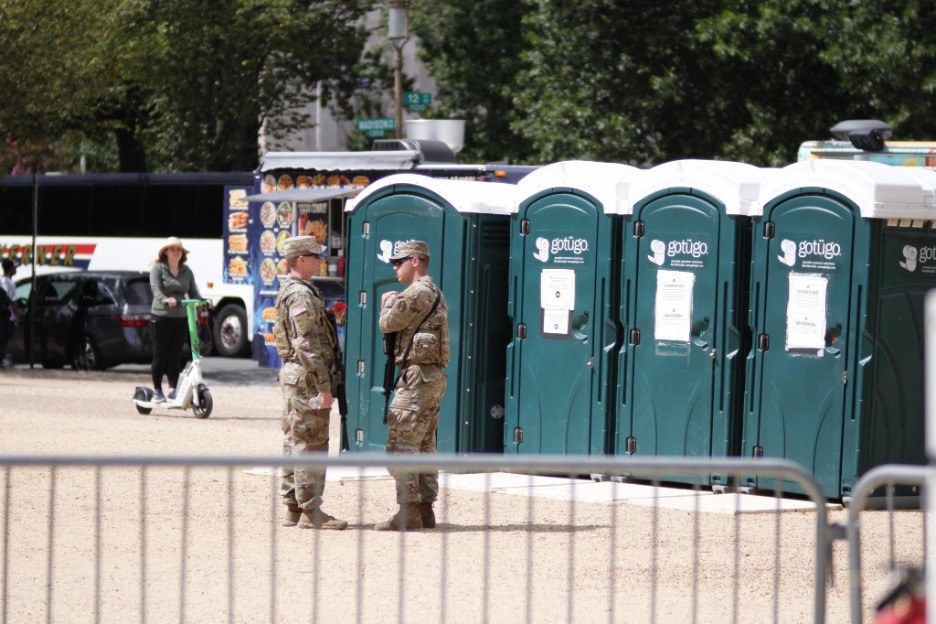
.jpg?sfvrsn=8253205e_5)
