Learning Resources: Götterdämmerung or Skirmish?
The Supreme Court’s decision thwarts President Trump’s attempt to enlist his emergency powers to levy taxes not otherwise permitted by law.

After an impatient wait, the U.S. Supreme Court finally handed down its opinion in Learning Resources, Inc. v. Trump, the tariffs case, on Friday, Feb. 20. Much commentary has ensued about the decision, with more to come. I offer three takeaways: (a) The Court’s justices spent a lot of time talking about how to interpret statutes in a period of governmental upheaval; (b) the Court, perhaps wisely, did not talk about the connection between taxation and takings, an argument that I had pushed; and (c) the decision takes away President Trump’s favorite tool for dealing with the rest of the world but will not necessarily end his obsessive fixation on tariffs as an instrument of state power. The decision may represent a significant loss for the administration, but it is not a crushing defeat.
Statutory Interpretation and Interpretative Doctrines
The decision’s bottom line is one I supported in an amicus brief, on Lawfare, and elsewhere. The International Emergency Economic Powers Act (IEEPA) does not authorize tariffs (nor, it seems, any other kind of financial exaction). As IEEPA contains indefinite and potentially sweeping grants of presidential power, the Supreme Court’s tasks were to find evidence of Congress’s intended scope of the grant and decide which doctrine to apply in the absence of conclusive evidence. One such inference, the major questions doctrine (MQD), received much attention, to the satisfaction of law professors and the dismay, most likely, of everyone else.
Justices Ketanji Brown Jackson, Elena Kagan, and Sonia Sotomayor (Kagan writing for the three) thought the evidence of legislative intent was clear enough to make inferences unnecessary—that Congress had never intended to convey an extractive power. Justice Jackson added a soliloquy on the relevance of legislative history. Meanwhile, Justices Samuel Alito, Brett Kavanaugh, and Clarence Thomas (Kavanaugh writing for the three) also found the evidence compelling, but in the opposite direction. Justices Amy Coney Barrett and Neil Gorsuch, as well as Chief Justice John Roberts, concluded that the evidence pointed toward no power and argued that the MQD bolstered that conclusion.
The MQD reflects a theory about how to interpret statutes that give the president power. It maintains that, if Congress wishes to significantly expand the president’s authority, its legislation should speak clearly. Applying the MQD in actual cases remains hard, as the seven opinions in Learning Resources show. They run from Justice Gorsuch’s extensive (that is to say, lengthy) defense of the doctrine as a coherent strategy tied to (a vision of) the constitutional separation of powers, to Justice Barrett’s argument for less coherence and greater care, to Justice Kagan’s position that the doctrine is an unnecessary and recent fabrication, however much she liked the work it did in this case, and to Justice Kavanaugh’s suggestion that the doctrine is great but of no use when bumping up against foreign relations issues. One thinks of Goldilocks: The MQD is either too much, too little, or just right.
This debate is reminiscent of another judicial doctrine, one that disfavors implied causes of action (known as the nonimplication doctrine). This doctrine, like the MQD, uses statutory interpretation to nudge Congress to be clear when it wants something consequential done. The MQD limits presidential power, while disfavoring implied causes of action constrains judicial discretion. Justice Lewis Powell struck the first blow for the nonimplication doctrine in his dissenting opinion in Cannon v. University of Chicago. Justice Antonin Scalia took up the cudgel in the 1980s, and by the 1990s, a consensus among the justices formed around the doctrine, which seems in good health today. With the MQD, a large majority accepts the concept, but the justices disagree significantly about its scope and purpose. How the doctrine evolves, and whether it becomes the expression of a substantive consensus, remains to be seen.
Money Matters
What the Supreme Court did not pay much attention to is the claim that, with respect to the discretionary power of the state, money is different. The majority accepted the point but did not do as much with it as I would have liked. The dissent rejected it altogether.
I believe that the exaction of money, what James Madison in Federalist #48 referred to as “access to the pocket of the people,” is a close relation to the takings power. Both employ licenses from the legislature to seize people’s property. In the case of takings, the Constitution requires fair compensation in return; in the case of tariffs and other taxes, the extracted money pays for public services that are not attached to a user fee. Both can be abused to serve the private ends of public actors. If property is a bulwark of liberty, something the founders believed, then we should demand that the legislative licenses are clear and definite.
This basic point helps unlock the riddle of how to read IEEPA. Congress adopted the statute in 1977 in order to separate presidential powers in international emergencies. The authority that existed in 1977, the 1917 (and much amended) Trading with the Enemy Act (TWEA), licensed a wide range of powers, including the taking of property, as responses to international emergencies. The 1977 legislation, while enacting IEEPA, amended TWEA. It preserved the TWEA authorities but limited them to instances of declared war. Congress later amended TWEA after 9/11 to cover armed attacks on the United States. IEEPA applies in the absence of war, when the president declares an international emergency. Some of the TWEA powers were copied in IEEPA, but the takings power was not.
The upshot is that “regulate,” the open-ended term that does all the work in IEEPA, cannot reasonably be read as extending to takings, given the division between the wartime TWEA and the peacetime IEEPA. If that is so, then surely takings-like powers, such as tariffs and taxes, also cannot fit within that term. In IEEPA, Congress expressed the view that measures that enrich the state are categorically different from other kinds of restraints on liberty. State enrichment can be a gateway to private rent-seeking, even embezzlement and fraud. Congress might be okay with lowering the U.S.’s guard against this evil during war, but not otherwise. Bizarrely, the dissent flipped this argument, regarding exactions as less intrusive than prohibitions while ignoring the risk of corruption.
Learning Resources holds that “regulate” does not encompass tariffs and taxes, but makes no mention of the taxes-takings analogy. Still, the point that money matters runs through the five opinions of the six-justice majority that struck down the Trump administration’s tariffs. This insight frames the way the justices accounted for the other evidence of Congress’s intentions behind IEEPA. Money matters because the Constitution clearly assigns key powers (taxing and spending) to the legislature, because its extraction interferes with personal liberty, or because it opens the door to corruption. For at least six justices, that insight significantly influences the way they read statutes, not just here but going forward.
What’s Next?
All of the Supreme Court’s justices recognized that they were acting against a background of specific delegations of tariff authority to the executive. Specifically, the delegations in Title 19 of the U.S. Code, the part of U.S. legislation devoted expressly to trade and tariffs. Indeed, a couple of the tariffs adopted in the first year of the present Trump administration, as well as all of those levied in the first, rest not on IEEPA but on Section 232. In the interval between the two Trump administrations, President Biden ratified the first Trump administration’s exercise of this authority. The Section 232 tariffs survive Learning Resources, as they fit within the terms of a clear legislative delegation.
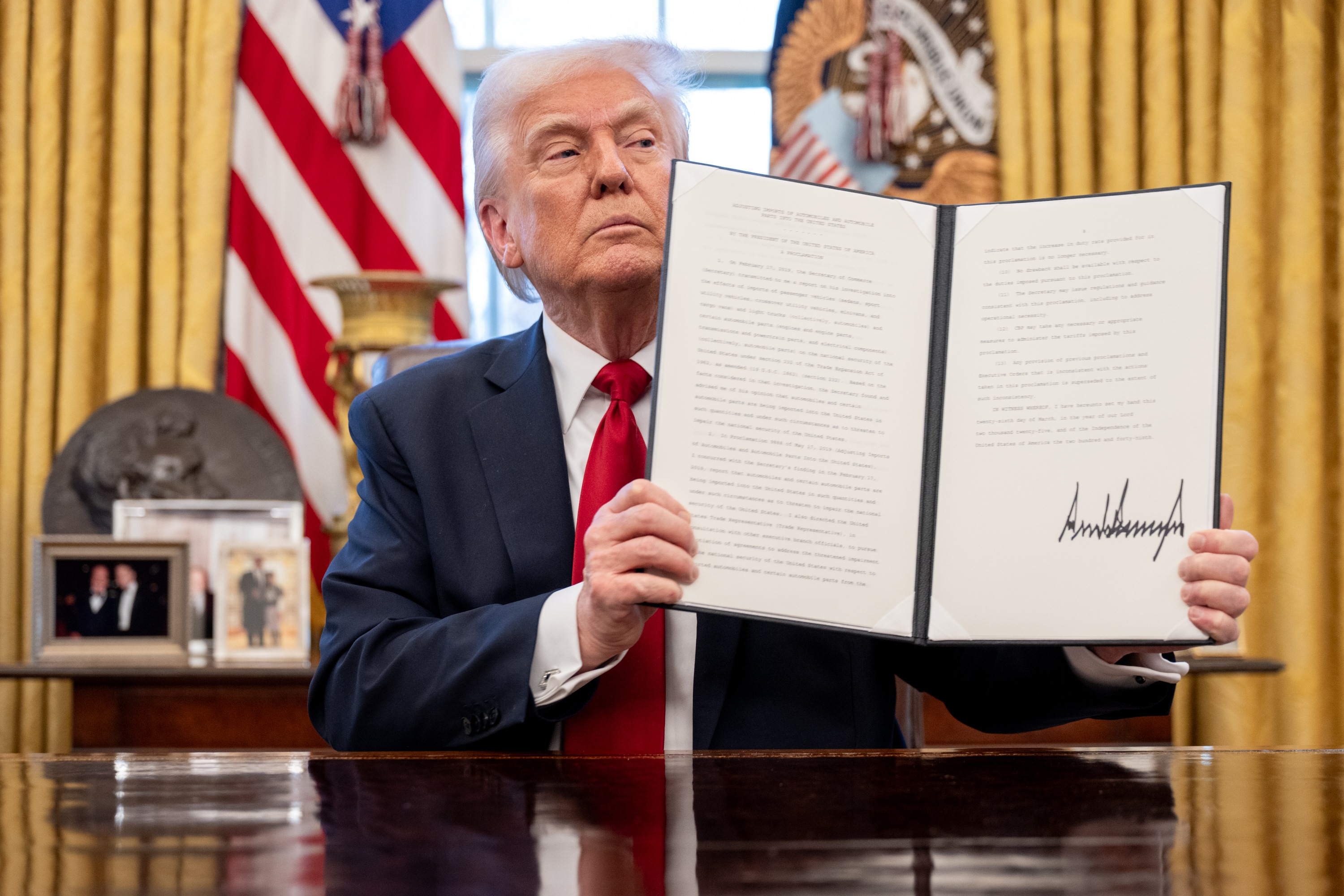
Justice Gorsuch’s concurrence enumerates the president’s well-founded Title 19 alternatives. Within hours of the decision, Trump accepted the invitation, even as he demeaned the justices who refused to bend to his will. In two executive orders, he replaced the invalidated tariffs with ones based on Section 122, which Congress had enacted in 1974 to ratify measures by the Nixon administration to grapple with a perceived balance-of-payments problem. This express authorization to levy tariffs, however, comes with guardrails, including a 15 percent cap, a 150-day limit, and a requirement of nondiscrimination within import classes. After initially imposing a 10 percent levy, Trump released a social media post the following day that he would invoke the full 15 percent allowed by the statute, although the adopted tariff stayed at 10 percent.
Why did Trump use this authority, rather than that for national security concerns (Section 232) or for retaliating against unfair and discriminatory foreign measures (Section 301)? Only the balance-of-payments power permits the president to act immediately, without time-consuming administrative investigations and interbranch coordination. Still, it seems a poor fit for Trump’s preferred maximum-pressure bargaining strategy.
Trump seems to believe that the power to terrify other countries best allows him to pursue the national interest. Threats and bluster are essential elements of any bargaining strategy for him: Carrots are no good without strong sticks. Only IEEPA allowed him to use tariffs as a stick, but only if its risky legal theories panned out.
Section 122, perhaps his second-best strategy, has two shortfalls. First, and of lesser significance, the statute requires a balance-of-payments crisis. The executive order tries to make the case that the U.S. is in one, but the order confuses balance of trade with balance of payments. Whatever the shortfalls in U.S. exports compared to imports of physical goods, the United States normally has a surplus in the export of services and remains an attractive place for foreign investors to park their capital. As a result, a healthy demand for U.S. dollars prevails. The United States does not have a crisis in the international market for the dollar.
This inconvenient fact may not matter, however, because the Supreme Court will likely regard the question of whether a crisis exists as one entirely in the president’s domain. Moreover, a less heralded part of the Learning Resources decision restricts legal challenges to these tariffs to a refund suit filed in the U.S. Court of International Trade, with the U.S. Court of Appeals for the Federal Circuit as the only avenue for appellate review. This move takes away the preferred strategy of litigants challenging executive actions, which is to forum shop for a friendly federal district court. The odds are not zero that the U.S. Court of International Trade would strike down the new tariffs, but not high. The odds that the Supreme Court would tolerate such a decision are even lower.
The second shortfall is Section 122’s cap. From Trump’s perspective, this presents a real problem: 15 percent is not nothing, but it is far less than what he threatened others with under IEEPA. Even if the 150-day sunset requirement can be circumvented by immediate renewals at the end of each period, the size of the tariff will inconvenience other countries, but not scare their governments. Yet Trump is committed to fear as a pillar of power.
All the other trade law provisions come with time delays. Sections 232 and 301 require time-consuming processes, which are no good if the goal is rapid strikes. Another provision found in trade law, Section 338, authorizing retaliation against unfriendly trade practices, requires less process, but legitimate arguments exist about its viability. The 1988 Omnibus Trade and Competitiveness Act, along with the 1994 Uruguay Round Agreements Act, can be read as implicitly repealing Section 338.
A deeper problem lurks, political rather than legal. There is growing evidence that the 2025 tariffs have had the effect that most trade experts predicted, increasing costs for U.S. consumers without significant offsetting gains for U.S. workers. It is early days, but the tariffs are not a good look going into the next round of elections. The connection between particular economic policies and voter preference is inevitably contingent and murky, but the pressure on Trump to reconsider his infatuation with tariffs will likely grow.
A fearful alternative exists. What worries me, and I suspect many, is that the president may shift his focus to other sources of power. If the president’s hallmark trade measures do not pan out, he may find his way to the wielding of another presidential authority less encumbered with legislative and judicial constraints. Learning Resources signals rather clearly that war powers are different and entail greater deference to the executive. With great possible payoffs and lower legal barriers, spectacular uses of armed force may result.
Trump has ordered two armed incursions on hostile states already: the airborne attack on Iran’s nuclear weapons program and the extraction of Venezuelan leader Nicolás Maduro for criminal prosecution in the United States. Both looked good in the moment, and neither has yet led to regrettable downstream consequences. The long, hard lessons of Vietnam, Afghanistan, and Iraq—the Princess Bride principle never to enter into a land war in Asia—are easily forgotten. Whatever the fallout from such steps, if Trump takes them, we cannot expect the Supreme Court to bail us out.