Palestinian Islamic Jihad and the Gaza Ceasefire

Editor’s Note: Although Hamas commands the lion’s share of attention in the fight for Gaza, another important actor is Palestinian Islamic Jihad (PIJ). Erik Skare of the Norwegian Institute of International Affairs argues that PIJ, for now, seems open to joining the ceasefire but that it may resume its role as spoiler in the months and years to come.
Daniel Byman
***
Palestinian Islamic Jihad (PIJ) has punched above its weight for decades by dictating Israeli-Palestinian conflict dynamics. Weakened considerably by years of devastating warfare following the Oct. 7 attacks on Israel, the movement has met President Trump’s Gaza disarmament track with near-silence rather than categorical rejection.
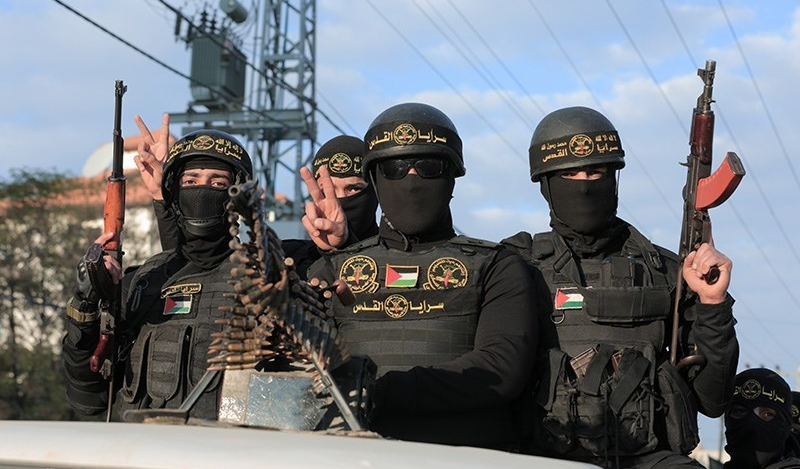
Although not participating in the planning for Oct. 7, 2023, PIJ did join the attack by first launching rockets from the Gaza Strip toward the Israeli border communities and then assaulting several Israeli military sites, such as the Nahal Oz military outpost where militants from Hamas’s Izz al-Din al-Qassam Brigades and PIJ’s al-Quds Brigades killed 66 Israeli soldiers.
As was the case for the other Palestinian factions, PIJ did not limit itself to military targets; its militants also targeted Israeli kibbutzim and moshavim, such as Be’eri and Nir Oz, where 151 residents in total were killed. PIJ’s secretary-general, Ziyad al-Nakhala, confirmed the following day that they had taken more than 30 Israeli hostages. After war broke out in Gaza, PIJ operated as one of the major military players alongside Hamas by targeting Israeli ground troops in head-to-head firefights, ambushes, and with improvised explosive devices and mortar attacks.
Stakeholder, Veto Player, Soldier, Spoiler
In addition to its military role, PIJ has shaped Israel-Hamas negotiations. PIJ has met regularly with Hamas leaders and members of its negotiation team throughout the war, consulting with Hamas on the U.S. and Israeli proposals under negotiation. In this capacity, as the second-largest armed faction in Gaza with several Israeli hostages under its control, it has provided Hamas with observations on those proposals and advice on how to proceed. It has also publicly articulated its own red lines and demands over the course of the war: a permanent ceasefire, no disarmament, return for all displaced in Gaza, full entry of humanitarian aid, and a complete Israeli withdrawal. PIJ has acted as a veto player, spoiler, stakeholder, or junior partner—depending on whether the analysis approaches Hamas’s sister movement as benign or malign.
So it came as a surprise on July 31 when Trump announced that there was an agreement for not just Hamas to disarm, but all militant factions in Gaza. Even more so when the news was confirmed by one of the members of Hamas’s negotiations team, Ghazi Hamad. Some aspects of the deal remain ambiguous: It remains unclear what disarmament means in practice and to what extent it is conditioned by Israel actually following through on its obligations according to the ceasefire’s first phase, including withdrawing from Gaza, letting in humanitarian aid, and halting its attacks on Gaza that have killed over 1,000 Palestinians since the ceasefire was implemented. Nonetheless, a reported commitment from Palestinian militants to disarm is striking.
From a Position of Principles …
This is a significant shift. PIJ’s espoused line throughout the 2023–2025 Gaza war has been clear and consistent. In December 2023, it promised that it would never surrender, and a month later, the group reiterated that “we will take the soul of whomever tries to disarm us, God willing.” On the two-year anniversary of the war’s start, it insisted that the arms of the resistance “will not be sheathed” as long as the occupation remains. That position did not change once the nominal ceasefire was implemented in Gaza on Oct. 10, 2025.
When this author asked a PIJ leader about the disarmament track earlier this month, he made it clear that PIJ still clings to its first principles: “Our historically declared positions affirm that the weapons of the resistance are not on the table for handover or removal. Any political arrangements must first guarantee a halt to the aggression and the withdrawal of the occupation.” This is largely in line with PIJ’s founding credo: Armed struggle is the sole means of establishing a Palestinian state, and this state must be established from the Jordan River in the east to the Mediterranean Sea in the west.
Yet PIJ has not published any statement forcefully denouncing the disarmament track. Rather than rejecting a track that threatens the movement’s sole means of struggle, PIJ has published only one brief communique on Telegram, on July 31, which stated that reports about the disarmament track are imprecise and that it has numerous reservations about what has been proposed. When its secretary-general, Ziyad al-Nakhala, met with Hamas’s leader for the West Bank, Zaher al-Jabareen, in Cairo on Aug. 1—the day after the announcement—no further official PIJ position was produced on the matter beyond stating that the suffering of the Gazan people had to be alleviated. Tellingly, the statement and news about the meeting were issued by Hamas, while PIJ remained silent.
… And a Position of Weakness
PIJ’s silence is best read as a symptom of its weakness and the pressure it is under after years of devastating warfare. Like Hamas, the group does not have many more cards to play. One obvious pressure point is attrition, and although there exists no systematic count of its casualties, the August 2025 joint investigation by the Guardian, +972, and Local Call found that 8,900 Hamas and PIJ fighters were dead or “reportedly dead.” These numbers do not take into account the recruitment of new militants through the course of fighting, and any estimate remains speculation. Read cautiously, however, it could indicate that as much as one-fifth of the original fighting force has perished. PIJ has, moreover, moved from carrying out an average of 40 weekly armed operations in and from Gaza in November 2023 to approximately 10 by September 2025, the month before ceasefire was implemented. With a 75 percent decline across two years, the operational collapse is presumably caused not just by a lack of fighters but also by munitions and rocket depletion, loss of tunnel infrastructure and freedom of movement, and the deliberate conservation of capabilities to survive in the longer run.
The other pressure point, for Hamas as for PIJ, is popular. A humanitarian catastrophe has taken hold for the civilian population in Gaza, with 2.1 million Palestinians crammed into one-third of Gaza’s original area and the ceasefire unable to stop Israeli bombings and prevent Palestinian death tolls from rising. While only 21 percent of Palestinians hold Hamas responsible for their suffering (54 percent blame Israel instead), support for Hamas and PIJ’s actions has declined over time, according to a poll by the People’s Company for Polls and Survey Research from Oct. 25, 2025. Support for the Oct. 7 attacks stood at 71 percent among all Palestinians in March 2024 but dropped to 53 percent in October 2025 after two years of destruction. Support in Gaza, specifically, is even lower, at 44 percent.
So while PIJ could declare without any associated costs in its 2018 political document that “to disengage from the armed struggle is … a defiance of religion, to give up the homeland, and to betray the charters, covenants, and the values upon which societies, states, homelands, and nations are built,” it cannot afford today to be framed as a spoiler. The PIJ leader with whom I corresponded made it clear that PIJ does not aspire to obstruct the negotiations, just that it objected to the absence of Israeli obligations and guarantees. “PIJ has stressed the necessity that any agreement include mutual obligations, so that every step the resistance commits to is met with an equivalent and binding step on the enemy’s side,” he said. “Every clause obligating the factions must be matched by a clear clause obligating the occupation.”
Whether PIJ does so because it genuinely cares about the humanitarian situation in Gaza or because the group worries it will be blamed for continued fighting is mere speculation, but the two are not mutually exclusive.
To an Electoral Partner ...
There are two scenarios for how PIJ chooses to proceed, both of which matter for the future of Gaza and the occupied Palestinian territories. There may be a creeping sense in PIJ that armed resistance in Gaza has exhausted itself—as is reportedly the case for some of the more moderate Hamas elements. Yet Hamas has always operated with greater flexibility than PIJ. Hamas has, for example, expressed an openness to a two-state solution along the 1967 borders, accepted electoral participation under occupation, and shown a willingness to govern. These are moves that PIJ could or would not make.
As Anwar Abu Taha, member of PIJ’s political bureau, stated when I interviewed him in 2018, “Hamas is a political movement engaged in the military field. PIJ is a military movement engaged in the political field.” While there are those in Hamas who play with the idea of turning into a legal political movement seeking power through democratic elections, that pragmatism has traditionally been far more constrained for PIJ. Hamas’s flexibility has helped it survive prolonged periods of Israeli counterinsurgency; it could turn to other avenues of influence, such as social work. For PIJ, its lack of flexibility has simply meant suffering.
One scenario, then, is that PIJ learns from its past. Indeed, PIJ has apparently held bilateral talks and collective meetings with Hamas, the Palestinian National Initiative, the Popular Front for the Liberation of Palestine (PFLP), and Mohamed Dahlan’s breakaway Fatah faction, Democratic Reform Current, in August to explore the formation of a broad electoral coalition to challenge Palestinian President Mahmoud Abbas. The new realities on the ground have thus provided PIJ the opportunity to, if not reinvent itself, then at least expand its limited repertoire. It can do so by referencing the need to preserve Palestinian unity and the necessity of reforming the Palestinian political system.
What those talks produce could break old path dependencies, forge new alliances, and make lasting changes within PIJ that could make the movement accept electoral participation under occupation.
… Or an Insurgent Competitor
Still, PIJ has punched above its weight for decades by influencing intra-Palestinian politics, shaping Islamist ideological development, and dictating when and how the Israeli-Palestinian conflict escalates. As political violence is a proven source of political capital and popular support for Palestinian factions struggling against the Israeli occupation, another scenario is that PIJ decides its greatest chance of survival is to increase the costs for Hamas, as it did in the 2010s.
Should Hamas disarm, it will create a new void for PIJ to exploit. Although this opportunity will be far smaller should Hamas remain an underground clandestine armed movement without governance responsibilities in Gaza, PIJ may escalate conflict cycles as it did in the 1990s. While the competition between Hamas and Fatah was a significant driver of Palestinian suicide bombings in the 1990s, the intra-Islamist competition between Hamas and PIJ carried equal, if not greater, weight as Hamas had to prove its “resistance credentials” after its forerunner, the Palestinian Muslim Brotherhood, had avoided armed struggle and politics for decades.
PIJ does not need to return to its former strength in order to make life miserable for the leaders of Hamas or Israeli forces. All it has to do is survive and cling to its original principles. Should Hamas remain armed, PIJ can simply revert to outbidding its rival’s violence through persistent pinprick operations before returning to Gaza’s ruins. Should Hamas give up its weapons, and thus its founding identity, then the Palestinian armed struggle is PIJ’s to inherit.