
Rethinking Treasury's Terrorism and Financial Intelligence Office



Editor’s Note: This article is a modified excerpt of policy recommendations from a recent publication by the authors in The Ledger: A Journal of Economic Statecraft. The original publication can be accessed here.
More than 21 years have passed since Congress created the Treasury Department’s Office of Terrorism and Financial Intelligence (TFI). In that time, TFI has pioneered the targeted use of financial sanctions, financial intelligence information, financial regulation, and international standard setting to support U.S. foreign policy and national security objectives “while also protecting the integrity of the U.S. and global financial systems.” Financial sanctions in particular have become a “tool of first resort,” as noted by the Treasury Department’s 2021 Sanctions Review and other analyses.
However, as put bluntly by former Treasury Department Deputy Secretary Justin Muzinich, TFI “is not a team built to analyze the complex economic and financial links that would be implicated in a great-power clash.”
TFI’s analytical demands have expanded well beyond its 9/11-era design. Over the past 20 years, sanctions programs have grown more than 1,000 percent; anti-money laundering/countering the financing of terrorism (AML/CFT) policy has shifted toward risk-based frameworks that presuppose quantitative evidence that TFI has no permanent capacity to produce; and when high-stakes operational decisions have required serious macroeconomic analysis—the 2022 Russia oil price cap being the clearest example—that work has fallen to other Treasury offices whose mandates do not include national security.
The Current Architecture
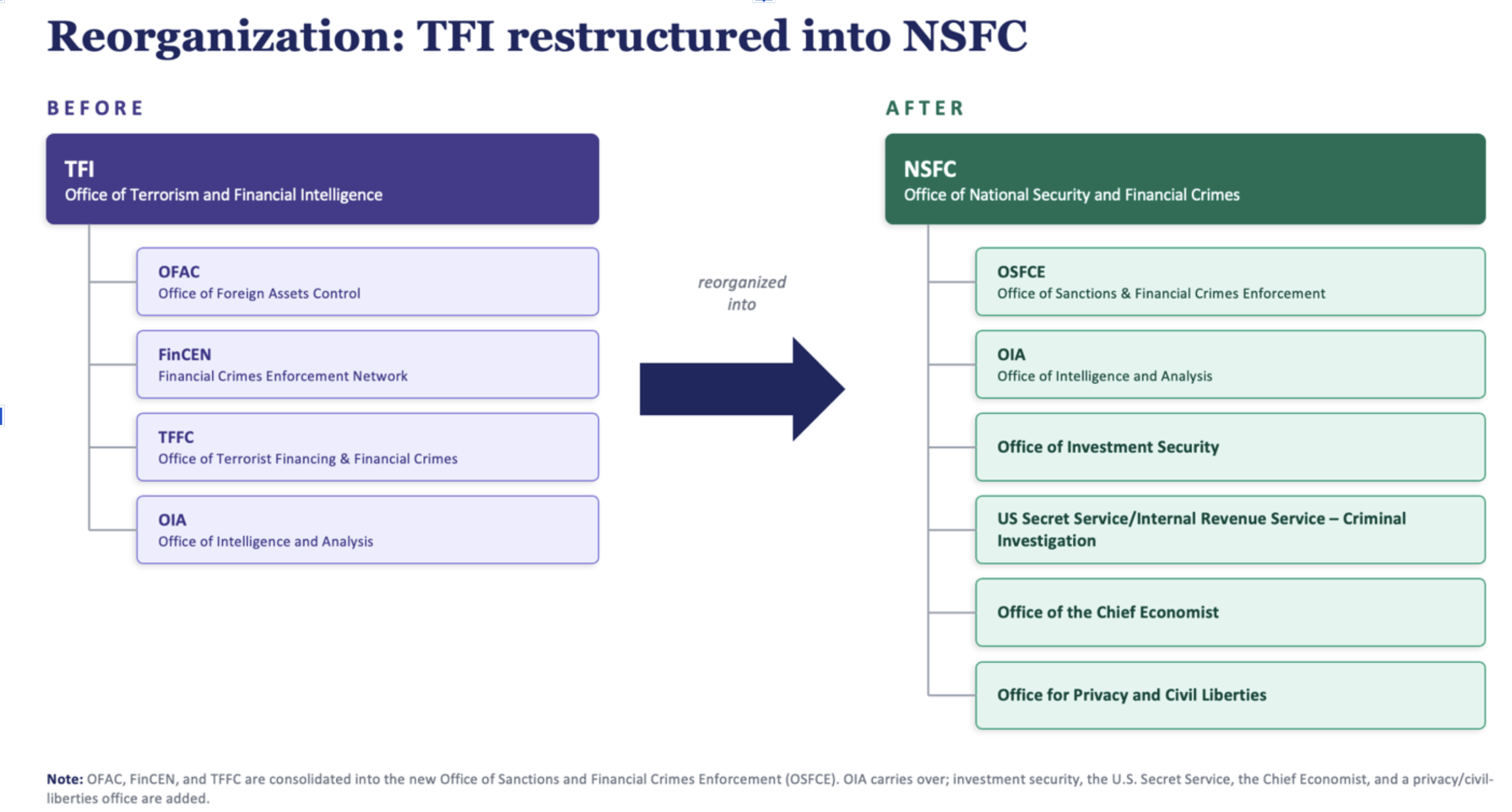
TFI currently supervises four primary component offices and bureaus with complementary, and sometimes overlapping, mandates: (a) The Office of Foreign Assets Control (OFAC) administers economic sanctions; (b) the Financial Crimes Enforcement Network (FinCEN) is the U.S. financial intelligence unit and primary federal AML/CFT regulator; (c) the Office of Intelligence and Analysis (OIA) is an element of the intelligence community; and (d) the Office of Terrorist Financing and Financial Crimes (TFFC) serves as the policy and strategy shop.
The overlapping mandates of the TFI components create internal bureaucratic challenges and complications when engaging with intragovernmental and nongovernmental stakeholders. For instance, TFI currently has three offices with a policy mandate: TFFC (as its primary function), OFAC’s Policy Division, and FinCEN’s Policy Division. TFI also contains two intelligence-focused elements: OIA (the intelligence community function) and FinCEN’s Research and Analysis Division (formerly called the “Intelligence Division”). For a bureaucracy with about 1,000 employees, these functions duplicate rather than amplify the office’s capabilities.
A Reform Agenda
The reforms proposed in this piece address three distinct but related deficiencies in TFI’s current design.
The first is a mission mismatch: TFI’s name, internal structure, and component mandates still reflect a post-9/11 counterterrorism orientation that no longer describes the office’s actual work.
The second is an analytical gap: TFI lacks the permanent economic capacity its expanded mandate now requires—a deficiency illustrated by the history of the Sanctions Economic Analysis Division (SEAD).
The third is an incomplete perimeter: The Department of the Treasury’s national security functions are scattered across offices with competing priorities, and the department lacks a criminal enforcement arm to complement its civil and regulatory tools.
New Name, Refined Mission: The Office of National Security and Financial Crimes
TFI should rebrand as the Office of National Security and Financial Crimes (NSFC). The name better captures the office’s actual capabilities and mission, particularly in combination with the other reforms recommended below. “Terrorism” as a framing made sense in the wake of 9/11, but terrorism is now just one of many priorities competing for TFI’s attention—alongside nation-state threats from Iran, North Korea, Russia, and China, and transnational threats involving cybercrime and fraud, narcotics trafficking, and human rights/corruption. Similarly, “financial intelligence” describes one important tool the office uses, but the framing often confuses private-sector stakeholders and raises concerns among civil libertarians.
Consolidating the Core
NSFC should administer a new merged bureau, the Office of Sanctions and Financial Crimes Enforcement (OSFCE), combining OFAC and FinCEN and incorporating TFFC’s policy function.
Over two decades, TFI’s component missions have become more integrated, which should be viewed as a sign of success. But stakeholders across government, industry, and foreign partners and adversaries do not meaningfully distinguish these functions in practice. Many conflate financial sanctions (an OFAC authority), Section 311 special measures (a FinCEN authority), and Bank Secrecy Act compliance and enforcement (also a FinCEN authority).
Suboffices within OSFCE would still delineate between sanctions and AML/CFT functions. But unified leadership would create efficiencies across rulemaking, licensing, policy development, enforcement, and engagement with intraagency, interagency, international, and private-sector partners. Enforcement would benefit in particular: A common enforcement structure would allow FinCEN and OFAC officers to be deployed flexibly as priorities shift. Congress has already signaled support for harmonization—routing sanctions whistleblowers to FinCEN, for instance—and the offices themselves have engaged in joint rulemaking (for the GENIUS Act in April 2026) and parallel enforcement actions since 2022.
The merger would also eliminate redundancies and reduce turf battles among three policy offices and two intelligence functions. OIA would remain a standalone office given its separate legal authorities as part of the intelligence community; Atlantic Council experts have offered separate recommendations on OIA reforms. This reorganization would not affect U.S. compliance with the Financial Action Task Force.
As part of this reorganization, the legacy OFAC function should include a dedicated delisting office—or, alternatively, a delisting function within its existing targeting, licensing, or compliance function—to encourage the dynamic and strategic use of sanctions, including through their responsible and regularized withdrawal. This idea has gained policy traction since we initially drafted this paper. On April 29, former Deputy National Security Adviser and inaugural TFFC Assistant Secretary Juan Zarate publicly floated the concept of strategic delisting. On May 19, Treasury Secretary Scott Bessent outlined parameters for adjusting sanctions and avoiding indefinite continuation in a speech before the No Money for Terror conference. Later, on May 26, the Treasury Department delisted 76 sanctions targets as part of a sanctions modernization initiative. Consolidating NSFC’s offices also creates structural room to incorporate additional functions going forward.
Moreover, the Office of Management and Budget should code the NSFC’s budget under the 050 national defense and security category to formally anchor its national security mandate.
Upgrading Analytical Capacity: A Chief Economist for National Security
NSFC should establish a permanent chief economist position at the assistant secretary level, reporting directly to the under secretary, with responsibility for economic and other analysis across all NSFC components—not just sanctions enforcement. This addresses the core failure of SEAD’s original design: analytical capacity that lacked institutional standing, a dedicated budget, and independence from any single component’s equities.
The model already exists. The Justice Department’s Antitrust Division embeds approximately 50 Ph.D. economists in its Expert Analysis Group, led by the deputy assistant attorney general for economics—typically a prominent economist on leave from an academic post. That structure gives the economics function real authority within an enforcement-oriented department, producing analysis that shapes enforcement decisions rather than getting absorbed by them.
This is deliberately an economics-led function, not a multidisciplinary one. The recurring binding constraint has been the absence of permanent, senior economic capacity. A chief economist position closes that specific gap; it does not displace the other lenses that already inform the Treasury Department’s work.
Integrating Investment Screening
With a consolidated core, NSFC can expand its mandate on both national security and financial crimes portfolios. On national security, the Treasury Department should migrate the Office of Investment Security—which chairs CFIUS—and the Outbound Investment Security Program from the Office of International Affairs (IA) into NSFC. Currently, the Treasury Department expends resources deconflicting these functions between TFI and IA. This consolidation would give the Treasury Department’s growing national security mission a single institutional home while freeing IA to focus on its broader international economic mandate.
Restoring Criminal Enforcement Capabilities with the U.S. Secret Service
A reorganized NSFC should also have criminal as well as civil enforcement capabilities. The absence of a law enforcement arm within Treasury’s departmental offices is itself a post-9/11 development. As Zarate documented in “Treasury’s War,” much of TFI’s early success in developing novel civil and financial tools reflected a pivot away from criminal legal authorities that had previously anchored the department’s national security and law enforcement work. That pivot produced innovative policy tools but left a gap. Civil sanctions and regulatory enforcement can freeze assets and impose compliance costs, but cannot indict, arrest, or seize. For financial crimes with a clear criminal nexus—cybercrime, cryptocurrency fraud, sanctions evasion through shell company networks—the absence of in-house criminal investigative capacity forces reliance on the Department of Justice, the FBI, and other referrals that diffuse accountability.
Returning the U.S. Secret Service to the Treasury Department is the most logical path to closing that gap. Though this proposal did not advance during the first Trump administration, it was reintroduced in 2023, and the case has since grown stronger. The Secret Service’s financial crimes mandate—covering cybercrime, cryptocurrency investigation, and currency fraud— already overlaps substantially with the Treasury Department’s enforcement priorities. Reuniting the two institutions would restore an operational pairing that existed for more than a century before the post-9/11 reorganization moved the Secret Service to the Department of Homeland Security. An alternative proposal could instead move the Treasury Department’s Internal Revenue Service - Criminal Investigation to NSFC.
Enhancing Financial Privacy and Civil Liberties
Given these expanded capabilities, NSFC should also establish an administratively independent, adequately resourced ombudsman office for privacy and civil liberties, operating across all NSFC components and programs. Over much of the past decade, TFI—and FinCEN and Bank Secrecy Act-derived information in particular—has been subject to sustained politicization, leaks, and criticism. A properly empowered ombudsman office would restore and maintain confidence in the handling of sensitive data and in the policies, procedures, and personnel responsible for its lawful use.
Below is an AI-enabled diagram to visualize the current TFI organizational design and the recommended consolidations and expansions to create NSFC.
* * *
The case for reform is not in dispute. The disagreement is about remedy.
Defining NSFC’s remit also means being explicit about its limits. A reformed NSFC would do a specific set of things well: assess the economic and financial consequences of sanctions and other coercive measures before and after they are imposed; integrate financial intelligence, enforcement, and economic analysis under unified leadership; and serve as the Treasury Department’s institutional home for the financial dimensions of national security. It would not—and should not—attempt to run industrial policy, manage supply-chain resilience, coordinate export controls, or arbitrate technology competition. Those functions belong to other departments with the requisite authorities and expertise. The value of the NSFC lies precisely in performing a bounded set of financial-statecraft functions with depth and durability, not in becoming a miniature Department of Economic Security inside the Treasury Department.
The proposals outlined here work with the grain of existing institutions rather than against them. Much more work will be required to implement these recommendations; this piece provides a starting point. Several key reforms—the TFI rebrand, the OFAC/FinCEN/TFFC consolidation, the chief economist position, investment security functionality, and the ombudsman—require legislation within narrow committees of jurisdiction. Others, like returning the Secret Service to the Treasury Department, are medium-term objectives requiring broader congressional action. But none require a decade to implement. The United States does not need a new department. It needs its existing economic statecraft apparatus to work—better resourced, better organized, and better calibrated to a threat environment that has moved well beyond the post-9/11 world that shaped TFI’s original design.


_enforcement_and_removal_operations'_(ero)_from_baltimore-_maryland__ride_along__on_2_august_2023-1.jpg?sfvrsn=50aeaecc_5)
