The Hemisphere of Exceptions

Editor’s Note: More and more governments are turning to emergency powers to expand executive authority—the United States included. Jeffery Tobin, of Florida International University, explains the prevalence and appeal of these policies that can circumvent unpopular and slow-moving legislatures, and how their increasing normalization is subtly eroding democracy and making it more difficult for U.S. policymakers to separate necessary measures from executive overreach.
Dana Stuster
***
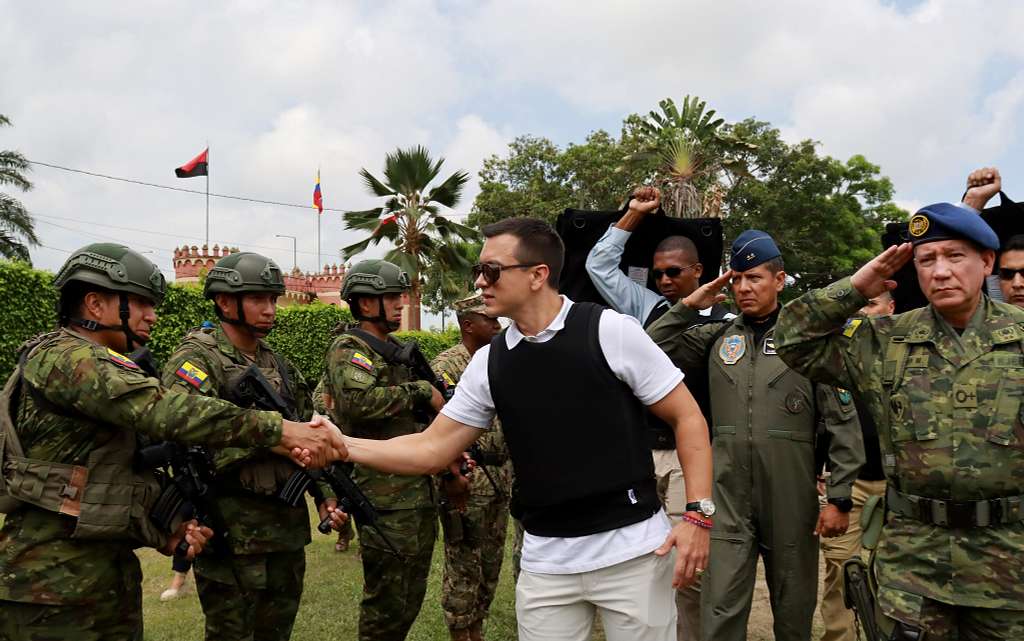
In October 2025, Ecuador declared a state of emergency in 10 provinces after clashes between protesters and security forces escalated into what authorities described as serious internal unrest. President Daniel Noboa’s government invoked emergency powers to deploy additional security forces and stabilize affected areas.
Later that month, Reuters reported that Ecuador’s wider security crisis, driven by increasingly fragmented criminal organizations, had fueled a rise in killings and violent confrontations across the country. The reporting documented how intensified anti-gang efforts contributed to the fracturing of major criminal networks, creating a more volatile landscape of rival groups.
Across the region, this pattern repeats: Emergency powers, once framed as exceptional tools for brief crises, have become central instruments of governance in countries grappling with political instability, organized crime, and eroding public trust. This shift matters not because emergencies themselves are new—every constitutional system allows for extraordinary authority in moments of genuine crisis—but because of how routinely and predictably these powers now appear, reappear, and persist. What was designed as a temporary suspension of ordinary legal and institutional constraints increasingly functions as a parallel mode of rule.
Executives rely on emergency authorities not only to respond to acute threats but also to manage chronic problems that democratic institutions have struggled to resolve. Over time, this reliance reshapes expectations: Legislatures grow accustomed to governing by renewing these executive powers rather than deliberation, courts recalibrate standards of deference, and security forces assume a more permanent role in public life. The result is not the collapse of democracy, but a subtler transformation in how it operates, with legality yielding to expediency and crisis becoming a standing justification rather than an exception. The increasing prevalence of these emergency powers complicates U.S. policy, making it more difficult to recognize democratic backsliding, even as Washington has used similar emergency measures to justify executive action.
These expansions of executive authority are increasingly becoming the norm. In Peru, for example, the government declared a 60-day state of emergency in several provinces in November 2025, deploying soldiers to support police in response to rising crime and public anxiety. As the decree approaches its expiration, the government faces a familiar choice: allow emergency powers to lapse or extend them in response to conditions that remain politically salient but unresolved.
The ongoing régimen de excepción in El Salvador—first implemented in March 2022—continues to permit mass detentions and curtailed legal protections. While the policy has reduced homicide rates dramatically, human rights groups and major news organizations have documented widespread abuses and due process concerns.
Honduras has used repeated states of exception in major urban areas to confront extortion networks and gang-related violence, extending measures beyond their initial time frames and increasing the operational role of security forces in domestic policing.
In Jamaica, the government has periodically implemented states of emergency in response to high homicide rates, granting security forces expanded powers for warrantless searches and extended detentions, without seeking Parliament’s approval. These measures often reappear in the same regions year after year. A similar pattern exists in Trinidad & Tobago, where the government has relied on exceptional security measures to confront entrenched criminal networks. While not always framed as formal emergency decrees, these heightened security responses illustrate how extraordinary authority has become part of the country’s long-term public safety strategy.
In Mexico, the militarization of internal security has deepened through the permanent integration of the National Guard under the Defense Secretariat—an extraordinary shift in a country where the constitution long restricted military involvement in policing. While not described as a “state of emergency,” the move effectively normalizes extraordinary security authority.
What ties these cases together is not identical legal frameworks, but a shared political logic—and a departure from earlier patterns of emergency governance. States in the region have long used exceptional powers in moments of acute crisis, but today’s reliance differs in both frequency and purpose. Emergency authorities now appear less as responses to singular shocks and more as tools for managing persistent conditions: chronic insecurity, fragmented party systems, legislative paralysis, and steadily eroding public confidence in democratic institutions.
Public surveys across Latin America consistently show declining trust in legislatures, courts, and political parties, while fear of crime ranks among citizens’ most pressing concerns. That erosion of confidence helps explain why executives find emergency measures politically effective—but it does not fully account for the shift. The coronavirus pandemic accustomed governments and publics alike to prolonged rule by decree, accelerated the normalization of extraordinary legal authority, and blurred the boundary between crisis management and ordinary governance. At the same time, social media-driven politics has increased the premium on speed, visibility, and narrative control. Under these conditions, exceptional powers offer leaders not just capacity, but theater. They demonstrate their ability to project decisiveness in systems increasingly perceived as slow, compromised, or incapable of delivering security through ordinary means.
Once implemented, emergency powers rarely disappear. Emergency measures create institutional habits that prove difficult to unwind, especially when the conditions used to justify them—crime, insecurity, political fragmentation—remain unresolved. What begins as a temporary deployment of security forces evolves into a standing presence, reshaping public expectations about how order is maintained and who is responsible for it.
Legislatures, initially asked to authorize exceptional powers for limited periods, grow accustomed to renewing them rather than debating alternatives. Courts, faced with ongoing claims of necessity, recalibrate standards of deference in ways that expand executive discretion without formally abandoning judicial review. Executives, in turn, come to treat emergency authority not as a last resort but as a reliable governing tool.
Jamaica offers a telling illustration. States of emergency first declared to contain acute surges in violence have been reimposed repeatedly across different administrations and regions, embedding extraordinary security measures into routine governance even as elections, legislative activity, and judicial oversight continue. The result is not permanent emergency rule, but instead a system in which exceptional authority becomes easier to invoke, harder to revoke, and increasingly normalized as part of the democratic landscape.
For the United States, this shift complicates foreign policy in ways that go beyond normative discomfort. Washington has repeatedly relied on its own exceptional authorities, including the use of national emergency declarations to impose tariffs, reallocate funds, and bypass ordinary legislative constraints. Those practices weaken the distinction between “normal” and “exceptional” governance that U.S. diplomacy often invokes when engaging partners abroad.
The problem, moreover, is not simply hypocrisy. The United States has long balanced its rhetorical commitment to democratic norms with pragmatic security cooperation, often working closely with partners whose governing practices fell well short of liberal standards. Emergency governance abroad has therefore never automatically precluded U.S. engagement. So while this tension has existed in U.S. relations for decades, its scope and visibility are growing. As emergency powers become a routine feature of governance across a growing number of democratic systems, it becomes increasingly difficult for U.S. policymakers to distinguish temporary necessity from durable exception—particularly when crisis governance persists without clear endpoints.
As more partners govern through recurring states of exception, U.S. engagement on migration control, counternarcotics, and internal security increasingly depends on authorities that sideline legislatures, weaken judicial oversight, or embed security forces in civilian governance. This creates a strategic dilemma: Cooperation often proves most efficient when emergency powers are in force, yet sustained reliance on those arrangements risks entrenching governance models that blur the line between democratic partnership and managed illiberalism—complicating not only U.S. credibility but also the long-term stability and institutional resilience of the partners on which U.S. policy depends.
This does not mean the region is abandoning democracy. Elections continue. Opposition parties exist. Courts still adjudicate major questions. But the grammar of governance is changing. Stability, rather than legality, becomes the central promise of leadership. Security becomes a stage on which political legitimacy is performed. And emergency powers evolve from temporary remedies into recurring tools for managing uncertainty. The danger is not the existence of emergency measures; every state uses them at times. The danger is the ease with which they now appear—and reappear—as normalized administrative instruments.
While still democracies, more and more states in the Western Hemisphere are adopting a framework shaped by exception rather than by ordinary institutional practice. The result is a quieter, more ambiguous transformation: Political life continues, but under conditions that increasingly treat fear and crisis as governing assumptions. The Americas are not necessarily moving toward abrupt authoritarian breakpoints. But they are drifting into a system where the extraordinary becomes routine, and where the space between crisis and governance grows harder to distinguish.
-1.jpg?sfvrsn=dd1c6b99_5)