The National Security Case for Judicial Review
Meaningful judicial scrutiny of national security claims is important for the rule of law, democratic legitimacy, and America’s strength at home and abroad.








.jpg?sfvrsn=6d5829a7_3)




The executive branch is increasingly asserting broad authority based on national security to justify a wide range of actions. As a result, federal courts are more frequently required, in the face of complex and conflicting precedents, to determine the degree of deference due to those claims. As these claims are assessed, we, former officials with national security experience in Republican and Democratic administrations and in the judiciary, thought it important to emphasize that, while there often are valid constitutional considerations in these cases, judges have demonstrated competence to consider sensitive and complex issues of national security. Appropriate judicial review strengthens national security, and there are risks inherent in undue deference.
Presidents of both political parties have previously made demands for deference, and judicial deference to the executive branch on core issues of national security is often appropriate, given the president’s role in foreign policy and as commander in chief. It is also the case, however, that review by the courts of national security claims made by the executive branch can be essential to prevent abuse of power. Moreover, ensuring that assertions of national security powers have factual and legal support and reflect appropriate processes often leads to wiser decisions and more credible outcomes. Public acceptance of executive actions as legitimate is strengthened by the knowledge that they are subject to meaningful judicial review, which helps sustain support for those actions.
Judicial review reaffirms American commitment to the rule of law and judicial independence, reflects the system of checks and balances designed to preserve our democracy, and reinforces America’s ability to garner support from other countries. In short, appropriate judicial review makes us stronger at home and abroad.
Background on Judicial Deference
Judicial deference, of varying degrees, to presidential assertions of national security authority has deep roots. From the Prize Cases in 1863 to Cold War and post-9/11 cases, courts have often accorded the president significant latitude to execute constitutional and statutory law in matters central to defense and foreign affairs.
This deference is based on the Constitution’s distribution of authority among three co-equal branches, designed to provide checks and balances without unduly hampering necessary efficiency. The president and Congress share explicit responsibility for national security, each with enumerated powers. Judges, too, play a role in national security, both directly in instances such as the Foreign Intelligence Surveillance Court’s review of requests for national security-related electronic interceptions, and more broadly in ensuring that actions taken in the name of national security are lawful and constitutional.
Courts sometimes decline—on “justiciability” grounds—to rule on “political questions” that are textually committed in the Constitution to the other branches. However, the fundamental requirement for courts to determine what is lawful has its own deep roots, going back to Marbury v. Madison. Even, and arguably especially, in the national security domain, courts have the responsibility to ensure that presidential actions are consistent with the Constitution and lawful. Courts interpret the law and its application, tasks that inherently require consideration of the factual context. These are core judicial competencies.
Judicial Review Supports the Rule of Law
Appropriate judicial review of executive claims of national security authorities is essential to ensuring that the nation remains governed by the rule of law. The fundamental importance of the rule of law was widely recognized by the founders, as illustrated by Alexander Hamilton in Federalist No. 78, where he articulated the critical role of the courts in ensuring conformity to the Constitution.
If courts decline to review whether executive assertions are supported by facts and are lawful, they enable violations of the law. Quoting Marbury: “To what purpose are powers limited, and to what purpose is that limitation committed to writing, if these limits may at any time be passed by those intended to be restrained?”
This concern is no less relevant in national security contexts. Particularly after 9/11, when foreign and domestic security distinctions were irrevocably blurred, and with the advent of ubiquitous security threats like those in cyberspace, action in almost any sphere can arguably be linked to national security. If courts do not find ways to effectively hear challenges to “national security” actions, they risk dramatically curtailing their vital role in our constitutional republic.
Such scrutiny of national security invocations is especially critical when individual constitutional rights are at stake. Declining to review national security claims in the face of alleged violations of constitutional rights implies a hierarchy in which national security claims always trump the Bill of Rights—an approach courts have rejected. As Justice Hugo Black wrote in the Pentagon Papers case:
The word “security” is a broad, vague generality whose contours should not be invoked to abrogate the fundamental law embodied in the First Amendment. … The Framers of the First Amendment, fully aware of both the need to defend a new nation and the abuses of the English and Colonial governments, sought to give this new society strength and security by providing that freedom of speech, press, religion, and assembly should not be abridged.
It is particularly important that courts review national security claims that potentially infringe upon or chill First Amendment rights: other mechanisms for holding the executive accountable—such as the press, the public, and elected officials—cannot function effectively in a climate of misinformation or fear of retaliation.
But it is not only First Amendment rights that are protected. Additional examples of courts (with congressional support) recognizing the supremacy of important constitutional rights include the determination that due process and Sixth Amendment rights cannot be overcome by executive claims of national security secrecy in criminal cases. Congress enacted the Classified Information Procedures Act (CIPA) to allow courts to review classified information to protect the rights of criminal defendants.
Judicial Review Strengthens National Security
Anticipation of judicial review promotes discipline in process and discernment within the executive branch, leading to more informed decisions, better resource allocation, and sustained public support—all of which are vital to national security. In our experience, delays caused by extensive procedures usually stem from a failure to make decisions, not from adherence to the rule of law. In contrast, we also know of instances in which the absence of appropriate process, or the lack of accountability, led to corner-cutting and decisions driven by desire rather than foresight, sometimes with disastrous consequences.
Importantly, undue deference threatens public confidence that courts are independent and able to enforce the president’s legal obligations. U.S. adversaries understand how this undermines America’s strength. They actively conduct information operations aimed at exacerbating declining trust in democratic institutions, including the courts, precisely because such erosion weakens the nation. Courts can help arrest this dangerous decline by demonstrating independence and maintaining checks and balances. As noted in Chief Justice John Roberts’s 2024 Year End Report on the State of the Judiciary, “[t]he federal courts must do their part to preserve the public’s confidence in our institutions.”
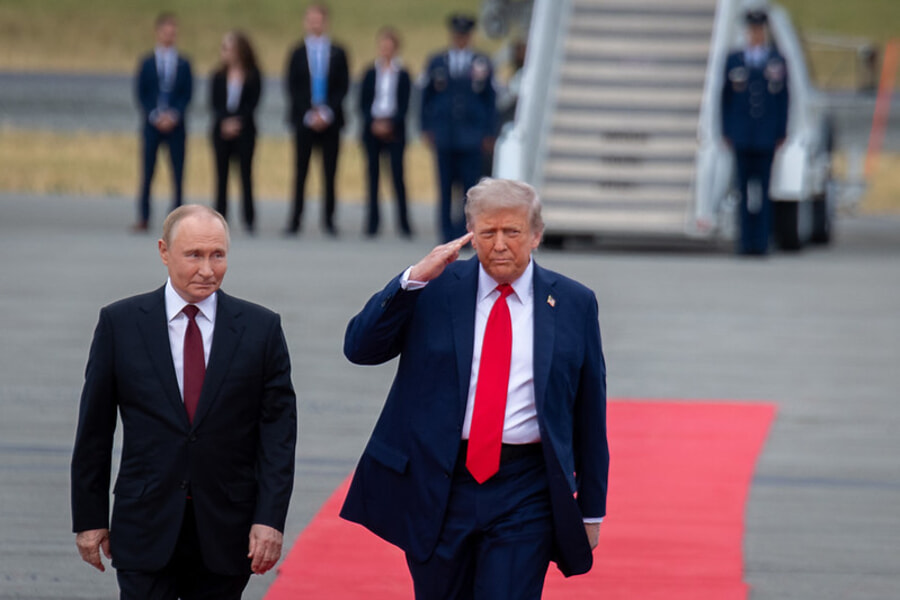
Internationally, America’s traditional commitment to the rule of law has been a significant source of strength. When Vladimir Putin invaded Ukraine, the U.S. was able to rally allies because the violation of the rules-based order was unmistakable. This shared commitment to the rule of law was also essential in building the coalition of the willing to counter Saddam Hussein’s invasion of Kuwait in 1990. In the same way, when Libya downed Pan Am Flight 103 over Lockerbie, Scotland, the U.S. ultimately built a strong multinational sanctions regime aimed at bringing the perpetrators to justice in a court of law.
America’s global leadership on vital national security actions is strongest when based on a clear commitment to the rule of law. That advantage is lost when the United States is perceived as acting—through commission by the executive or legislative branches and/or omission by the courts—without due regard to ensuring compliance with the law.
Courts Are Competent to Review Assertions of National Security Authority
The suggestion that judges lack the expertise to consider issues involving national security is refuted not only by the many cases in which courts have managed to do just that but also by successful institutional structures created by Congress. These include the Foreign Intelligence Surveillance Court and the U.S. Court of Appeals for the Armed Forces, and processes such as the CIPA, in which judges are explicitly responsible for carefully reviewing sensitive national security-related facts.
That said, courts often are reluctant to second-guess national security decisions, given the executive’s access to greater expertise and better information. But if that is the basis for deference, courts can still assess whether the government has in fact relied on that expertise and the factual inferences drawn by the government have a rational basis.
Thus, even in areas ordinarily warranting greater deference, courts need not ignore publicly available and reliable facts. Courts play a central role in determining whether the antecedent facts exist and that they justify the invocation of national security authority. Scrutiny of the executive’s process also can help ensure the determination reflects a genuine assessment of facts and law. If the executive demonstrates a thorough, deliberate, expert-driven process, courts can appropriately afford greater deference. Conversely, opaque, cursory, or pretextual processes justify skepticism. Process failures often signal that considerations other than facts and law drove the decision—considerations less deserving of deference.
Courts are also increasingly willing to look behind the presumption of regularity, which assumes officials act lawfully and in good faith. Available information may justify questioning that presumption, especially if the executive has acted unlawfully or in bad faith in related matters.
Some judges might worry that curbing the unlawful excesses of a single president—perhaps viewed as an anomaly—could lead to precedents that unnecessarily limit future presidents. But judges are experts in crafting holdings that apply narrowly to the facts before them. More importantly, experience suggests that once the breadth of power available through unchecked assertions of national security is revealed, future presidents are likely to follow that path. Courts should recognize that the actions they are being asked to review may not be anomalies but stress tests revealing weaknesses in a system that relies heavily on norms and assumptions of regularity.
* * *
We each took an oath to support and defend the Constitution, understanding that doing so is essential to the nation’s strength. The founders who drafted that Constitution had just fought a war against a tyrannical king. They crafted a system of checks and balances to ensure the young republic would be strong enough to withstand continued threats to its security. Courts should therefore be extremely wary of executive assertions that the defense of the nation requires them to abdicate their constitutional responsibilities.
The work of safeguarding checks and balances belongs to all three branches. The executive branch must faithfully execute laws passed by Congress and comply with orders from the courts. Congress must clarify and enact appropriate guardrails on executive authority through legislation. But the courts have an equally vital role: ensuring that executive action remains within constitutional and statutory limits, even when, and perhaps especially when, national security is invoked.
Nuala has held pivotal leadership positions in government and the nonprofit sector as the first Chief Privacy Officer of the U.S. Department of Homeland Security (DHS) and as President and CEO of the Center for Democracy and Technology.
Nuala holds an A.B. from Princeton University, an M.Ed. from the Harvard Graduate School of Education, and a J.D. from Georgetown University Law Center.