The President Doesn’t Have Unlimited Power to Impose Import Bans
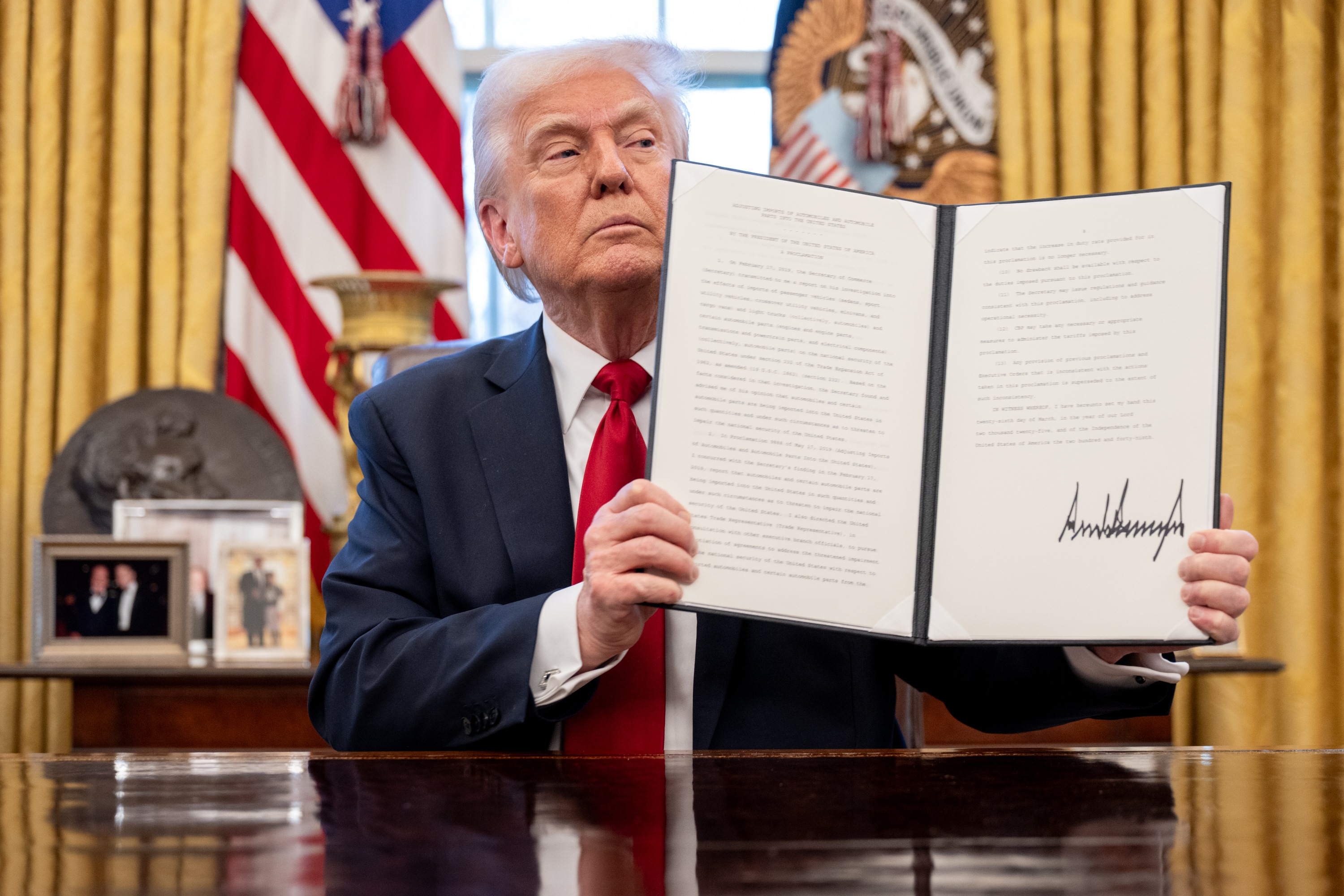

President Trump recently tried to use Section 338 of the notorious Smoot-Hawley Tariff Act of 1930 to ban several categories of Canadian imports outright, as well as to impose tariffs on others. This led some to fear that Trump has discovered a largely unlimited power for the president to restrict imports.
Courts have thus far constrained Trump’s efforts to impose sweeping tariffs, most notably in the Supreme Court’s decision in Learning Resources, Inc. v. Trump (a case I helped litigate), which struck down Trump’s massive imposition of tariffs under the International Emergency Economic Powers Act of 1977 (IEEPA). But perhaps import bans would be different. Trump himself said after the IEEPA decision that “I can destroy the trade. I’m even allowed to impose a foreign country destroying embargo.”
That claim is badly wrong. Like tariffs, import restrictions are a congressional power under the Constitution, not an executive one. Thus, the president cannot impose import bans without congressional authorization. While some statutes delegate import restriction authority to the president, that power is strictly limited. And, as with tariffs, interpreting these authorities in a way that gives the president a blank check to impose import bans would run afoul of the major questions doctrine and constitutional nondelegation.
It remains to be seen whether Trump or a future president might decide to claim sweeping authority to impose import bans at will. But when and if such an effort materializes, courts should strike it down.
The Tariff Precedent
Trump may resort to import bans because courts have so far taken a dim view of his attempts to impose sweeping worldwide tariffs. In Learning Resources, the Supreme Court not only ruled that IEEPA doesn’t authorize tariffs but also emphasized that tariffs are a congressional power, and that the president does not have the power to “impose tariffs on imports from any country, of any product, at any rate, for any amount of time.” Thus, the Court invalidated Trump’s plan to impose 10 percent tariffs against almost all U.S. trading partners and additional supposedly “reciprocal” tariffs on many others.
Significantly, three Supreme Court justices also emphasized that the tariffs run afoul of the major questions doctrine, which requires Congress to “speak clearly” when authorizing the executive to make decisions of “vast economic and political significance.” The two lower court decisions in the case (by the U.S. Court of International Trade and the U.S. Court of Appeals for the Federal Circuit) also relied heavily on the major questions doctrine in striking down the IEEPA tariffs.
The Court of International Trade and Justice Neil Gorsuch (in a Supreme Court concurring opinion) also emphasized that, if the administration’s interpretation of IEEPA was correct, it would violate the constitutional nondelegation doctrine, which constrains delegation of legislative power to the executive. While the limits of the nondelegation doctrine are far from clear, virtually unlimited delegation of a major congressional authority to the executive would violate the doctrine, if anything does.
Later, Trump sought to impose similar tariffs using Section 122 of the Trade Act of 1974. The U.S. Court of International Trade rightly invalidated these tariffs in May (although appellate litigation continues), and they have since expired (Section 122 tariff impositions are limited to 150 days). The court ruled that Trump’s tariffs violate Section 122’s terms and that the administration’s interpretation of the statute would render it unconstitutional under the nondelegation doctrine.
In July, Trump sought to use Section 301 of the same 1974 act to impose tariffs of 10 to 12.5 percent on imports from 60 U.S. trading partners, including Canada, Australia, the nations of the European Union, and others, under the pretext that these countries allow imports of goods using “forced labor,” thereby supposedly burdening U.S. exports. The Section 301 tariffs are also likely illegal, and the U.S. Court of International Trade is currently considering multiple challenges against them.
Most recently, Trump used Section 338 of the Smoot-Hawley Tariff Act of 1930 to impose 50 percent tariffs on some Canadian goods and ban others entirely. No legal challenges have been filed against these actions yet. But these impositions are vulnerable because Section 338 has been superseded by later statutes, because Trump’s tariffs violate the terms of the law, and because the administration’s interpretation of Section 338 runs afoul of the major questions and nondelegation doctrines.
Constitutional Limitations on the Power to Ban Imports
Like the tariff power, the power to impose nontariff import restrictions is a congressional authority, not an executive one. It arises from Congress’s “power to regulate commerce with foreign nations,” enumerated in Article I of the Constitution. The president, by contrast, is not given any independent authority to impose import bans. Thus, import bans—like tariffs—can be imposed only with congressional authorization.
For this reason, executive claims of authority to impose import bans are subject to the same major questions and nondelegation constraints as executive invocations of the tariff power. If the president claims a sweeping power to impose large-scale import bans, it must, under the major questions doctrine, be clear on the face of the statute. And if that power lacks meaningful constraints, it can be invalidated under the nondelegation doctrine. Just as the president lacks the power to “impose tariffs on imports from any country, of any product, at any rate, for any amount of time,” he also doesn’t have the power to impose bans on imports from any country, of any product, for any amount of time. In last year’s decision in Federal Communications Commission v. Consumers’ Research held that delegations of the power to impose taxes and other similar levies must have a clear floor and ceiling and that “[t]he guidance needed is greater when an agency action will affect the entire national economy than when it addresses a narrow, technical issue.” Delegations of the power to impose import bans should be subject to comparable constraint.
In one key respect, sweeping executive power to impose import bans is even more problematic than a similar power over tariffs. Tariffs still allow continued importation of covered goods, even if at a much higher price. By contrast, import bans forbid it entirely, thereby inflicting even greater suffering on consumers, investors, and others. This further strengthens the case for applying the same constitutional constraints to executive import bans as those that restrict executive imposition of tariffs.
Limited Nature of Statutes That Might Authorize Import Bans
A number of federal laws might potentially authorize import bans in some situations. But all are limited in nature. None give the president sweeping authority to ban any imports he wants.
IEEPA may provide the broadest such authority. Although, as the Supreme Court ruled, the act does not authorize imposition of tariffs, it does empower the president to “regulate” or “prohibit” importation of goods. But, like other authorities granted by IEEPA, the law makes clear that these can be used only to “deal with any unusual and extraordinary threat, which has its source in whole or substantial part outside the United States, to the national security, foreign policy, or economy of the United States, if the President declares a national emergency with respect to such threat.”
There is nothing “unusual,” “extraordinary,” or threatening about the vast majority of imports to the United States. Such imports are commonplace, happen routinely, and pose no threat. To the contrary, basic Economics 101 shows that international trade is generally beneficial: The U.S. buys goods from other countries that they produce better or more cheaply than we can, freeing our own productive capacity for tasks at which we have a comparative advantage. At the very least, no extraordinary or unusual threat is posed by imports from liberal democratic allies such as Canada, Australia, and the nations of the European Union, which Trump has repeatedly tried to impose tariffs against (and, in the case of Canada, now also import bans).
In the IEEPA tariff litigation, we and other plaintiffs argued that trade deficits (cited by Trump as the rationale for his “Liberation Day” tariffs) did not pose any unusual and extraordinary threat, and that the tariffs did not “deal with” the supposed threat of fentanyl imports (used as a rationale for tariffs against Canada, Mexico, and China). The Court of International Trade based its decision against the fentanyl tariffs in part on that basis. The Supreme Court did not address these issues because it ruled that IEEPA does not allow tariffs at all.
IEEPA has previously been used to impose narrowly targeted import bans, usually against authoritarian adversaries of the United States. But if Trump were to use IEEPA to impose sweeping import bans, including against U.S. allies, courts should not simply defer to the administration’s claims that the imports in question pose some threat. That would conflict with the statutory text, and convert an emergency power intended for use only in extreme situations into a blank check for the executive. It would also run afoul of the major questions doctrine. A sweeping power to impose import bans at will would undeniably be a major question. And it is, at the very least, far from clear that IEEPA’s text requires such deference. A virtually unlimited executive import-ban power would also violate the constitutional nondelegation doctrine.
Section 338 also has an import-ban provision. But it applies only if the president concludes that a trading partner hit with initial Section 338 tariffs in response to its own discriminatory trade restrictions has “maintained or increased” those discriminatory policies. Thus, any import ban imposed under this statute is legal only if the initial Section 338 tariffs the ban is supposed to reinforce were themselves legal. Those targeting Canada are not, and therefore Trump’s follow-up import ban is also illegal. In addition, as previously noted, there is a strong case that Section 338 has been superseded by later laws and is therefore defunct.
More generally, as with IEEPA, turning Section 338 into a blank check for tariffs and follow-up import bans would run afoul of the major questions and nondelegation doctrines. It is far from clear that Section 338 grants such sweeping authority (or even remains in effect at all). And if it did grant such power, it would create a constitutional nondelegation problem.
Other statutes that can potentially be used to impose import bans raise similar issues. They, too, are limited in nature, and attempts to turn them into a blank check for executive-imposed import restrictions would similarly violate the major questions and nondelegation doctrines.
Section 301, for example, authorizes “duties or other import restrictions,” but only when the U.S. trade representative concludes, after an investigation, that “an act, policy, or practice of a foreign country is unreasonable or discriminatory and burdens or restricts United States commerce.” Attempts to turn this into a blank check for import restrictions are vulnerable to all the same objections as the administration’s effort to turn Section 301 into a blank check to impose tariffs. As I have detailed in an article and an amicus brief in the current Section 301 litigation (filed on behalf of the Cato Institute, prominent executive power scholar Michael McConnell, and myself), these include a variety of problems under the text of the statute, plus major questions and nondelegation issues.
Section 232 of the Trade Expansion Act of 1962 allows presidents to, among other things, “adjust” imports of articles when necessary to protect national security. Some presidents have used this provision to impose import bans against adversaries such as Iran. But, once again, this is not a general grant of power to impose bans. In its 1976 ruling in Federal Energy Administration v. Algonquin SNG, Inc., the Supreme Court emphasized that the executive discretion granted by this provision is “far from unbounded” and that any such blank check would violate constitutional constraints on delegation. Today, such an interpretation of Section 232 would also violate the major questions doctrine (mostly developed by the Supreme Court in more recent years).
Section 232 has been abused before, such as when Trump used it in October 2025 to impose tariffs on imported upholstered furniture and kitchen cabinets on the pretext that such products somehow threaten national security. Courts should crack down on such shenanigans. Lower courts have sometimes been overly deferential to presidential invocations of national security threats under Section 232. But Section 232 is not a blank check for protectionism, and current Supreme Court precedent does not require courts to allow it to become such.
Other laws allow imposition of import bans on goods from specified countries, such as those that support terrorism, those that use chemical or biological weapons, and those subject to relevant United Nations Security Council sanctions. But these and other similar laws apply to only a narrow range of states, and any attempt to turn them into a blank check for executive import bans (for example, through bogus, unsupported claims that trading partners support terrorism even if they don’t actually do so) would be at odds with the statutory text and also raise major questions and nondelegation problems.
The president can, of course, use some of these statutes to impose relatively narrow, targeted import bans. And such tools have been used against U.S. adversaries, such as Iran and Soviet bloc nations during the Cold War. But that does not mean they can serve as the basis for Trump’s massive campaign of worldwide protectionism.
It is also possible the administration will find some little-used or superseded statute, as they have attempted with Section 338 and Section 122 (a provision never previously used, because it was supposed to be utilized in conditions that can arise only under a fixed exchange rate monetary system of a kind the United States has not had since 1973). But such efforts will be subject to legal challenge and cannot justify any sort of sweeping executive import-ban power.
Courts cannot prevent all dubious import bans and restrictions. Elsewhere, I have outlined how and why we need stronger congressional constraints on various emergency powers, including IEEPA. Among other things, Congress would do well to limit “national emergencies” and other similar invocations of extraordinary powers by setting strict time limits. But even existing legislation sets extensive constraints on executive-imposed import restrictions. And if it did not, it would violate the nondelegation doctrine.
In sum, import bans are not some magic wand the president can use to constrain trade at will. They are subject to most of the same kinds of legal restrictions as tariffs. Courts should rigorously enforce those constraints if Trump or a future president decides to use import bans as a tool for a massive executive-driven trade war.