The Situation: Our Closest Ally Compares Us To The Soviets
Reading Prime Minister Carney’s Davos speech carefully
The Situation on Tuesday reflected on the president’s derangement.
Today, let’s consider some of the consequences of the president’s derangement.
In a historic speech to the South African parliament in 1960, British Prime Minister Harold Macmillan described how decolonization and independence was blowing like a “wind of change” through the African continent.
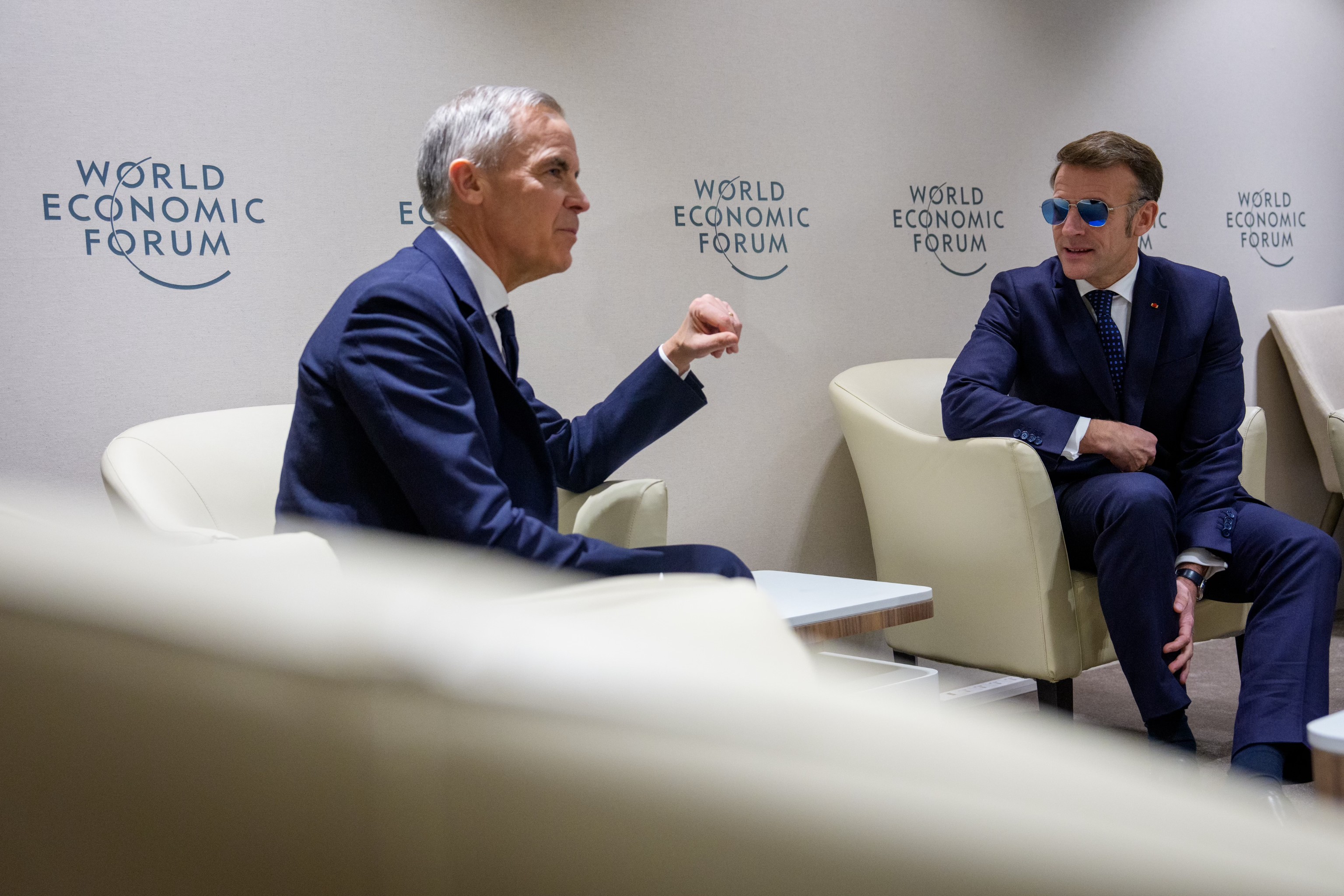
This week at the World Economic Forum in Davos, Canadian Prime Minister Mark Carney delivered a historic “wind of change” speech of his own—a revolutionary, anti-American speech—which received a standing ovation from a decidedly non-revolutionary, non-anti-American crowd. Carney’s wind is surely of the gale force variety. And to be clear, both its revolutionary and anti-American character are wholly justified.
You should watch the speech in full if you haven’t done so already.
Let us start by stating a plain simple fact: The leader of America’s closest ally has given a public speech in which his two key reference points for the United States of America are Thucydides's Melian Dialogue and Czech dissident Václav Havel, who later became president of a post-Communist Czechoslovakia.
“Today I will talk about a rupture in the world order, the end of a pleasant fiction and the beginning of a harsh reality, where geopolitics, where the large, main power, geopolitics, is submitted to no limits, no constraints,” Carney begins in French, as is often customary for Anglophone Canadian prime ministers.
Switching back to English for the duration, Carney observes that every day brings a reminder of Thucydides’ aphorism, that “we live in an era of great power rivalry, that the rules based order is fading, that the strong can do what they can, and the weak must suffer what they must.” Faced with this brutal anarchic logic of international relations, Carney says, “there is a strong tendency for countries to go along to get along, to accommodate, to avoid trouble, to hope that compliance will buy safety.” The prime minister then offers a spoiler alert: “Well, it won’t.”
For those whose Thucydides is rusty, the Melian Dialogue is a section of the Greek historian’s famous book on the Peloponnesian War, in which the powerful Athenians—who are, by the way, destined to lose the war—confront recalcitrance in response to their demands from the much-less-powerful island of Melos. The dialogue is foundational in the world of realpolitik, famous for the Athenian statement that “right, as the world goes, is only in question between equals in power, while the strong do what they can and the weak suffer what they must.”
This is how our closest ally now talks about us—in public, in the most famous address he is likely ever to give. What is the “pleasant fiction” of which the “rupture in the world order” signals the “end”? Here Carney adopts a bracing level of candor with the crowd of world leaders. The pleasant fiction is that America presides over a benign international order:
For decades, countries like Canada prospered under what we called the rules-based international order. We joined its institutions, we praised its principles, we benefited from its predictability. And because of that, we could pursue values-based foreign policies under its protection.
We knew the story of the international rules-based order was partially false that the strongest would exempt themselves when convenient, that trade rules were enforced asymmetrically. And we knew that international law applied with varying rigour depending on the identity of the accused or the victim.
This fiction was useful, and American hegemony, in particular, helped provide public goods, open sea lanes, a stable financial system, collective security and support for frameworks for resolving disputes.
So, we placed the sign in the window. We participated in the rituals, and we largely avoided calling out the gaps between rhetoric and reality.
This bargain no longer works. Let me be direct. We are in the midst of a rupture, not a transition.
Carney here is saying the quiet part out loud. Trumpism, or MAGA—as well as its cousins overseas—is not some aberration. It is irrevocably altering the world order, and only the proverbial ostrich with its head in the sand can continue to pretend that American hegemony is the benign force it has mostly been in the modern era. That is the first blunt truth our closest ally—with whom we share a 5,525 mile border, the longest in the world, all of it undefended—just announced to the world: The world is a state of nature, and the United States is just the biggest bully on the block.
So, in this state of nature that we all have to admit defines global politics, what’s a middle power to do?
For guidance, Carney here turns to Havel, which is in and of itself a depressing fact. Havel, after all, was a creature of the pax americana—a deep believer in what we used to call American values. He was an anti-communist dissident who believed in things this country used to represent: freedom of speech, anti-authoritarianism, limits on government power over human souls. Recall that when Havel came to power after the Berlin Wall came down, he befriended Frank Zappa—whom he later eulogized in the pages of the New Yorker—in Prague: “for those who refused to be swept aside by persecution—who tried to remain true to a culture of their own—Western rock was far more than just a form of music.”
This was America to Havel. But it is not that America for which Carney now cites Havel with reference to us.
What work is Havel doing in Carney’s speech? We are the Communist Party, the oppressor. And the middle power country—let’s call it Canada—is the protagonist of Havel’s famous allegory of the greengrocer who, living under an oppressive communist regime, places a “workers of the world unite” sign in his window every day. Here’s how Havel described it. An extended quotation is justified to emphasize just what Carney is deploying Havel to say about us:
The manager of a fruit-and-vegetable shop places in his window, among the onions and carrots, the slogan: "Workers of the world, unite!" Why does he do it? What is he trying to communicate to the world? Is he genuinely enthusiastic about the idea of unity among the workers of the world? Is his enthusiasm so great that he feels an irrepressible impulse to acquaint the public with his ideals? Has he really given more than a moment's thought to how such a unification might occur and what it would mean?
I think it can safely be assumed that the overwhelming majority of shopkeepers never think about the slogans they put in their windows, nor do they use them to express their real opinions. That poster was delivered to our greengrocer from the enterprise headquarters along with the onions and carrots. He put them all into the window simply because it has been done that way for years, because everyone does it, and because that is the way it has to be. If he were to refuse, there could be trouble. He could be reproached for not having the proper decoration in his window; someone might even accuse him of disloyalty. He does it because these things must be done if one is to get along in life. It is one of the thousands of details that guarantee him a relatively tranquil life "in harmony with society," as they say.
Obviously the greengrocer is indifferent to the semantic content of the slogan on exhibit; he does not put the slogan in his window from any personal desire to acquaint the public with the ideal it expresses. This, of course, does not mean that his action has no motive or significance at all, or that the slogan communicates nothing to anyone. The slogan is really a sign, and as such it contains a subliminal but very definite message. Verbally, it might be expressed this way: "I, the greengrocer XY, live here and I know what I must do. I behave in the manner expected of me. I can be depended upon and am beyond reproach. I am obedient and therefore I have the right to be left in peace." This message, of course, has an addressee: it is directed above, to the greengrocer's superior, and at the same time it is a shield that protects the greengrocer from potential informers. The slogan's real meaning, therefore, is rooted firmly in the greengrocer's existence. It reflects his vital interests. But what are those vital interests?
Let us take note: if the greengrocer had been instructed to display the slogan "I am afraid and therefore unquestioningly obedient;' he would not be nearly as indifferent to its semantics, even though the statement would reflect the truth. The greengrocer would be embarrassed and ashamed to put such an unequivocal statement of his own degradation in the shop window, and quite naturally so, for he is a human being and thus has a sense of his own dignity. To overcome this complication, his expression of loyalty must take the form of a sign which, at least on its textual surface, indicates a level of disinterested conviction. It must allow the greengrocer to say, "What's wrong with the workers of the world uniting?" Thus the sign helps the greengrocer to conceal from himself the low foundations of his obedience, at the same time concealing the low foundations of power. It hides them behind the facade of something high. And that something is ideology.
The system persists, not through violence but through, as Carney puts it, “the participation of ordinary people in rituals they privately know to be false.” This, in Havel’s words, is “living within the lie.”
In case the allegorical meaning escaped the Davos attendees or anyone doubts that Carney is comparing the United States to the Communist Party of the Eastern bloc, Carney declares: “Friends, it is time for companies and countries to take their signs down.”
Despite the theme of this year’s meeting being "A Spirit of Dialogue"—which sounds either ironic or inanely aspirational, depending on how dark one’s sense of humor is—the World Economic Forum is often characterized as an elite echo chamber, rather than a forum of frank exchange on the world’s most existential crises. Yes, there are exceptions, like when Dutch historian Rutger Bregman pointed out the uncomfortable fact that thousands of private jets carrying the world’s wealthiest individuals had descended on a Swiss ski town for a panel on income inequality. But that moment went viral precisely because it was an anomaly.
Carney’s speech is something different. It is not a dig at Davos. It is not a dig at his audience. It is a declaration of a set of truths—a declaration that follows ineluctably from a protracted period of presidential derangement and the failure of the American political system to either restrain such derangement or to choose non-deranged alternatives.
What changed exactly? Carney delivers a diagnosis:
Over the past two decades, a series of crises in finance, health, energy and geopolitics have laid bare the risks of extreme global integration. But more recently, great powers have begun using economic integration as weapons, tariffs as leverage, financial infrastructure as coercion, supply chains as vulnerabilities to be exploited.
You cannot live within the lie of mutual benefit through integration, when integration becomes the source of your subordination.
The multilateral institutions on which the middle powers have relied—the WTO, the UN, the COP—the architecture, the very architecture of collective problem solving are under threat. And as a result, many countries are drawing the same conclusions that they must develop greater strategic autonomy, in energy, food, critical minerals, in finance and supply chains.
He then offers an apocalyptic vision of where all this leads: a “world of fortresses,” one that is “poorer, more fragile and less sustainable,” and one in which countries are forced to engage in transactional “risk management.”
Canada and other middle powers thus stand at a kind of crossroads: “whether we adapt by simply building higher walls, or whether we can do something more ambitious.”
Unsurprisingly, Carney suggests the latter road, one of “value-based realism,” to use a term coined by Finnish President Alexander Stubb, both “principled and pragmatic.” This path forward means “engaging broadly, strategically with open eyes,” “calibrating” Canada’s relationships, and “prioritizing broad engagement to maximize our influence, given and given the fluidity of the world at the moment, the risks that this poses and the stakes for what comes next.” Carney’s former colleagues in banking and finance might call this hedging.
To be sure, he is not entirely rebuilding Canadian foreign policy from the ground up. At least some planks of the old world seem to him worth saving: an unwavering commitment to NATO’s Article 5, support for Denmark’s sovereignty over Greenland, and an active role in Ukraine’s coalition of the willing. But on trade and even some aspects of national security, Carney says Canada is “rapidly diversifying,” including an agreement for “a comprehensive strategic partnership with the EU, including joining SAFE, the European defence procurement arrangements” and “12 other trade and security deals on four continents in six months.” In just the past few days, Carney says, Canada forged “new strategic partnerships with China and Qatar” and is negotiating free trade pacts with India, ASEAN, Thailand, Philippines and Mercosur. Conspicuously absent from this list of partners new and old, of course, is the United States.
In his rallying cry for “building coalitions that work—issue by issue, with partners who share enough common ground to act together,” the former central banker is calling for a kind of solidarity. Instead of “Middle powers of the world, unite!” he opts for a more moderate slogan: “middle powers must act together, because if we're not at the table, we're on the menu."
A year into the Trump administration, it’s not clear that the United States is still at that table, despite having built it. Because the United States too is at a crossroads: Do we want to preside over the destruction of the architecture we built—one from which we benefit so thoroughly? Do we really want to be the biggest bully in the state of nature? Do we want to be the Soviet Communist Party?
Of course not. That would be deranged.
And yet, The Situation continues tomorrow.