The Situation: We Agree


The Situation on Tuesday looked back at a nearly-month-old court opinion that contains multitudes.
That same day, Jan. 6, the White House released a document entitled, “January 6: A Date Which Will Live in Infamy.”
The document is designed to enrage people who might have considered Jan. 6 an insurrectionary riot designed to overturn the legitimate results of an election President Trump had lost.
But we refuse to be baited.
Responding with rage, fact-checking, or protesting this document all seem counterproductive. Rage merely gives the president the response he wants. Fact-checking implies that there is some factual mediation to engage in between truth and falsehood—a premise fit only for dilettantes. And protestations? Well, those and a few bucks will get you a cup of coffee.
So in the spirit of national reconciliation and putting the past behind us all, we’ve decided not to call out any of the mendacity in this document but to focus only on our areas of agreement with the White House’s outrageous account of Jan. 6.
As it turns out, we agree with the White House on a lot. We’ve detailed our concurrences in the following annotations:
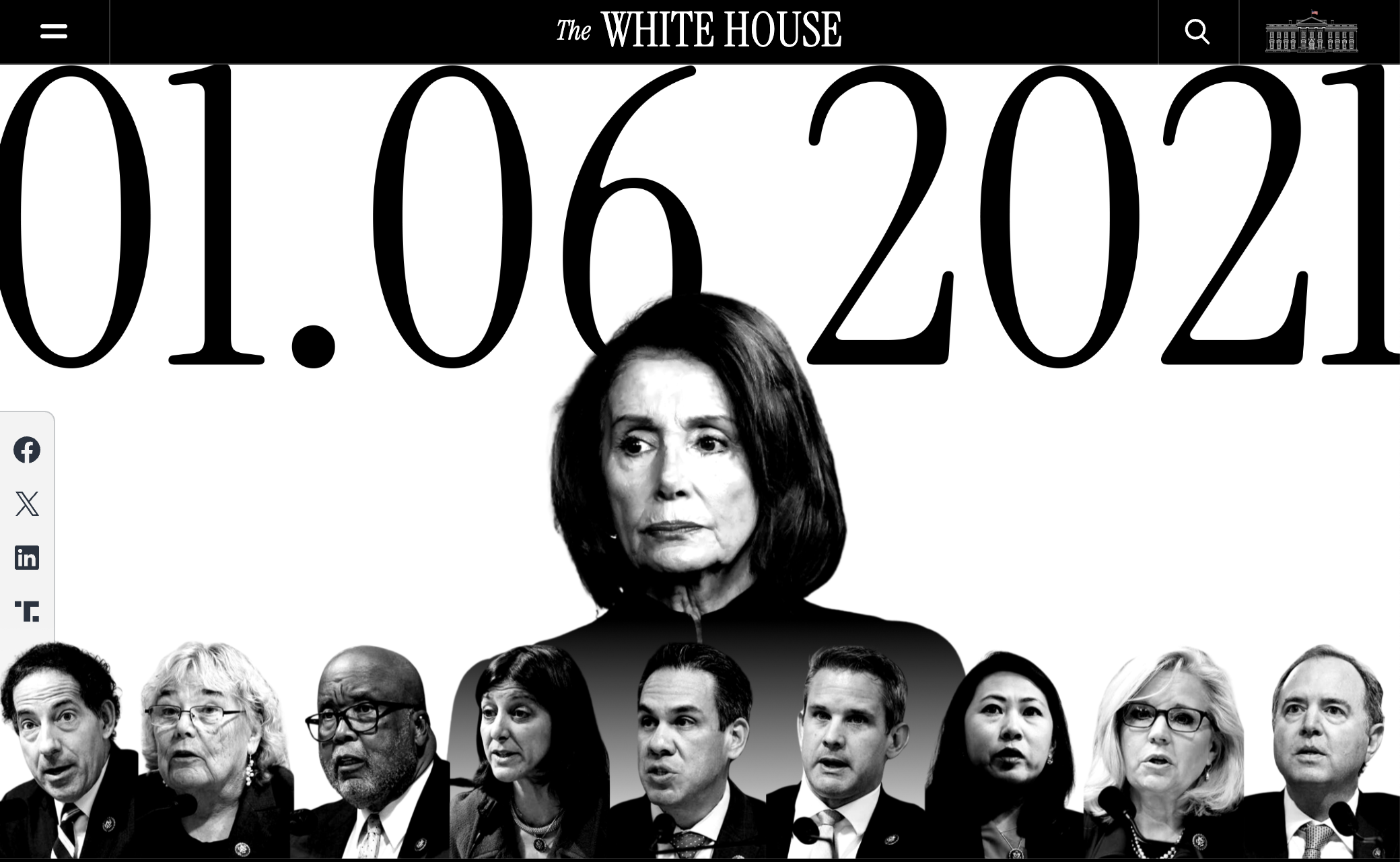
Let’s start with the title: “A Date Which Will Live in Infamy.”
Yep. Seems appropriate. No notes.
Not sure why the image shakes every three seconds, but whatevs.
Speaking of the image, none of the people featured in this picture montage actually took part in the Jan. 6 mob. Most prominently, the page features Rep. Nancy Pelosi (D-Calif.), who was speaker of the House of Representatives at the time of the attack. Her office was ransacked by rioters while her staff hid under a table in a barricaded room. The other figures in the image are all members of the House Select Committee to Investigate the Jan. 6 Attack on the U.S. Capitol. The Jan. 6 Committee held ten live-televised public hearings, completed an 18-month investigation into the attack, and published an 814-page final report.
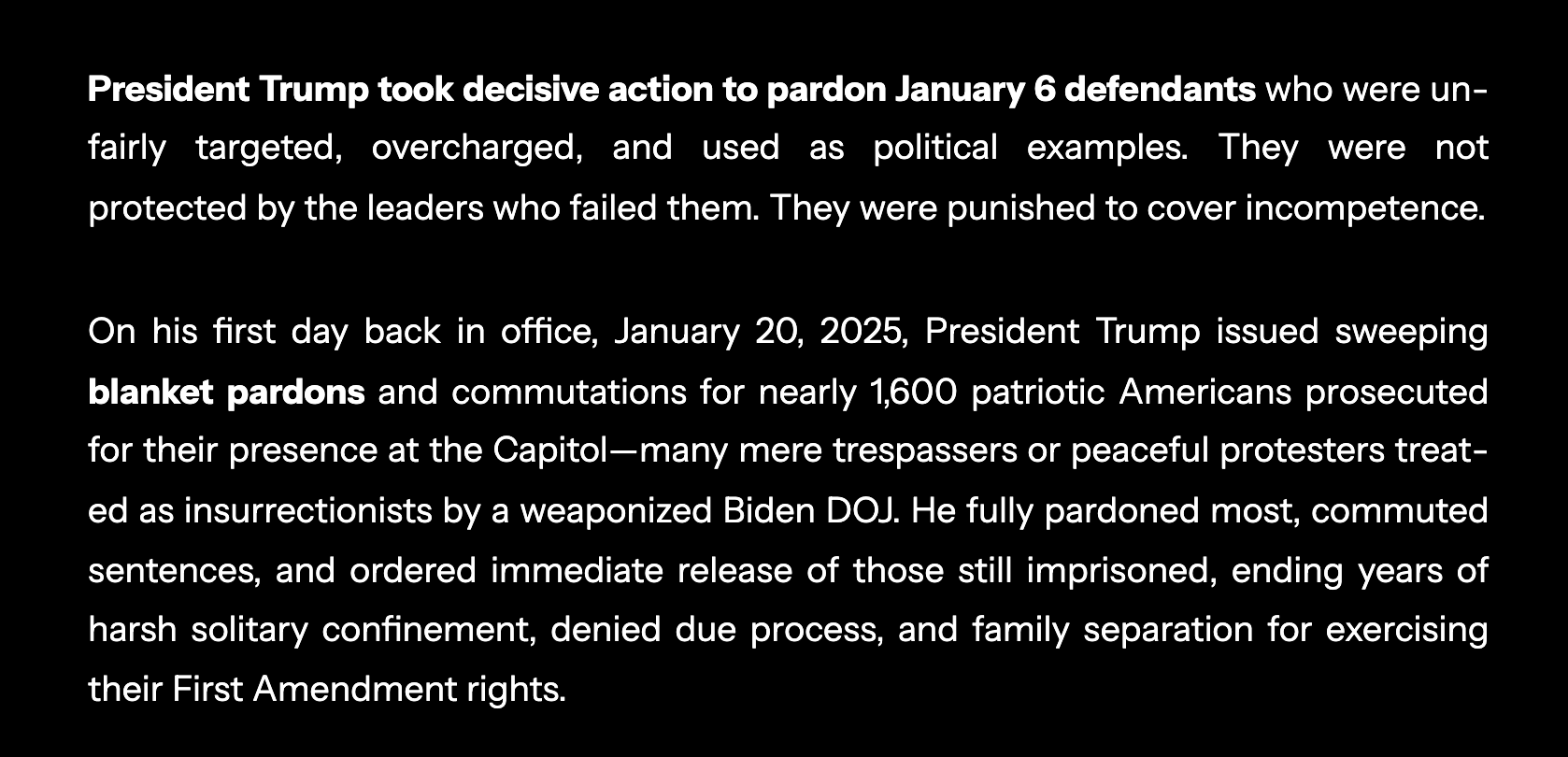
Fully agree. President Trump certainly did take decisive action to pardon more than 1,500 people for their crimes connected to Jan. 6.
Whether these individuals were unfairly targeted, overcharged, or used as political examples we—in the spirit of not dwelling on divisive questions—will leave to the reader to decide. Let’s just all agree that members of Congress who found their offices ransacked and were forced to flee the House floor in gas masks will likely feel differently on this question from, say, the frustrated Trump voter who bought into the notion that his candidate had an election stolen out from under him.
The White House also states that “they” were not protected by the leaders who failed them—and that’s clearly right too. It was, after all, Trump who summoned the mob, encouraged its lawless activity, and then only belatedly told people to go home. It was, after all, under Trump himself that the manhunt for Jan. 6 perpetrators began. And it was Trump who left office without pardoning a single Jan. 6 perpetrator, leaving them all to face justice.
This statement is also true if we interpret “they,” a little atextually, to refer to the various officers who were hospitalized as a result of injuries they sustained while warding off thousands of rioters. “They” were failed by the president who refused to take action for 187 minutes while a violent assault on the Capitol was taking place in his name. “They” were also punished because of the incompetence of a leader who told his angry supporters to “fight like hell” and then neglected to stop them for more than three hours while he watched them smash windows and assault Capitol police officers.
We also agree that more than 1,500 pardons covered people for their “presence” at the Capitol—though “presence” doesn’t seem like quite the right word here. The better word would be “crimes.” Presence, after all, does not require a pardon.
The White House contends that many of those pardoned were “mere trespassers or peaceful protestors treated as insurrectionists by a weaponized Biden DOJ.”
And yes, it was, in fact, the Justice Department under the Biden administration that handled the prosecutions—though justice for the Jan. 6 perpetrators began even in the 14 days between the insurrection and Biden’s inauguration.
The White House’s description of “mere trespassers” is also correct—at least for a lot of people. Most of these defendants were indeed trespassing—in violation of 18 U.S.C. § 1752. And a bunch of them were convicted of no more than trespassing. Couy Griffin, for example, was trespassing when he breached the boundary of the Capitol established to restrict public access and remained behind that boundary for approximately two hours.
But that word “mere” is a tricky one here. Because, say, Dominic Pezzola, was also trespassing when he gained entry to the Capitol building. But was he merely trespassing? He got in by smashing a window with a stolen Capitol Police shield and then smoked a cigar inside the building. He called it “victory smoke.” Many other people were merely trespassing while merely committing violent felonies.
The White House is also correct in claiming that these defendants were treated as insurrectionists. They did, after all, try to obstruct the peaceful transfer of power from one administration to the next. Many of them did call for the public hanging of the vice president. And many assaulted police officers and destroyed government property. Many brought guns and other weapons and organized an attack plan. Fourteen were convicted or pleaded guilty to seditious conspiracy—a felony “akin to treason” with a maximum penalty of 20 years. So, yes. They were “treated” as insurrectionists.
The Trump administration’s claim that they were “denied due process” appears to be a reference to the fact that some defendants were held without bail. This is, well, a bit of a stretch. These were those defendants such as Kyle Fitzsimons, who were deemed by the courts to be at high risk of obstructing justice, flight, or posing a danger to the community. In fact, even some accused (and later convicted) of violent crimes were released from pretrial and held in home detention or ordered to wear an ankle monitor; consider the case of Richard Barnett, for example. But let’s not dwell on points where we can’t agree.
We also appreciate the delicious irony of the Trump White House’s pride in its ending of “family separation.” Guy Reffitt’s son—who turned his father in and has spent much of the last five years in hiding because of death threats—was “terrified” about his father’s release, and even purchased a firearm to protect himself. Family separation isn’t always the worst thing in the world when dealing with family members who are violent felons.
Meanwhile, the administration has continued its separation of thousands of migrant families.

We agree. It’s all Nancy Pelosi’s fault. All of it.
No doubt, thousands of Americans did pay the price for the “political failures” they did not create.
And yes, Congress did create a select committee to investigate and respond to the attack. The bipartisan select committee—established by House resolution after the Senate’s failure to pass a bill establishing a bipartisan national commission—conducted an 18 month investigation. It was tasked with unraveling a massive cluster of evidence and argumentation about that day, all while the Justice Department conducted its own investigations and prosecutions of thousands of rioters—and ultimately the former president. It issued hundreds of subpoenas as well as records and interview requests. And yep, that cost some money, as congressional investigations tend to do.
The White House is also correct that the committee’s presentation of its findings to the public was a scripted spectacle. We’ll even add that these hearings aired at times designed to obtain maximum viewership.
The committee, after spending time and money investigating and litigating issues surrounding Jan. 6 and its aftermath, needed to clearly and efficiently present its findings to the American public. And the scripted, visually interesting hearing with blockbuster testimony did exactly what it was intended to do: capture the attention of the American public—at least briefly.
The footage featured on the White House page features Pelosi questioning why the National Guard had not been deployed at the Capitol before the attack even began. In the video, and as highlighted in bold on the White House’s Jan. 6 page, a seemingly frustrated Pelosi exclaims “I take responsibility for not having them just prepare for more.”
For context, rioters began their assault on the Capitol police just before 1:00 p.m. The National Guard did not arrive on the scene to assist Capitol police and D.C.’s Metropolitan Police Department until 5:40 p.m.—after the riot had been mostly subdued.
According to the New York Times and transcribed interviews with the House Administration Committee, the hourslong delay in the National Guard’s deployment was largely due to a miscommunication between then-Defense Secretary Christopher C. Miller and then-Secretary of the Army Ryan D. McCarthy. After a “critical conversation” the day of the Capitol riot both men, as the Times put it, left “with a different understanding of how quickly the Guard would be deployed—and who would give word that it was authorized.”
Over the course of four hours, McCarthy, Miller, and other high level Trump administration officials dodged phone calls, dragged their feet on deploying the Guard in fear of “bad optics,” and incorrectly assumed that the official order had already been handed down. It was not until 5:09 p.m. that evening, that the Army chief of staff—who happened to pass by Gen. William Walker, then commander of the D.C. Guard, waiting on a teleconference call—gave Gen. Walker the official go ahead to deploy the Guard to the Capitol. It’s a disappointing and, frankly, embarrassing story for the U.S. military.
But there is a central figure who could have—despite the miscommunications and lethargy—bypassed the military chain of command and significantly expedited the National Guard’s deployment to aid terrified officers who so badly needed assistance. If President Trump had the courage to pick up the phone and give the order, rather than watching the attack unfold on his television, the Guard could have mobilized hours earlier. Pelosi, in her capacity as then-speaker of the House, had no authority to deploy the National Guard to the Capitol. Only the president, the defense secretary, and the secretary of the Army had that power.
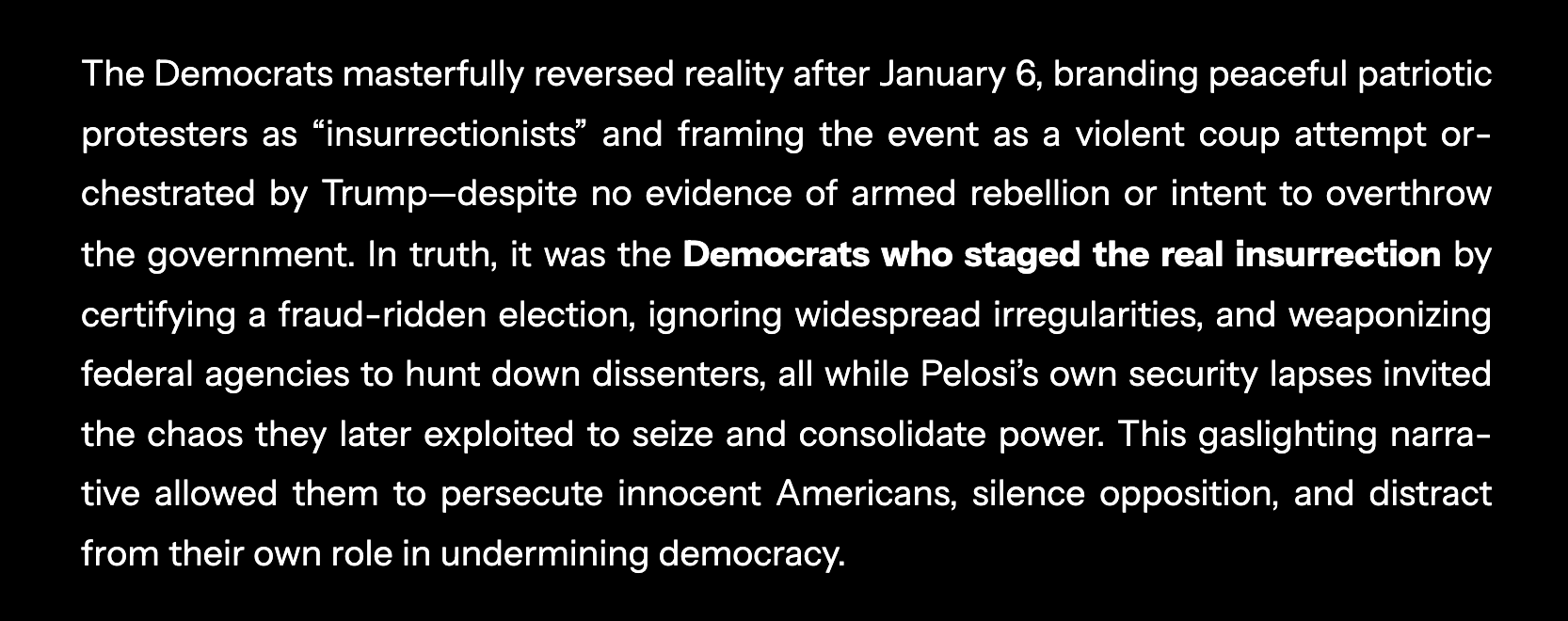
Okay, this one stretches our capacity to be agreeable. But we’ll do what we can: Yes, there is a significant “gaslighting narrative” being pushed by senior government officials.
* * *
The White House’s page also displays a timeline featuring its version of events that day. Let’s see what we can agree with in that timeline:
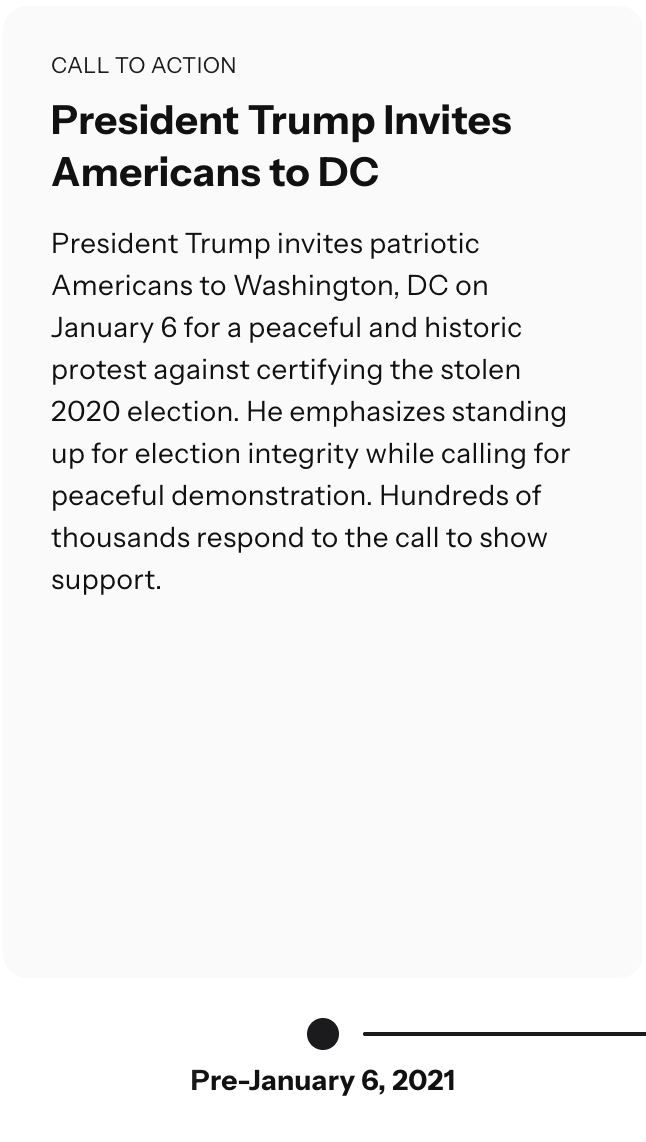
Trump did invite Americans to D.C. More specifically, at 1:42 a.m. on Dec. 19, 2020, sharing a report by Peter Navarro claiming to have found election fraud that could swing the election results in Trump’s favor, he tweeted, “Big protest in D.C. on January 6th. Be there, will be wild!”
Whether “will be wild” screams “peaceful” is a matter about which reasonable Americans may have differences.
But yes, hundreds of thousands of people did respond to the call, including on the TheDonald.win message board, as the Jan. 6 Committee report summarized: “Trump Tweet. Daddy Says Be In DC on Jan. 6th” wrote one user. Others discussed, “surrounding and occupying the U.S. Capitol; cutting off access tunnels used by Members of Congress; the types of weapons they should bring; and even how to build a hangman’s gallows.”
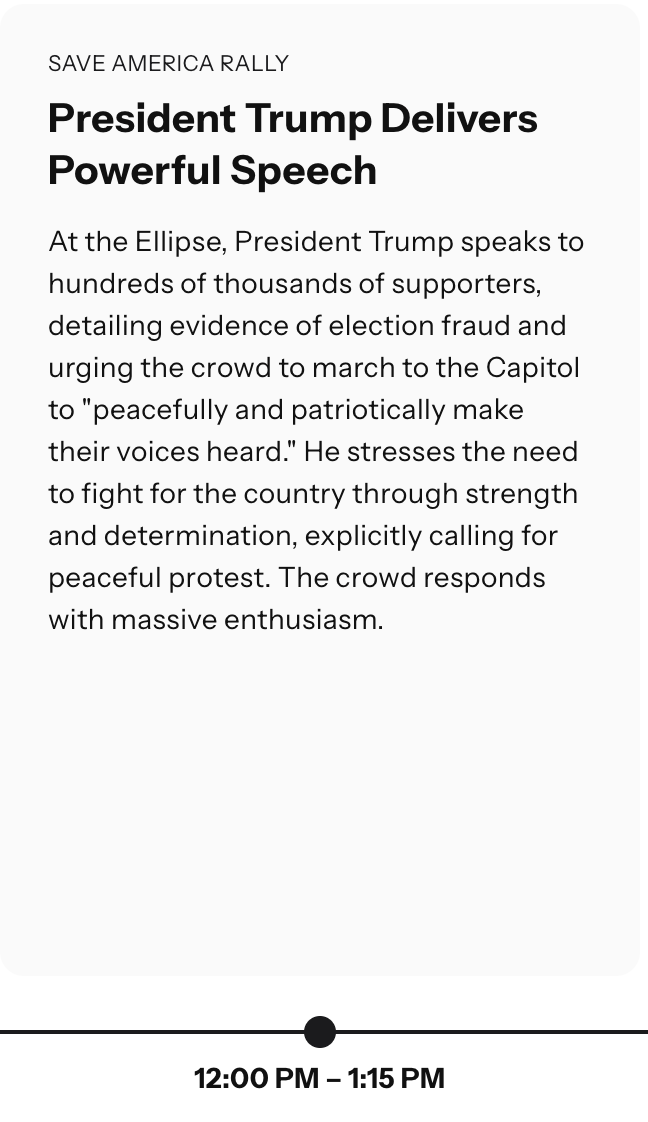
Trump did, indeed, deliver a powerful speech about election fraud.
And he did, indeed, urge followers to march to the Capitol and mention the word “peacefully.”
Indeed, his speech was so powerful that it triggered the mob’s descent upon the Capitol. The timeline does not bother to mention certain other features of President Trump's speech: his call for his supporters to “fight like hell,” most notably. “And we fight. We fight like hell,” he said to the crowd at the Ellipse. “And if you don’t fight like hell, you’re not going to have a country anymore.”
The timeline also doesn’t mention that Trump then directed his supporters to “walk down Pennsylvania Avenue” to the Capitol to try and give Republicans “the kind of pride of boldness that they need to take back our country.”
But yes, he did mention the word “peacefully”—twice even.
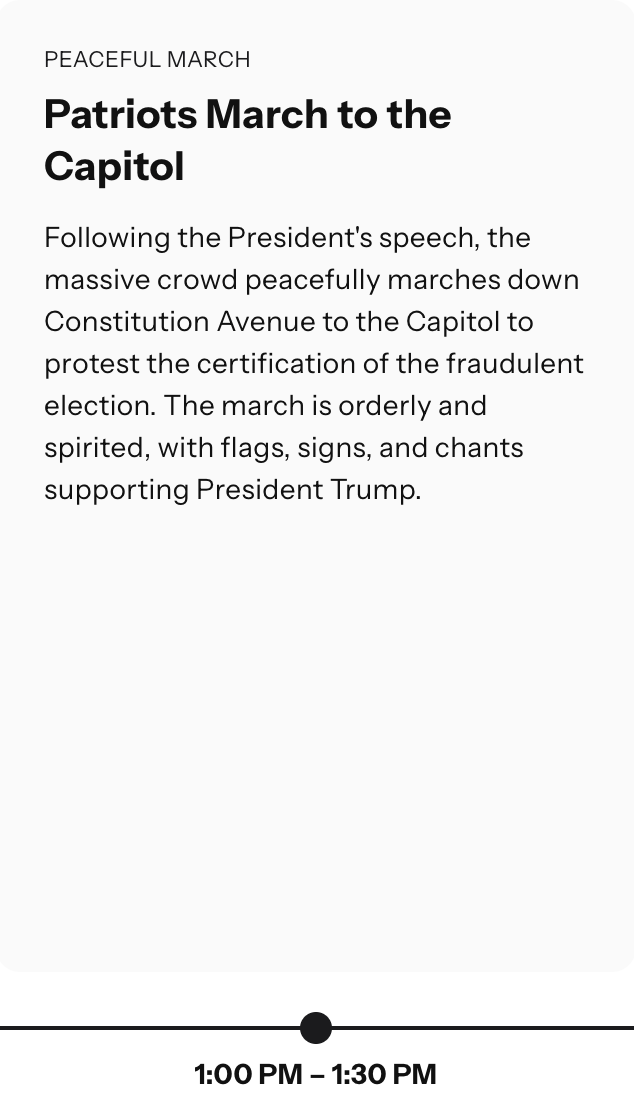
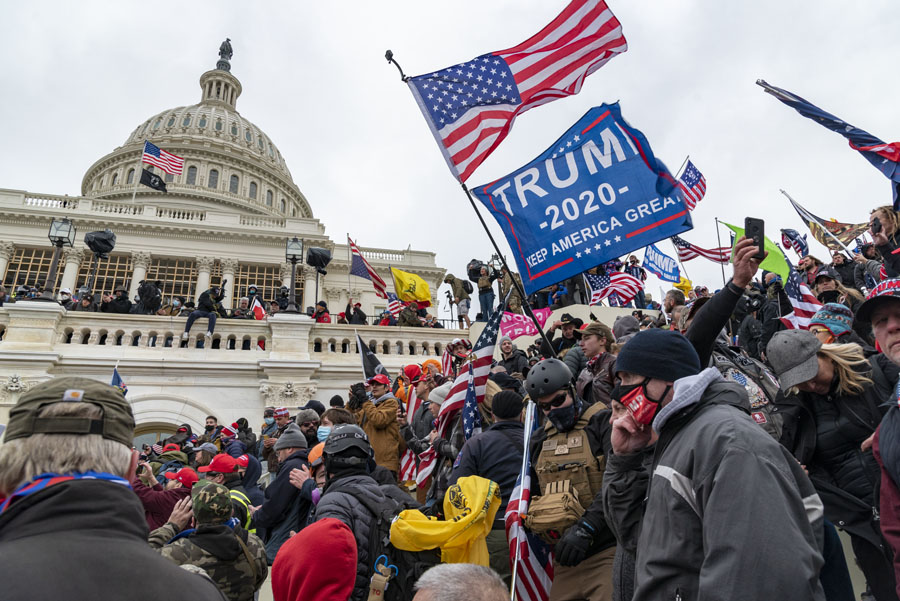
This is quite true. Some of Trump’s supporters indeed marched down to the Capitol building in an orderly fashion. Some were so orderly that they were already there. Members of the Proud Boys, for example, toppled the first set of barriers to the building in a systematic and organized fashion—beginning right around the time President Trump finished speaking. According to testimony by former White House aide Cassidy Hutchinson, the Secret Service alerted top White House staffers that police lines were collapsing at the Capitol around 1:00 p.m.
One person who didn’t march to the Capitol in an orderly fashion was Trump himself, though he promised marchers that he would be there with them. This plan, however, was thwarted by the Secret Service, who insisted on bringing him back to the White House. Trump arrived back at the White House at 1:19 p.m., and six minutes later settled in a private dining room where he watched the events of the day unfold on Fox News.
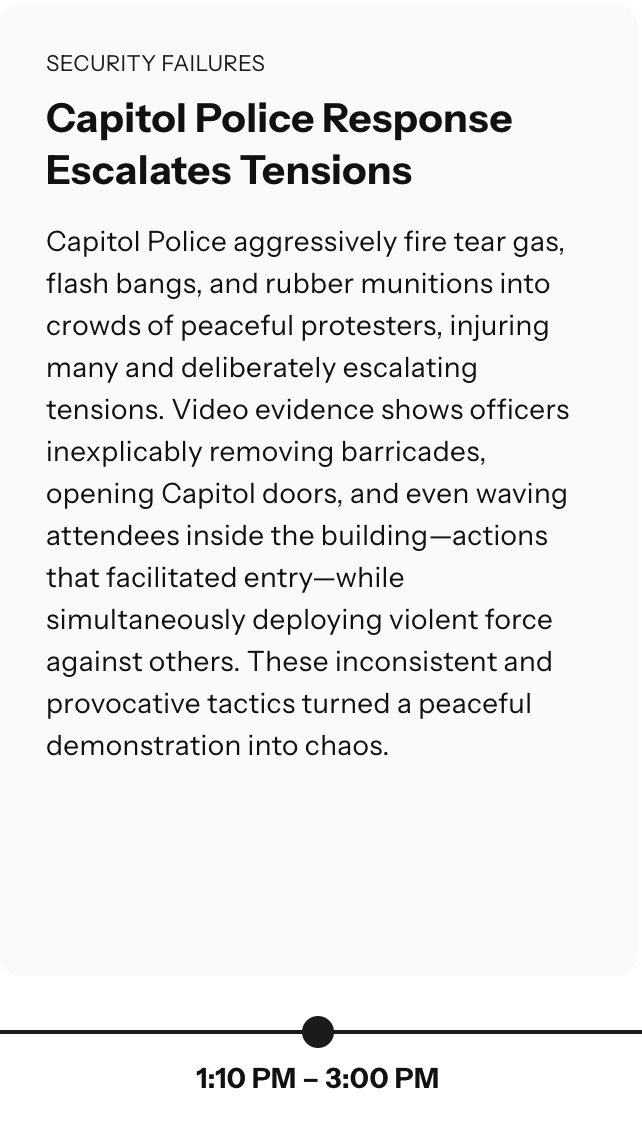
This one is tough to find points of agreement with. We’re trying, in the spirit of national reconciliation, to understand where Trumpworld is coming from. Really. But we’re having trouble seeing how Capitol Police officers such as Caroline Edwards—who was the first officer to be injured by the Jan. 6 mob—incited the violence they suffered from. According to Edwards’s testimony before the Jan. 6 Committee, she was slammed to the ground by protestors who breached a barrier at the Peace Circle on Capitol grounds. She was knocked unconscious and when she regained consciousness she saw “officers on the ground. They were bleeding, they were throwing up…I saw friends with blood all over their faces, I was slipping in people’s blood. It was carnage, it was chaos.” There are dozens of stories similar to that of Edwards’s—including that of Daniel Hodges, who was punched, kicked, beaten with his own riot baton, crushed with a police shield, and almost had his eyes gouged out.
Almost.
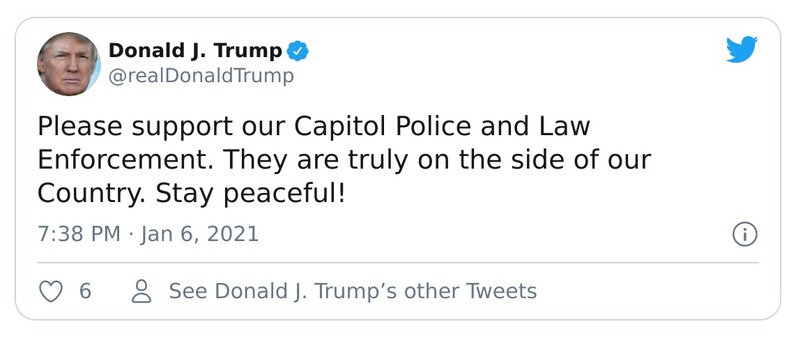
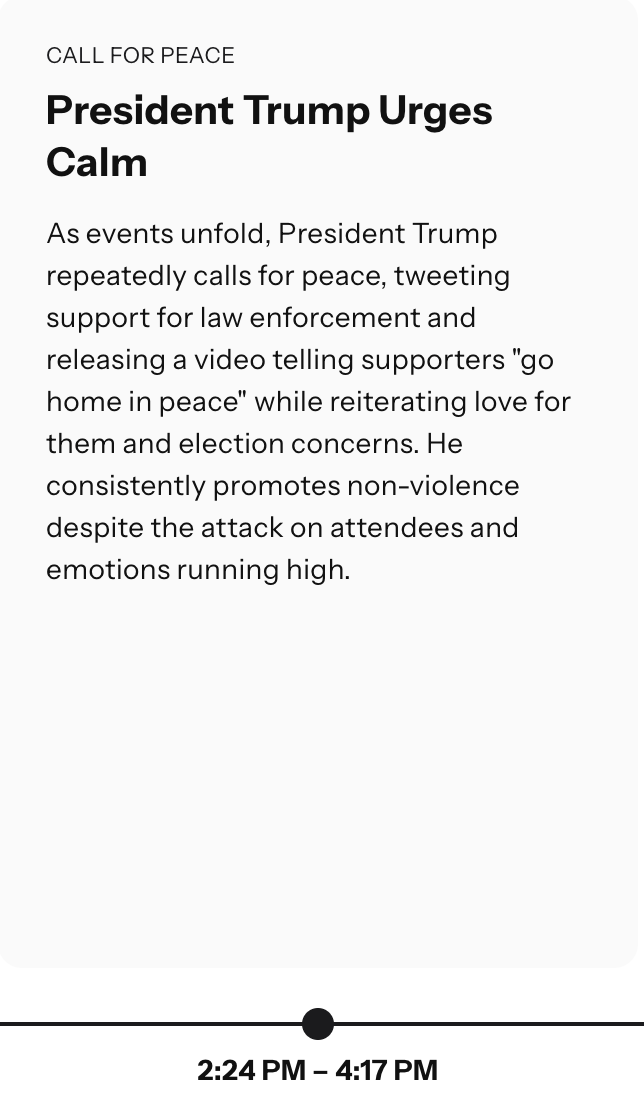
At 2:38 p.m.—amid the ongoing violent attack—Trump tweeted that rioters should “stay peaceful” and to support Capitol Police and law enforcement, but he didn't tell the protesters to leave the Capitol grounds. Meanwhile, Trump’s aides and allies were begging the president to tell his supporters to go home.
Trump didn't tweet again until 3:13 p.m., in which he asked everyone at the Capitol to “remain peaceful” and “respect the Law and our great men and women in Blue.” But still, he did not tell his supporters to go home.
It wasn’t until almost an hour later, and with more pleading from aides and allies, that Trump tweeted out a video telling rioters, “You have to go home now. We want to have peace.”
So yeah, “consistently promotes non-violence” may be a wee bit of an overstatement. But it is true that when Trump belatedly tweeted after hours of inaction, and when he wasn’t encouraging the mob, he did say words encouraging people to stay peaceful and that he ultimately asked people to go home.
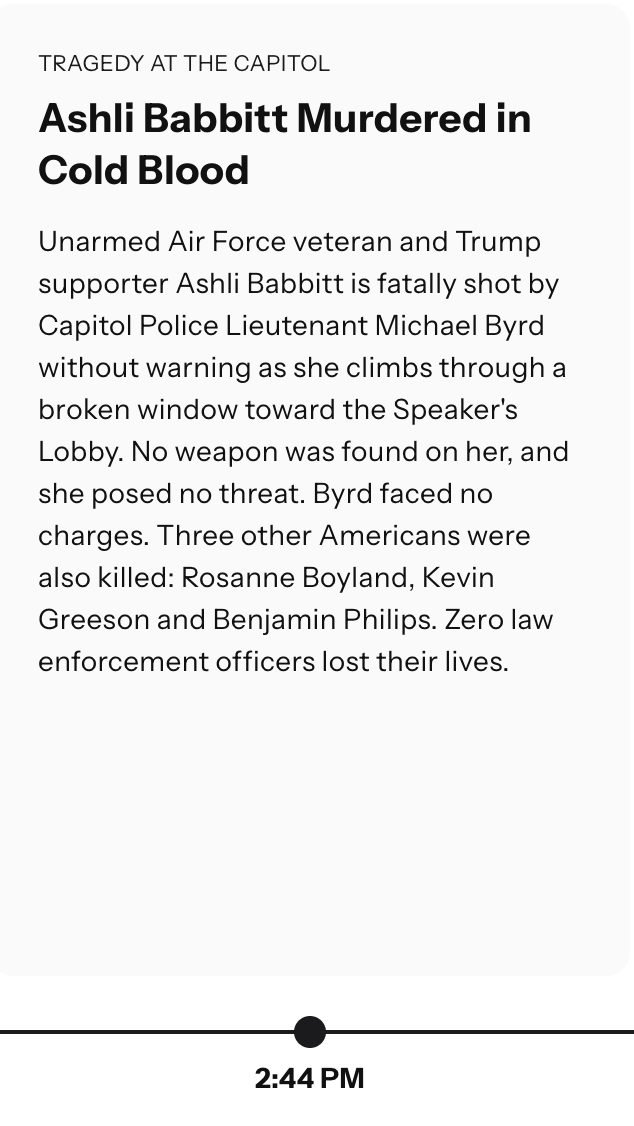
Ashli Babbitt’s death and the other deaths that occurred as a result of the attack are indeed tragedies, though the other people whose deaths the White House names were not killed by law enforcement. One was trampled by rioters. One had a stroke. And one had a heart attack.
Moreover, the White House’s timeline neglects to mention some facts surrounding the circumstances of Babbitt’s death, facts that some Americans might find significant. After a horde of rioters made their way toward the House chamber, Lt. Michael Byrd found himself responsible for the protection of 60-80 House members and staffers who were barricaded inside the House chamber. Rioters, including Babbit, descended upon the House chamber, breaking the windows on the doors that stood between the mob and congressional members and staffers. Byrd—with limited vision as a result of the barricaded furniture on his side of the door—repeatedly yelled for the crowd to get back. Still, Babbit climbed through the broken glass. Byrd then fired a single shot—the first time he had shot his weapon in 28 years on the force. He acted both in self-defense and in defense of the members of Congress and others in the House chamber she was in the process of breaching. Babbitt succumbed to her injuries.
It is also not quite accurate to say that “zero law enforcement officers lost their lives” as a result of the attacks. While it is true that no officers died on the scene, any number were injured, some seriously. And the White House’s website leaves out the names of five police officers who served at the Capitol on Jan. 6 who also died in the days and weeks after the riot. This list includes Brian D. Sicknick, who after being attacked by rioters died of stroke, as well as Jeffrey Smith, Howard S. Liebengood, Gunther Hashida, and Kyle DeFreytag, who all died by suicide in the period following the attack.
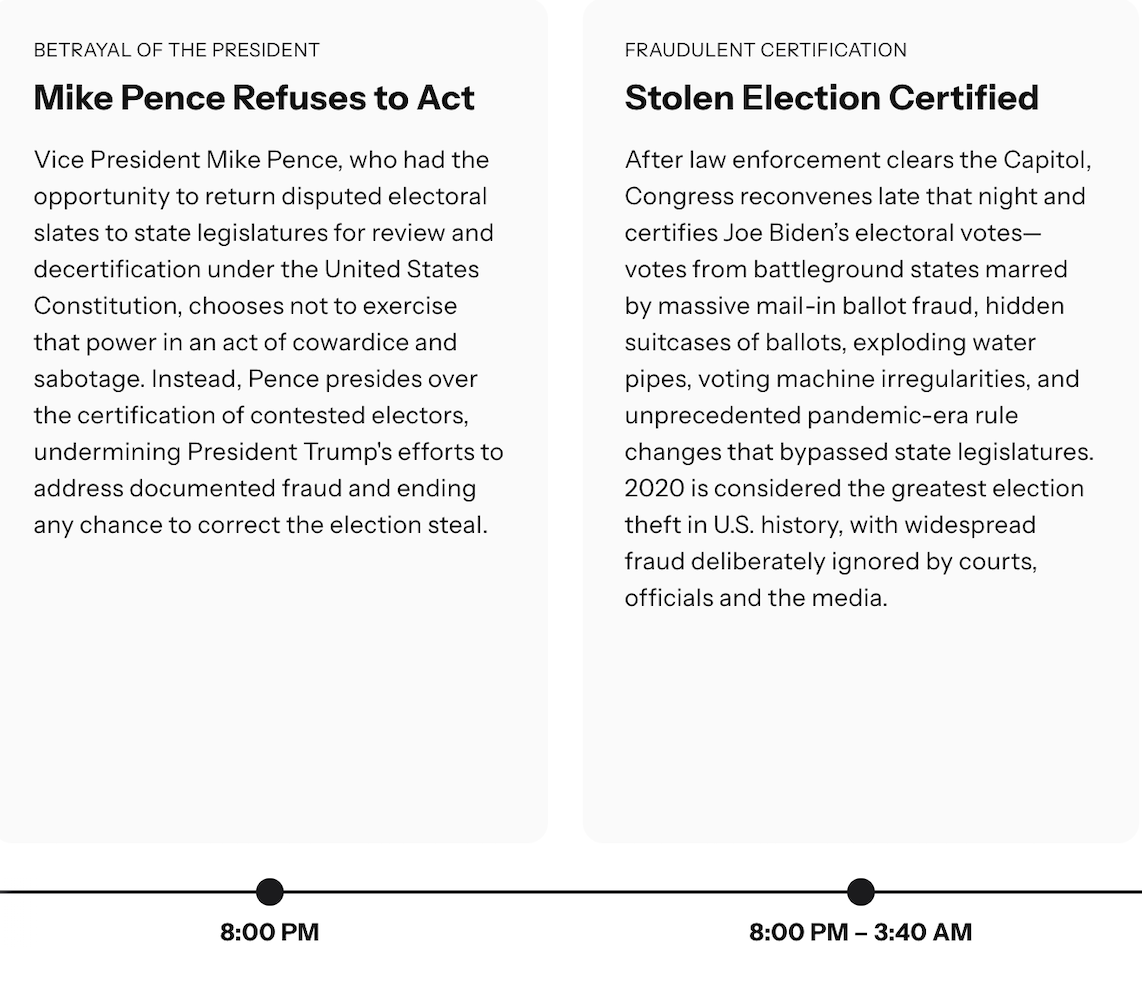
Mike Pence choosing his oath of office over President Trump? Check. Refusal to certify fraudulent slates of state electors? Check. Abiding by the Constitution and the will of the American people? Check.
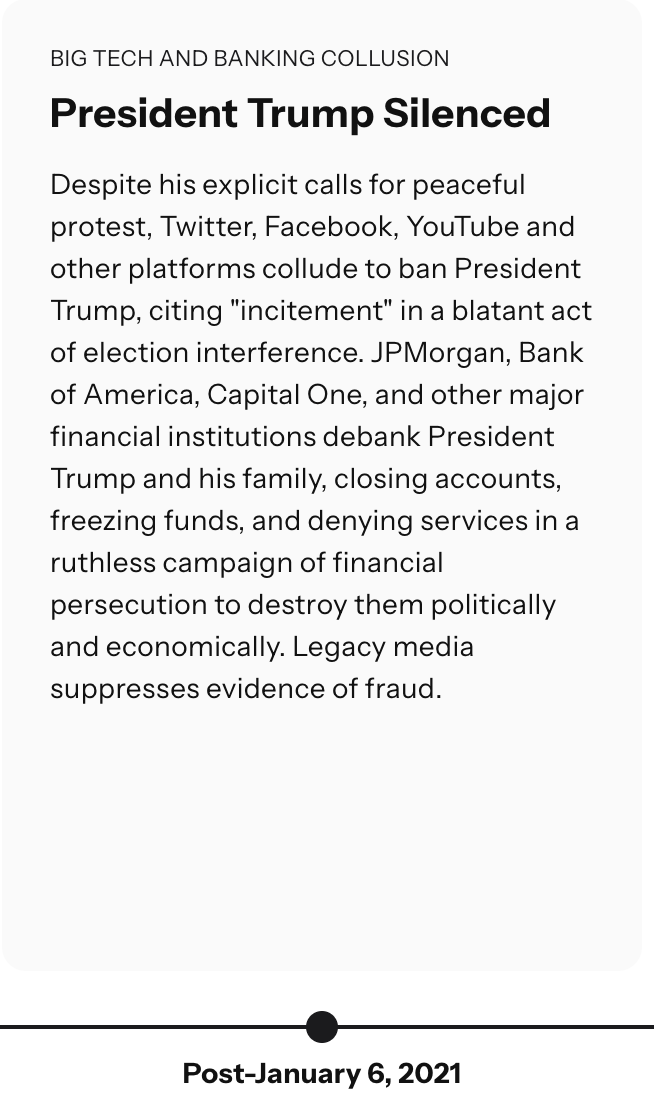
All true. President Trump was silenced. That’s why you didn’t hear from him for so long.
After he incited the insurrection, spent hours refusing to condemn the angry mob of his supporters, attempted to overturn the results of a free and fair election, and violated all of the social media companies’ terms of service, those social media companies decided they no longer wanted to give the president a platform.
It didn’t last. Trump’s accounts were reinstated on various platforms, and the various tech CEOs have spent the last few years cozying up to Trump. In any event, Trump has his own popular social media platform now. Why “post” when you can “truth”?
Like social media platforms, the banks mentioned on the White House’s Jan. 6 page terminated their business with Trump and his organizations. Other banks refused to conduct business with the Trump Organization as well. Despite the fact that, according to the Times, “no legal right to a bank account exists,” Trump issued an executive order to address this seemingly personal gripe, to ensure that "politicized or unlawful debanking is not used as a tool” to inhibit the beliefs, affiliations, or political views of Americans.
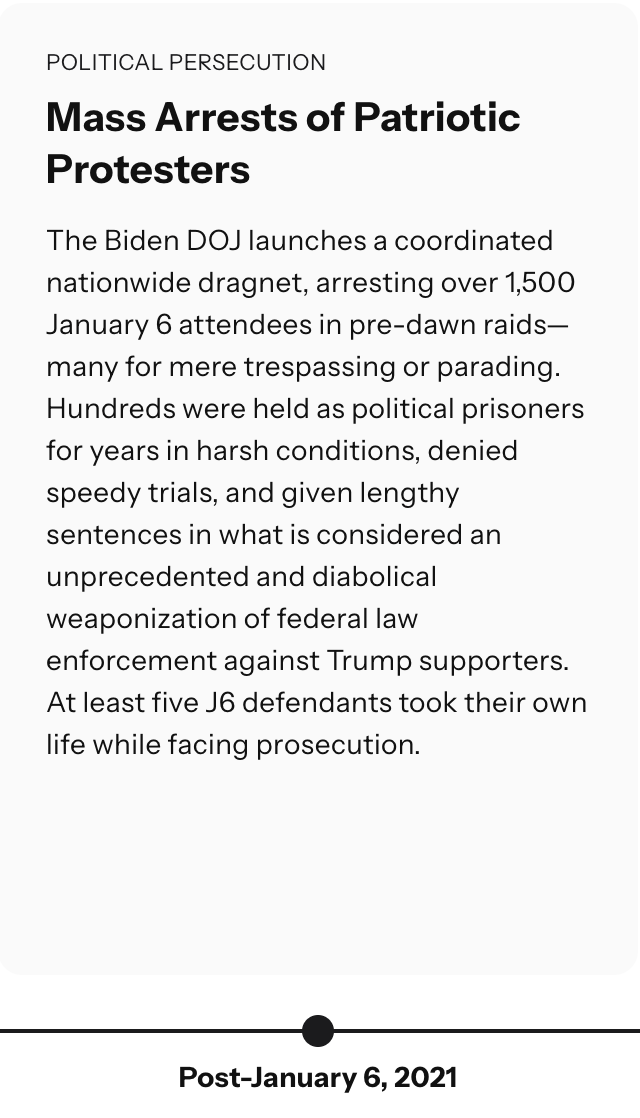
We are in total agreement here. After the mass violent attack on the Capitol building and the attempt to block the certification of the election going on within it, the Justice Department began investigating, arresting, and prosecuting the perpetrators. Interestingly, it was actually the “Trump DOJ” that launched the first arrests of Jan. 6 attendees. Guy Reffit, for example, was arrested just 10 days after the riot—a few days before President Biden took office. The White House makes much of the fact that “hundreds” were held for “years,” but the median sentence for convicted rioters was approximately 60 days in prison—owing to the fact that a great many of the Jan. 6 insurrectionists were, in fact, “merely” convicted of trespassing.
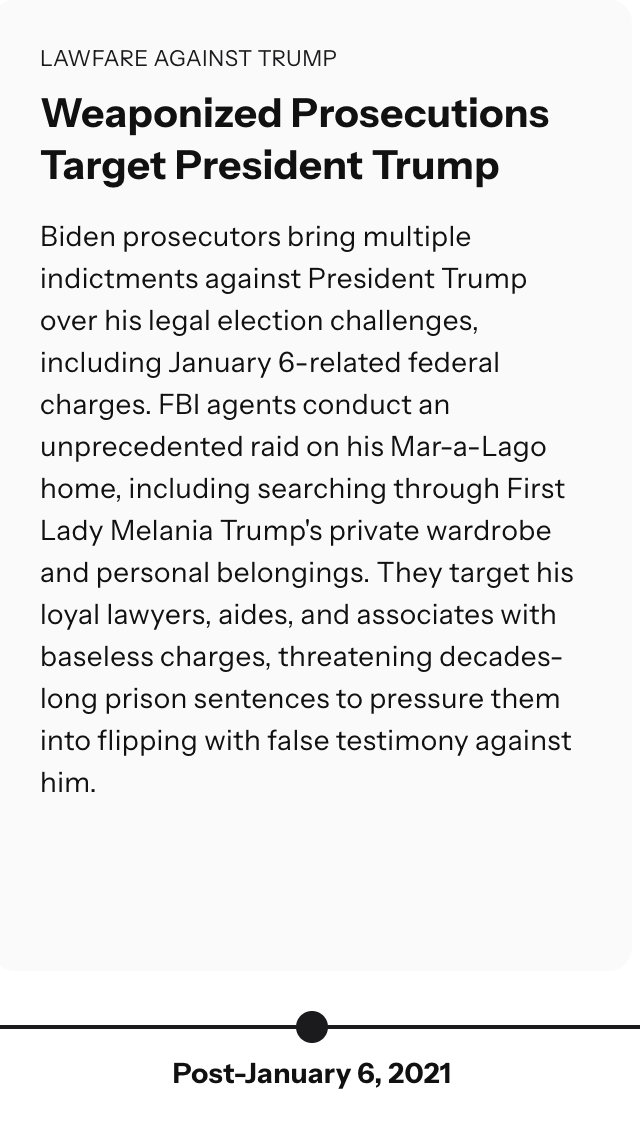
Correct. After two lengthy investigations conducted by Special Counsel Jack Smith, the Justice Department brought two indictments against former President Trump. The first, in the Southern District of Florida, related to the alleged mishandling of classified documents at Mar-a-Lago. And yes, the FBI did indeed conduct an unprecedented raid at Trump’s Mar-a-Lago, and it did find classified documents improperly stored in a shower, a ballroom, and elsewhere. The second indictment came down in the District of Columbia for Trump’s alleged attempts to subvert the results of the 2020 election on and around Jan. 6. And let’s not forget, Trump was also indicted by a grand jury in Fulton County, Georgia for his alleged attempt to overturn election results in the state, and convicted on 34 counts of falsifying business records in New York.
Whether any or all of this reflects “weaponized” prosecution or the fact that Trump in fact committed a lot of crimes is a question we’ll leave for another day.
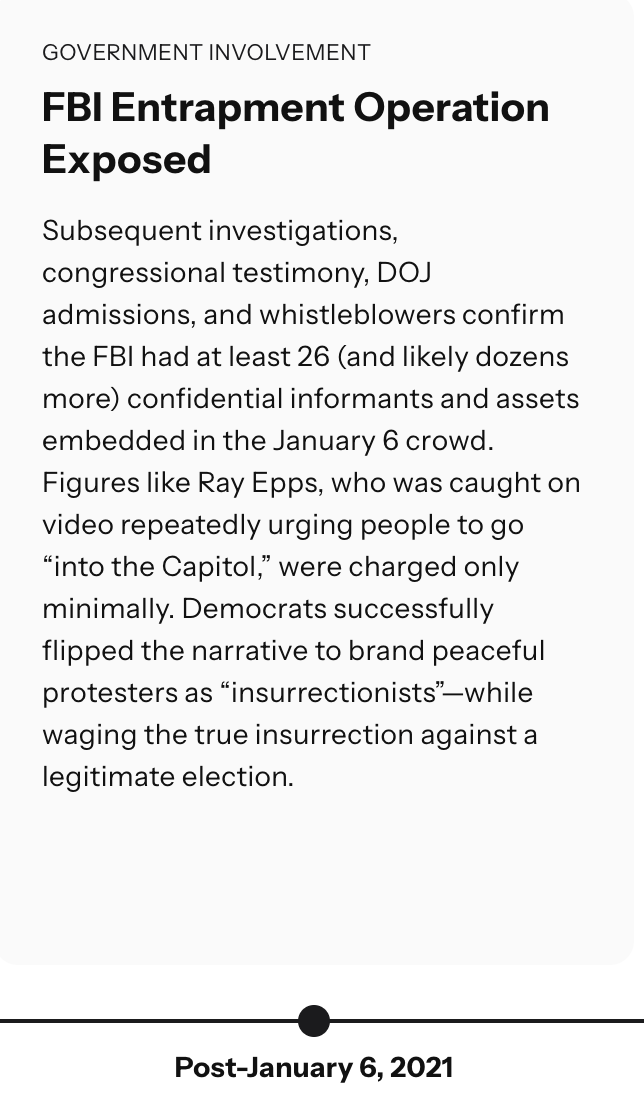
Ray Epps, a Jan. 6 rioter, did indeed go to prison for his role in the Jan. 6 attack. But that is all Epps is in this context: a Jan. 6 rioter. He was not, as the White House suggests but does not quite say here, a covert government agent planted to instigate the Jan. 6 attack.
Further, the Justice Department Inspector General Michael Horowitz concluded in his review of the FBI’s handling of the leadup to Jan. 6 that there was “no evidence . . . showing or suggesting that the FBI had undercover employees in the various protest crowds, or at the Capitol, on January 6.” It is true that 26 FBI confidential human sources were in Washington in connection with the Jan. 6 protests, some of whom ended up in the Capitol.
Here, of course, we have to disagree: Lawfare never fails.
The Situation continues tomorrow.