Trafficking in Israel’s War Crimes in a Midtown Manhattan Synagogue
Participation in the promotion of land sales in the occupied Palestinian territories violates the Geneva Conventions and may be a war crime.
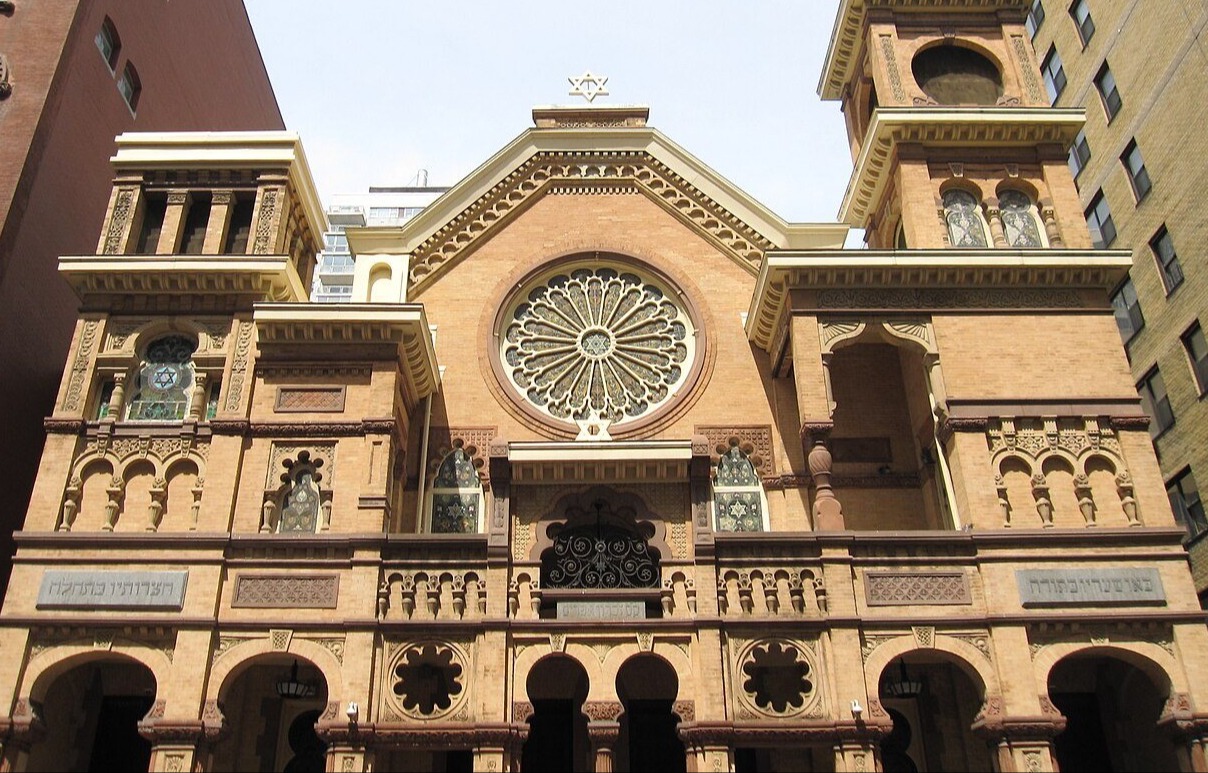

Several synagogues in the United States, the United Kingdom, and Canada have hosted real estate fairs promoting land sales in the occupied Palestinian territories. In May, the Park East Synagogue in Manhattan hosted its second “Great Israeli Real Estate Event” put on by the “My Home in Israel” real estate consortium. Properties up for sale reportedly included those in Israeli settlements in the West Bank.
Apart from the legality of Israel’s occupation of the West Bank, these settlements have been widely adjudicated and criticized as unlawful, by the International Court of Justice, the UN Security Council, the International Committee of the Red Cross, the legal adviser to Israel’s own Ministry of Foreign Affairs, the U.S. State Department, and over 160 civil society groups, including Human Rights Watch, Amnesty International, and several Israeli human rights organizations.
These real estate events do more than facilitate the Israeli war crime of transferring one’s own civilian population into occupied territory; some of them may also violate U.S. and state anti-discrimination laws by excluding non-Jews through “a firewall of attendance registration requirements” that demand the name of the applicant’s own synagogue and rabbi. These events may also violate U.S. prohibitions on war crimes. This article provides a breakdown of the applicable international and domestic law.
The Geneva Conventions Prohibit Transfer of the Occupier’s Population Into Occupied Territory
Since the end of World War II, customary international humanitarian law and Article 49 of the Fourth Geneva Convention have strictly prohibited an occupying power from transferring segments of its own civilian population into occupied territory. Every country is a party to the Geneva Conventions. This prohibition is foundational to the post-World War II international legal order under Article 2(4) of the United Nations Charter, which prohibits interstate uses of force and, therefore, the use of force to acquire territory—while conquest was once a legally permissible goal and consequence of war, that is no longer the case with the advent of the UN Charter.
The International Court of Justice (ICJ) declared that Israel’s West Bank occupation violates international law precisely because of the incursion’s nature and duration. The occupation has veered from the intended purpose of the law of occupation—to safeguard the rights of the occupied—to its opposite: de facto annexation of their territory. In its July 2024 advisory opinion titled the “Legal Consequences Arising From the Policies and Practices of Israel in the Occupied Palestinian Territory, Including East Jerusalem,” the ICJ stated:
Israel has adopted certain policies and practices which are not in conformity with the legal régime governing occupation. Moreover, ... Israel’s policies and practices, including its continued expansion of settlements, are designed to establish facts on the ground that are irreversible, which entrench the annexation of large parts of the Occupied Palestinian Territory and impede the exercise of the right to self-determination by the Palestinian people[.]
And:
The Court considers that the violations by Israel of the prohibition of the acquisition of territory by force and of the Palestinian people’s right to self-determination have a direct impact on the legality of the continued presence of Israel, as an occupying Power, in the Occupied Palestinian Territory. The sustained abuse by Israel of its position as an occupying Power, through annexation and an assertion of permanent control over the Occupied Palestinian Territory and continued frustration of the right of the Palestinian people to self-determination, violates fundamental principles of international law and renders Israel’s presence in the Occupied Palestinian Territory unlawful.
In short, according to international law scholars Yuval Shany and Amichai Cohen, the prolonged occupation violates two key principles of international law—the prohibition on acquisition of territory by force and the right to self-determination. The Fourth Geneva Convention’s explicit prohibition of the transfer of one’s own population into occupied territory exists to enforce these principles, which are exactly what’s at stake in the sale of property to non-Palestinians in the illegal Israeli settlements.
It Is a War Crime to Appropriate Enemy Property
The Geneva Conventions establish special obligations for especially serious violations. While all violations trigger signatory countries’ legal responsibility, certain violations, known as “grave breaches,” also obligate countries to criminalize and prosecute or extradite violators, regardless of where the violations occur. Each of the four Geneva Conventions identifies a number of such grave breaches, relevant to the class of persons protected by each convention. Occupation is governed by the Fourth Geneva Convention, which protects civilians. Among the grave breaches of the Fourth Convention is the extensive and unlawful appropriation of territory not justified by military necessity.
That the Israeli settlements in the occupied territories are both illegal and extensive is well established by the ICJ advisory opinion, which also concludes that they constitute an appropriation of property to effect a de facto annexation, which, because it is unlawful, cannot be justified by military necessity.
The U.S. War Crimes Act of 1996 implements the Geneva Conventions’ obligation to criminalize grave breaches, thus making these land sales a war crime in the United States, even though the property in question is located abroad. The War Crimes Act has broad jurisdictional reach covering violations committed in the United States or anywhere else if the victim or offender is a U.S. national, permanent resident, member of the U.S. armed forces, or, pursuant to a 2023 amendment, whenever the offender is found in the United States. This recent amendment implements the United States’ obligation under the Geneva Conventions to try or extradite perpetrators of “grave breaches, regardless of who they are or where the act(s) occur.”
Aiding and Abetting War Crimes is the Same as Committing Them
There’s a direct link under the prohibitions of the Geneva Conventions and the U.S. War Crimes Act to these real estate promotions. Federal law establishes the same degree of criminal responsibility for those who aid and abet war crimes as it does for the principal perpetrators. Aiding and abetting liability applies to anyone who assists, facilitates, or encourages the commission of a war crime. While the individual prospective purchasers and perhaps even some officials at synagogues promoting these events may claim ignorance of the Israeli policies to acquire Palestinian territory, it is hard to imagine the same ignorance on the part of the real estate companies promoting these sales.
In Rosemond v. United States, the landmark criminal case defining the mens rea for aiding and abetting, the Supreme Court held that for accomplice liability, the defendant must have advance knowledge of the crime’s details and make a deliberate, purposeful decision to assist in the illegal activity. Since, as everyone knows, ignorance of the law is no excuse, it need not be proved that the accused knew the conduct was illegal, only that his or her conduct was part of an overall project that is, in fact, illegal.
Recent Supreme Court cases address liability for aiding and abetting, but in the context of civil liability, not criminal. In Twitter v. Taamneh (2023), the Court drew on traditional criminal law precedents to flesh out what “knowing substantial assistance” means under the civil Anti-Terrorism Act: conscious, voluntary, and culpable participation in the wrongful act. In Cisco v. Doe (2026), the Court restricted the federal judiciary’s authority to recognize secondary liability in instances when statutory authorization is absent. These holdings have no direct impact on criminal liability, but they do reinforce the importance of congressional support for aiding and abetting liability as 18 U.S.C. § 2 provides in the criminal context.
The Obligation to Ensure Respect
As a party to the Geneva Conventions, the United States has an obligation under international law to ensure respect for the conventions, as distinct from the equally important obligation to respect them. The obligation to respect is a commitment by the United States not to engage in violations, while the obligation to ensure respect is a commitment to implement and enforce national laws to prohibit violations by others within U.S. jurisdiction.
The repression of violations is key to ensuring respect and entails not only punishing violators but also preventing violations. Thus, in the case of the U.K. synagogue-based promotions, over 100 lawmakers are on record protesting the events, correctly asserting that they violate the U.K.’s obligations under international law and may constitute war crimes.
The United States has complied with the first part of its obligation to ensure respect by implementing a war crimes law that prohibits the appropriation of occupied territory. It has yet to comply with the second part—that is, enforcement—by putting an end to these real estate promotions and prosecuting their purveyors.
Federal, State, and Local Housing Discrimination Laws
Apart from the provisions of international and domestic law for war crimes, these real estate events, to the extent they are exclusive to Jews, may violate federal law and, in the case of New York City, state and municipal laws that prohibit housing discrimination.
There is a general presumption against extraterritorial application of U.S. laws. However, the fact that the real estate in question is located outside the United States may not be dispositive, as the discriminatory sale is taking place on U.S. territory.
In RJR Nabisco, Inc. v. European Community (2016), the Supreme Court emphasized the importance of determining whether the conduct that is the focus of the statute in question occurs abroad or at home. In that case, the culpable conduct and the injury occurred abroad: Colombian and Russian drug cartels smuggled narcotics into Europe, sold them for euros, and used the proceeds to purchase RJR cigarettes as part of a complex “black-market peso exchange” money-laundering scheme. Contrarily, under the Fair Housing Act, for example, and state and city civil rights codes, the statutory “focus” is on preventing discriminatory commercial practices, advertising, and contractual exclusion occurring within U.S. borders.
First Amendment Rights of Worshippers
Inevitably, pro-Palestinian activists have protested outside the synagogues hosting these events. In response, pro-Israel advocates and lobbying organizations—such as the Anti-Defamation League—have branded these demonstrations as inherently antisemitic attempts to intimidate Jewish worshippers and stifle the First Amendment right to the free exercise of religion. In public statements and demands for law enforcement intervention, these groups routinely conflate the physical venue (a house of worship) with the commercial activity occurring inside it, arguing that any protest on synagogue grounds is a prima facie violation of religious freedom and civil rights.
These criticisms fail on multiple legal fronts. To begin with, the First Amendment applies to state action, not to the conduct of private, non-state demonstrators exercising their own First Amendment rights. Furthermore, not all activities occurring inside a house of worship constitute a protected exercise of religious freedom. A “church” that promotes a distinct criminal enterprise receives no constitutional shield because the underlying act is a crime—just as the commercial appropriation of occupied territory is a crime.
The criticism that demonstrators exhibit their inherent antisemitism by holding their demonstrations at synagogues, thus blaming all Jews for Israeli policy, also falls flat. Quite obviously, the demonstrations are at synagogues because that’s where the illegal land promotions are being held. If anyone is equating Israeli policies with Judaism, it is the organizers of these events.
Finally, while the broader pro-Palestinian movement is certainly not immune to antisemitism, one need not be antisemitic to oppose these events. The prominent presence of Jewish activists among the demonstrators, alongside formal opposition from organizations such as Jewish Voice for Peace (JVP) and IfNotNow attests to a simpler truth: These protests are explicitly framed around international and domestic law, not religious identity. When a coalition of local residents and Jewish activists gathers to protest, their public mandates, signs, and legal briefs focus squarely on violations of the Geneva Conventions and domestic anti-discrimination laws. One need not even be pro-Palestinian to object to these fairs; one need only be anti-war crime.
* * *
As a child of Holocaust survivors with extensive family in Israel, I firmly support the right of both Israelis and Palestinians to live in peace and security, whether in a single state or two states. The expansionist policies of the Israeli government, like the eliminationist rhetoric and conduct of Hamas, are direct impediments to the right of self-determination for both peoples.
It may be naive to expect the Trump administration to enforce domestic war crimes statutes in this context. However, those who traffic in these illicit real estate fairs and wish to travel abroad should be forewarned: Under the principle of universal jurisdiction, all states are empowered—and under the Geneva Conventions, obligated—to prosecute “grave breaches” regardless of where they occur. The International Criminal Court (ICC) might also have jurisdiction, given that the land in question is in Palestine, a party to the International Criminal Court Treaty. This is, in fact, the basis upon which the ICC has already issued arrest warrants in connection with Israeli practices in Palestine.
To the extent these real estate fairs violate foundational state and municipal laws prohibiting discrimination in consumer affairs and housing, local authorities, state attorneys general, and civil litigators have a ripe opportunity to use the law to put an end to these illegal and odious practices.