Trump’s Cuba Problem
Editor’s Note: Even as the United States engages in an on-again, off-again war with Iran, U.S. leaders are also turning their eyes to Cuba, long seen as a thorn in America’s side, and there is talk of applying the “Delcy Model” to the country. Amherst College’s Javier Corrales argues that this would be a mistake: The Cuban regime is more entrenched than its Venezuelan counterpart, and using similar tactics would probably fail.
Daniel Byman
***
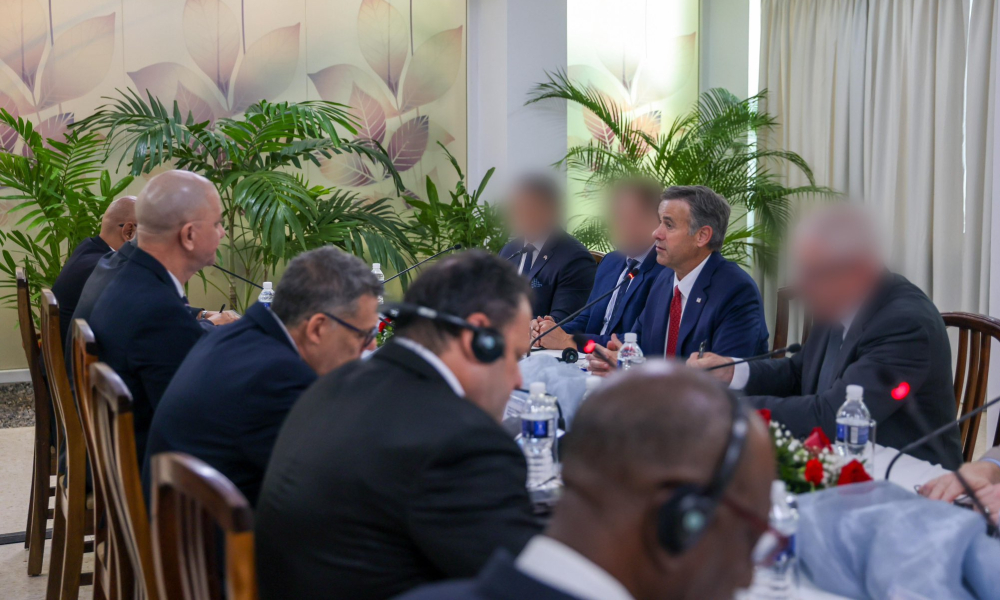
One of the options the White House is considering in Cuba is a repeat of the January 2026 operation in Venezuela. That operation involved removing the dictator by force and making business deals with the dictator’s former entourage. In May, CIA Director John Ratcliffe flew to Havana to meet with former President Raúl Castro’s grandson and Cuban intelligence chiefs. Ratcliffe urged the Cuban leadership to “take a lesson” from the Venezuela operation.
If the Trump administration is feeling inspired by the Venezuela operation to “solve” the Cuba problem, it may be applying the wrong template. In Venezuela, Washington got lucky—it targeted a regime uniquely suited to capitulation. Mistaking that particular vulnerability for a general formula could lead to miscalculation in Cuba.
The Venezuela operation was predicated on replacing the dictator at the top with an insider willing to change Venezuela’s foreign economic policy. It worked because Nicolás Maduro’s regime was, at its core, a transactional enterprise. Built on corruption and a culture of secret deal-making among its inner circle, it was organizationally capable of doing what corrupt regimes do best: cutting a deal with a foreign power and its business tycoons.
That susceptibility had been visible for some time before U.S. forces snatched Maduro. Under the Biden administration, negotiations over oil had already established a pattern of back-channel accommodation with Caracas. The regime’s willingness to trade political concessions for sanctions relief and investment, which continued during the first year of the second Trump administration, revealed that ideology had never been more than a rhetorical veneer. When the United States finally applied decisive pressure, it found a counterpart ready to negotiate a surrender in return for a bailout.
That counterpart was Delcy Rodríguez, number two under Maduro. Her willingness to engage directly with U.S. interlocutors was the hinge on which everything turned. But her defection was not simply a personal calculation—it was made possible by the character of the system she inhabited, a regime organized around deals with foreign powers and big businesses. Those regimes always contain figures whose primary loyalty is to their own prosperity. When the calculus shifts, so do they.
Cuba presents a fundamentally different problem. The Cuban state is not, primarily, a corruption enterprise wearing a revolutionary costume. It is, at its foundation, a genuine institutional order that has been built over six decades around a specific ideological dogma—anti-Americanism—and a particularly rigid organizational apparatus. Anti-Americanism is not merely performative but constitutive of the regime’s self-understanding, and the keepers of Cuba’s governing machine are not desperate for any grease that a U.S. bailout would provide.
Unlike the Venezuelan regime, the Cuban regime has learned to accept, and even welcome, the costs of always alienating the United States. The institutional foundations of the Cuban state—the party, the military, and the security apparatus—have been erected to survive without the United States, and to repel the United States militarily if it must. If anything, the regime’s institutions have learned to profit from U.S. absence.
The ideologues and the ultranationalists at the party level have always loved this intransigence toward Washington, and the military, for its part, loves the profits it makes by blocking economic liberalization. In post-Soviet Cuba, the state has granted the military a virtual monopoly on export-import businesses. If the Americans arrive, they lose that monopoly.
No doubt, the costs of always alienating the White House are deeply felt by the Cuban population—but not the regime. The regime has never cared what the population wants and how much it suffers. As long as the United States continues to allow remittances to Cuba and the repressive apparatus stays strong, the regime has figured that they will remain safe; ordinary Cubans make do and, more important, few would dare to rebel.
In other words, the Cuban regime has lived with U.S. sanctions (happily, I would say) since 1960. It does next to nothing to end them, which conveys how comfortable they are with the embargo. It has been six decades accustomed to keeping the United States out. Maduro in Venezuela, by contrast, never wanted the embargo. His regime had lived with sanctions only since 2019 and had spent most of its time since 2023 trying to undo them.
The embargo, the diplomatic isolation, the periodic intensification of pressure—all of this has become, paradoxically, part of the DNA of Cuban governance. The external threat justifies internal discipline; the siege mentality is also a political resource.
This does not mean that corruption and deal-making are absent from the state’s political life—they are not. But these arrangements operate beneath and within an organizational body that is not feeling threatened economically.
A Cuban Delcy Rodríguez might still exist. It is not inconceivable for Cuba to change economic course. Just this week, in response to U.S. pressure, Cuba's National Assembly approved a package of economic reforms aimed at expanding private-sector participation and attracting investment. It is also not inconceivable for some big shot—senior enough to matter, pragmatic enough to deal, and sufficiently disenchanted with the current leadership—to risk defection. Many authoritarian systems produce figures who calculate that accommodation with an external power offers better prospects.
The Cuban population, for its part, would almost certainly welcome such a turn. The economy has been decimated by decades of economic stagnation under the Soviets, insufficient reform after the Soviets, and a post-pandemic collapse of its tourism industry attributable far more to mismanagement than to the embargo. Economic ruin has eroded whatever revolutionary fervor once existed among ordinary Cubans. The last president to make overtures to Cuba—Barack Obama—became a local idol. Any U.S. president willing to open up Cuba’s economy again will be equally revered by the masses.
But a potential defector at the top level of government would face institutional obstacles that Rodríguez does not seem to be facing in Caracas. In Venezuela, the regime’s key pillars—the military officers who ran state enterprises, the civilian elites who extracted rents from the oil economy, the political fixers who managed the informal patronage networks—were ultimately mercenary actors who could be compensated into acquiescence. In Cuba, the calculus is different. Those who profit from the current arrangements are people whose entire careers, identities, and worldviews have been organized around resistance to the United States.
A Cuban transition engineered through U.S. pressure would require overcoming not just material interests but ideological and institutional orders at the state level. The regime’s ideological and institutional orders might be relics from the past, but they are still there and make the regime considerably resistant to capitulation.
None of this makes change in Cuba impossible. Economic catastrophe and the mass emigration of the young people who might otherwise have staffed the next generation of the system are eroding the regime’s capacity to reproduce itself. But the prospects of a clean capitulation by insiders followed by easy business deals with the United States would be difficult for a Cuban Delcy to deliver—and would be a complete betrayal of Cubans’ democratic aspirations.
With a clean capitulation unlikely and military action a possibility, it is important not to overstate the state’s resilience despite Cuba’s preparations. While the Cuban state is not the weak cesspool of corruption that made the Venezuelan state eager to capitulate, it is also not the formidable military bastion that the Iranian state has proved to be. Both Cuba and Iran have been resisting the United States for decades, but Iran has acquired far more war experience, and success at war makes states stronger. The Cuban state, by contrast, is rusty; it hasn’t really tested its military capacity since its African interventions ended in 1991. In other words, the Cuban state won’t capitulate right away, but it won’t prevail militarily against the United States if an invasion materializes.
But replacing a specific leader or defeating the state militarily will not fix Cuba. Cuba’s current crisis is the product of four mutually reinforcing pathologies: communism, which has suppressed markets and consumption for six decades; authoritarianism, which has extinguished political pluralism and civic life; protectionism, which has concentrated trade rights in the hands of a privileged few rather than opening the economy to non-elites; and neo-colonialism, in the sense that Cuba has taken cues from foreign patrons—first the Soviet Union, then Venezuela, now Russia and China—rather than governing in the genuine interest of its citizens.
Any serious strategy for Cuban recovery would need to address all four. The Trump administration, however, appears focused primarily on ending communist economic control through leadership change, while offering little coherent vision for the remaining issues. Even if maximum (military) pressure succeeds in cracking open Cuba’s command economy, an authoritarian state with restricted political pluralism, captured trade networks, and continued dependence will not produce a free, prosperous Cuba. At best, it offers a one-fourth solution to Cuba’s problems. At worst, it produces a different variety of extraction.
Washington should not press for a “friendly takeover.” It should press instead for the government to launch conversations with Cuban society about how to democratize institutions. The blueprint could come from Cuba’s long-ignored 1940 constitution, one of the most democratic in the world at the time. The goal should be to create political rules in which no Cuban actor is forced again to lose politically as much as Cuba’s democratic forces have lost since the 1950s.
In 1898, the United States had to intervene militarily in Cuba to displace a brutal regime, but showed hesitancy in delivering on the Cuban nation’s highest ideal back then—full political rights. We could be on the verge of a rerun.