War, Race, and America’s Values
A review of Wil Haygood, “The War Within a War: The Black Struggle in Vietnam and at Home” (Alfred A. Knopf, 2026)
On a rainy spring morning in New York’s Hudson Valley this past May, Secretary of Defense Pete Hegseth delivered a fiery speech to the graduating class of the United States Military Academy at West Point. The lecture—and it most certainly was a lecture—relied on now-standard talking points from the former Fox News host.
To the assembled West Point Corps of Cadets and their families, Hegseth railed against an “obsession with race and gender,” linking it directly, if mendaciously, to a “watering down of discipline.” He argued that the phrase “Our diversity is our strength” was “the single dumbest phrase in military history.” He instructed cadets that they should “not see color” or “celebrate identity months.” And he castigated those who “embraced the DEI craze and tried to introduce diversity and inclusion studies,” which, in Hegseth’s mind, meant they also were advocating for “anti-American ideologies.”
If the secretary’s oration was unsurprising—in both combative tenor and muted Republican Party pushback—what immediately followed offered a jarring image that called into question the underlying message of his address.
Following West Point graduation-day traditions, Hegseth was presented a framed cadet saber, a symbolic gift from the graduating cohort. Cadet Miles Manney, a Kansas City native and class president, bestowed the honors, standing next to the defense secretary for pictures as both their hands clutched the wooden shadow box. It was a time-honored part of the day’s ceremony.
What stood out this day and after this speech? Manney is Black. And, by all accounts, an impressive young man. As a cadet, he served as the brigade information systems officer for the entire corps, earned a minor in terrorism studies, and taught Protestant Sunday school. Looking now at the photo, as both men held on to that cadet saber box, one cannot help but wonder what was going through their minds. Did Hegseth deem Manney undeserving of his position? That Manney had graduated from West Point simply to fill an “arbitrary” DEI “quota” of the kind Hegseth had criticized during his address? Was Manney pained by the coded language and perceptible dog whistles of Hegseth’s hostile speech? How did Manney’s family and close friends feel about the politicization of a day intended to be about celebration of achievement?
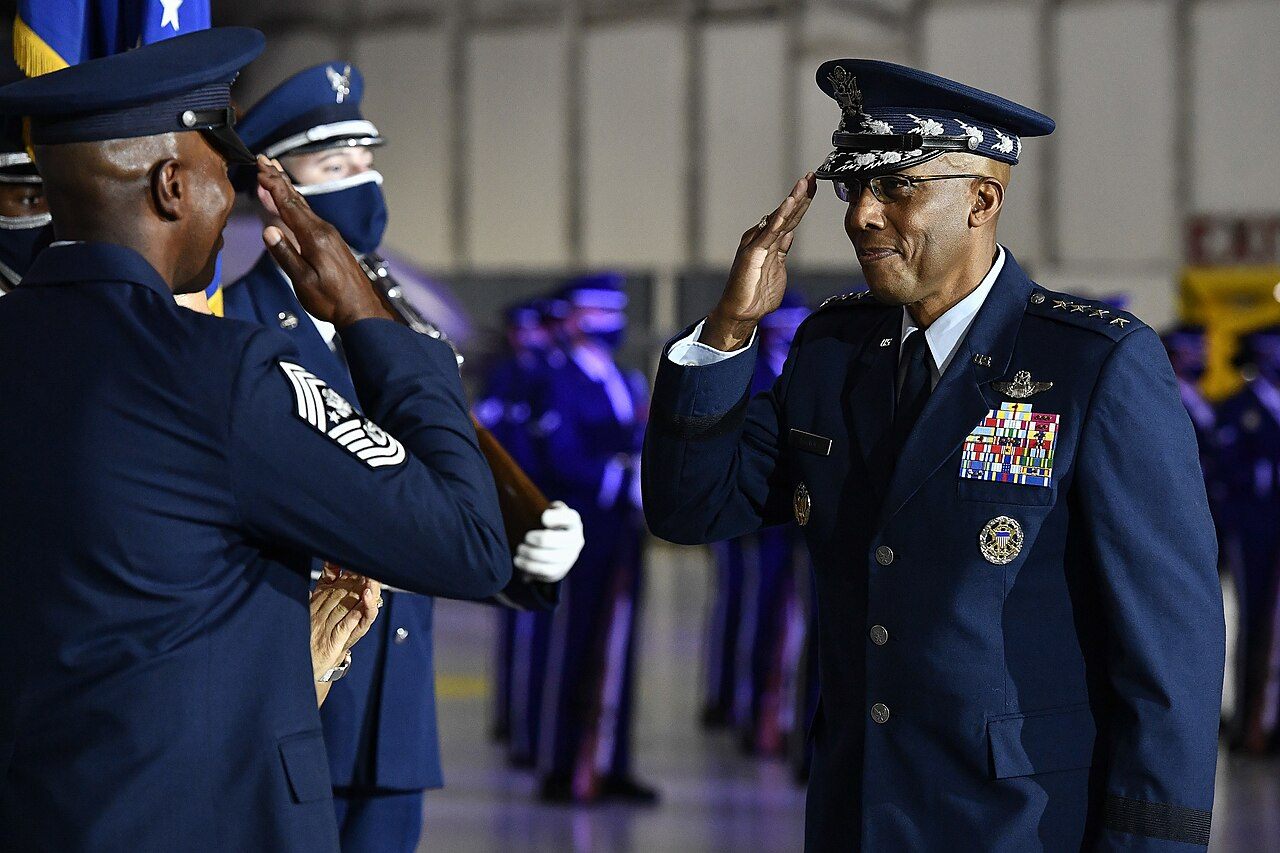
The language in Hegseth’s sermon offered stark testimony that the Black struggle in America, while surely improving since the Cold War civil rights era, endures. Journalist and author Wil Haygood likely would agree. In the epilogue for his latest—and superb—book, “The War Within a War: The Black Struggle in Vietnam and at Home,” Haygood writes admiringly of Lloyd Austin III and Charles Q. Brown, the first Black men to rise to the ranks, respectively, of secretary of defense and chairman of the Joint Chiefs of Staff. A postscript, however, tenders a more somber tone. Haygood ends his story with both Secretary Hegseth and President Trump assailing a “cadre of gifted Black military leaders,” purging websites of “notable Black and female achievements in the military,” and, ultimately, firing Brown from his chairmanship.
If Haygood leaves his readers on a discouraging note, it’s hard not to be inspired by the personal stories that drive “The War Within a War.” In writing about the “Black struggle,” both at home and abroad, Haygood tells the stories of a series of individuals whose dedication to social, political, and economic progress is as energizing as it is uplifting. The breakdown of the Cold War consensus during the turbulent decade of the 1960s makes that struggle all the more impressive.
Haygood’s book, however, is not just a tale of civil rights struggles during the era of the Vietnam War. Rather, Haygood paints a larger story of the Black experience in America as he moves across the nation’s racial past with both compassion and authority. Reading Haygood’s account is akin to following a seasoned docent through the National Museum of African American History and Culture in Washington, D.C., whose tour focuses on military service and the promises and consequences of America’s martial past.
Still, the American war in Vietnam takes center stage in Haygood’s narrative. Complementing the work of historians before him, such as Beth Bailey, who long have explored the military’s institutional approach to the “problem of race” during the 1960s, Haygood’s book concentrates on individuals, advancing a more social and cultural rendering of this era. And, in a way that combines journalistic narrative with keen historical exploration, he offers informative context with which to make sense of his featured individuals’ stories.
We see Black recruits being sent into combat units in Vietnam at a disproportionately higher rate than White soldiers. We peer in on local draft boards, especially in the American South, that reinforced racialized politics by proffering military service deferments based more on color than on need. We empathize with young Black men and their families as they make decisions about donning a uniform predicated on economic necessities and limited employment opportunities within America’s inner cities of the 1960s. And we listen to activists such as James Baldwin, Muhammad Ali, and Martin Luther King Jr., all of whom likened the bombing of Vietnamese villages to the violence meted out in Black neighborhoods across the United States.
This historical context, while both necessary and engaging, only forms the foundation for the personal stories that Haygood so capably recounts. At their core, these tales illuminate the deep relationships between an overseas war and an existential struggle at home, linked indivisibly by an American nation grappling with its very identity. In essence, two conflicts unfolded simultaneously during the 1960s with race at the center of both. Connecting them, Haygood’s writing evokes the breezy, sometimes surreal style of Michael Herr’s “Dispatches” combined with Studs Terkel’s ear for oral history and brisk storytelling in “The Good War.”
Each chapter—independently following a doctor or an infantry company commander or a Motown executive—transitions seamlessly from home front to battle front. Haygood confidently tours ROTC programs at historically Black colleges and universities and the heavy fighting around Landing Zone X-Ray in Vietnam. He juxtaposes the “wanton savagery of white law enforcement” at Selma with the “Black anger and defiance … percolating in Vietnam.” If one needs evidence of the deep bonds between war and the society that fights it, “The War Within a War” offers an impressive place to start.
Contradictions abound in these personal stories, presenting difficult questions, if not challenges, to the men and women who served in Vietnam, if not to 1960s American society writ large. Was the “dap” handshake—a stylized greeting popular among African American soldiers involving palm slaps and fist bumps—a sign of cultural esprit de corps or an affront to military order and discipline? Was fighting communism abroad more important than resolving racial inequities at home? Perhaps most frightening of all, were young Blacks conscripted into the armed forces and trained to kill the enemy a potential threat to society once they returned home from Vietnam? Haygood carefully avoids a moralistic tone while exploring these weighty questions, instead elevating the individuals he follows by accentuating their voices across an expansive narrative.
In one illustrative chapter, Haygood turns his attention to Wallace Terry, one of Time magazine’s most discerning correspondents of the entire war. Terry had followed in the footsteps of earlier reporters working for prestigious Black newspapers such as the Chicago Defender. He attended Brown University and arrived in Vietnam in 1967 to help cover “the Negro soldier” serving there. Terry, as witness, wrote about the growing political consciousness among Black troops, listened as they made connections between military policy in Vietnam and racial injustices at home, and, like many veterans, found it difficult to integrate back into society after returning to the United States. His oral history of the Black experience in Vietnam, “Bloods,” remains an indispensable resource for historians of the conflict.
In another chapter, Haygood demonstrates breadth of scope by featuring the temperamental relationship between President Lyndon Johnson and Georgia Democratic Sen. Richard Russell. An ardent segregationist “Dixiecrat,” the chairman of the Senate Armed Services Committee also was a committed anticommunist and mentor to LBJ. Russell voted against the Civil Rights Act of 1964 yet committed himself to giving Johnson everything the president required to prosecute the war in Vietnam. On the ground in Southeast Asia, however, Black soldiers watched in despair as the president reluctantly yet purposefully diminished funding for his War on Poverty at home to compensate for a ballooning defense budget in support of an increasingly stalemated conflict overseas.
If contradictions drive many of Haygood’s stories, so too assumptions among Black Americans that military service would lead to expanded civil rights, a way to prove their mettle as citizen-soldiers and be rewarded accordingly for their sacrifices. Such expectations were not new. During World War I, scholar and civil rights activist W.E.B. Du Bois applauded Black participation in the global conflict as a means for attaining full citizenship. Meritocracy in the armed forces, so the argument went, would extend to civilian society. Perhaps unsurprisingly in retrospect, Du Bois would be disappointed by the “betrayal” of an American government and society all too eager to reinforce the Jim Crow system of oppression at the war’s end.
Both the contradictions and assumptions highlighted by Haygood elicit a compelling argument made by historian William A. Taylor. In “Military Service and American Democracy,” Taylor maintained that uniformed service might be seen as a “litmus test for American values” and that military personnel policies often “served as the nation’s conscience, bringing difficult and uncomfortable questions about American values into sharp relief.” It’s hard to decipher where Haygood might fall in this historical argumentation.
There are moments within Haygood’s story of true meritocracy in action. West Point graduate Joe Anderson, whose infantry platoon became the subject of an Oscar-winning French documentary. Air Force pilot Fred Cherry, who broke down racial barriers during his service in the Korean War before being shot down and imprisoned in North Vietnam and becoming a model of resistance for his fellow POWs. Art Gregg, whose prowess in logistics earned him a place in history as the U.S. Army’s first Black lieutenant general and namesake of Fort Gregg-Adams in Virginia—until Secretary Hegseth changed the base’s designation back to Fort Lee.
Yet alongside these inspiring stories sit tales of political disappointment and economic despair. Black youths drafted into the armed forces through Project 100,000—ostensibly a government-sanctioned “social uplift program”—that made eligible for conscription the poor and less-educated segments of society. Black veterans struggling with the consequences of an unfair courts-martial system or the debilitating effects of Agent Orange and drug habits formed in Southeast Asia. Dwight Johnson, one of only 23 Black recipients of the Medal of Honor in Vietnam, who suffered from post-traumatic stress and was fatally shot in Detroit while trying to rob a grocery store. Were these stories a “litmus test” of American values? Or those of Cherry and Gregg?
Perhaps, looking back on this tumultuous era, the answer is a complicated “both.” And perhaps that’s among the greatest values of reading “The War Within a War.” It seems understandable, then, that Haygood places the story of Henry Flipper, the U.S. Military Academy’s first Black graduate in 1877, within the chapter on Joe Anderson, West Point class of 1965. Chances are that newly minted 2nd. Lt. Miles Manney will honor their legacies by writing his own chapter of some future story.
In the end, being swept up in a narrative unencumbered by strict adherence to historical chronologies allows readers to contemplate how our nation’s martial history cannot be told without considering our long and complicated history with race. Haygood moves back and forth between years, even decades, to place the Vietnam era in its rightful historical context. In doing so, he shows us how war and race are inseparable from the American story.
“The War Within a War” is a book of breathtaking scope that should be read by any American interested in learning from their nation’s racialized military past. And, perhaps not least of all, by those like Pete Hegseth who, regretfully, seem far less so.