
Why Is the Weaponization Report So … Normal?
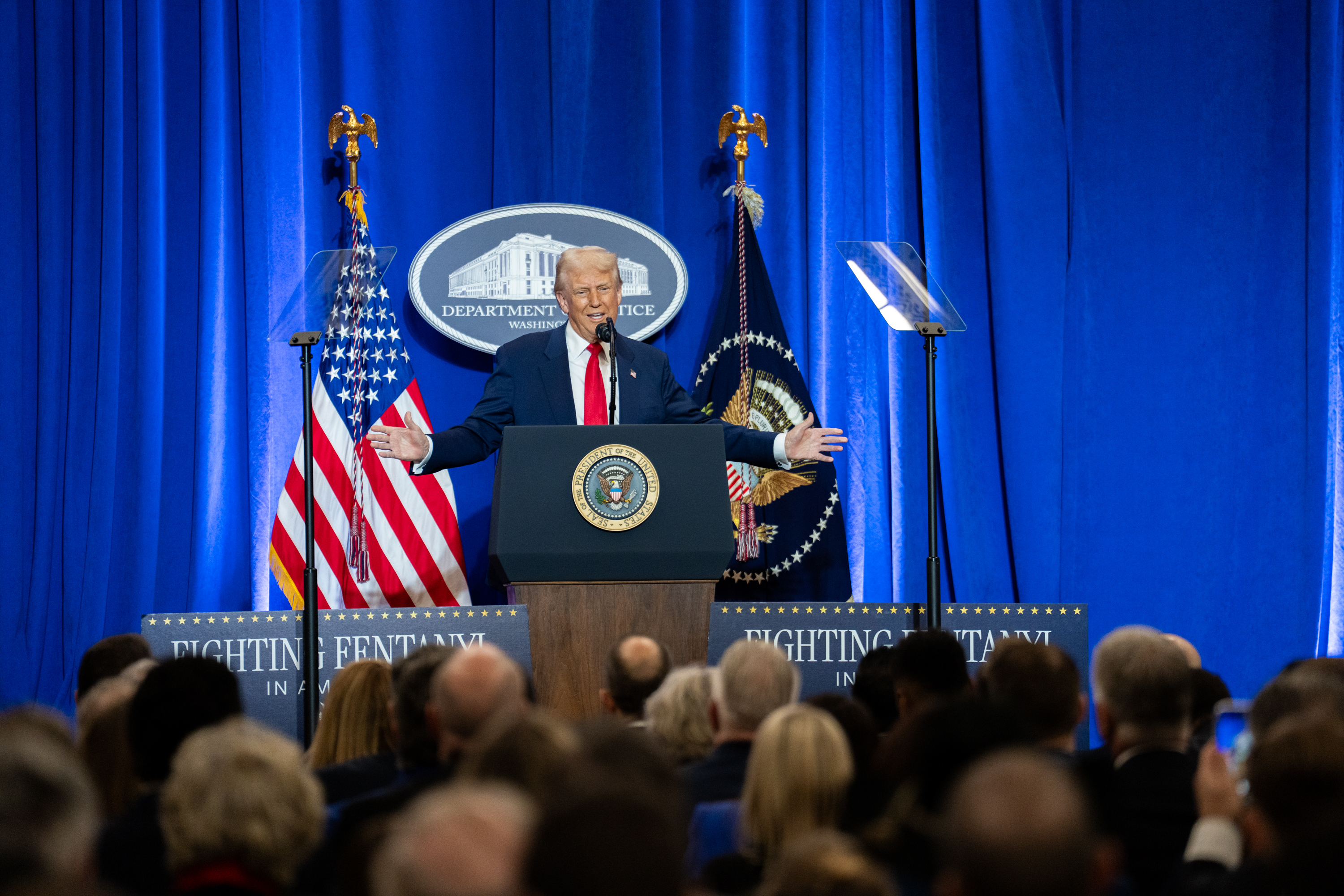

Whatever your ideological persuasion, the first report of the Justice Department’s “Weaponization Working Group” confirms what you already knew. The top-line finding is that “[t]he Biden DOJ violated the rights of Americans by its biased enforcement of the FACE Act,” a federal law that criminalizes violence against reproductive health care providers. For those who believe in a malevolent “deep state,” the report affirms that career federal prosecutors unfairly and improperly targeted conservative Christian anti-abortion protesters. For those who believe that the Trump administration is misusing the Justice Department to pursue political vendettas, the report provides yet another example of the administration’s efforts to smear legitimate criminal investigations of anyone who happens to be MAGA-aligned. So far, so predictable. But the report should still shock—not because of its conclusions, but because of whom it targets and how it targets them.
Former Attorney General Pam Bondi created the Weaponization Working Group, mere hours after she took office, in response to an executive order requiring her office “to review” the Biden administration’s civil and criminal enforcement actions in light of its “unprecedented, third-world weaponization of prosecutorial power.” Bondi directed the group to review not only departmental actions that directly involved the president—including Special Counsel Jack Smith’s investigation and federal cooperation with state and local investigations of “President Trump, his family, and his businesses”—but also the investigation and prosecution of Jan. 6 rioters and “non-violent protest activity” prosecuted under the Freedom of Access to Clinic Entrances (FACE) Act. After former chair Ed Martin was reportedly ousted in February of this year, the group issued its first report in April. The 37-page document charges that “[t]he Biden DOJ” improperly “pursued more severe charges and significantly harsher sentences for peaceful pro-life defendants than violent pro-abortion defendants,” “ignored” anti-abortion groups while engaging with “pro-abortion” groups, and engaged in conduct and comments that evinced bias, among other allegations. To right these wrongs, the report says, the Trump administration pardoned numerous convicted defendants, dismissed pending investigations, and took “appropriate personnel actions,” though these are not detailed in the report. The report also notes that, “[w]here appropriate, DOJ may refer current or former employees for criminal prosecution.”
To be clear, the report’s conclusions, while unsurprising, are nonsense. I know that because I was a career federal criminal prosecutor in the Civil Rights Division tasked with enforcing the FACE Act and other civil rights laws. I served during administrations of both parties—starting in 2017, during the first Trump administration, through the Biden administration, and more than a year into the current Trump administration. I—along with my colleagues in the division, the FBI, and United States Attorney’s Offices—followed the evidence, without regard to politics. But you don’t need to take my word. As Regan Rush and Megan Marks at Red Line for Civil Rights have already explained comprehensively, the public record shows no pattern of selective prosecutions during prior administrations, let alone any apples-to-apples disparities in the way violence by and against anti-abortion advocates was investigated, prosecuted, or sentenced. Quinta Jurecic at the Atlantic, too, lambasts the “shoddiness” of the report, from its fallacious reasoning—for example, one reason sentences were higher for anti-abortion violence is that these defendants engaged in more violent acts than had pro-choice defendants—to its fundamental disingenuity: The Trump Justice Department has done exactly what it decries by openly indicating that it will prosecute violence against anti-abortion crisis pregnancy centers more readily than violence against pro-choice reproductive health care providers.
It is true that, as these commentators and others have pointed out, the gentlest surface-scraping reveals factual inaccuracies, misleading mischaracterizations, material omissions, and unsupported conclusions. But the report’s shoddy analysis is strikingly polished. The report is not merely, as Jurecic suggests, a “restatement of Project 2025’s preordained conclusions.” It is a careful repackaging of those conclusions as the diligently researched, evidence-based, nonpartisan findings of an ordinary bureaucratic “working group.” The document is well written and amply sourced, with more than 200 footnotes and 800 pages of appendices. In contrast to the department’s recent error-ridden work product—the Trump-appointed judge overseeing the Texas redistricting case complained that the Civil Rights Division had submitted a letter that contained “so many factual, legal, and typographical errors” that it was difficult to discern its meaning—the report is free of apparent mistakes. It contains a sort of methodology section, in which it claims that its investigation of allegedly partisan FACE Act enforcement stemmed from concerns raised by a United States Attorney’s Office about religious discrimination, which in turn spurred a “search for responsive documents” in the Civil Rights Division that yielded “about 700,000 results.” The report specifies that “both career attorneys and political appointees” reviewed these “results” and “compiled these findings based on the full scope of the data set.” “Data set?” A Twitter screed this is not.
The “data set” in question is hundreds of internal emails among Justice Department employees and between department employees and organizations that represent victims (a daily and unremarkable type of communication for criminal prosecutors). The disclosure of internal Justice Department emails—which constitutes a potential waiver of legal privileges that would ordinarily shield such emails from public disclosure and a sharp departure from department confidentiality practice—is itself striking: With few exceptions, such communications are confidential for good reason.
Also striking, though, is the terminology: Why does the report characterize these opaquely selected emails as “data”? Why does the report emphasize the quantity of material collected? And why did the report’s authors collect any “data” at all? For those inclined to agree with the report, no “data” was necessary. The prosecutions and non-prosecutions spoke for themselves; anti-abortion advocates have been pressing the same disparate treatment claims for years. For those disinclined to agree with the report, the emails prove nothing more than that career employees did their jobs.
Why does the report suggest that the email collection was spurred by the concerns of a “United States Attorney’s Office” in response to “open-ended questions,” rather than a corollary to the president’s order to root out the weaponization that was predetermined to exist? The executive order that compelled the formation of the working group was called “Ending the Weaponization of the Federal Government,” suggesting that the report’s conclusions were foregone; a working group can’t end weaponization unless it finds weaponization in the first place. Why pretend otherwise?
Why highlight the claimed participation of “career” employees (whatever that means nowadays)? The administration has insisted that career Justice Department employees are untrustworthy deep state holdovers and has treated them accordingly; why would their involvement now be presented as a kind of legitimizing factor? And why attempt to source the document so thoroughly? Any undergraduate struggling to pad out a paper in the wee hours of the morning recognizes the quantity-over-quality footnote game, but footnotes are for professors.
So for whom was this report painstakingly crafted? (And it was, apparently, painstaking. As former Attorney General Pam Bondi’s chief of staff Chad Mizelle told CNN: “Part of the reason the weaponization work has been difficult is that you need people who are MAGA and who are really competent.” This is, he explained, “a very small group of people.”) If MAGA folks were already persuaded, anti-MAGA folks never will be, and people who fall into neither camp (if any exist) don’t care about “data sets,” as I strongly suspect, why bother with the gloss?
The likely answer is an alarming one. As Mizelle also noted, the end goal of the weaponization working group is not reports, but prosecutions. President Trump has repeatedly demanded that Justice Department officials investigate and prosecute high-ranking officials and elected Democrats, and the Trump administration has repeatedly fired and demoted low-ranking career officials whose earlier work ran afoul of this administration. But so far, the Trump Justice Department has not yet targeted its own career civil servants for criminal prosecutions. This report may be an attempt to offer a blueprint for such prosecutions—and its neater-than-expected packaging may signal that the intended audience is not Trump or his political appointees, but federal judges.
From this perspective, the report’s superficial thoroughness and its attempts to appear legitimate are disturbing. Setting aside the question of what possible predication there could be to investigate or prosecute career civil servants for doing their jobs within the letter and spirit of the law, the saying goes that a grand jury would indict a ham sandwich (despite the department’s recent high-profile struggles to obtain indictments). The one-sidedness of federal grand jury practice, in which a prosecutor alone presents evidence (often exclusively the testimony of a law enforcement officer working closely with the prosecutor) and asks that the grand jury find probable cause to support an indictment, generally works because Justice Department policy and attorney rules of professional responsibility require prosecutors to “ensure that justice is done.” But a grand jury presented only with the same valid-sounding “data” and “findings” contained in the report might accept them, despite the fatal flaws obscured by the gloss. After that, a defendant can ask a judge to dismiss legally insufficient charges. The federal bench, which has grown increasingly skeptical of the Justice Department—especially its efforts to prosecute the president’s political enemies—is unlikely to be seduced by the number of citations alone, but persuasion may not be the goal. A sympathetic judge could use an apparently well-sourced, eminently quotable report or briefing based on the report, to paraphrase the old saying, as a drunk uses a lamppost: more for support than illumination. And even an unsympathetic judge can’t immediately disregard well-pleaded (even if ultimately factually and legally unsupportable) claims. Federal courts generally afford government lawyers a presumption of regularity: not an unthinking acceptance but rather a deference that starts by assuming that government attorneys—especially criminal prosecutors, who have additional professional responsibility obligations—have accurately and completely represented the facts and law. Additionally, the American legal system affords wide latitude to prosecutorial discretion and generally protects the charging decisions of prosecutors from judicial scrutiny. That’s not to say an indictment based on the “facts” of the report would not, ultimately, be dismissed, but it is to say that judges generally cannot toss even highly suspect prosecutions out of hand.
The report’s architects may also be contemplating their own futures. Just as the authors of Project 2025 thought about what they could accomplish in a favorable future administration, Trump administration officials may now be considering the ways in which an unfavorable future administration could seek accountability for current violations of law and policy. Perhaps in building a framework that could be used to investigate and prosecute former Justice Department officials, current department officials are considering their own future defense if they are later accused of malicious prosecution. Criminal lawyers are intimately familiar with the concept of mens rea, the guilty mind. It’s much easier to discern improper motivation in a vengeful social media post than it is in the report’s familiar government-speak, effortful sourcing, and claimed quantity of supportive material. In that sense, the “career employees” who allegedly participated in the writing of this report may even serve as rhetorical human shields, not only by lending legitimacy but also by blurring the boundaries of who should be held responsible for the report and what follows.
So much of the ongoing desecration of the Justice Department is loud and obvious and in all caps. But the quiet destruction reflected in the almost soothing mundaneness of the Weaponization Report should trouble adherents to the rule of law at least as much, for how quickly and easily democratic institutions have given way—and for what comes next.

-(2)-(2)-(1).jpg?sfvrsn=21cee67a_7)
