A Political Earthquake in Ukraine
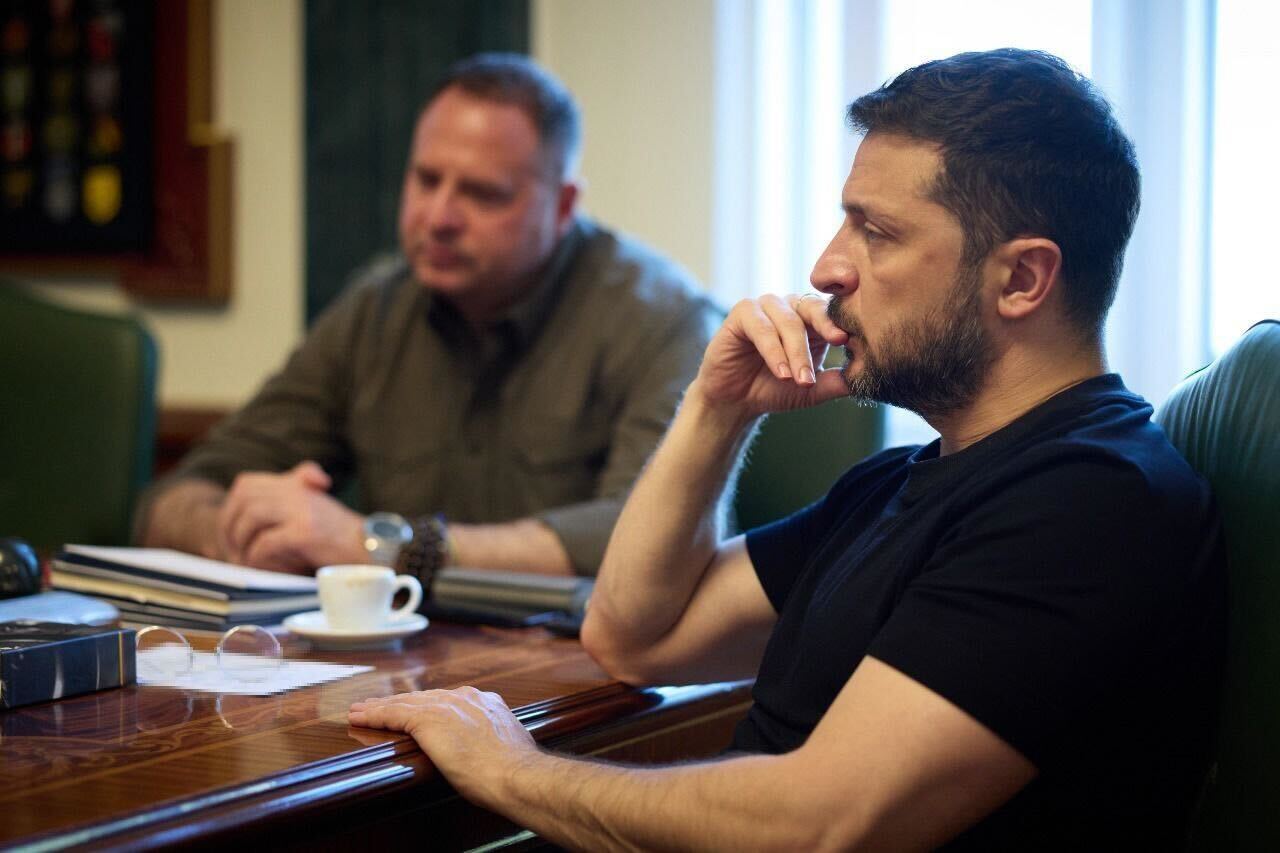

Almost three weeks have passed since Ukraine’s President Volodymyr Zelensky sacked his controversial chief of staff, Andriy Yermak. Even though his successor remains a mystery, it’s hard to overstate the profound effects the firing is bound to have on the Ukrainian government.
Despite the relative institutional unimportance of the office of the president, Yermak turned it into the single most powerful body of the Ukrainian government. Ever since he became the chief of staff in 2020, Yermak had amassed unprecedented influence over the country’s domestic and foreign policy. He was effectively a co-president, despite not being the country’s prime minister—who is supposed to share the country’s executive power—and despite the growing allegations of his corruption and nepotism, allegations that have come from civil society, from journalists, and from Zelensky’s political opposition.
Zelensky ignored the critics for years, until anti-corruption detectives burst into Yermak’s apartment in central Kyiv on the morning of Nov. 28. They came with a search warrant related to a sprawling corruption case that had already implicated a number of Zelensky’s other close friends. Hours later, Zelensky gave a speech announcing a reset of the president’s office.
“I want no one to have any questions for Ukraine,” the president said, referring to mounting criticism from the civil society and even Ukraine’s allies abroad.
And yet, “questions for Ukraine” remain, first and foremost, about who will replace Yermak. Zelensky is reportedly considering the defense intelligence chief, Kyrylo Budanov, or the minister of digital transformation, Mykhailo Fedorov, for the job. But nearly three weeks after his chief of staff’s departure, the president has yet to name Yermak’s successor. And even more important questions remain. Chief among them is whether the new person, whomever they may be, will be able to overhaul the dysfunctional system Yermak has spent years building.
Improbable Power
Just like his boss, the comedian and actor Zelensky, Yermak was not a traditional pick for the job.
Before becoming chief of staff in 2020, Yermak was an entertainment lawyer and a film producer with no political experience. He owned a number of law firms and film companies, and even co-produced several movies. Yermak said in interviews that he met Zelensky in 2010 when both of them worked in television—Yermak’s company provided legal services for a TV channel of which Zelensky was the executive producer at the time.
For nine months before landing the big job, Yermak was Zelensky’s adviser. In that role, he successfully led the negotiations about a prisoner swap in September 2019 that brought home 35 Ukrainian prisoners held captive by Russia. He also secretly met President Trump’s personal lawyer, Rudy Giuliani, in Madrid in 2019. The meeting was part of Trump’s effort to find dirt on then-presidential candidate Joe Biden, whose son was a board member of the Ukrainian energy company Burisma. The effort culminated in Trump asking Zelensky to investigate Biden’s activities in Ukraine or risk losing millions in military aid, a quid pro quo that led to an impeachment inquiry. Yermak was a key player in the saga, leading the communications through the “irregular channel”—which is to say the nondiplomatic channels that ran through Giuliani—between the two administrations.
After becoming the head of the president’s office in February 2020, Yermak got an all-access pass to Zelensky. He was right by the president in all events and meetings, and officials reportedly complained that it was impossible to speak with Zelensky without Yermak in the room.
This literal closeness, and the close personal friendship between Zelensky and Yermak, manifested in several ways.
Yermak served as a sort of gatekeeper for Zelensky, personally doing much of the president’s bidding while isolating him from criticism and dissenting opinions. Such a flattering environment, later combined with the worldwide adulation of Zelensky as a modern-day Winston Churchill after Russia’s full-scale invasion, sometimes contrasted sharply with Zelensky’s reception at home. Members of civil society, activists, and journalists routinely criticized the president for concentrating too much power in the presidency and not delivering on promises of good governance. Zelensky would snap at Ukrainian journalists during the rare press conferences, seemingly shocked at their questions about the government’s efficacy, accusing them of being mouthpieces for hire—though for whom, he did not specify.
More importantly, Zelensky trusted Yermak so much that he empowered him to act as the de facto appointment authority for several jobs across government, from board members at strategic state-owned enterprises to cabinet members; the appointees were often either unqualified or embroiled in corruption scandals. Yermak’s tenure also coincided with two other critical developments: Zelensky’s party winning a supermajority in the parliament in 2019, and the declaration of martial law in Ukraine prompted by Russia’s full-scale invasion in 2022, which rendered elections impossible and strengthened the mandate of the wartime president.
The close personal relationship between Yermak and Zelensky, as well as the unique domestic political factors, transformed the president’s office into the single most powerful institution in the country.
“As chief of staff, Yermak had real influence over a great deal of processes, personally leading over a hundred working groups on everything from the issue of combating international bribery to the repatriation of Ukrainian kids that were kidnapped by Russia, encompassing basically all areas of public policy” Anastasiia Radina, a Ukrainian lawmaker from Zelensky’s party, told me.
“It’s not a secret that the vast majority of staffing decisions were either born in the president’s office, or, given the government’s super-majority in the parliament, were discussed and approved by the president’s office” Radina added.
Numerous Ukrainian media investigations revealed Yermak’s ties to officials in all parts of the government. His reported protégés currently occupy some of Ukraine’s most powerful posts, including prime minister and prosecutor general. Heads of the state property fund, the anti-monopoly committee, the state customs service, and the tax service, as well as members of supervisory boards of several state-owned enterprises, reportedly are also associates of Yermak. The list is far from exhaustive.
Several of Yermak’s deputies have also been targets of corruption probes. Authorities charged one deputy with corruption, and two more remain under investigation.
The former chief of staff’s influence also extended to Ukraine’s foreign policy. Yermak led Ukraine’s delegation during peace talks with Russia and the U.S., despite his lack of English proficiency and reports of him aggravating Ukraine’s allies with his communication style and misunderstanding of the U.S. political context.
Yermak’s authority “went far beyond the powers vested in the head of (the president’s office),” Ivanna Klympush-Tsintsadze, a lawmaker with opposition party European Solidarity, told me. It included “Yermak’s direct instructions to government officials and parliamentary leadership, the transfer of the functions of the Ministry of Foreign Affairs to his very strange deputies, the de facto authorization by President Zelensky to perform the function of national security adviser,” and more.
Yermak’s Downfall
Yermak’s ouster came as a result of Operation Midas— the National Anti-Corruption Bureau of Ukraine’s (NABU’s) 15-month investigation that uncovered a corruption scheme in the country’s energy industry. The scheme consisted of a criminal group that forced suppliers of a state-owned energy company, Energoatom, to pay them kickbacks. The scandal implicated several of Zelensky’s close friends, as well as Ukraine’s ministers of energy and justice, who have since been fired.
NABU didn’t initially name Yermak as one of the suspects when it announced the results of its investigations on Nov. 10. But given his wide-reaching influence, it was hard to believe that such a large-scale operation involving the top brass of the Ukrainian government could escape Yermak’s eye.
On Nov. 16, the head of the Specialized Anti-Corruption Prosecutor’s Office, NABU’s partner organization, said one more person was under investigation, someone with the codename “Ali Baba.” That person allegedly held meetings with the law enforcement apparatus to coordinate attacks on the anti-corruption agencies and prosecute their detectives. Ukraine’s leading news outlet, Ukrainska Pravda, reported that Ali Baba was Yermak, who has long had the nickname “AB” for his name and patronymic, Andrii Borysovych.
A number of Ukrainian lawmakers, including some from Zelensky’s own party, demanded Yermak’s dismissal, but Zelensky ignored them, not only keeping Yermak but once again appointing him to lead a new round of negotiations with the U.S.
Less than three weeks later, however, NABU detectives searched Yermak’s apartment. Although he wasn’t charged with any crime, and still has not been, the crisis evidently became too large for Zelensky to ignore.
“There must be no reasons to get distracted by anything other than defending Ukraine,” Zelensky said in a speech on Nov. 28, hours after the search. “There will be a reset of the Office of the President of Ukraine.”
Three weeks later, Zelensky still hasn’t named his next chief of staff.
The government has already begun to democratize. Instead of the usual top-down approach, the parliament has reportedly found its footing and began working with the cabinet to find ministerial replacements, all without the involvement of the president’s office.
And yet, Yermak’s firing alone likely won’t be enough to cleanse the government of the former chief of staff’s countless associates, nor will it singlehandedly overhaul the highly centralized system of government he built over the years.
“I would like to see an overhaul of the relationship between the president and the president’s office with the cabinet and parliament, and an end to the manual control (of the government), which violates the law,” Klympush-Tsintsadze, the opposition lawmaker, told me.
She added, “It’s not merely about personalities. It’s about reviewing the system and rules of governance.”