A Tale of Two Mogadishus

Editor’s Note: The security situation in Somalia, especially its capital city, may be improving, but the government is probably overstating how permanent the progress is. Tricia Bacon assesses both the good and bad news from Somalia, arguing that there is real progress but that divisions and an inconsistent U.S. approach hinder further success.
Daniel Byman
***
Al-Shabaab has not carried out a major attack in Mogadishu since mid-December 2025, a rare lull in violence in the capital of Somalia from al-Qaeda’s affiliate in the region. But the calm has not reached politics. The president’s term expired on May 15, and since then he has been governing on a one-year extension that the opposition does not recognize. Less than three weeks after his term expired, on June 3 and 4, government and opposition-aligned forces clashed in the streets of the capital.
At the same time, the African Union Support and Stabilization Mission in Somalia (AUSSOM) is in unprecedented jeopardy. In a July 1 diplomatic note, the United States notified the African Union that it would block renewal of United Nations Support Office in Somalia, which provides critical logistical and operational support for AUSSOM. The U.S. note cited Somalia’s failure to sustain security gains and “internal rivalries and political infighting” that continue to undermine the fight against al-Shabaab. The move comes after the United States blocked a UN resolution to fund AUSSOM through UN contributions late last year. But Washington’s position is also contradictory: Even as it kneecaps AUSSOM, it has waged the most intensive air campaign in Somalia’s history, striking al-Shabaab at a pace to exceed last year’s record.
On a recent trip to Mogadishu, I heard two very different stories of the situation there as AUSSOM’s withdrawal looms. One is told with confidence by people who believe they are winning, decisively and for good. The other comes from people convinced that such confidence is premature or, worse, dangerous. Both stories are built from real observations, but the two sides interpret these same facts as evidence of very different trends. In the coming months, as the scaffolding that has propped up the Somali state for two decades gets pulled away, it will become clear which story accurately captures the circumstances.
The First Mogadishu
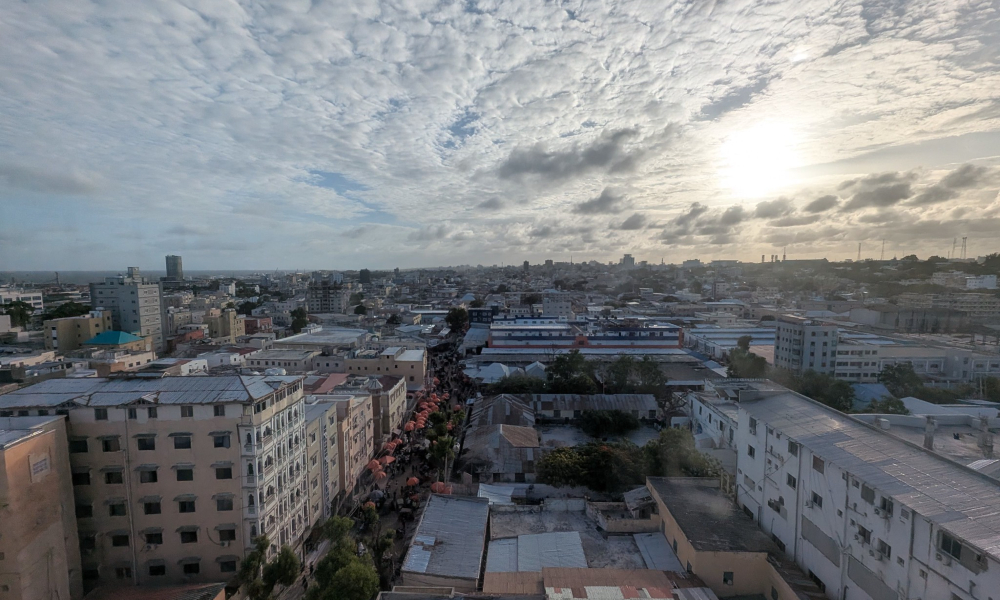
The first account comes from Somali government officials, particularly security officials. It is a story of a capital that has turned a corner. Streets are safer than they have been in a generation, people are enjoying a vibrant social scene, new towers are rising downtown, and the insurgency, which has been squeezed out of the capital, is nearing outright defeat.
They describe, with evident pride, a security apparatus built specifically to thwart al-Shabaab’s weapon of choice, vehicle-borne explosive devices supported by armed attackers. Cameras now cover much of the city, especially its roads and businesses. Security personnel at checkpoints check vehicles against an electronic system. Vehicles must be registered to an individual who holds a national ID, and a missing vehicle must be reported within 48 hours or the owner is presumed complicit in whatever happens next. Vehicles flagged as suspicious are entered onto a blacklist that requires checkpoint officers to initiate searches. If they fail to do so, their actions are detected and they are questioned, hindering al-Shabaab’s ability to co-opt officers at checkpoints. Outside the city, checkpoints increasingly rely on explosive-detection dogs. Officials describe further refinements already in motion, on the assumption that al-Shabaab will adapt and the system will have to adapt faster.
They also maintain that al-Shabaab’s “taxation” networks inside the city—a critical source of funding for the group—have been broken, and that U.S. airstrikes are helping to keep the group hunkered down and unable to plan.
They argue that the climate in Mogadishu has changed for the better. They point to construction in the city, apartment buildings in particular, which they argue investors would not finance unless they believed the security would hold, and which they expect will eventually ease Mogadishu’s prohibitively high rents. They point to a social scene that has loosened visibly: Cafes are busier than they used to be, beaches are more crowded, and young Somalis post their outings on TikTok without a second thought, a small sign of how much fear has receded from residents’ daily calculations.
Officials extend the same confidence outward. Some, arguably most, believe Somali forces are ready to operate without AUSSOM, particularly given Turkey’s continued backing.
This has all emboldened the president. President Hassan Sheikh Mohamud has announced a “final offensive” against al-Shabaab in the coming months. The same posture carries over into politics: no compromise, whether the adversary is an insurgent group or a political rival. His one-person-one-vote plan—the centerpiece of his push to move Somalia away from clan-based indirect elections, in which clan elders select elected officials—remains unchanged and on track in this telling. His term extension is, in practical terms, a settled matter. In this account, any attempt to disrupt Mogadishu’s rise through violence, whether by al-Shabaab or the opposition, would backfire, because ordinary Mogadishu residents are enjoying the calm too much to tolerate it being put at risk.
The Second Mogadishu
The second account comes from officials aligned with the opposition, civil society figures, analysts, and some of the international community. It does not dispute the security gains in Mogadishu so much as it disputes what they mean.
Those holding this view acknowledge that the government’s measures have made real progress in Mogadishu and forced al-Shabaab to change its tactics. But they insist the group is simply playing a longer and more patient game, as it has before. Rather than reading the reduced attack tempo as a group on the verge of defeat, this account reads it as discipline. Al-Shabaab is absorbing losses from U.S. airstrikes because the group knows there is nothing credible to follow up on the gains achieved from those strikes. A smaller number of large, high-value attacks on government targets, as occurred in 2025, also serves its purposes better right now than the indiscriminate violence against civilians in the capital that alienated the population in the past.
Meanwhile, the group is still quietly collecting some taxes in Mogadishu, and tracking who fails to pay for a later reckoning. They bemoan the government’s ban on media reporting about issues that could pose a security threat, which has translated into a restriction of coverage about al-Shabaab that would allow the public to stay informed.
On the military side, this account is far more skeptical of Hassan Sheikh’s “final offensive” to extend this security beyond Mogadishu. Officials in this camp say there is no real operational plan behind the announcement, and certainly no strategy for what happens after territory is cleared—the same gap that has undone previous offensives against the group.
This account is also more willing to look at who is paying for Mogadishu’s transformation. Government demolitions clearing space for new construction have displaced poorer residents, who will never be able to afford new apartments being built and who have lost what little they had. Anger over the demolitions is real and, in this telling, growing, evidence that the new Mogadishu is increasingly a city of haves and have-nots, prosperous for elites even as it worsens for the poor.
Politically, this account is unstinting. It describes the one-person-one-vote push not as democratic progress but as an unfeasible power grab by a president who has become increasingly authoritarian, with some even invoking Siad Barre as a comparison. Barre ruled Somalia as a military dictator from 1969 until his 1991 ouster, which triggered the state’s collapse into civil war. Unlike Hassan Sheikh’s first term, when he consulted widely across civil society, with different clan elders, and even with the opposition, he is now described as governing through a narrow circle of advisers and difficult to reach. His position, in this account, is propped up by a series of opaque agreements with Turkey, the eventual price of which and the actual benefit to Somalia they will provide remains unclear.
Finally, this account insists that Mogadishu does not represent all of Somalia. Beyond the capital, the country is fragmenting rather than consolidating. Federal member states Puntland and Jubaland have effectively withdrawn from the federal government and now operate independently of it. South West State attempted the same in March, touching off months of fighting between federal-backed forces and loyalists of the ousted president that culminated in a disputed inauguration in July. Somaliland has secured recognition from Israel, the first country to legitimate its independence. Al-Shabaab still controls large swaths of rural territory. And the African Union force that the government insists it no longer needs is, in this account, still doing indispensable work, particularly Ugandan troops, whose operations against al-Shabaab and whose role securing Mogadishu’s airport will not be replaced easily by Somali forces.
Why the Gap Matters Now
Neither of these Mogadishus is invented. The government’s account is not simply propaganda. It is true that the checkpoints function more effectively, the construction is visible, and al-Shabaab’s attack tempo in the capital has slowed. The opposition's account is not simply sour grapes. The demolitions have occurred, the center-periphery tensions are producing violence, and the authoritarian drift is felt by people who dealt with a more consultative Hassan Sheikh in his first term. What divides these two Mogadishus is how each side reads the same set of facts; one group interprets them as indicating that the city is experiencing a durable turnaround, while the other sees a temporary, elite-centered tinderbox that could be ignited by multiple sparks.
That interpretive gap is not necessarily new, but it is about to matter in a way it hasn’t before because the external support that has allowed Somalia to muddle through is being withdrawn at the same moment. Washington’s decision to block renewal of UN logistical support for AUSSOM removes the financial floor under the African Union forces at a time when the mission as a whole lacks funding. This is compounded by an international community no longer capable of mediating, particularly an absence of U.S. leadership. The United States has no ambassador in Mogadishu, and the UN special representative position, last occupied by a U.S. ambassador, is sitting vacant.
How Somalia responds to this change will determine whether the recent developments are the start of meaningful security gains, or something that only looks that way from inside the ring of checkpoints surrounding Mogadishu.
Somalia’s Real Test
Al-Shabaab has outlasted every campaign against it not because it is unbeatable, but because it has never had to face a unified opponent over time. There have been moments of unity and focus, but these have not endured, allowing the group to repeatedly recover from setbacks. Every time Somalia’s political infighting has absorbed government attention and resources—whether over presidential terms, federal member state relations, or clan representation—al-Shabaab has had room to regroup.
That pattern has not changed. It has simply been overshadowed by a narrative that too often treats the insurgency as primarily, if not solely, a security problem.
The international community has reinforced that framing. Washington’s posture actually replicates the pattern: It is simultaneously leaving its ambassador post empty while escalating its unilateral air campaign to record levels, doubling down on a security tactic while neglecting a political strategy. Checkpoints, cameras, airstrikes, and AUSSOM funding are all investments in the security sector, and they have, at times, produced measurable gains. But these have never been sufficient on their own and won’t be now, because the thing sustaining al-Shabaab is not primarily a security gap. It is political dysfunction. Years of external support have made some of Somalia’s security sector more capable without making its political settlement more durable, and that gap is where al-Shabaab finds room to operate.
The test coming this fall and winter will be about more than what the trends in the country indicate. The true test is also not whether the government can win a hypothetical “final offensive.” It is whether Mogadishu’s political rivals and the country’s federal member states can find a path to political reconciliation to deny al-Shabaab the space that political infighting has given it. This time, they will also be asked to do it with far less international engagement and support.