AI Governance by Phone Call
.png?sfvrsn=94f97f2c_3)

Editor's note: On June 2, the White House released a version of the executive order discussed in this article.
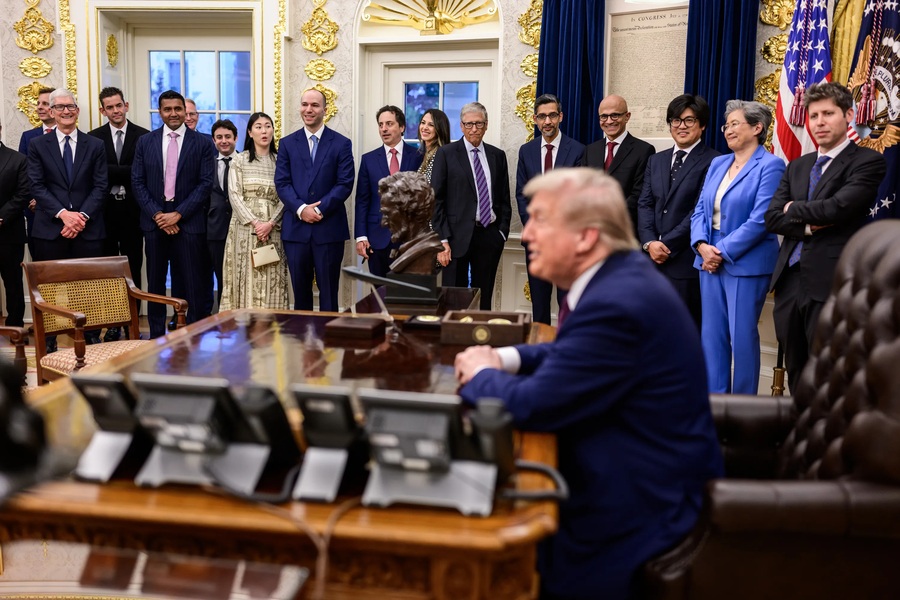
On Wednesday, the White House invited leaders of OpenAI, Google, Anthropic, Meta, and Microsoft to the Oval Office for a signing ceremony the following afternoon. President Trump was to sign an executive order on AI and cybersecurity—the administration's most formal effort yet to establish a voluntary process for reviewing frontier models before their release. But roughly three hours before the ceremony, when some company executives were already in the air to Washington, the White House called it off.
Trump told reporters he had "postponed" the order because he "didn't like certain aspects of it," adding: "I think it gets in the way of—you know, we're leading China, we're leading everybody, and I don't want to do anything that's going to get in the way of that lead." Former White House AI and crypto czar David Sacks called the president that morning—"unbeknownst to anybody," one official said, and "derailed it." Sacks purportedly raised concerns held by some in the AI industry that a "voluntary" review system could harden into a de facto licensing regime, slow the pace of American AI development, and hand China the lead. One source offered a blunter explanation for the president’s decision: Trump "just hates regulation," and the order was "just something doomers wanted."
There’s a line among public policy watchers that policy is personnel. This latest episode adds support to the idea that policy is also personal. However, it would be wrong to treat all of this as just another episode of disorganized personalism in the White House. Two additional elements of this story are worth emphasizing. The first is the substance of what was killed—about as mild an intervention as a serious government response to frontier-model risk could be. The second is the absence of any reliable process for working through frontier-AI disagreements, which matters more right now than it would in most periods: The next three years are likely the inflection point for the technology, and the United States cannot afford to govern them by impulse.
What the Order Would Have Done
Thanks to a leaked draft, we know roughly what was on the table. The order—titled "Promoting Advanced Artificial Intelligence Innovation and Security"—opened with the administration's now-standard line about leading the world in AI by refusing "to stifle this innovation with overly burdensome regulation." What followed was, for the most part, not regulation of industry at all.
The bulk of the order directed the government to harden its own systems in anticipation of future cyber threats posed by AI and the need to ensure the durability and resiliency of relevant offices and functions. It called on the Cybersecurity and Infrastructure Security Agency (CISA) to issue binding directives shoring up federal civilian networks, instructed the Office of Personnel Management to expand cybersecurity hiring, and created a Treasury-led "AI cybersecurity clearinghouse" to coordinate the discovery and patching of software vulnerabilities "in voluntary collaboration with the AI industry and operators of critical infrastructure." (Why Treasury, rather than CISA or the National Institute of Standards and Technology [NIST], would run a cybersecurity clearinghouse is unclear. It may have to do with the "outsized" role Treasury Secretary Scott Bessent has played in shaping the White House’s AI policy following Mythos.) This is about the least controversial thing a government can do in response to a new threat: defend itself.
The pre-deployment "vetting" of AI models provision that received significant attention was Section 3, and it was conspicuously hands-off. Similar to the “kick the tires” period called for in Lawfare by one of us (Frazier) alongside former White House AI adviser Dean Ball, it directed agencies to design a voluntary framework under which a developer could ask the government whether its model qualified as a "covered frontier model," and could give the government and "trusted partners" access before public release so that vulnerabilities could be found and patched in advance. The National Security Agency would lead the classified benchmarking process that would determine the threshold for "covered frontier model."
And, to avoid any miscommunication about the permissiveness of this process, Section 3(c) was explicit that lab participation was voluntary: "Nothing in this section shall be construed to authorize the creation of a mandatory governmental licensing, preclearance, or permitting requirement for the development, publication, release, or distribution of new AI models, including frontier models." The drafters expressly anticipated the objection that this was a back-door licensing scheme and wrote a disclaimer against it directly into the text.
The process the order envisioned did not come out of nowhere. Earlier this year, the Commerce Department announced that it had signed agreements with frontier labs to conduct predeployment testing through NIST's Center for AI Standards and Innovation (CAISI). The order would have extended that arrangement, largely by bolting on a coordination function.
Voluntarism as a Ceiling, Not a Floor
No policy is without its trade-offs, and this one is no exception. A 90-day prerelease window is a real cost in a fast-moving race; a lab that participates ships later than one that doesn't, and one can sincerely believe that the marginal security gain from early government access is small next to the compounding cost of slowing American AI development. It’s also an open question whether CAISI has the institutional resources necessary to review all the models that may be queued in a 90-day window. As Neil Chilson, head of AI policy at the Abundance Institute, pointed out, there was a recent period in which six models were released in a three-month span.
Empowering the government to help select "trusted partners" for early model access—especially through a classified NSA benchmark that is opaque to the public—hands officials a lever to pick winners and losers. Those left outside this select group may find themselves less prepared for novel cyber threats, for example. And a "voluntary" program can certainly become a template for a mandatory scheme down the line. Given the serious cybersecurity threats that frontier models pose, we think that these costs are worth bearing, though we recognize that reasonable minds can differ.
But it's worth underscoring the implications of postponing (if not outright canceling) this order, which, by its own terms, was about as modest a frontier-AI intervention as the federal government could put on paper: voluntary, focused on the government's own defenses, and explicitly barred from becoming a licensing regime. The objection isn't so much about government coercion as about the government having any settled role at all. Voluntary, in other words, isn't the floor of frontier AI policy in this administration; it's the ceiling.
This is a questionable position given that the concerns animating this draft order will likely grow in the near future. It is also self-defeating for those who applauded the order’s delay or demise. Far from resolving the risk of government meddling in AI, killing the order just leaves in place what Ball has described as the "opaque and essentially lawless" alternative: government access happening through back channels, on terms set case by case, with no stable rules at all. It may also slow AI adoption. If Fortune 500 companies and critical infrastructure entities are unsure whether using the latest models will expose them to significant risks, they may hesitate to deploy those models at all. Worse, when (not if) an AI-based cyber threat arrives—for example, public release of a frontier model that finds and exploits zero-days at scale—the United States will not have an orderly process to respond. It will have whatever a White House under immense political pressure can cook up in short order. That is a recipe for overreach.
In the long term the choice is between regulation that's well thought out and contestable today, and regulation that's indiscriminate and panicked later. Whether it knows it or not, opponents of a thorough, specific vetting process are choosing the latter.
The Uncertain Future
Where the Trump administration's AI policy goes from here is anyone's guess. Those supposedly speaking for AI labs may have won this battle, but the White House remains divided on the issue: A faction reportedly including Secretary of Treasury Scott Bessent takes frontier-model risk seriously and wants the order signed. And the broader Trump coalition is hardly an accelerationist monolith. Days before the canceled signing, Steve Bannon and more than 60 MAGA-aligned figures urged the president to require mandatory testing of advanced models—a request that reflects MAGA’s deep suspicion of Silicon Valley and AI. With his poll numbers continuing to fall, Trump may soon decide that AI populism is worth experimenting with. Either way, the lack of a deliberative process that can actually resolve these issues is a bad sign for all those in favor of a reasoned and effective AI policy framework—one that harnesses the benefits and mitigates the risks.
At least while this administration is susceptible to policy by phone call, stability on AI policy will have to come from Congress. Otherwise, America's AI policy will continue to exhibit its characteristically Trumpian flavor: dependent on whomever the president happened to talk to last. The next three years may be the most consequential this country will get on frontier AI governance. That is no way to spend them.