
Can Pakistan Contain the Violent Politics of Blasphemy?
Editor’s Note: Pakistan has a long history of political violence connected to the state’s severe blasphemy laws. The government’s decision to ban Tehreek-e-Labbaik Pakistan, a particularly aggressive source of blasphemy vigilantism, has stemmed some of this violence, write the Quincy Institute’s Adam Weinstein and Atlantic Council’s Michael Kugelman. But, they argue, this success will take continued effort to maintain.
Dana Stuster
***
In October 2025, Pakistan found itself battling two hardline Islamist movements at once. Its air force struck targets deep inside Afghanistan in retaliation for the Afghan Taliban’s protection of the Tehreek-e-Taliban Pakistan, or Pakistani Taliban, which has waged a relentless campaign of attacks on Pakistani troops and police. At home, security forces cracked down on Tehreek-e-Labbaik Pakistan (TLP), a homegrown political party and protest movement that rallies tens of thousands around the country’s harsh blasphemy laws and often turns violent. The border clashes with Afghanistan drew much more global attention, but it is the confrontation with TLP and its aftermath that will prove far more consequential for Pakistan’s future. So far, the ban on TLP appears to have reduced blasphemy-related violence and extremist political mobilization. But similar lulls have happened before, only for the movement to resurface. Whether this one lasts will depend on continued vigilance.
TLP emerged on Pakistan’s national stage in 2017, when it brought the twin cities of Islamabad and Rawalpindi—the country’s political and military nerve centers—to a standstill with a massive protest. Since then, TLP has staged mass protests, contested elections, and plastered its slogans on rickshaws and car windows across the country, cementing itself as a powerful religious party. For most Pakistanis, encounters with the group came during its paralyzing street demonstrations when authorities shut down mobile networks and sealed major roads with shipping containers. During the most recent mid-October protest, one netizen joked online that “Islamabad has five seasons: summer, container, autumn, winter and spring.” These protests often flared suddenly and dissipated just as quickly, leaving long stretches of calm. Such patterns fueled a popular belief, especially among critics of the establishment, that TLP was a pawn of the military or of opportunistic politicians—most notably Imran Khan’s Pakistan Tehreek-e-Insaf (PTI), which many accused of using the group as a spoiler to win the 2018 election. That suspicion, while not entirely baseless, is also a luxury of distance. For Pakistan’s Ahmadis, Christians, and even Sunni Muslims accused of blasphemy, and at times for foreign workers caught in the wrong place, TLP’s ideology is no abstraction. It is a violent threat, always waiting to surface.
Communal violence and vigilantism are embedded in the DNA of TLP. The country’s blasphemy laws serve as a convenient vehicle for the group’s power, transforming the resentment of disaffected young men into mob fury that can erupt in the streets or against their neighbors. Originally introduced by Britain during colonial rule to prevent sectarian strife by criminalizing insults to religious figures, Pakistan’s blasphemy laws were expanded and further Islamized under the military dictator Mohammad Zia-ul-Haq. The most severe provision prohibits insults to the Prophet Muhammad, but in practice, the definition of “insult” has grown dangerously elastic.
In May 2023, a cleric attending a rally for Imran Khan’s PTI declared that he respected Khan “like a prophet.” The crowd turned on him, beating him to death with metal rods. This chaotic form of blasphemy enforcement extends even to those who defend the accused. TLP’s patron saint is the late Mumtaz Qadri, the police officer who assassinated Punjab’s governor, Salman Taseer, for supporting Asia Bibi, a poor Christian woman falsely accused of blasphemy after sharing a cup of water with Muslim coworkers. Qadri’s trial and execution for the murder of Taseer turned him into a martyr and inspired TLP’s founder, the late wheelchair-bound cleric Khadim Rizvi, who harnessed the blasphemy issue to rally tens of thousands to his cause.
A full accounting of TLP’s record of violence would fill many pages, but a few examples capture its deadly impact. The group incited mobs to burn down a Christian neighborhood in the city of Faisalabad over an unproven blasphemy claim, caused hundreds of millions of dollars in damage to cities during protests, and killed multiple police officers in street clashes. Its followers have desecrated Ahmadi graves, lynched a Sri Lankan factory manager and set his body ablaze for removing TLP posters on company property, and carried out dozens of mob killings.
The vigilante culture TLP promotes risks international crises for Pakistan. In one case, a U.S. citizen of Pakistani origin was shot dead inside a Pakistani courtroom after being accused of blasphemy. In another, the group’s protests led the government to pledge to expel the French ambassador. More recently, TLP supporters detained a Chinese worker accused of blasphemy, prompting Pakistani authorities to quietly spirit him out of the country to prevent his murder.
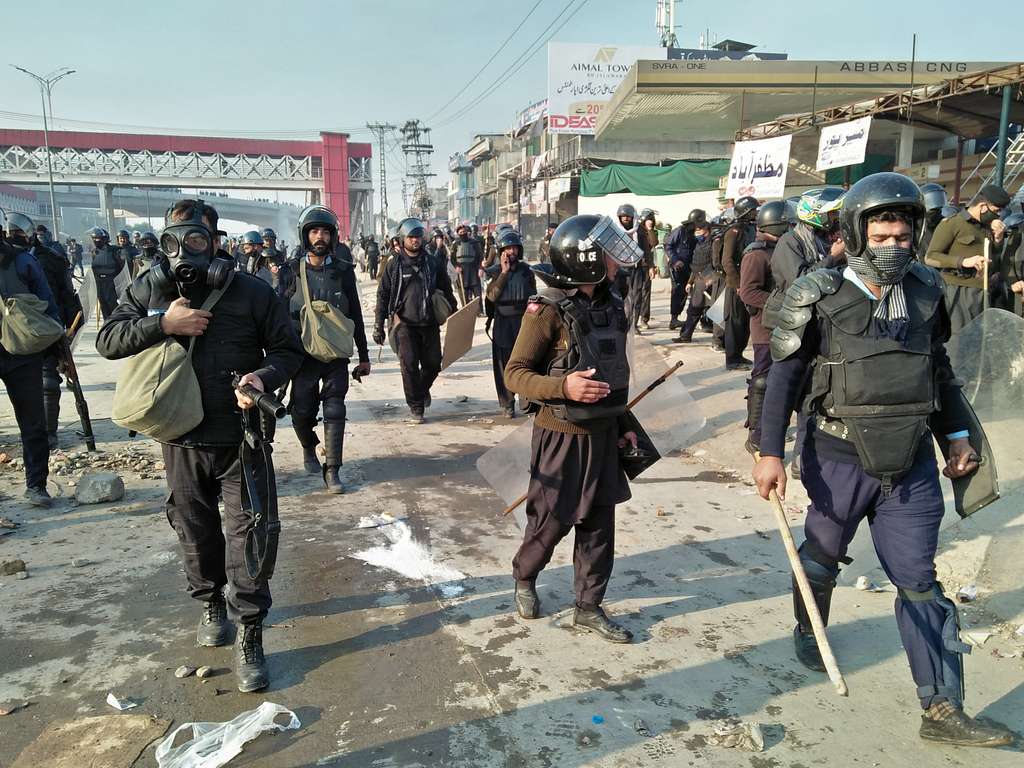
This legacy of TLP violence is an important backdrop for the events last October. TLP announced a protest in solidarity with Gaza, with plans to march from Lahore to Islamabad and then stage a demonstration in front of the U.S. Embassy. But it never made it to Islamabad; police broke up the protest in the city of Muridke. Details are sketchy about the crackdown, though according to Pakistani media reports there were at least several deaths of protesters and one police fatality. Then, on Oct. 24, Islamabad announced it was banning TLP under Pakistani anti-terrorism laws.
The Pakistani state has traditionally treated TLP with caution, using legal measures to manage the group’s threat while also negotiating with—and at times giving in to—the group’s demands, for fear of provoking the ire of its large support base and allied hardline religious groups. Pakistan did ban TLP once previously, in 2021, after it staged violent protests against the publication of satirical cartoons in France depicting the prophet Muhammad. But the ban was later removed, on the condition that TLP not return to violence.
Pakistani officials cited the violation of that condition as the reason for the reimposition of the ban. But they were likely guided by other considerations as well, chief among them a realization that the group has simply become too dangerous, with its repeated violence that causes bloodshed but also leads to massive chaos that results in extended road closures—a consequence with major implications from economic performance to air travel.
This violence and instability is why some criticism of the state’s response misses the mark. Observers have slammed the state’s response for being overly repressive, and for being the latest global example of attempts to stifle pro-Palestine and anti-Israel sentiment. The state’s response was certainly violent and heavy-handed, but many of the protesters had themselves turned violent in Muridke, and some critics have wildly exaggerated the death toll from the crackdowns. Pakistan is trying to get closer to the Trump administration, and so it does have a strong motivation to limit anti-Israel sentiment, especially in front of the U.S. Embassy. Still, the state didn’t crack down on TLP simply because it’s pro-Palestine; it did so because it has become increasingly fed up with—and fearful of—a group that has consistently resorted to violence, even after pledging to give it up. Islamabad appears to have concluded that the costs of cautious management of the group outweigh those of crushing it.
But Pakistan now faces a fundamental policy dilemma—one that policymakers have grappled with for decades but have not been able to properly address. Pakistan may not be a radicalized society, but radical ideas do resonate across wide swaths of the population and enable TLP and its ilk to mobilize in large numbers. The decision to ban TLP after quelling its recent protest risks further instability if its support base takes issue with the move and pledges fresh mobilizations against it. So far this has not occurred.
Another risk is that a different group could rise to fill the same space. The Muttahida Qaumi Movement (MQM), an ethnic Muhajir party that once had the power to shut down Karachi, was weakened after a series of paramilitary operations in the 2010s, but not destroyed. TLP moved in to occupy parts of the political vacuum left behind by MQM. That pattern could easily repeat.
So far this has not occurred, but the state must manage this continued threat even as it works assiduously to present itself to the world as a responsible partner, and as a nation worthy of international investment—whether in tourism, technology, energy, or critical minerals. It can do this by punishing blasphemy-related vigilantism, utilizing clerics and police to talk down crowds when they form, and making it clear to mainstream religious political parties that they must respect the rule of law when it comes to blasphemy. With the Trump administration intrigued, at least for now, by investment opportunities in Pakistan, Islamabad has an especially strong interest in making a destabilizing threat like TLP less visible.
But this is easier said than done. It’s one thing to stage military operations against anti-Pakistan terror groups and degrade their capacity to strike. But unlike the Pakistani Taliban, TLP enjoys sizable constituencies and support bases across Pakistani society and the blasphemy laws that grant legitimacy to movements like TLP are unlikely to be repealed. The Pakistani government can’t simply make it go away. In the years ahead, how Pakistani officials tackle the ongoing TLP challenge will have a major impact on Pakistan’s politics, economy, internal stability, and international relations.

.png?sfvrsn=1f2a75b9_7)
