Chemical Security Is National Security
Editor’s Note: The United States has long supported international efforts to end chemical weapons programs, in part by supporting the Organization for the Prohibition of Chemical Weapons (OPCW). George Mason University’s Gregory Koblentz warns that this support is in danger and that it could jeopardize programs to halt the use of chemical weapons around the world.
Daniel Byman
***
Swiss ambassador Sabrina Dallafior, the newly elected director-general of the Organization for the Prohibition of Chemical Weapons (OPCW), traveled to Damascus in mid-October. As the head of the international organization charged with implementing the Chemical Weapons Convention (CWC) that bans chemical weapons, her visit marked Syria’s progress in closing the book on the nation’s decades-long chemical weapons program.
Even after Syria joined the CWC in 2013 and the OPCW verified the destruction of Syria’s declared chemical weapons stockpile by the following year, President Bashar al-Assad continued using chemical weapons as part of his desperate and bloody bid to stay in power. Following the overthrow of Assad in December 2024, the new Syrian government has made important progress in cleaning up Assad’s toxic legacy. In May, OPCW inspectors confirmed the discovery of dozens of chemical munitions that Assad had hidden from inspectors. In August, Syria began destroying these weapons under the OPCW’s supervision, the first such destruction since 2014. The Syrian government has also turned over more than 100,000 documents related to the former chemical weapons program to the OPCW. Locating, securing, verifying, and safely destroying the remnants of Assad’s chemical weapons program will be a long-term process as Syrian teams and OPCW inspectors continue to scour the country and analyze documents searching for clues as to the whereabouts of remaining chemical warfare agents, precursors, munitions, and production equipment.
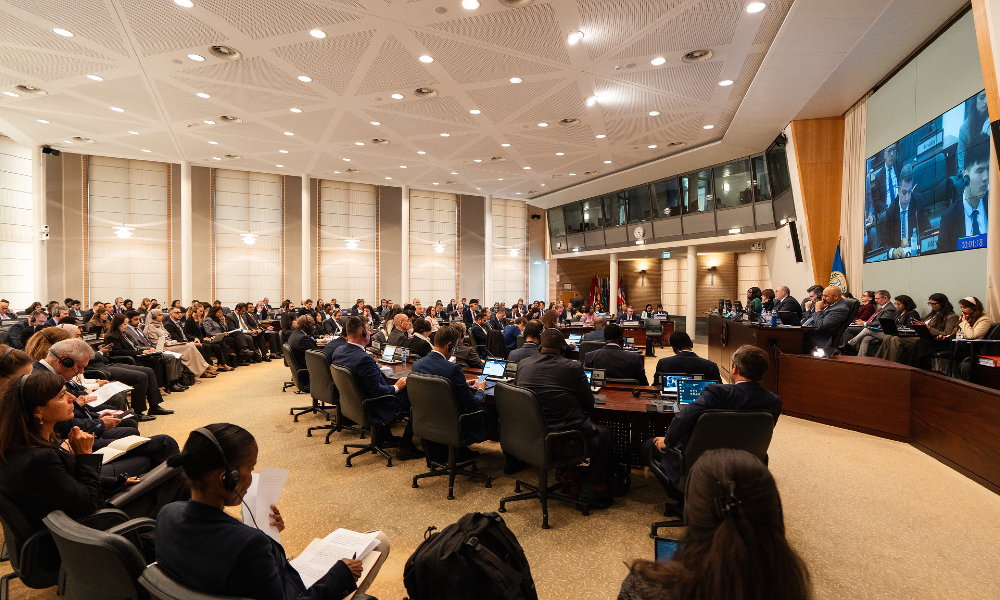
This ambitious and vital undertaking, however, is threatened by a financial crisis at the OPCW. In early October, Dallafior told diplomats attending a high-level meeting at the organization’s headquarters in The Hague that due to the failure of state parties, particularly the United States, to pay their annual dues on time, the OPCW was running out of money. According to Dallafior, the “stark reality” is that the OPCW “may have to curtail core activities if the situation does not improve soon, including in relation to Syria deployments and other forms of technical assistance.” Ahmet Üzümcü, who served as director-general of the OPCW at the height of the Syrian chemical weapons crisis, has echoed Dallafior’s warning about the potential impact of this “alarming” situation on the chemical weapons nonproliferation regime.
The OPCW’s financial crisis threatens the ability of the organization to pursue its vital mission of preventing the proliferation and use of chemical weapons around the world. In addition to endangering current operations overseeing the destruction of chemical weapons in Syria, the OPCW’s assistance to Ukraine to defend it against Russia’s use of toxic chemicals on the battlefield may have to be curtailed and the agency would be unable to launch new missions such as investigating recent revelations about Sudan’s production and use of chemical weapons.
United States Withholding Funding From OPCW
The primary cause of the financial crisis afflicting the OPCW is the failure of the United States, the largest contributor to the OPCW, to fully pay the $17 million it owes for 2026. This contribution is one-fifth of the OPCW’s annual budget of $90 million, which the United States voted in favor of last year. To put that amount into perspective, this is less than .04 percent of the $43.6 billion that the Pentagon estimates the Iran war has cost so far.
The CWC has historically enjoyed strong bipartisan support in the United States. The treaty was drafted by the Reagan and H.W. Bush administrations and ratified by the 1997 Republican-controlled Senate during the Clinton administration. Since then, the OPCW has verified the destruction of more than 72,000 tons of declared chemical weapons in eight countries and inspected thousands of chemical facilities to ensure that they are being used only for peaceful purposes. The OPCW won the Nobel Peace Prize in 2013 for its “extensive efforts to eliminate chemical weapons.”
This shortchanging of the OPCW is surprising given President Trump’s strong response to the use of chemical weapons by Russia and Syria during his first term, including the imposition of stiff sanctions against both countries and the use of military force twice against the Assad regime. During Trump’s first term, the United States also led an effort to add Novichok nerve agents to the CWC’s list of regulated chemicals, strengthened the OPCW’s ability to attribute chemical attacks, and was one of the founding members of the Partnership Against Impunity, a coalition of 40 countries dedicated to holding perpetrators of chemical attacks accountable for their crimes.
The United States’ refusal to fully fund the OPCW is in stark contrast to the State Department’s own assessment of the vital role that the OPCW plays in international nonproliferation and U.S. national security. In its fiscal year 2026 budget, the State Department requested $18.1 million for the OPCW for its role in “enhancing U.S. safety, security, and prosperity by deterring the use of chemical weapons by state and non-state actors.” Even though the fiscal year 2027 budget request that State sent to Congress in April included a 79 percent funding cut for international organizations, the department identified the OPCW as one of seven multilateral organizations for which funding would be prioritized because these agencies “directly advance U.S. national security, economic interests, and global stability.” Indeed, at the latest Executive Council meeting, Ambassador Nicole Shampaine, the U.S. permanent representative to the OPCW, provided a strong endorsement of the organization and its vital contribution to U.S. and international security. The cause of the State Department’s contradictory approach of publicly praising the value and importance of the OPCW while withholding the funding the organization needs to accomplish its mission is unclear.
The Global Chemical Threat Landscape
The OPCW is currently engaged in important operations in Syria and Ukraine, and a new mission in Sudan may be on the horizon. In addition, the United States has alleged that Iran is violating the CWC, and human rights groups have raised concerns that Iran used incapacitating chemical agents on protesters in January 2026.
In Syria, the OPCW is finally making progress locating, securing, and destroying the remnants of the Assad regime’s chemical weapons program. So far, just over half of the newly discovered leftover weapons have been destroyed under OPCW supervision while Syrian teams and OPCW inspectors search the country for more. OPCW inspectors are busy translating the 100,000 documents the Syrian government has turned over and analyzing dozens of samples taken from suspected chemical weapons sites. The United States has been supportive of these efforts through its active participation in the Syrian-led multinational Breath of Freedom Task Force that is coordinating the provision of international assistance to Syria for chemical weapons verification and destruction. For its part, the OPCW has undertaken training missions to build the capacity of the Syrian government to find, secure, and destroy chemical weapons left over from the Assad regime.
Cleaning up Assad’s toxic legacy is both a counterproliferation and a counterterrorism priority. In its latest report, the UN Security Council’s terrorism sanctions committee warned that the Islamic State had kidnapped a chemical engineer to help the terrorist group acquire chemical weapons left over from the Assad regime’s old arsenal. As I have written elsewhere, “Even a single successful chemical attack by Assadist insurgents in Damascus or Aleppo could scare off investors and set back reconstruction in that country for years. In this case, an ounce of prevention is worth a pound of sarin.”
Ukraine is another important focus for the OPCW. Russia continues using chemicals as weapons against Ukraine at an unprecedented scale, with more than 14,000 reported incidents since Russia’s full-scale invasion in 2022. The United States and multiple European governments have accused Russia of using riot control agents and chloropicrin, a World War I-era vomiting agent, on the battlefield in Ukraine. The OPCW has conducted five investigations of toxic chemicals being used in Ukraine, and each time they confirmed Ukraine’s allegations that riot-control agents have been used in combat, which is banned by the CWC. The OPCW has also trained Ukrainian experts to detect, investigate, and respond to chemical attacks.
The OPCW has also played a crucial role in responding to Russia’s use of chemical weapons against perceived “enemies of the state” by confirming the findings of British and German labs that the Soviet-developed Novichok nerve agent was used to poison the double agent Sergei Skripal in 2018 and Putin critic Alexei Navalny in 2020. In 2020, members of the CWC adopted a proposal co-written by the United States to add Novichok agents to the CWC’s schedule of regulated chemicals, the first time this list had been updated since the treaty entered into force. The OPCW is in the process of establishing a network of labs that can detect toxins, such as the one used to fatally poison Navalny in 2024, to complement the lab network it has already used to good effect to investigate chemical attacks conducted by Syria and Russia.
Recent reports of chemical weapons use by Sudan could place new demands on the OPCW that are not covered by its regular budget. Since the United States first accused Sudan in May 2025 of using chemical weapons against the Rapid Support Forces as part of that country’s civil war, additional credible evidence has emerged that Sudan produced a stockpile of aerial bombs designed to disperse chlorine gas and used chlorine-filled cylinders in at least two attacks in September 2024.
During the first Trump administration, the United States declared Iran to be in violation of the CWC for its undeclared production of chemical weapons and its transfer of chemical weapons to Libya in the 1980s. In addition, the United States has assessed that Iran is developing pharmaceutical-based agents to use as incapacitating chemical weapons. The United States used an OPCW meeting in 2024 to reveal new information about Iran’s weaponization of medetomidine, a veterinary sedative. The United States has identified several Iranian entities believed to be conducting research and development on chemical weapons, including incapacitating agents. The use of incapacitating chemicals, like medetomidine, for domestic law enforcement purposes was declared illegal by state parties to the CWC in 2021, with the strong support of the United States. In early 2026, human rights groups reported worrisome indicators that Iran had used chemicals that were more disabling and dangerous than standard riot-control agents to break up some protests as part of its bloody crackdown on domestic dissent. No international investigation of these incidents has taken place so far.
The allegations regarding Russia, Sudan, and Iran could potentially trigger an investigation of alleged use, a technical assistance visit, or even a challenge inspection of suspected chemical weapons facilities. Any of these deployments would place new demands on the OPCW’s inspectors and laboratory.
Impact on OPCW Operations
The ability of the OPCW to handle its existing high-stakes missions in Syria and Ukraine, or to take on new missions in Sudan or Iran, is being put at risk by the United States’ overdue payments. Over the summer, the OPCW’s independent financial advisory board warned that these missing payments have placed the organization in a “precarious” financial situation and it now faces the “unprecedented circumstance” of having to cancel or postpone routine activities, including inspections and verification missions. These are strong words from otherwise mild-mannered accountants. By October, Dallafior reported that “we are more than 75 percent of the way through the year, but we have received less than 65 percent of assessed contributions for 2026.” To offset this budget crunch, the organization has instituted a de facto hiring freeze, exhausted its operational reserve fund, and begun diverting money from an auxiliary account to fund operating expenses.
It is possible that U.S. officials are under the mistaken impression that they can continue to fund OPCW’s activities in Syria and Ukraine through voluntary contributions to the dedicated trust funds that exist for both countries. This is not practical. These trust funds supplement, but do not replace, funds from the regular budget. More important than the size of the trust funds for Syria and Ukraine is that they cover only some of the direct operational costs that the OPCW incurs. The OPCW’s activities in Syria and Ukraine rely heavily on overhead support provided by different components of the OPCW that are paid for out of the regular budget.
The voluntary contributions received by the OPCW since the fall of the Assad regime are not even sufficient to cover the expected operational costs of verification and destruction in Syria; the OPCW has had to tap into another account to cover the shortfall. The OPCW was recently forced to reallocate some of that account to cover the salaries of employees. Now that the main operational reserve fund has been depleted, the rest of this auxiliary account may be needed to keep the lights on at the OPCW’s headquarters. This would leave the Syria mission with a multimillion-dollar shortfall through the end of 2027.
As the rest of the OPCW slowly grinds to a halt due to a lack of funds to pay for travel, logistics, security, training, and equipment, the organization will be hard-pressed to sustain its activities, not just in Syria, but in Ukraine as well, and unable take on new missions in Sudan or Iran.
The United States should deliver its full assessed contribution to the OPCW immediately. Chemical weapons are the only weapon of mass destruction that have killed anyone in the past 20 years, and the United States, and the world, are safer today thanks to the OPCW’s elimination of declared chemical weapons stockpiles. Because states and terrorist groups are still pursuing these weapons, the OPCW’s work remains vital and deserves strong U.S. support.