Dissecting Trump’s Deal for Russian Diesel
There is more smoke than fire to the deal — except when it comes to Ukraine.
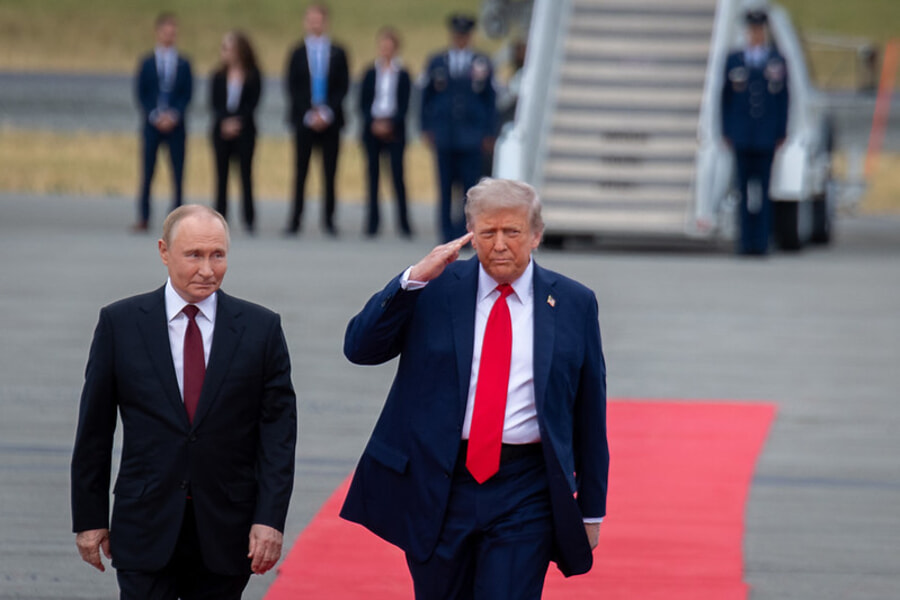

This past Friday, Oct. 9, President Trump announced a new energy deal that has the potential to upend U.S. sanctions policy towards Russia. On the heels of a “highly successful discussion” with Russian President Vladimir Putin, Trump wrote on Truth Social that Russia would soon be providing millions of tons of diesel fuel—a key resource that has been the target of U.S. sanctions since shortly after Russia’s 2022 invasion of Ukraine—“to the American and Global Marketplace[.]” According to Trump, this would mean that “Diesel Prices for Americans and, indeed, the World, will be COMING DOWN, IN RECORD NUMBERS, AND FAST!”
Trump’s announcement was a transparent political statement aimed at addressing concerns over spiking energy—and specifically diesel fuel—prices that are widely attributed to the Iran War and expected to seriously undermine his fellow Republicans in next month’s midterm elections. But the prospect of the United States going from sanctioning Russian diesel fuel to importing has proven more controversial than Trump anticipated. Condemnations came quickly from across the political spectrum. By Oct. 13, a bipartisan coalition of senators publicly urged Trump to reverse his decision. Thus far, however, Trump has stuck firm, defending his decision as “the right choice for the American People.”
Digging into the details, however, reveals Trump’s diesel deal to be anything but. As a legal matter, it’s not clear that Trump’s actions can actually clear the way for U.S. imports of Russian diesel fuel as he claims. And while he can ease U.S. restrictions on the global market for Russian diesel fuel, a number of other factors make it unlikely that doing so will meaningfully impact prevailing prices. Instead, the deal’s most serious consequences will likely be felt in Ukraine, as Putin appears to have persuaded Trump that Ukraine’s strikes on Russia’s diesel fuel industry—a major contributor to its recent military success—are pushing up global energy prices and thus hurting Trump’s domestic political prospects.
The operative legal instrument behind the diesel deal is General License No. 135, which the Treasury Department’s Office of Foreign Assets Control (OFAC) issued on Oct. 9, shortly after Trump’s Truth Social post. It exempts “all transactions … related to the sale, delivery, offloading, or importation, including importation into the United States[,]” from two longstanding sets of Russia-related U.S. economic sanctions: the Russian Harmful Foreign Activities Sanctions Regulations codified at 31 C.F.R. part 587, which were promulgated around the 2022 invasion of Ukraine; and the Ukraine-/Russia-Related Sanctions Regulations codified at 31 C.F.R. part 589, which were promulgated following Russia’s 2014 occupation of Crimea. Both are the products of executive orders issued by Trump and his White House predecessors, using the authority the International Emergency Economic Powers Act (IEEPA) provides to the president.
Licensing exceptions to such restrictions are a well-accepted aspect of the president’s authority under IEEPA, meaning Trump can almost certainly waive whatever limits these sanctions set on the ability to import Russian diesel fuel into the United States. (There is an argument that Trump was obligated to provide Congress prior notice and an opportunity to countermand before licensing exceptions to at least some of these sanctions, to the extent that they “significantly alter[] [U.S.] foreign policy with regard to the Russian Federation.” But the Trump administration has declined to do so for prior similar licenses without consequence.)
The problem is that these executive-imposed sanctions aren’t the only legal restrictions on such imports. In 2022, Congress also enacted the Ending Importation of Russian Oil Act, which states that “[a]ll products of the Russian Federation classified under chapter 27 of the Harmonized Tariff Schedule[,]” including diesel fuel, “shall be banned from importation into the United States.” As they are imposed by statute, the president cannot waive or terminate these restrictions except as permitted by Congress. The act only allows the president to terminate them when certain conditions are met, including a peace agreement “accepted by the free and independent government of Ukraine.” It also requires the president to follow a specific process that includes substantial advance notice to Congress and an opportunity for it to countermand the president’s decision. None of those conditions have been met, and there are no signs that Trump intends to pursue this process. Hence, these statutory restrictions appear to remain in place.
The Trump administration has given no explanation as to how its new diesel deal should be reconciled with this statute, other than to generically assert that “[t]he granting of this general license is consistent with similar actions previously taken by OFAC and is in compliance with all applicable laws.” The text of the 2022 law, however, points to one possibility: it says that the import ban should be implemented “in a manner consistent with any implementation actions issued under Executive Order 14066[,]” which is one of the executive orders underlying the Russian Harmful Foreign Activities Sanctions Regulations and the IEEPA-based measure that originally banned the importation of Russian petroleum products before Congress decided to install that ban in statute. Contemporaneous statements by legislators suggest that this language was intended to preserve the effects of certain general licenses the Biden administration had issued under Executive Order 14066 to allow for the orderly wind-down of existing economic relationships, not to render the import ban waivable without congressional authorization.
Nonetheless, the Trump administration might argue that this language makes the import ban subject to future general licenses as well, including General License No. 135. Doing so would, however, effectively reinstall an item-by-item waiver provision that had been in the original House-passed version of the bill but was removed in the final version following criticisms from within Congress. It would also render the act’s detailed termination provisions surplusage, as a president who wished to end the program could simply issue a broad license to that effect. Both moves run counter to established principles of statutory interpretation. Hence, while the Trump administration may have a colorable argument, it’s far from clear that it would prevail in federal court.
Of course, the Trump administration has been willing to rely on questionable legal arguments before. Nor is it clear who might be willing and able to challenge the Trump administration’s position in court, though the competitors of anyone who imports Russian diesel fuel—whether non-participating diesel fuel providers or purveyors of competing fuel sources, like biodiesel and renewable diesel—seem likely to have standing to do so if and when any imports actually happen. But before it can get that far, the Trump administration will need to persuade a different audience of its legal arguments: the private U.S. companies who would actually import Russian diesel fuel. And that may not be easy.
The reason is that relying on General License No. 135 is not risk-free. Federal law imposes substantial criminal and civil penalties for any “importation … into the United States contrary to law[,]” both of which seem applicable to violations of the 2022 import ban. President Trump can use his pardon power to shield importers from the former but not the latter, which can include penalties equal to the value of any unlawfully imported goods as well as the forfeiture of any vessels used to transport them. Moreover, those penalties are potentially applicable for up to five years after a prohibited import arrives in the United States, meaning the next presidential administration will also get an opportunity to pursue them. Prospective importers will thus need confidence that any legal argument they rely upon is strong enough to shield them from potential future enforcement actions, including in federal court. The above reading of the 2022 import ban seems unlikely to satisfy them.
For these reasons, General License No. 135 seems unlikely to lead to an actual increase in U.S. imports in Russian diesel fuel—a point Trump appeared to concede in remarks to the press on Tuesday. Instead, as Trump described it, Russia will be releasing the agreed upon diesel fuel “to the entire world,” not directly to the United States. In other words, General License No. 135’s most direct and substantial impact is likely to be overseas.
Indeed, General License No. 135 removes restrictions on “the sale, delivery, offloading, or importation … of diesel fuel of Russian Federation origin” anywhere in the world, not just in the United States. Executive order-based sanctions issued under IEEPA—which Congress has partly codified but left subject to Treasury Department licensing—were the main U.S. constraint on the global market for Russian diesel fuel. By suspending these restrictions, General License No. 135 makes it easier for the rest of the world to purchase Russian diesel fuel again. In this sense, General License No. 135 is perhaps understood as a successor to the other general licenses—specifically, Nos. 133, 134, and 134B—that the Trump administration issued in the spring to allow some trade in Russian crude oil and petroleum products, in hopes of lowering global energy prices that were spiking (and have since remained high) as a result of the Iran War. But while those licenses were framed as temporary 30-day exceptions for a limited subset of Russian oil products (those already loaded onto vessels), General License No. 135 lasts six months and applies to future shipments as well, suggesting a more enduring policy shift.
That said, General License No. 135 is also narrower than these prior licenses in one important regard: It applies only to diesel fuel, not the broader range of petroleum products addressed by prior licenses. This may simply reflect Trump’s political calculus that diesel fuel prices are of primary political concern to U.S. consumers (and voters). But it may also be a tacit acknowledgment of another set of statutory limits on the horizon: the Lindsey O. Graham Sanctioning Russia and Iran Act of 2026 that Trump signed into law last month.
Among other measures, the Graham act directs the president to impose substantial new tariffs on certain countries that are major importers of Russian-origin crude oil by Oct. 18. But it defines “crude oil” as “the substance described in Harmonized System code 2709”—a definition that does not include diesel fuel, which code 2710 covers instead. Hence, focusing General License No. 135 on diesel fuel allows the Trump administration to argue that it is not urging countries to act contrary to the letter of those Graham act provisions it is required to implement later this month. Whether Trump’s actions are consistent with the spirit of that law, however, presents a much harder question.
Of course, the fact that the Trump administration has the legal authority to remove U.S. sanctions on the global trade of Russian diesel fuel doesn’t mean that doing so will yield the lower diesel fuel prices Trump has promised. The European Union and other traditional U.S. allies still have substantial sanctions on Russia’s oil sector that are likely to continue presenting a barrier to increased trade in Russian diesel fuel.
More fundamentally, even if all legal barriers were removed, it’s not clear that Russia can actually produce and export enough diesel fuel to meaningfully lower global prices. In part due to Ukrainian military strikes, Russia’s capacity to produce diesel fuel has been severely diminished in recent months. Prior to Putin’s deal with Trump, Russia had actually installed export limits on diesel fuel, as its domestic demand exceeded its production capacity. While Putin lifted some of these limits as part of his deal with Trump, it’s unclear whether Russia will be able to produce enough diesel fuel to meet the relatively modest export targets the two leaders agreed to—4,800,000 tons of diesel fuel, enough to satisfy about two percent of U.S. demand—let alone the much larger amount that would be needed to meaningfully impact global prices. This is especially true as Russian domestic consumers may have to import diesel fuel to compensate for those exports, mitigating any net impact on global supplies. That said, Russian authorities have said they are aiming to restore diesel production and exports to prior levels—if, that is, Ukrainian strikes can be held at bay.
In this sense, the main payoff of the diesel deal may be limited to what President Trump deployed on Truth Social on Friday: a politically convenient talking point, promising relief to U.S. consumers that may never arrive. The fact that global diesel fuel prices have not meaningfully moved in the days since the deal was announced suggests that the broader diesel fuel industry does not seem to view this promise as credible. Meanwhile, the hostile reception the diesel deal has received domestically—including among Trump’s fellow Republicans—suggests it may not be the domestic political boon that Trump may have hoped for.
Nonetheless, the diesel deal does not come cost free. In exchange for facilitating diesel fuel exports, Putin appears to have convinced Trump to pressure Ukraine into ending strikes against Russia’s petroleum sector, including by withholding key U.S. security assistance. Perhaps more concerningly, he also appears to have persuaded Trump that Ukraine’s attacks on Russia’s oil infrastructure are substantially contributing to global energy prices, putting Trump’s domestic political interests and Russia’s strategic interests into alignment. This appears to be the impetus for the “energy ceasefire” that Trump unilaterally declared over the weekend, without consulting either side. Only Ukraine seemed to begrudgingly abide by the ceasefire, as it held off on striking Russian diesel facilities while Russia continued to hit various sites related to Ukraine’s energy sector.
As of Oct. 15, Ukraine appears to have resumed strikes as well. The question now is whether European allies, opposed members of Congress, and others can convince Trump to reverse course and drop the one-sided arrangement he tried to impose before he does serious damage to Ukraine’s war effort. But doing so will also mean effectively abandoning the diesel deal, which Trump himself described as being contingent on “the condition of [Russia’s] Diesel Refineries.” Either way, this seems like a steep price to pay for such a limited payoff. The fact that Trump was willing to do so may reflect a fundamental misunderstanding on his part—or it may be a sign of just how subordinate supporting Ukraine is to Trump’s domestic political interests.
Former senior officials from the first and second Trump administration have long warned about the dangerous dynamics of Trump’s relationship with Putin: Trump’s focus on interpersonal dynamics over policy details; Putin’s ability to “pla[y] to Trump’s ego and insecurities with flattery”; Trump’s focus on “reelection calculations” over U.S. foreign policy interests. The fact that the diesel deal emerged from a direct conversation between the two leaders fits all too comfortably within this established pattern. In this sense, it can serve as further confirmation of what some analysts have long claimed: that when it comes to Russia, Trump’s personal involvement may be his own worst enemy.