Inside the Legal Battles Ahead for Nicolás Maduro
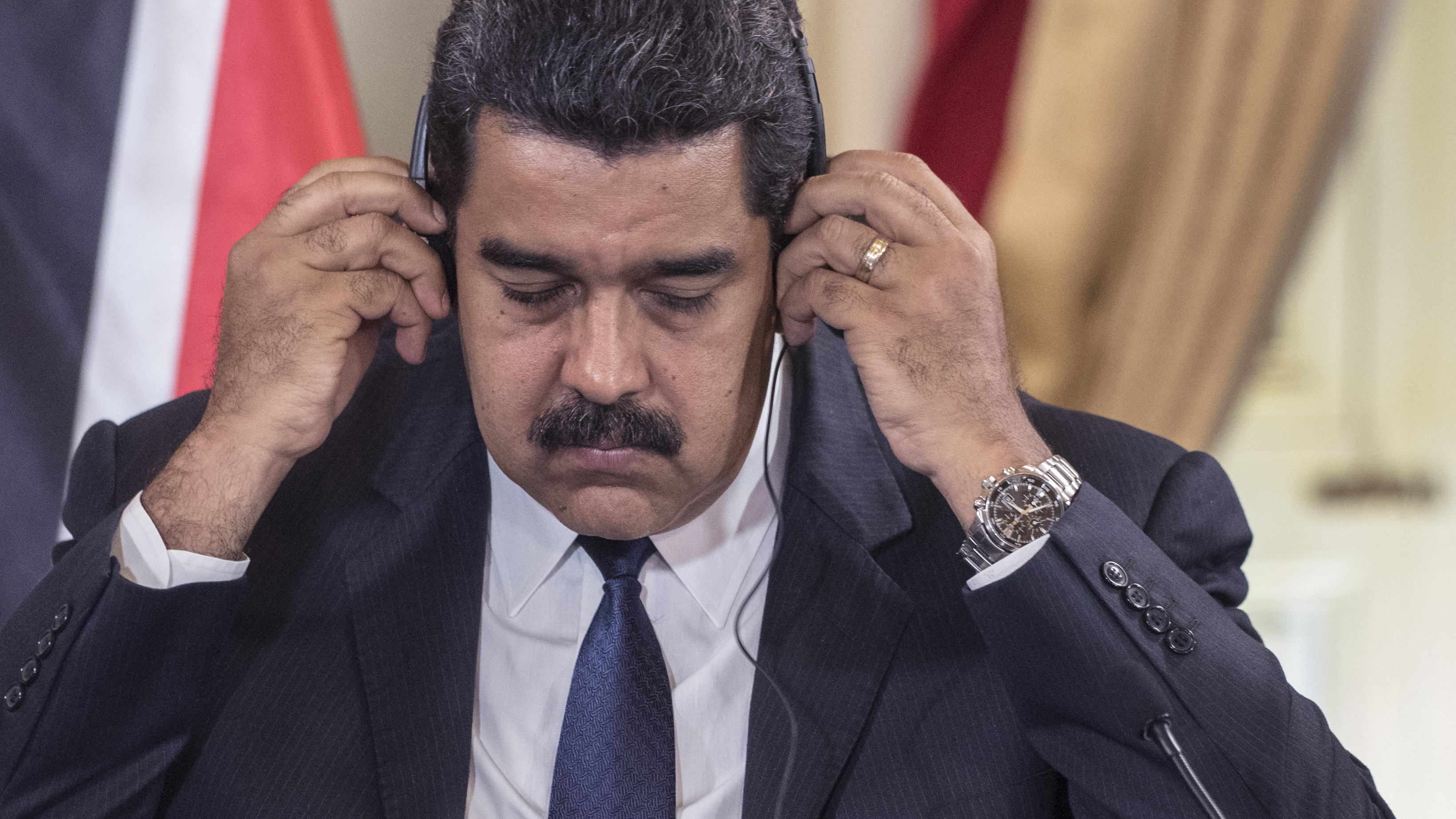




Two drastically different stories emerged from the New York courtroom in which Nicolás Maduro appeared earlier this week to face criminal charges. In one telling, the president of a sovereign state was forcibly kidnapped from his residence by a hostile nation’s forces, rendered a de facto prisoner of war, and whisked away to face an uncertain fate involving what his abductors’ attorney general referred to as “the full wrath of American justice.” The opposing narrative tells the story of a cruel dictator of a foreign nation, complicit in illegal drug trade and its associated crimes of violence against the United States, who is finally facing accountability for his transgressions. In that story, the dictator’s arrest was brought about by law enforcement agencies following long-established legal principles; the involvement of the military in his apprehension was solely for the protection of the arresting agents.
The sheer scale of the effort to apprehend Maduro could provide succor to either point of view. Many of the techniques and tools used by the units involved in the incursion into Venezuela—the disabling of the region’s power supply and critical infrastructure, the deployment of armed drones and electronic warfare planes, the use of half a dozen squadrons’ worth of fighter and bomber aircraft, and knowingly risking the lives of civilians who had nothing to do with Maduro’s alleged crimes—make clear that, extraterritorial or not, this was not a run-of-the-mill arrest.
The conflicting interpretations of these events will unfold in the form of criminal litigation. The government’s indictment of Maduro provides the specifics of what it must prove to convict—and for its narrative to prevail. But Maduro can raise a variety of defenses. While each appears to face an uphill battle due to existing case law, there is reason to take the arguments seriously; the unprecedented nature of Maduro’s case may make it distinguishable from other quasi-analogous cases, of which there are few, some nonbinding.
In other words, it’s a case ripe for creative legal argumentation. Whether the parties’ litigation strategies lean into that opportunity will play out in court.
The Charges
Maduro is charged in the Southern District of New York (SDNY) with four counts related to narco-terrorism, drug trafficking, and weapons possession. The 25-page indictment describes a decades-long campaign of corruption in which an “illegitimate government” leveraged its “power to protect and promote illegal activity, including drug trafficking”—and exploited the proceeds to enrich and entrench “the country’s political and military elite.” Maduro was originally indicted in March 2020; this superseding indictment was unsealed hours after his arrest.
The indictment names as co-conspirators Maduro’s wife, Cilia Flores; his son, also named Nicolás Maduro; two high-ranking Venezuelan officials, Diosdado Cabello and Ramón Rodríguez; and an alleged leader of the Tren de Aragua gang, Héctor Guerrero.
This conspiracy, the document claims, involved partnerships with U.S.-designated foreign terrorist organizations (FTOs) such as the Fuerzas Armadas Revolucionarias de Colombia (FARC), Ejército de Liberación Nacional (ELN), Sinaloa Cartel, Zetas, and Tren de Aragua. The ousted Venezuelan president as well as top officials and family members are accused of assisting these groups in transporting “thousands of tons” of cocaine to the United States via waypoints in Central and South America.
The indictment includes a litany of alleged overt acts in furtherance of the conspiracy. Generally, prosecutors say, Maduro and his regime provided regular and repeated law enforcement and logistical support to drug traffickers. Specifically, they claim that Maduro sold diplomatic passports to drug traffickers to allow them to travel under diplomatic cover; arranged for the movement of private planes transporting drug proceeds also under diplomatic cover; worked with Flores, assisted by armed military escorts, to traffic drugs previously seized by Venezuelan law enforcement; and ordered kidnappings, beatings, and murders against those who owed them money or otherwise threatened their drug trafficking operation.
Maduro’s co-conspirators are also accused of accepting bribes to broker meetings with cartels and perform other favors related to drug trafficking (some officials, the indictment alleges, accepted cuts of the proceeds or even of the product itself); arranging for the protection of drugs in transit by armed men carrying automatic machine guns and grenades; and coordinating global smuggling of drugs, including to Miami and New York. The indictment mentions multiple meetings between the Maduro regime and the aforementioned FTOs.
The indictment additionally discusses conduct by Venezuelan officials who pleaded guilty in SDNY to charges in previous indictments superseded by the Jan. 3 indictment: Hugo Carvajal and Clíver Alcalá. Their cooperation may prove crucial to the case. In December 2025, Carvajal, who has not yet been sentenced, released through his attorney a three-page letter from prison addressed to “President Trump and the People of the United States,” making accusations against Maduro and offering to “provide additional details.” The letter was originally published in the Dallas Express. Two of the Venezuelan first lady’s nephews were also convicted by a jury of cocaine trafficking conspiracy in 2017 in a saga dubbed the “Narcosobrinos affair.”
Count one, narco-terrorism conspiracy, alleges that Maduro and his co-defendants “combined, conspired, confederated and agreed together and with each other to violate” (21 U.S.C. § 960a). This statute links prohibited acts related to the manufacturing, distribution, or dispensing of narcotics to the provision of “anything of pecuniary value to any person or organization” involved in terrorist activity or terrorism. In this case, the distribution of and possession with intent to distribute cocaine is linked to providing support to the FARC and the other FTOs.
Count two, cocaine importation conspiracy, alleges that Maduro and his co-defendants violated 21 U.S.C § 963 by importing a controlled substance into the United States; manufacturing, distributing, or possessing with intent to distribute a controlled substance with cause to believe that substance would be unlawfully imported into the United States or waters within 12 miles of it; and distributing or possessing with intent to distribute a controlled substance on board an aircraft registered in the United States.
Count three alleges that Maduro and his co-defendants, in relation to or in furtherance of the narco-terrorism and drug distribution counts, knowingly used, carried, and possessed automatic machine guns and other destructive devices, in violation of 18 U.S.C § 924.
And count four is a conspiracy charge related to the same statute as count three.
Potential Challenges on Grounds of Illegal Arrest and Transfer to U.S.
Maduro will likely raise legal challenges to his indictment on the grounds that his arrest and transfer to the United States were sufficiently unlawful as to warrant dismissal of his case. While those arguments will face an uphill battle—as described further below—they will undoubtedly be the subject of litigation. Indeed, Maduro’s counsel already indicated that he would raise defenses related to “the legality of [Maduro’s] military abduction.” While he didn’t specify what those might be, one can imagine a number of possible routes.
For one, Maduro may raise claims relating to the extraterritorial nature of his arrest—for instance, that he was forcibly abducted by the U.S. military from Venezuela, a foreign state, in apparent violation of the United Nations Charter and other international law. While the executive branch has long maintained that federal law enforcement may effectuate arrests overseas in pursuit of domestic criminal charges, Maduro will undoubtedly argue that even if such authority exists, it is limited—and that his arrest falls outside the bounds of what’s permitted.
Maduro may, for instance, point to the heavy involvement of U.S. armed forces to argue that his extraction from Venezuela was not an extraterritorial arrest as much as it was a military operation to depose a head of state. Here, Maduro may attempt a variation of the argument Gen. Manuel Noriega made in challenging his prosecution in the 1990s.
Noriega had been arrested in 1989, after President George H.W. Bush sent tens of thousands of troops to Panama in Operation Just Cause. According to the Bush administration, the operation had four objectives, only one of which related to Noriega: to protect Americans, to restore democracy, to safeguard treaties relating to the strategically valuable Panama Canal, and to arrest Noriega to face criminal charges in the United States. Noriega, fleeing prosecution, hid out at the embassy of the Holy See—relying on a Vatican emissary to pick him up at a Dairy Queen on his way. U.S. troops surrounded the building and blasted heavy metal music until he surrendered after an 11-day standoff. Noriega was eventually convicted on eight counts of racketeering, drug trafficking, and money laundering, with the leading catch-all racketeering conspiracy count charging that he assisted a Colombian cartel in shipping cocaine through Panama and ultimately to the United States. Noriega's defenses in his case could very well resurface in Maduro’s.
In particular, Maduro may replicate Noriega’s argument that the court should exercise its inherent supervisory power to decline jurisdiction, because hearing the case would effectively make the court complicit in the government’s alleged misconduct. Although the court rejected Noriega’s claim, that decision, out of the U.S. District Court for the Southern District of Florida and affirmed by the U.S. Court of Appeals for the Eleventh Circuit, is not binding in Maduro’s case. In addition, there’s good reason to believe Maduro would try to distinguish the facts of his case from that of Noriega’s, particularly in light of the Noriega court’s comment that invocation of the court’s supervisory power would have been appropriate if the arrest had been “a pure law enforcement effort in which government agents deliberately killed and tortured individuals for the sole purpose of discovering a fugitive’s whereabouts in order to secure his arrest.” The Noriega court found that his arrest was incidental to, not the purpose of, the U.S. military’s invasion of Panama, which it suggested served to mitigate concerns about military involvement in a criminal law enforcement arrest. In Maduro’s case, the opposite appears true: The government appears to be arguing that the U.S. military’s presence in Venezuela was entirely premised on supporting law enforcement in making the arrest, not on broader military objectives occurring in the context of an armed conflict. In other words, Maduro would argue that if the military was only involved in a supporting-law-enforcement capacity, its reported killing of about 75 people in the course of the operation is comparable to the Noriega court’s hypothetical, for which it suggested a court should exercise its supervisory powers to dismiss the case. Still, the use of inherent supervisory power to dismiss a case is quite controversial; it’s unclear whether higher courts would be willing to entertain such an argument.
Similarly, Maduro may argue that his arrest and transfer to the United States was an illegal violation of the Posse Comitatus Act—that is, that the military acted beyond its authority by engaging in law enforcement actions. The government appears likely to argue that the military’s involvement was an exercise of the so-called protective power, which relies on the theory, articulated in a 1971 Office of Legal Counsel (OLC) memo and elsewhere, that the president has the inherent authority to use the military to protect federal functions such as law enforcement. (This is the same theory on which the Trump administration based its deployment of military personnel to support immigration enforcement.)
Using the military in support of extraterritorial arrests is nothing new. The government has used the military to bring other defendants to face criminal trial in the United States, including not only Noriega but also Fawad Yunis, Mustafa al-Imam, Abu Anas al-Libi, and Abu Khatallah. And Noriega was not the only defendant to argue that the military’s involvement should require dismissal of his case: Abu Khatallah argued that his capture in Libya, which had been carried out by a military joint special operations team with the assistance of a single FBI special agent, implicated the Posse Comitatus Act’s prohibition on the use of the military to execute domestic laws. Like Noriega, Abu Khattalah’s challenge failed: While the court ultimately avoided the question of whether the Posse Comitatus Act applies extraterritorially (a question that OLC has answered decisively in the negative), it held that because the act is a criminal statute, the government’s potential violation of it would not matter to his prosecution in any event. The proper remedy for violating the Posse Comitatus Act, the court ruled, was criminal prosecution of the military personnel who violated it, not dismissal of the criminal charges against Abu Khatallah that had resulted.
Maduro may nonetheless try to bring a claim relating to the Posse Comitatus Act. The Abu Khatallah decision, out of the U.S. District Court for the District of Columbia, is not binding precedent; it may also be distinguishable on the grounds that—like in Noriega—it occurred in the context of ongoing U.S. military operations (in Abu Khatallah’s case, involving Libya).
All of these potential arguments focus on the circumstances of Maduro’s arrest and transfer to SDNY. But a long-standing doctrine, originating in the 19th century and applied consistently since then, may preclude any serious consideration of the points Maduro’s team may raise with respect to those circumstances: The Ker-Frisbie doctrine, named after a pair of Supreme Court cases, clearly states that the manner in which a defendant is brought to trial does not affect the court’s ability to try him.
In Ker v. Illinois (1896), a defendant charged in Illinois with larceny and embezzlement fled to Peru. The government sent a messenger to Peru with a warrant seeking the defendant’s extradition. But for unclear reasons, the messenger chose instead to kidnap the defendant and bring him back to Illinois, where he was convicted. The Supreme Court held that “such forcible abduction is no sufficient reason why the party should not answer when brought within the jurisdiction of the court which has the right to try him for such an offence, and presents no valid objection to his trial in such court.”
The court reaffirmed this holding in Frisbie v. Collins (1952), in which Michigan police officers kidnapped a defendant in Chicago and brought him back to Michigan, where he was convicted of murder. The Supreme Court upheld his conviction, reaffirming “the rule announced in Ker ... that the power of a court to try a person for crime is not impaired by the fact that he had been brought within the court’s jurisdiction by reason of a ‘forcible abduction.’”
Frisbie overturned a court of appeals decision that had reasoned that to uphold the conviction “would in practical effect lend encouragement to the commission of criminal acts by those sworn to enforce the law.” The Supreme Court noted that the Federal Kidnapping Act prescribes severe penalties for violations and declined to impose, as a further sanction, a ban on prosecuting defendants who have been kidnapped.
Maduro may attempt to distinguish Ker-Frisbie on several grounds. First, he might argue that the U.S. extradition treaty with Venezuela forbids abductions. In United States v. Alvarez-Machain (1992), the Supreme Court rejected a challenge to the indictment of a Mexican national on the ground that Drug Enforcement Administration agents had arranged for his forcible abduction from Mexico to face federal charges in Texas. The Court indicated that Ker-Frisbie would clearly control the case if not for the defendant’s argument—which the lower courts had accepted—that the district court lacked jurisdiction to try him because his abduction violated the U.S.-Mexico extradition treaty. After reviewing the text, negotiation history, and practice under the treaty, the Court concluded that the abduction did not, in fact, violate it. Noriega raised this argument unsuccessfully: The Eleventh Circuit concluded that he failed to demonstrate, “by reference to the express language of a treaty and/or the established practice thereunder, that the United States affirmatively agreed not to seize foreign nationals from the territory of its treaty partner.” Maduro may well attempt to distinguish the Venezuelan extradition treaty from its Panamanian and Mexican counterparts.
Maduro may also try to distinguish Ker-Frisbie on the ground that those cases involved abduction by a private party or state official, not—as in his case—the federal government. The majority’s decision in Alvarez-Machain would appear to foreclose this argument: It held that this distinction bore no relevance. The three dissenting justices, however, noted that they would have distinguished Ker-Frisbie for that reason. Though a clear long shot—and one that would not pay off until several rounds of appeals—Maduro could test whether a newly composed Supreme Court would agree with the Alvarez-Machain dissenters.
Maduro could also try to avail himself of the so-called Toscanino exception to the Ker-Frisbie doctrine by alleging government conduct so grotesque that it overcomes the general rule. In United States v. Toscanino, a citizen of Italy arrested on narcotics charges alleged that he had been kidnapped in Uruguay as part of a scheme orchestrated by U.S. officials and subsequently subjected to torture via beatings, electric shocks, and denial of sleep and food. In 1974, on appeal of Toscanino’s conviction, the U.S. Court of Appeals for the Second Circuit—coincidentally, the appellate court that would hear any appeal in Maduro’s case—called into question the continuing validity of Ker-Frisbie and remanded to the district court to allow Toscanino to present any credible evidence of abhorrent actions taken by or at the direction of U.S. officials. (On remand, he presented no such evidence, and the district court denied his motion to vacate his conviction.) The following year, in United States ex rel. Lujan v. Gengler, the Second Circuit limited the scope of the Toscanino exception in an appeal by one of Toscanino’s co-defendants. The court of appeals clarified that the exception was available only to those who alleged “cruel, inhuman and outrageous treatment,” rather than a “simply illegal” abduction. Because Lujan (unlike Toscanino) alleged no such treatment, he could not attempt to avail himself of the exception.
It appears that no court has actually granted relief pursuant to the Toscanino exception, and some courts have called its continuing validity into question. And Maduro would have to allege and prove evidence of horrific mistreatment by U.S. persons, or those acting on his behalf, in the course of his abduction. To date, no such allegations have emerged.
Noriega unsuccessfully made a Toscanino argument based on the U.S. invasion itself. As summarized by the district court, he claimed that “the deaths, casualties, and destruction of property caused by the United States military action in Panama is ‘shocking to the conscience’ and therefore falls within the Toscanino exception as narrowed by Lujan.” In rejecting this argument, the district court and the court of appeals noted that under Supreme Court precedent a defendant cannot argue that outrageous government conduct aimed at third parties violated his right to due process.
Head of State and Official Acts Immunity
Maduro will also likely argue that he is immune from prosecution either because he remains the head of state of Venezuela or because he is charged for official acts undertaken on behalf of the Venezuelan state. The doctrine originates in common-law notions of foreign sovereign immunity, which date back to the Supreme Court’s 1812 decision in The Schooner Exchange v. McFaddon, in which the Supreme Court held that U.S. courts lack jurisdiction over a ship owned by, and sailing in the service of, a foreign nation.
The doctrine of head-of-state immunity provides that the current head of a foreign state may not be tried either criminally or civilly in a U.S. court. In The Schooner Exchange, the Court noted that such sovereign immunity included “the exemption of the person of the sovereign from arrest or detention within a foreign territory.”
The doctrine is simple enough under normal circumstances. But what happens when there is a dispute over whether the defendant actually was the head of state at the time of the charged conduct? The United States has not recognized Maduro as the legitimate head of state since 2019, in the wake of a presidential election the previous year that was marred by fraud. Courts that have considered the issue have deferred to the executive branch on whether a defendant is the legitimate head of state. The Supreme Court, however, has yet to weigh in.
In the Noriega case, the district court and the Eleventh Circuit both rejected his head-of-state immunity claim. The courts noted that the United States had never recognized Noriega—an unelected military strongman—as a head of state. The courts also noted that, under the Panamanian constitution, the president is the head of state, and Noriega never occupied that position. And the Eleventh Circuit noted that at no point in the proceedings had the government of Panama made an appearance to seek immunity for Noriega. Accordingly, both courts concluded that, even if they had to make an independent determination as to whether Noriega qualified as a head of state for immunity purposes, they would determine that he did not.
If the judge in Maduro’s case holds that courts must defer to the executive with respect to head-of-state determinations, Maduro’s head-of-state immunity argument would fail. But in the (probably unlikely) event that the judge holds that he must make an independent determination, Maduro’s effort to distinguish his case from Noriega’s would be more plausible. Unlike Noriega, Maduro purported at all times to hold, and act under the authority of, the office of president. (Like its counterpart in Panama, the Constitution of Venezuela provides that the president is the head of state.) Moreover, the de facto leader of Venezuela, Vice President Delcy Rodríguez, who was recently sworn in as interim president, said in the hours following Maduro’s arrest that he remains the legitimate president. Whether she sticks to this position and whether she would advance it on Maduro’s behalf before the U.S. courts—indeed, whether she continues to lead the nation—remains to be seen.
Head-of-state immunity is not the only immunity Maduro could raise in his defense. In Samantar v. Yousuf (2010), the Supreme Court recognized that an individual foreign official may be entitled to common law immunity from civil suit for acts performed within the scope of his or her official duties.
While the Supreme Court has not squarely addressed whether the common law immunity acknowledged in Samantar would extend from a civil to a criminal context, the Second Circuit has suggested that it does. That case, commonly referred to as Halkbank III, involved criminal allegations against Halkbank, a commercial bank owned by the Republic of Turkey, for conspiring to evade U.S. sanctions against Iran. On remand from the Supreme Court, the Second Circuit considered the bank’s claim that it was entitled to sovereign immunity because it is an instrumentality of the state. The appeals court ultimately rejected that claim, holding that the conduct alleged in the indictment related to the bank’s commercial activity rather than its acts on behalf of the Turkish state. In doing so, however, the court affirmed that common law sovereign immunity could in principle apply in a criminal context.
The immunity recognized in Samantar and Halkbank—often referred to as “official acts” or “foreign sovereign” immunity—is distinct from head-of-state immunity in several important respects. Most notably, head-of-state immunity is a form of status-based immunity: Its availability turns on the individual’s status as the sitting, and recognized, head of a foreign state. By contrast, official acts immunity is conduct based. It attaches not to the office held by the defendant, but to the nature of the acts alleged, shielding officials from suit for conduct undertaken in an official capacity on behalf of the foreign state. Additionally, unlike head-of-state immunity, official acts immunity applies to lower-level officials, and it may be available even after that official has left office.
Accordingly, even if Maduro is not entitled to head-of-state immunity—either because he is no longer in office or because the United States does not recognize him as Venezuela’s legitimate head of state—he might still assert official acts immunity as a jurisdictional defense to the charges alleged in the indictment. Whether that defense succeeds would depend on a fact-specific inquiry of the alleged conduct and whether it can properly be characterized as conduct carried out under color of Maduro’s official duties.
On the facts alleged here, that inquiry appears straightforward. The indictment charges Maduro with drug trafficking, weapons offenses, and narco-terrorism—crimes that, on their face, bear no plausible connection to any legitimate governmental function. Courts have previously rejected claims of official acts immunity where the alleged conduct consists of putatively criminal activity, such as extrajudicial killings, torture, or financial fraud, even when such conduct is carried out by senior government officials or instrumentalities of the state.
Still, in other contexts, the Supreme Court has emphasized that distinguishing between official and unofficial conduct for the purpose of resolving immunity claims requires a fact-sensitive approach—one that focuses on the function of the acts performed rather than the nature of the crimes alleged or the official’s subjective purpose. That approach was most recently applied in the domestic context in Trump v. United States. There, the Court recognized broad presidential immunity for “official acts” and significantly narrowed the scope of the indictment charging Trump with federal crimes related to his efforts to overturn the results of the 2020 election. In so holding, the majority stated that courts may not “deem an action unofficial merely because it allegedly violates a generally applicable law.”
If he raises an official acts immunity claim, Maduro may well invoke the Trump v. United States functional approach, focusing on the governmental authority he exercised rather than the corrupt ends the government ascribes to his conduct in the indictment. While it would be unlikely that such a claim would ultimately succeed, some of the allegations in the indictment could conceivably be framed—at a high level of generality—as involving official conduct. Indeed, the indictment itself seems to acknowledge as much. The document states that Maduro “leveraged government power to protect and promote illegal activity”—language that implicitly acknowledges the use of official authority.
Or consider, for example, the government’s allegation that Maduro, during his tenure as Venezuela’s foreign minister, “sold Venezuelan diplomatic passports to individuals that [he] knew were drug traffickers.” Maduro would likely characterize this conduct at a high degree of abstraction, arguing that it was official in nature because it involved the issuance and control of diplomatic passports—functions traditionally associated with the authority of a state’s foreign minister.
Looming over all of this is a key unresolved question: How much deference should courts afford to the executive branch’s view about whether a foreign official is entitled to common law official acts immunity? Courts have traditionally afforded absolute deference to the executive in the context of status-based immunities, such as head-of-state immunity, because the executive branch’s power to recognize foreign governments supports such deference. Some courts, however, have drawn a distinction when addressing conduct-based immunity. On remand from the Supreme Court in Samantar, for example, the Fourth Circuit concluded that the executive’s determination is “not controlling” in the context of official acts immunity, though it does carry “substantial weight.”
The Supreme Court has yet to resolve this deference question, though at least two justices have recently acknowledged the unsettled and “thorny” state of the law. The Second Circuit’s precedent likewise leaves key issues unresolved. While the appeals court’s decision in Halkbank III suggested that courts should defer to the executive’s foreign sovereign immunity determination, it did not squarely address whether the judiciary must adhere to those views if they conflict with established common law principles.
Whatever the ultimate answer, the question may reach the appellate courts sooner rather than later. If the district court rejects Maduro’s immunity arguments, those decisions will be appealable on an interlocutory basis, meaning prior to trial, under the collateral order doctrine.
Venue
Maduro might argue that the case must be dismissed for improper venue. Federal law—specifically, 18 U.S.C. § 3238—requires that criminal defendants whose offenses occurred outside the jurisdiction of any district court be tried “in the district in which the offender ... is arrested or first brought.” Given that Maduro was arrested in Venezuela, the pertinent question in his case is where he was “first brought.” Reporting indicates that Maduro arrived in the continental United States via the Stewart Air National Guard Base in Newburgh, New York. Newburgh is located in Orange County, New York, which is indeed part of the Southern District.
That would seem to foreclose a venue challenge, but there’s a potential wrinkle that Maduro’s defense team may try to exploit. Before arriving in Newburgh, the military aircraft transporting him apparently made a stop at the naval base in Guantanamo Bay. While Guantanamo does not fall within the jurisdiction of any “district,” Maduro’s team may argue that because he was not “first brought” to SDNY, the government has failed to meet § 3238’s requirement.
There’s another interesting wrinkle relating to the Guantanamo stop. Federal law prohibits any funds “authorized to be appropriated or otherwise made available for the Department of Defense” to be used to transfer anyone detained at Guantanamo to the United States. Given that Maduro reportedly arrived at a U.S. military base by means of military aircraft, it would appear such funds were inevitably used to effectuate his transfer from Guantanamo to the United States. The statute—which was first passed in 2015 as part of the National Defense Authorization Act (NDAA) and has been substantially renewed in every subsequent NDAA through the present—was originally designed to prevent Guantanamo detainees from the so-called war on terror from being tried in federal court. But the statute doesn’t define “detainee” with reference to that group; it merely specifies that a detainee is not a U.S. citizen or member of U.S. armed forces, and that the detainee “is or was held” by the Defense Department. Based on the facts as reported, Maduro would seem to fit that description. It would seem highly unlikely that a violation of that statute would inure to his benefit as part of his criminal defense, but an enterprising attorney might look into it.
* * *
As all of the above makes clear, each of the possible challenges that Maduro might raise will be an uphill battle. But the government’s audacious actions in apprehending Maduro are unprecedented—leaving ample room for Maduro to try to distinguish his case from negative past precedent and otherwise test the boundaries of existing law. Whether he pursues such an aggressive strategy—and whether courts find merit in his arguments—remains to be seen.