Is the Counter Ransomware Initiative Keeping Up With Ransomware?
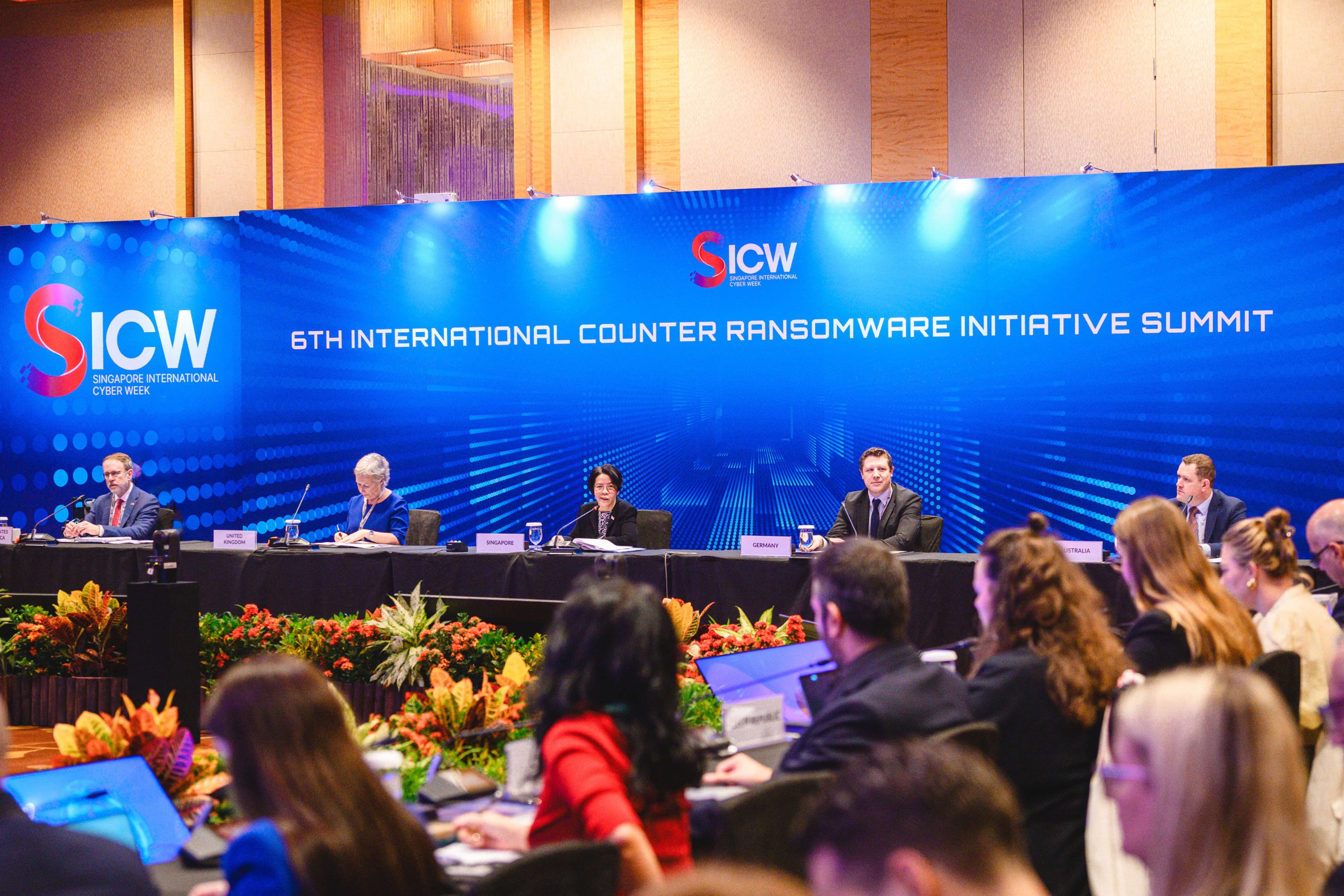



The Counter Ransomware Initiative (CRI) held its sixth summit in Singapore on Oct. 16. Launched under U.S. leadership in 2021, the CRI has grown to include 76 countries and organizations, with the goal of “[building] collective resilience to ransomware, [disrupting] the ransomware ecosystem and [designing] policy approaches to combat ransomware.” Breaking with previous meetings, the 2026 summit ended without a published joint statement from its members or even a steering committee summary. As of this writing, the only available public information about the summit comes from a speech by a Singaporean minister and an Australian press release on the CRI’s Global Standards Framework. By contrast, previous summits produced publicly available accounts of commitments and planned work, including joint statements in 2023 and 2024 and a steering committee summary in 2025.
This retreat from public statements comes as the threat of ransomware is growing. Singapore’s cybersecurity minister reported at the summit that more than 8,200 victims appeared on ransomware data-leak sites in 2025, a 50 percent increase from the previous year. At the same time, artificial intelligence (AI) tools are making it easier for motivated actors to carry out complex attacks against a wider array of organizations. What is clear from the 2026 summit is that public support for the CRI is waning. Explaining that shift means returning to where Lawfare’s 2022 coverage left off: how the CRI has evolved, how ransomware has outpaced it, and what we know about where it stands today.
The CRI, Four Years On
The Biden administration worked to establish the CRI to help countries share threat information, disrupt ransomware operations, respond to attacks, and support victim governments.
Since 2022, CRI membership has grown and it has developed a governance structure that facilitates cooperation between both public and private partners. Since 2025, the CRI has been overseen by a steering committee—Australia, Germany, Singapore, the United Kingdom, and the United States. The creation of the steering committee reflected a need for more centralized coordination as the CRI grew from 30 to 76 participating members. The CRI’s work is divided into four pillars: Policy (led by Singapore and the United Kingdom), Diplomacy and Capacity Building (led by Germany and Nigeria), the International Counter Ransomware Task Force (ICRTF) (led by Australia and Lithuania), and the Public-Private Sector Advisory Panel (co-chaired by Canada, Arctic Wolf, and BlackBerry). The latter was established at the 2024 summit, when CRI formalized the participation of seven private-sector partners.
The CRI has secured joint commitments on ransomware. However, it remains unclear if those steps have reduced the frequency or impact of ransomware attacks. In 2023, members signed a nonbinding joint statement that “relevant institutions under the authority of our national government should not pay ransomware extortion demands.” By the 2025 summit, five countries had requested assistance through the CRI portal, while 67 members had endorsed the broader coalition’s supply chain guidance. Australia and Interpol produced an assessment of ransomware countermeasures, and Portugal examined the adoption and effectiveness of incident response guidance. In 2025, after a ransomware attack targeted Collins Aerospace’s MUSE check-in and boarding software, paralyzing airports across Europe, CRI members endorsed the coalition’s supply chain guidance. In 2026, Canada and Australia jointly developed a Global Standards Framework in consultation with CRI members to provide members with a “practical roadmap to strengthen resilience against ransomware threats,” including a self-assessment tool to assist members in measuring their progress on countering ransomware. CRI members are also continuing to contribute to CRI’s public advisory system, which provides near-daily updates on new threats.
CRI’s cryptocurrency work offers another area to assess whether its advisory frameworks support operational results. As the Center for Cybersecurity Policy and Law’s account of the 2023 summit explains, members sought to disrupt ransomware payments by sharing information on cryptocurrency wallets associated with ransom transfers. Under the Biden administration, the White House announced a Treasury Department commitment to share illicit wallet data, alongside efforts to strengthen anti-money laundering controls for virtual asset service providers, and to improve crypto asset seizures. These measures could help members target financial services that support ransomware groups, but sharing wallet information itself does not establish that payments were blocked or proceeds were recovered. This transparency gap is common for CRI initiatives: After programs are announced, minimal enforcement data is released, making it difficult to gauge practical results. For example, the 2025 statement reported five member state requests for assistance; however, we do not know if those requests improved outcomes. Similarly, observers do not know if the crypto coordination announced in 2023 resulted in improved outcomes because there is no public report or implementation data available.
The Trump administration’s lack of public engagement with the CRI has complicated its work. The 2025 summit was the first held outside of the United States. At the time, the then-head of Singapore’s Cyber Security Agency, David Koh, said that the fifth summit said that the fifth summit “was difficult because almost no one from the U.S. administration came.” As of this writing, the United States has not posted any public acknowledgement of this year’s summit. This is despite the fact that the United States was listed as a co-chair for the summit and is a member of the overall CRI steering committee. After this year’s summit, while Singapore’s Josephine Teo thanked Australia and Canada for their leadership in developing the CRI’s Global Standards Framework, her address did not mention the United States.
The Evolving Ransomware Threat
The Trump administration’s waning public commitment to the CRI is occurring in the context of a persistent increase in the number and sophistication of ransomware attacks. Verizon’s most recent Data Breach Investigations Report found ransomware accounted for 48 percent of all breaches, up from 25 percent in its 2022 report. These attacks are being perpetrated by a wider population of actors. Dark web tracking data from Ransomware.live found the number of active, autonomous ransomware groups posting victims’ data to leak sites surged from 61 groups in 2022 to more than 146 active groups by mid-2026. Chainalysis’s 2026 analysis also describes a growing number of actors that buy access to victims’ networks and rely on shared criminal tools and infrastructure.
For governments combating the threat, this proliferation of attackers complicates their approach. CRI members have pursued individual ransomware organizations through coordinated law enforcement operations. Examples of this include the 2023 FBI takedown of the Hive network and the 2024 multinational operation against LockBit. Today, however, that approach is less effective, as there is now a large population of smaller criminal actors, making it more difficult to alleviate the problem by targeting individual groups.
This fragmentation, however, may cut both ways. Since these smaller groups generally rely on the same services, infrastructures, and tools, investigators are sometimes more able to connect attacks that initially appear unrelated and coordinate efforts to disrupt them. This is one of the benefits of the CRI’s information sharing platforms, which allow members to circulate threat information across borders more rapidly. Singapore cited one example at the sixth summit: During a February 2025 operation against Phobos and 8base, investigators warned more than 400 companies of ongoing or imminent attacks. The ongoing success of such information sharing processes requires that information shared through CRI channels reaches victims in time for them to react.
Ransomware methods have also evolved. In 2022, the CRI was focused on meeting the challenge of double extortion: encryption with the threat of leaking stolen data. Today, threat actors often use more complicated multi-extortion tactics that layer additional methods such as harassment, public leaks, and distributed denial of service (DDoS) attacks to force payouts. Attackers continue adapting how they gain access and extract payment. Coveware’s 2026 reporting highlights abuse of help desks and trusted cloud access, as well as data-theft schemes targeting sensitive legal records. Since public disclosure—and not loss of access—is the threat in data-theft schemes, backups are insufficient to discourage ransom payment in these cases.
Public reporting has also identified ways in which ransomware has become increasingly state sponsored. For example, U.K. authorities detailed ties between the cybercriminal gang Evil Corp and Russian intelligence. States are engaging in ransomware operations for a variety of reasons: gaining operational funding, achieving political or military goals, or even reaping personal financial gain. This occurs in the context of a symbiotic relationship between cybercriminals and the states that host them. By operating in countries that refuse to cooperate with foreign law enforcement—such as China, Russia, and and Iran—cybercriminals are shielded from prosecution. In return, those governments benefit from access to skilled hackers who can carry out operations on the state’s behalf.
Finally, the most notable evolution in ransomware is AI’s role in enabling the scaling of attacks. AI tools permit multi-extortion attack vectors by automating workflows and uplifting unskilled actors. In July 2026, for example, researchers at Sysdig identified a ransomware attack carried out by AI agents. The operator, JadePuffer, broke into an exposed server, harvested credentials, encrypted the stolen files, and demanded payment, all without evidence of human direction.
While most ransomware operations are not fully autonomous, AI increasingly plays a role in specific tasks in order to increase attack speed—automating data gathering, generating deception materials, and creating advanced malware to bypass traditional security filters. This year, when FulcrumSec attacked the pharmaceutical company Novo Nordisk, it disclosed that it used AI tools to facilitate ransom negotiations, including using models to estimate the value of the stolen data and preparing press releases to increase pressure on Novo Nordisk to pay. This AI-driven increase in attack sophistication is a worrying trend. At the same time, AI tools can also bolster cyber defenders, assisting in real-time behavioral anomaly detection, predictive threat-hunting, and automated incident response capabilities. The challenge is ensuring that organizations build capacity with these new defensive tools in time.
Conclusion
Ransomware is a transnational threat, and responding effectively requires reliable cross-border coordination. The CRI has made important contributions, but the results remain uncertain. As Canada’s statement at the 2025 CRI summit put it: “[D]espite [CRI’s] best efforts, we are failing to deter or degrade ransomware actors and the dark ecosystem they operate within.”
As the scale of the threat accelerates, overt commitment to the CRI has declined. The near-total absence of public statements from the 2026 summit sends its own message. It is not clear whether the quieter summit in Singapore marks a pause in ransomware or a move away from the CRI toward other coordination mechanisms, but what is clear is that the threat of ransomware is not abating. Moving forward, the CRI would be wise to publish meaningful aggregate metrics on operational successes (such as data on fulfilled assistance requests or the time between intelligence sharing and victim notification). This improved transparency would help observers understand the part the CRI is playing in improving the global response to ransomware.