Justice Delayed
A review of Carol Leonnig and Aaron C. Davis, “Injustice: How Politics and Fear Vanquished America’s Justice Department” (Penguin Press, 2025).
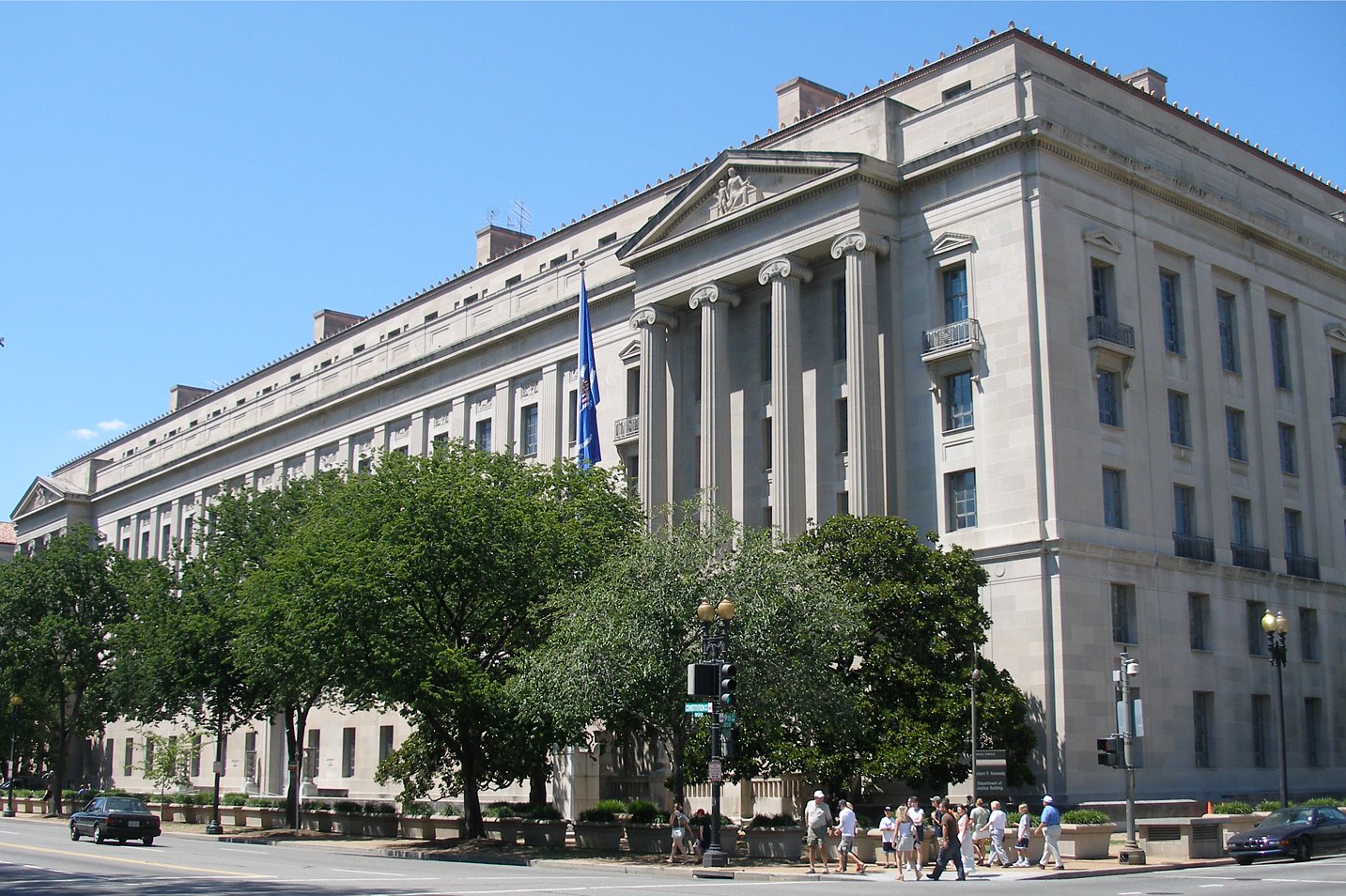

Carol Leonnig and Aaron C. Davis’s “Injustice” tells the story of the Justice Department over nearly a decade. A reader could reasonably expect from the title to learn mostly about the department under President Trump—but she’d be mistaken. The heart of “Injustice” is an account of the department during Biden’s administration, particularly the institutional inertia and political tiptoeing that slowed down investigations into Biden’s predecessor until it was arguably too late. The Biden years, however, are all the more striking to read about because Leonnig and Davis bookend them with significant reporting on what came before and what is now coming after: the Trump 1 years, when the department buckled but didn’t wholly bend under partisan pressure, and the Trump 2 years, when the department has become a political weapon openly wielded by the president.
The opening pages of “Injustice”—set at the dusk of the first Trump administration—describe a Justice Department whose employees continue to believe that, as some career prosecutors put it in a toast to departing colleagues, “truth still matters!” The closing chapters capture an agency totally transformed. The acting deputy attorney general declares that upholding the Constitution “means implementing the agenda that the president was elected to implement”; the attorney general announces in an inaugural speech to staff, “We are proud to work at the directive of Donald Trump.”
But most of the book takes place between these two versions of Justice (and justice). “Injustice,” written by two then-Washington Post reporters—Leonnig has since left the paper for MSNOW—is replete with details about as juicy as one can manage about the intricacies of a government bureaucracy. The authors don’t stop at events; they also include the feelings of the leaders and rank-and-file employees of a storied institution coming apart. Previously untold anecdotes from sources at the epicenter of the Justice Department’s implosion make familiar events both more interesting and more intelligible.
The clearest takeaway is this: Attorney General Merrick Garland’s department is explained by the one that came before it, and—despite all his efforts to ensure precisely the opposite outcome—helps explain the one that came after it.
“Old-School to the End”
“Injustice” begins with Justice Department employees during the first Trump administration agonizing over matters that by the end of the book will seem quaint: Debating whether to seek an indictment against Andrew McCabe, prosecutors are put off by rumors that White House officials “sought to plant negative stories about the former FBI deputy director.” They worry that, if Trump gets his way, “what might he demand next?” Good question. The rest of the section covers the costs of being too credulous that usual norms will apply in unusual times.
During Robert Mueller’s investigation into Russian interference in the 2016 presidential election, the special counsel was reluctant to ask Attorney General William Barr to support a court fight to force Trump to answer questions under oath because he didn’t want to put Barr in—the authors report that Mueller told his team—the “awkward” position of saying no. Later, Barr wore “a wide smile” after Mueller told him that his report would not assess whether the president’s efforts to hinder the investigation amounted to the crime of obstruction of justice—because it would be “inappropriate” to lodge an accusation that Trump would have no route, as a sitting president whose charging is prohibited by Justice Department policy, to challenge in court. Barr was also pleased that the writeup would have no executive summary.
Most will remember that Barr eventually went ahead and provided his own summary and his own prosecutorial judgment that the evidence wasn’t sufficient for an obstruction of justice charge. “Old-school to the end,” the authors write, “Mueller played into a trap set on the board by the leaders of his own Justice Department.”
But even Trump’s own appointees, the writers show, flinched—hard—at some of his demands during that time, mostly as they related to overturning the 2020 election. Yes, the Justice Department was willing to look into absurd claims of “suitcases of ballots … snuck into an Atlanta tabulation center” (this should sound familiar from recent events) or “an Italian aerospace company” having coordinated “with the CIA to switch” votes. Yet officials tried to back the president off believing in these conspiracy theories, and they refused to send a letter to Georgia’s legislative and election administration leaders falsely asserting concerns of fraud. They also refused to declare the election corrupt in a press conference and “leave the rest,” as Trump put it, to him and Republican congressmen.
“You should understand your entire department leadership will resign,” Acting Deputy Attorney General Richard Donoghue told Trump just days before Jan. 6, in an attempt to dissuade him from sending the letter to Georgia officials or installing Jeffrey Clark, a conservative ideologue with little in the way of credentials but lots in partisan fervor, as attorney general. That would look bad. Trump, ever wary of the optics, retreated.
Barr had red lines, too. Leonnig and Davis write that Barr defended FBI Director Christopher Wray against the president, both because he “felt Wray generally deferred to him” and because he saw the role of FBI director as “an apolitical position.” They also report that he informed Trump’s chief of staff about one move that would happen “over my dead body”: The installation of inexperienced non-agent Kash Patel as FBI deputy director. We all know how that ended.
Appearing to Do Justice
Merrick Garland said in his confirmation hearing as attorney general, “It’s not just that the Department of Justice has to do justice. It’s that it has to appear to do justice. The people of the United States have to believe that it does justice.” To which one might reasonably reply: Okay, but it still has to do justice. The second and central section of “Injustice” shows how Garland’s attempts to ensure his department appeared to do justice may, when it comes to Donald Trump’s possible crimes, have gotten in the way of the actual doing.
Vowing the rule of law as his cardinal guiding principle, Garland repeated a mantra when it came to the Jan. 6 riot: Follow the facts, wherever they may lead. The trouble with that approach, as Leonnig and Davis show, was that it sometimes meant that prosecutors neglected to take the initiative in seeking out the facts. Investigators were, admittedly, “busy investigating the riot” in the wake of Jan. 6—but Garland and Deputy Attorney General Lisa Monaco and senior FBI officials such as Washington Field Office head Steven D’Antuono also declined at multiple junctures to expand the investigation to the possible “masterminds” of the plot in Trump’s orbit: “Unless investigators turned up clues from rioters’ phones or financial records that pointed them back toward the president’s campaign, the decision effectively walled off Trump and his allies from becoming subjects of an F.B.I. probe.”
The steps the Justice Department did take, it took too slowly—creating, for instance, an enormous trove of evidence that was shared with all defendants; putting plea agreements on hold to ensure consistency; slow-walking the approval of seditious conspiracy charges against members of the Oath Keepers and Proud Boys. It was not until 391 days after the Jan. 6 attack on the U.S. Capitol that the Justice Department convened a grand jury to authorize subpoenas for crucial documents and interviews related to the scheme.
Even after that, FBI Director Wray, presiding over a workforce scarred by the way the GOP had hammered it over the Crossfire Hurricane investigation into links between the Trump campaign and Russian election interference, remained reluctant to sign off on investigating Trump or his campaign themselves. And inquiries into potentially criminal actions that preceded the Jan. 6 attack on the joint session of Congress, such as the one suggested by the inspector general for the National Archives into the slates of Trump electors in half a dozen states who falsely attested to Trump’s victory despite his loss in their states, were shunted even further aside.
Of course, ultimately, the facts did lead to the very top. But the Justice Department under Garland only began to pursue that line of inquiry in earnest after the congressional Jan. 6 committee’s investigation effectively forced its hand, by prompting—through its fight to obtain the emails of Trump lawyer John Eastman—a federal judge to find that it was “more likely than not” that President Trump had attempted to obstruct the congressional joint session. At that point, Wray finally insisted that “senior leadership take an active role.” His counsel, instructed to make a recommendation, advised naming the campaign but not naming the president. The decision at long last reached Garland by way of Monaco, and the attorney general immediately signed off.
Garland, the authors write, believed that returning “the department to regular order meant letting decisions—especially those that could be viewed as touching on politics—bubble up to him.” And bubble up they had, but at the slowest of simmers. By the time prosecutors were anywhere close to caught up on Jan. 6—or on the newly surfaced classified documents scandal, whose probing was also delayed by the FBI—the 2024 election was fast approaching, and the target of their investigations had announced he would be a candidate. So had President Biden.
“Injustice” does not give Special Counsel Jack Smith the hero treatment any more than it does the Justice Department’s leadership. He charged hard where the Justice Department had previously tiptoed, but he alienated many attorneys on his team by proving as much of a “one-way street” with them as he was with the public, “demanding information but sharing it … sparingly or not at all.” Those he did confide in were the exception—the lawyers outside his inner circle came to call the lawyers within it the “Cult of Jack.” And he made mistakes, most consequentially his decision to file the classified documents case in Florida after miscalculating the odds it would be assigned to Judge Aileen Cannon (as it eventually was) at one in six rather than one in three.
But “Injustice” also shows how even his independent probe wasn’t insulated from the timidity atop the Justice Department. Leonnig and Davis report that Smith asked Solicitor General Elizabeth Prelogar to help him attempt to get Cannon removed from the case after her unorthodox rulings in favor of Trump struck most legal experts as strained at best—but she rejected the request, saying there wasn’t enough evidence to try to remove the judge. And when Smith presented Garland with potential election inference charges, he was “visibly unenthusiastic.” The biggest problem of all was that Smith simply didn’t have enough time: to amass as much evidence through as many interviews and other investigative avenues as possible; to prosecute potential co-conspirators even though those cases could cause complications or delays for the main event; to put the Jan. 6 case back together again after the Supreme Court’s ruling on presidential immunity shattered it.
Proud to Work at the Directive of Donald Trump
“Injustice” unfolds, then, with all the pathos of a classical tragedy. Merrick Garland’s Justice Department ended up acting against Donald Trump just aggressively enough to inspire the accusations of weaponization with which Trump now justifies transforming the department into exactly what Garland was determined not to let it become: a vehicle for gratifying presidential whims and satisfying political vendettas. But the department under Garland wasn’t aggressive enough—or wasn’t aggressive enough soon enough—to forestall that fate, by ensuring people who actually committed crimes ended up in prison and out of power.
The book concludes with the Justice Department’s ravaging early in Trump’s second term: the purging of career civil servants and their replacement with presidential cronies; the installation in leadership positions of those who wouldn’t and haven’t dared to push back against the president even to the degree the department did during his initial term; an executive order bullying a law firm out of challenging the administration; and a political appointee lying in court about deportations. The worst part? Much of this looks tame compared to what has occurred since “Injustice” went to press, from the prosecutions of James Comey and Letitia James; to the charges against protesters on ginned up (and later dropped) allegations of assault; to the FBI raid on an election tabulation center in Fulton County, Georgia.
“Injustice” invites a question that plagues the self-proclaimed opposition to President Trump and the MAGA movement today: Is it possible to respond to the destruction of norms by clinging ever harder to those very same norms—or do you sometimes have to break something a bit in order to rebuild it? Ultimately, by describing a Justice Department that overcompensated so thoroughly for the misconduct of its predecessors that it ended up not behaving normally at all, the book escapes truly having to answer.