One Emergency After Another

“Emergency powers would tend to kindle emergencies,” wrote Justice Robert Jackson in 1952. This warning came as the Supreme Court prohibited President Truman from using emergency authority to seize the nation’s steel mills during the Korean War. Today, Justice Jackson’s words are more relevant than ever: In February, Chief Justice John Roberts echoed Jackson’s alarm in his opinion invalidating President Trump’s use of emergency authority to impose global tariffs.
Emergency powers remove procedural and substantive constraints on executive power and enable the president to respond swiftly in times of crisis. But these powers are also easy to trigger and hard to unwind, making them vulnerable to abuse.
President Trump’s invocation of the International Emergency Economic Powers Act (IEEPA) to impose global tariffs continued a long-standing pattern of presidents using IEEPA authority as a “standard tool of foreign policy” in response to emergencies of questionable legitimacy. Beyond IEEPA, however, past presidents have generally exercised self-restraint, largely reserving non-IEEPA powers for responses to genuine crises. President Biden’s use of the COVID-19 emergency to cancel over $400 billion in student loans and the first Trump administration’s reliance on a dubious border emergency to fund construction of a southern border wall are notable exceptions. But they are notable precisely because non-IEEPA abuses of emergency powers are so rare.
By contrast, as shown in the data on “emergency orders” discussed below, compared to President Trump, no recent president has invoked non-IEEPA emergency powers more frequently, across a broader range of issues, and as a routine tool to advance domestic policy goals. Many of these purported emergencies are dubious, as demonstrated by the president’s energy emergency declaration, which has been used as a policy tool to circumvent Congress.
Justice Jackson’s warning has become a reality. Where Congress falls short, the judiciary must step in to uphold the separation of powers. In particular, courts may need to apply a more searching form of judicial review to effectively constrain bad-faith abuse of emergency powers.
The Trump Administration Is Invoking Emergency Powers More Frequently
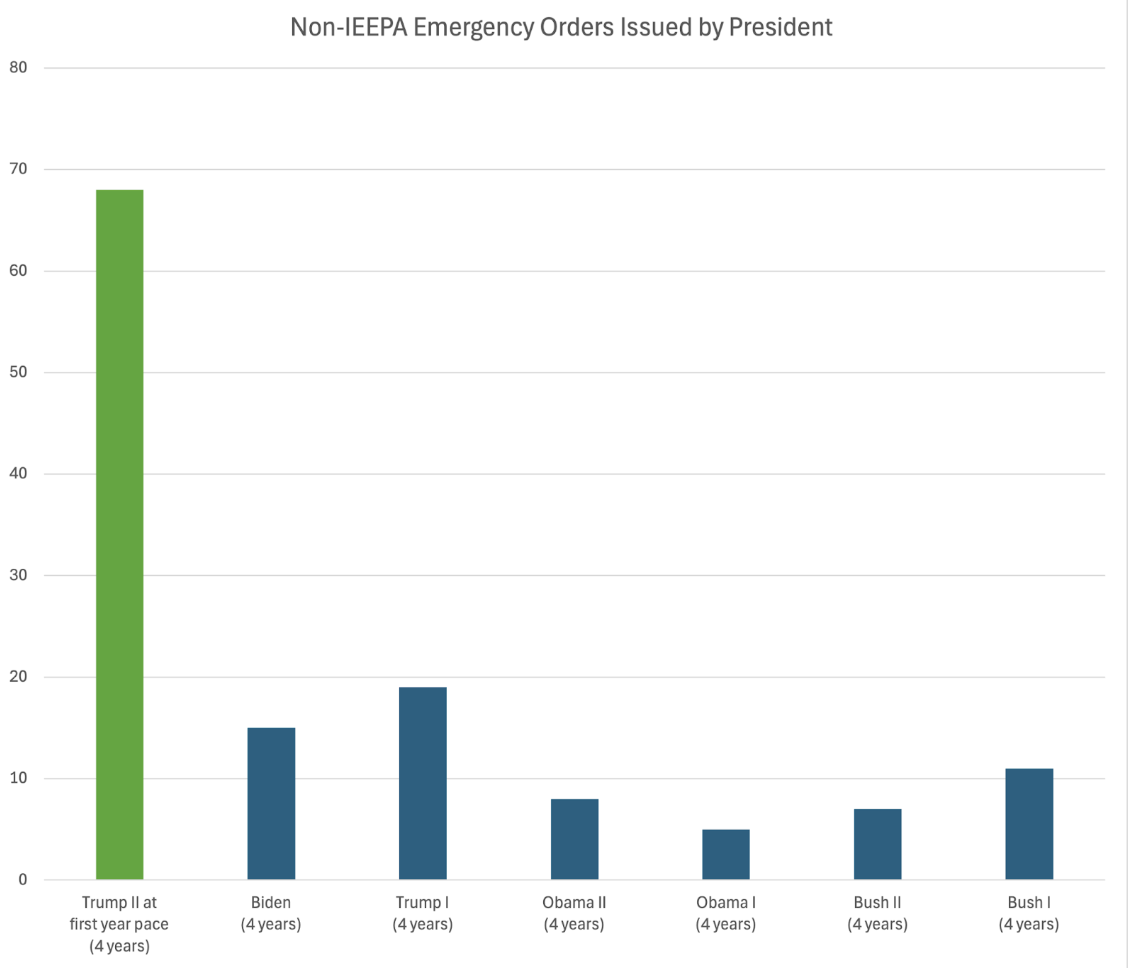
A cross-presidential comparison of non-IEEPA emergency orders reveals a marked increase under President Trump’s second term (Data sourced from the Center for Applied Environmental Law and Policy).
Remarkably, these figures are likely an underestimate. The dataset only includes executive orders and presidential proclamations that contain the word “emergency” or “emergencies,” such as the president’s declaration of emergency at the southern border, his order directing agencies to use emergency authorities to expedite coal leasing on federal lands, and his declaration of a crime emergency in Washington, D.C. (and subsequent measures). As a consequence, the data does not capture, for example, the use of emergency powers by federal agencies acting pursuant to the direction of the president, invocations of the Alien Enemies Act to declare an “invasion” sufficient to deport alleged members of Tren de Aragua, and National Guard deployments across the country. There is no denying the administration’s reliance on an unprecedented volume of emergency orders to carry out its agenda, even considering the growing use of emergency powers by past presidents.
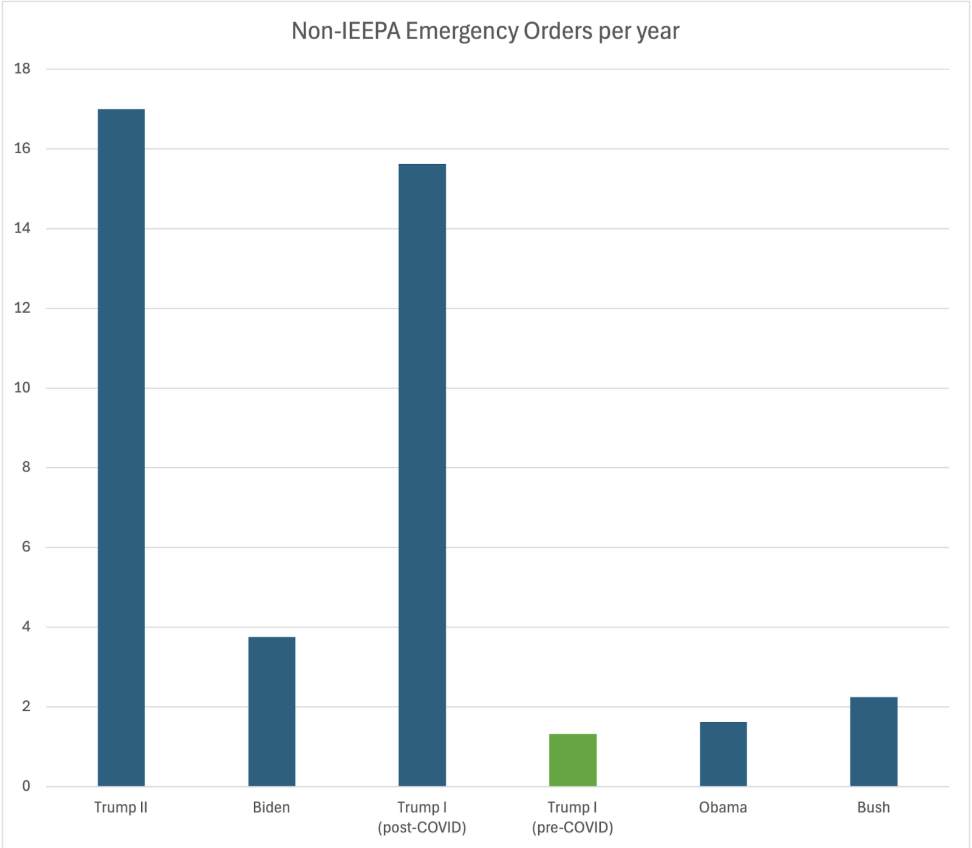
In his second term, President Trump is issuing non-IEEPA emergency orders at a COVID-era pace, far surpassing all recent presidents.
The volume and pace of non-IEEPA emergency orders is a distinctive feature of the second Trump administration in particular. During his first term, President Trump’s issuances of non-IEEPA emergency orders spiked following the onset of the coronavirus pandemic in March 2020, which could reasonably be regarded as an emergency. Yet despite the absence of any comparable crisis in the first year of Trump’s second term, the pace of non-IEEPA emergency orders closely resembles the pandemic peak.
The National Energy Emergency
Perhaps the clearest example of the administration’s abuse of emergency powers for domestic policymaking purposes is President Trump’s declaration of a “National Energy Emergency.” Issued on his first day back in office—long before the current conflict in Iran disrupted global energy markets—the declaration claimed that “insufficient energy production ... and generation” constitute “an unusual and extraordinary threat” to the United States. In January 2026, the president extended this emergency for another year without offering any additional explanation.
The administration has based its promotion of fossil fuel production on this “emergency.” Federal agencies have relied upon the declaration to prevent coal plants from retiring, scale back environmental reviews for energy and critical mineral projects, and attack state environmental laws.
Yet at the same time, the administration’s stated policy toward renewable energy production and generation is to “blockade” projects and “kill the wind industry in America.” In 2025, the president’s hostility toward renewable energy development contributed to the cancellation of $35 billion in announced clean energy investments and at least 26.5 gigawatts of new wind capacity. That’s enough to power almost 10 million homes. Whatever one’s views on the proper energy mix, these efforts make little sense in the face of a national emergency predicated on insufficient energy supply.
The contradiction between the stated basis for the National Energy Emergency and the administration’s treatment of renewables highlights a seemingly indisputable fact: The Trump administration is using emergency authorities not to address a supply crisis, but to bypass environmental laws and promote the president’s fossil fuel agenda. Rather than pursuing the typical, challenging path of securing congressional buy-in to change the law, the administration is invoking emergency powers to evade statutory constraints on executive action.
The National Energy Emergency is part of a broader strategy of emergency powers abuse, extending to immigration, trade, National Guard deployments, and beyond. Nor does such abuse seem likely to stop: Building off this emergency playbook, administration-aligned activists are now lobbying the White House to use emergency authorities in an unprecedented attempt to impose federal control over elections. At bottom, the administration is weaponizing emergency authority, transforming it from a tool for responding to crises into a means of kindling them.
Congressional and Judicial Response
This pattern and practice of abuse is especially troubling because there are few meaningful checks on a president’s use of emergency powers. Congress created the National Emergencies Act (NEA) in 1976 to place limits on the president’s use of emergency authority. As initially conceived, the statute’s primary check on the executive was Congress’s ability to terminate any national emergency declaration by a concurrent resolution, sometimes called a legislative veto, which did not require the president’s signature. But in 1983, the Supreme Court in INS v. Chadha deemed legislative vetoes unconstitutional. Now, an effectively insurmountable two-thirds congressional majority is required to overcome a presidential veto and terminate a national emergency declaration.
Courts, meanwhile, often treat direct challenges of national emergency declarations as “political questions” unfit for judicial review. Such emergency declarations unlock the use of nearly 100 emergency statutory provisions that carry no meaningful restrictions on when they may be invoked; the only statutory precondition is the emergency declaration itself. The interaction between NEA unreviewability and substantively unconstrained emergency powers statutes creates significant obstacles for judicial review of potentially broad powers, which Congress originally intended the president to invoke only in limited circumstances.
The upshot is that no coordinate branch is well positioned to quickly and effectively combat a president’s systematic abuse of emergency authorities. This dynamic presents a serious constitutional issue. When Congress writes statutes authorizing emergency powers, it assumes that the president will exercise such powers in good faith. The political question doctrine and the Constitution’s express requirement that the president “shall take Care that the Laws be faithfully executed” (emphasis added) similarly rely on this assumption.
But how should Congress and the courts respond when it appears that assumption is failing?
Legislative reform of the national emergency declaration framework is essential. A bipartisan array of scholars, advocacy groups, and legislators have accordingly proposed promising solutions. Congress had an opportunity to implement some of these solutions after the first Trump administration, but reform efforts fizzled out. For now, it is unlikely that Congress will be able to rein in this administration’s abuse of emergencies, as President Trump will almost certainly veto any bill seeking to reduce the scope of his executive powers. This all but eliminates the possibility of a legislative solution in the next three years.
It is therefore left to the courts to adapt and act now. In both pandemic-era litigation and the tariffs case, the Supreme Court has been clear that emergencies do not preclude courts from conducting their well-established duty to police the bounds of statutory delegations and to invalidate actions that exceed those bounds. Recent emergency powers cases bear this out. The Supreme Court struck down President Trump’s tariffs and President Biden’s student loan relief for exceeding the statutory authority delegated by Congress. In many cases, judicial review of whether the asserted emergency powers exceed delegated authority will be enough to rein in presidential abuse.
But as discussed above, some emergency statutory provisions require nothing more than a national emergency declaration to invoke their authorities. For example, President Trump invoked the National Energy Emergency to unlock an emergency waiver provision of the Defense Production Act. The waiver strips away limitations constraining the president’s authority to direct investments in domestic industry. The statute’s sole criterion for invoking this waiver is that a national emergency has been declared. Because the waiver eliminates every substantive standard against which a court could evaluate agency action, there is arguably no law left for a court to apply.
Presumably, Congress intended this waiver authority (and all other emergency statutory provisions) to be invoked only during genuine emergencies. This administration, however, frequently invokes facially dubious emergencies and has demonstrated a troubled record of candor with the judiciary. In response, courts may need to peek behind the curtain and take a “harder look” at emergency power actions when assessing whether the action is arbitrary and capricious under the Administrative Procedure Act (APA). Usually, courts treat this standard as deferential and will not substitute their judgment for the reasonable decisions of the agency (although some recent cases suggest that the Supreme Court may be moving toward more demanding review of agencies’ factual determinations).
The government also benefits from considerable limits on discovery, evidentiary development, and record supplementation in APA cases. These litigation advantages are no longer warranted for this administration––nor should they be for future administrations that engage in a similar pattern and practice of emergency-powers abuse. A more probing “harder look” review could include requiring evidentiary hearings, loosening the standard for expansion of the agency record, permitting broad discovery, or closely assessing pretextual justifications for the agency action more often than not.
This level of scrutiny is not uncharted terrain for courts in the Trump era. When the first Trump administration attempted to add a citizenship question to the census, the Supreme Court held that a “strong showing of bad faith”––including, as some commentators noted, lying to the Court––justified looking beyond the government’s stated rationale, and the Court accordingly struck down the action as pretextual. In response to the second Trump administration’s increased propensity for misrepresentation to courts, judges appointed by presidents across the ideological spectrum have dispensed with the judicial “presumption of regularity,” which assumes that the government complies with applicable rules and honors its ethical duty of candor to the courts. These judges have admonished the government and its officials for making in-court misrepresentations including “omit[ting] key information” and “outright lying.”
Courts have intervened even in typically sacrosanct executive domains, including military affairs and national security. A Trump-appointed judge blocked the federalization of National Guard troops in Oregon, finding “[t]he President’s determination was simply untethered to facts.” And five courts enjoined the administration’s attempt to halt offshore wind construction notwithstanding the government’s claims of national security interests.
President Trump is not the first president to invoke emergency powers for less-than-crisis-level policy matters. But the sheer scale, pace, and breadth of emergency powers deployed by this administration presents an opportunity for courts to reject this behavior and rein in executive overreach. The tariffs case is a step in the right direction. Courts should continue to heed Justice Jackson’s prescient warnings and prevent this administration—and all future ones—from eroding the separation of powers under the guise of emergency.

-(1).jpg?sfvrsn=9348bc4e_5)