State of the Union 2026: National Security Excerpts
A roundup of foreign policy and national security statements from Trump’s second address to Congress since taking office again.
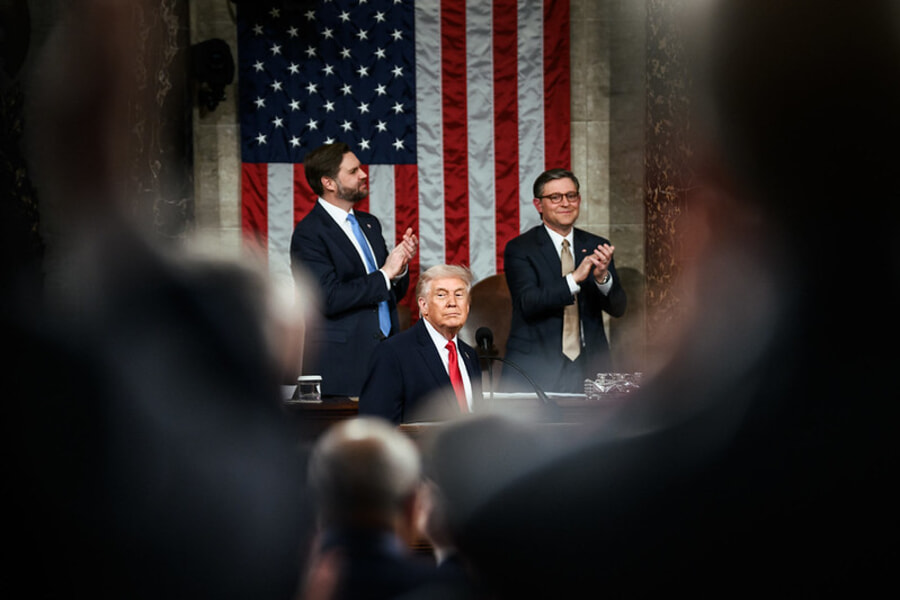

President Trump opened the 2026 State of the Union by reporting that “[o]ur nation is back - bigger, better, richer, and stronger than ever before.” He recalled that when he spoke in the chamber this time last year, he had inherited what he described as “a nation in crisis with… a wide open border, horrendous recruitment for military and police… and wars and chaos all over the world.” He contrasted those conditions with the present moment, asserting “with dignity and pride that we have achieved a transformation like no one has ever seen before and a turnaround for the ages.”
Below are excerpts from the speech related to national security and foreign policy.
On Border Security
In relation to national security, President Trump began with the issue of border security. “Today our border is secure, our spirit is restored… our enemies are scared… our military and police are stacked, and America is respected again—perhaps like never before.”
He continued:
After four years in which millions and millions of illegal aliens poured across our borders, totally unvetted and unchecked, we now have the strongest and most secure border in American history–by far. In the past nine months, zero illegal aliens have been admitted to the United States.”
He added that “we will always allow people [to] come in legally–people that will love our country and will work hard to maintain [it].”
President Trump further asserted, “We are deporting illegal alien criminals from our country at record numbers and we’re getting them the hell out of here fast—we don’t want them,” and declared that the “only thing standing between Americans and a wide-open border right now is President Donald J. Trump and our great Republican patriots in Congress.
On the issue of funding for border security, President Trump criticized Democrats, accusing them of cutting off funds for the Department of Homeland Security and thereby triggering what he characterized as “another Democrat shutdown.” He claimed that “the first one cost [the country] two points on GDP,” suggesting that this made the Democrats “quite happy now that they [had] closed the agency responsible for protecting Americans from terrorists and murderers.” According to the president, the lapse in funding had effectively “closed the agency responsible for protecting Americans from terrorists and murderers.”
He further demanded the “full and immediate restoration” of all funding for border security and the Department of Homeland Security. President Trump framed the moment as an opportunity for Americans to observe “what their representatives believe.” He invited every legislator to stand in support of what he described as a “fundamental principle”: that “the first duty of the American government is to protect American citizens, not illegal aliens.”
On Fentanyl Across the Border
President Trump asserted that “[t]he flow of deadly fentanyl across [the] border is down by a record 56 percent in one year.”
The president also stated that he “designated these cartels as foreign terrorist organizations” and “declared illicit fentanyl as a weapon of mass destruction.” He attributed the reported decline in drug trafficking to a new military campaign, asserting that his administration had “stopped record amounts of drugs coming into our country and virtually stopped it completely coming in by water or sea,” and adding that people “probably noticed that very seriously damaged their fishing industry.”
On Venezuela
While discussing U.S. oil production, President Trump indicated that the U.S. had received more than 80 million barrels of oil from Venezuela, whom he called “our new friend and partner.”
The president praised the U.S. forces who captured former Venezuelan President Nicolás Maduro and spoke with optimism about the country’s future: “In January, elite American warriors carried out one of the most complex spectacular feats of military competence and power in world history. No one has seen anything like it.” He added that the operation drew international attention, adding, “[F]oreign leaders–I won’t tell you who–called me and they said, ‘very impressive, very good.’ They couldn’t believe it. They just watched. They saw what happened.”
He celebrated what he described as a decisive victory over the “outlawed dictator” Maduro, saying U.S. forces had ended his reign and brought him to face “American justice.” He framed this as a “colossal victory for the security of the United States” and a fresh start for the people of Venezuela. He stated that the United States is now “working closely with the new president of Venezuela, Delcy Rodríguez, to unleash extraordinary economic gains for both of our countries and to bring new hope to those who have suffered so terribly.”
On Ending Wars
As part of “restoring security for Americans abroad,” President Trump claimed to have “ended eight wars” in his first ten months in office, citing conflicts between Cambodia and Thailand; Pakistan and India; Kosovo and Serbia; Israel and Iran; Egypt and Ethiopia; Armenia and Azerbaijan; the Congo and Rwanda; and Israel and Palestine. On the war in Gaza, Trump said it was “just about there” and said there “would have been a nuclear war” between India and Pakistan if not for his intervention there.
On Russia and Ukraine
President Trump spent little time on Russia and Ukraine. He referred to this war as the ninth war that his administration is working to end, and he repeated that it was “a war which would have never happened if I were president." Notably, the speech took place on the fourth anniversary of Russia’s full-scale invasion of Ukraine.
On Israel and Gaza
In his list of wars that he brought to an end, President Trump included the war in Gaza, saying it “proceeds at a very low level.” The president focused on hostage negotiation—thanking U.S. Special Envoy Steve Witkoff and Jared Kushner, the president’s son-in-law and an informal advisor—detailing how bodies of deceased Israeli hostages were recovered with cooperation from Hamas. “Under the ceasefire I negotiated,” the president stated, “every single hostage—both living and dead—has been returned home. Can you believe that? Nobody thought it was possible.”
On Iran
President Trump touted the success of last summer’s attack on Iran’s nuclear facilities, known as Operation Midnight Hammer. He claimed that U.S. forces “obliterated” and “wiped out” Iran’s nuclear weapons program.
The president also mentioned the recent protests in Iran and the regime’s brutal crackdown. “Just over the last couple of months with the protests, they've killed at least, it looks like…32,000 protesters in their own country,” the president said. “They shot them and hung them.” He also claimed the United States played a role in limiting the bloodshed, claiming, “We stopped [the regime] from hanging a lot of [protesters] with the threat of serious violence.”
Referring to the ongoing talks with Iran, President Trump emphasized that he wanted a diplomatic solution but would not abide Iran’s pursuit of nuclear weapons: “We are in negotiations with them, we want to make a deal, but we haven’t heard those secret words: we will never have a nuclear weapon…My preference is to solve this problem through diplomacy, but one thing is certain: I will never let the world’s number one sponsor of terror—which they are by far—to have a nuclear weapon.”
On NATO
President Trump referred to NATO countries as “our friends and allies.” He claimed credit for NATO members’ increase in military defense spending from two percent to five percent of their GDP. “[W]e were paying for almost all of them,” Trump said. “Now they're paying five as opposed to not paying for it.”
On Tariffs
President Trump claimed that tariffs were one of the primary reasons for “the country’s stunning economic turnaround, the biggest in history, where the Dow Jones broke 50,000 four years ahead of schedule and the S&P hit 7000 where it wasn’t supposed to for many years.”
The president hailed what he views as the power of tariffs in making trade deals around the world. The tariffs, claimed the president, “took in hundreds of billions of dollars to make great deals for [the] country both economically and on a national security basis.” He stated that countries that had been “ripping us off for decades are now paying us billions of dollars.” He continued:
We made deals, the deals are all done and they’re happy. They’re not making money like they used to, but we’re making a lot of money. There was no inflation, tremendous growth. And the big story was how Donald Trump called the economy correctly and 22 Nobel Prize winners in economics didn’t. They got it totally wrong, they got it really wrong.
He brought up the Supreme Court’s “unfortunate” ruling on the unconstitutionality of the International Emergency Economic Powers Act tariffs, asserting that “the good news is that all countries and corporations want to keep the deal that they already made.” He claimed that those with whom the United States has already struck deals know that the “power” he has “to make a new deal could be far worse for them,” so they will be inclined to stick to the original deals.
Despite the recent Supreme Court ruling, President Trump indicated that he would move forward with tariffs using what he described as “fully approved and tested alternative legal statutes,” explaining that although these mechanisms are a “little more complex,” they are “probably better,” and would lead to a solution “even stronger than before.” He stated that congressional action would not be necessary because the authority he intends to use is “already time-tested and approved.” The president further asserted that the United States is “taking the peace,” claiming that several wars had been settled as a result of the threat of tariffs. Looking ahead, he expressed the belief that tariffs, which are “paid for by foreign countries,” would “substantially replace the modern day system of income tax” which will “tak[e] a great financial burden off the [American] people.”
-(1).jpg?sfvrsn=9348bc4e_5)