Public Service in the Second Trump Administration
A review of Michael Lewis, “Blockers” (Norton, 2026).

One of the blessings of modern societies is that we rarely notice how thoroughly government surrounds us. In the United States, weather predictions from the National Weather Service appear on our phones without attribution; food inspections by the Department of Agriculture and Food and Drug Administration (FDA) limit exposure to E. coli; and planes avoid midair collisions thanks to the Federal Aviation Administration (FAA). Government work is “submerged” in ways that make it difficult for ordinary citizens to see its successes—even as its failures are often visible and violent. Programmatic failures exacerbate deadly disasters by hampering the government from rescuing individuals following a hurricane, preventing the spread of pandemics, and keeping contaminated food off grocery store shelves.
This asymmetry creates perverse incentives for elected officials, who are motivated to win reelection for themselves and their copartisans. Voters reward elected officials for delivering relief following a natural disaster, but not for investing in the infrastructure necessary to mitigate those disasters in the first place. They respond to promises of immigration reform and tax cuts—not to promises to replace the IRS’s aging computers or to expand government research on fire suppression. Consequently, elected officials devote their time to pursuing splashy policy proposals rather than the mundane work of public administration. Persistent neglect leads to inefficiency and mismanagement, and active dismantling of government capacities leads to programmatic meltdown. Together, Michael Lewis’s 2018 book “The Fifth Risk” and his new “Blockers” paint a picture of the threat this sort of undoing of government poses to the public.
“The Fifth Risk” asked: “What are the consequences if the people given control over our government have no idea how it works?” The eponymous “fifth risk” is “program management”: “the risk a society runs when it falls into the habit of responding to long-term risks with short-term solutions.” Voters worry about whether the government will protect them from big risks—pandemics, hurricanes, terrorist attacks, and the like—but they rarely stop to think about the harms that result when an administration lays off FDA inspectors or the FAA struggles to hire a sufficient number of air traffic controllers.
“The Fifth Risk” trains the reader to trace every disaster back to a government that lacked adequate capacity to pay attention. My office window faces the rebuilt I-35W bridge, which collapsed in 2007, killing 13 people and injuring 145. My mother was less than a mile from the bridge when it happened. The National Transportation Safety Board ultimately concluded that the engineering firm responsible for designing the bridge had undersized its gusset plates. But it also faulted the federal and state officials who had performed an insufficient review of the bridge’s design. Lewis teaches readers to see such disasters as preventable through competent administration.
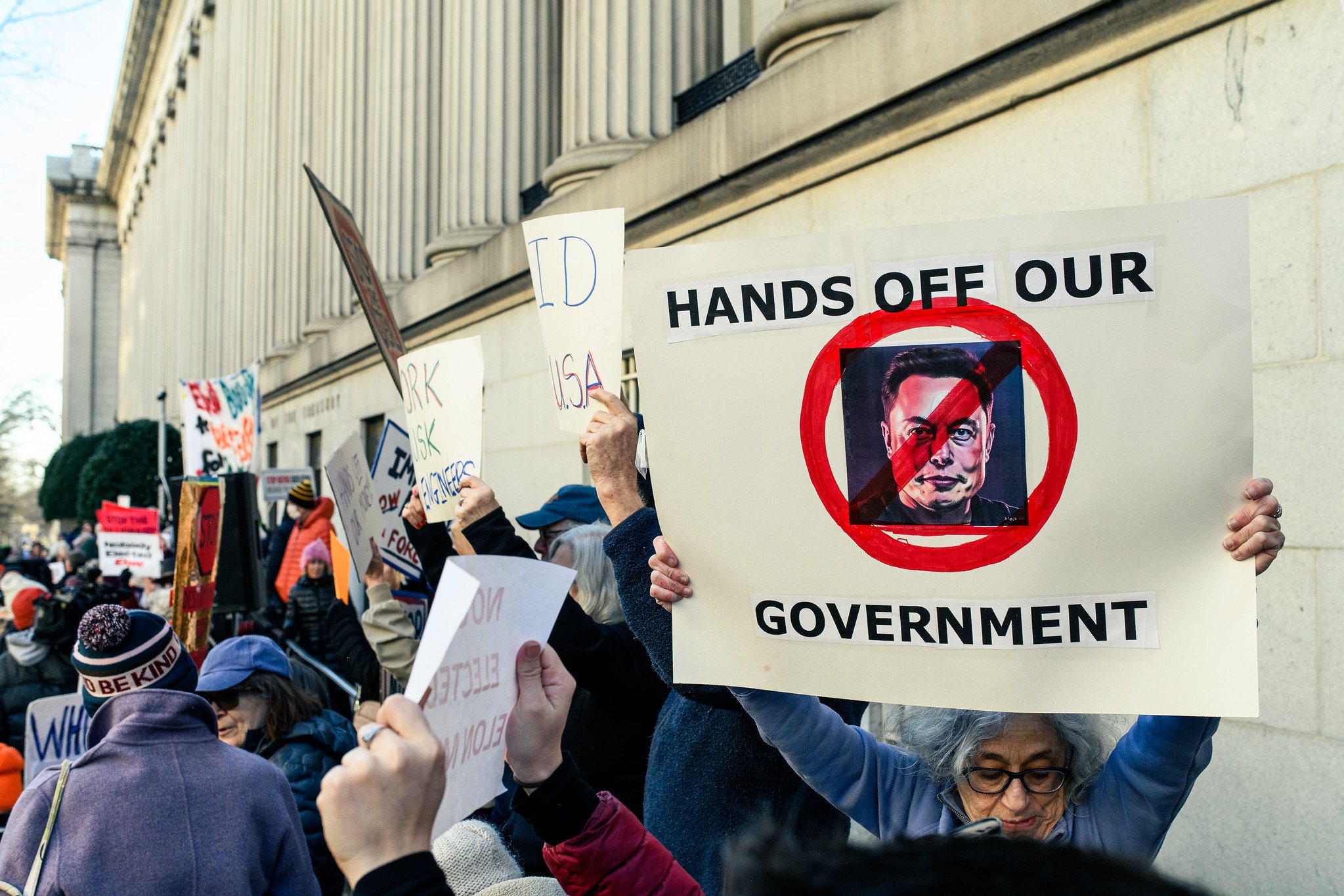
While “The Fifth Risk” portrayed the first Trump administration as uninterested in governance, Lewis’s latest book—“Blockers”—accurately describes the second administration as actively hostile. “Blockers” markets itself as a story of resistance by career civil servants. The eponymous “blockers” are, in the administration’s telling, the “inferior persons” who “could not see beyond the way things were to the way they ought to be.” “Blockers” tells the story of how Elon Musk, the young engineers of his Department of Government Efficiency (DOGE), and Trump’s political appointees sought to drive these career employees out of government.
“Blockers” is organized around six vignettes, each of which features a different protagonist in conflict with the Trump administration. It begins with Colin O’Brien—the chief security officer at the United States Institute of Peace (USIP)—trapping DOGE and its private security contractors in the building on St. Patrick’s Day like Kevin McCallister torturing the Wet Bandits on Christmas Eve. The event leads Nate Cavanaugh—the head of DOGE’s assault on the USIP—to describe the agency as “by far the least peaceful agency that we’ve worked with” to Jesse Watters on Fox News.
The protagonists of “Blockers” are not household names, but they are undeniably accomplished. Francis Collins led the Human Genome Project and the National Institutes of Health during both the Obama administration and the first Trump administration. Alex Maranghides became one of the nation’s leading experts on wildfires at the National Institute of Standards and Technology. Kathleen Walters protected the treasure trove of IRS data collected from millions of tax returns. Tim Curry, who led the Office of Personnel Management’s (OPM’s) accountability and workforce relations office, was described by a political appointee as one of those “people who if they are hit by a bus the government stops working.”
Lewis does not portray the protagonists as the sort of deep-state liberals President Trump often describes. Curry, for example, is something of a chameleon whose politics are hard to pin down. As one political appointee told Lewis, “I have spent one hundred hours in a room with the man and I don’t have any clue what his politics are. There is no one I have spent a hundred hours with whose political affiliation I do not know.” Paul Dans—who was OPM’s chief of staff in the first Trump administration before he led Project 2025—describes Curry as “a pocket-protector guy, useful guy, good at his job.” Curry even agrees with some of Project 2025’s diagnoses, such as the inflation of performance ratings, and he shares the mantra of the vast majority of career civil servants: “get to work doing what the president asked you to do or get out.”
Many of the protagonists object not to the administration’s goals—they are used to the ebb and flow of partisan politics—but to its unabashed lawlessness. As DOGE descended on the federal government, Curry admitted that “if they had asked him to help” remove as many federal employees as possible “he would have helped them.” According to Lewis, “What they were doing might be bad management,” but Curry had “grown used to bad management.” Although the executive order required the presence of a lawyer on each agency’s DOGE team, the teams showed up without them. Therefore, the problem confronted by the protagonists was not simply bad policy but that many of DOGE’s activities blatantly violated the terms of governing laws. As Walters told Lewis, “Everything [DOGE] wanted was against the law.” This left the protagonists with a choice: violate their oaths of office or become the very “blockers” the administration wanted gone.
Given how the book markets itself, one might expect Curry to leave the federal workforce in the same blaze of defiance as O’Brien. But neither Curry nor the other protagonists are saboteurs or martyrs. They are (extra)ordinary career civil servants who discover they are “no longer wanted.” As Curry comes to realize that the “entire messy apparatus he’d devoted his career to making work just a bit better was suddenly irrelevant,” he slowly begins to carry home the personal belongings in his office. By late February 2025, the walls of Curry’s office were empty and, for the first time in his career, he had no interest in responding to emails. So he left.
Lewis trusts the reader to conclude that the departure of these protagonists from the federal government—and the other 400,000 employees who have left since the start of the second Trump administration—leaves the United States with fewer cures for diseases, less protection from wildfires, weaker safeguards on its most sensitive data, and no neutral referee when the government fights with its own employees. He does not say so, but readers of “The Fifth Risk” know the consequences of hollowing out the administrative workforce.
Lewis’s portrait of these civil servants adds sociological color to a rich literature on the federal workforce. The protagonists all possess high levels of what public administration scholars describe as public service motivation. Individuals with high levels of public service motivation are drawn to government by a commitment to particular programs, a desire to take part in making policy, or a sense of obligation to the public. Empirical research has consistently concluded that active resistance among career employees is rare, and that administrative governance is best described as a collaboration between the political appointees who have policy goals and the career employees with the expertise to identify effective and legal paths to achieving those goals. Of course, career employees may voice concerns about a given proposal, but they consistently recognize the president’s right to choose among policies subject to the legal constraints enacted by Congress. Insubordinate employees who actively refuse lawful orders are subject to removal
In Lewis’s telling, at least one DOGE employee came to realize what public administration scholars have known for decades. DOGE assigned Sahil Lavingia to the Department of Veterans Affairs—which DOGE somehow believed lacked an organization chart—to identify waste, fraud, and abuse. What surprised Lavingia was the enthusiasm of the workforce. He told Lewis, “People like working for the government! These people were enjoying their jobs. I was surprised.” Although the Trump administration shed more than 400,000 employees in its first year, DOGE’s misunderstanding of what motivates federal employees made its tactics less effective than it expected.
Lavingia’s discovery sets up one of the most surprising moments in the book. Lewis concludes “Blockers” with a coda in which Lavingia returns to government as a career employee motivated to improve the Treasury Department’s public-facing software. The vignette shows how some of DOGE’s own employees came to abandon the narrative of a resistant and sclerotic bureaucracy.
Those hoping for a chronological account of what happened to the federal workforce in the first year of the Trump administration should look elsewhere. Some of the most consequential events of the past two years—the removal of probationary employees, the reductions in force, Trump v. Slaughter, and many others—receive only short mentions and no analysis. The book’s narrative weaves between the pre-Trump careers of its protagonists and their experiences in the administration. This narrative structure lends itself to Lewis’s goal of showing how specific employees experienced the Trump administration, but not to helping readers understand the events themselves.
Lewis also makes a few uncharacteristic errors that will make administrative-law experts wince. For example, Lewis contrasts the “General Schedule” with the excepted-service schedules, such as Schedule F, as though they are mutually exclusive categories of employees. They are not. The General Schedule is a payment and classification system created by the Classification Act of 1949. The excepted-service schedules are appointment authorities governing how a position is filled. A single position can sit in both: Most career attorneys, for example, are classified in Schedule A of the excepted service but paid on the General Schedule. He also fumbles the history and law surrounding what he calls “mongrel institutions” (aka independent agencies).
The petty annoyances of an expert in civil service law should not deter readers from picking up “Blockers.” Lewis is not a lawyer, and his objective is not to explain the nuances of federal personnel law to a general audience. His goal is more ambitious: to explain the role that government plays, the spirit of the people who staff it, and the damage that the Trump administration has done to the executive branch. “Blockers” is a story about what the federal government—and the American public—has lost.
Lewis does not shy away from documenting government inefficiency. His vignettes show how persistent neglect has left many agencies with shoestring workforces and broken water fountains. Some of the employees the protagonists encounter are the unmotivated career bureaucrats Project 2025 envisioned. Nor does Lewis offer any grand proposals for reform. Readers looking for those can find hundreds of white papers online by authors with deeper legal and policy expertise, such as Loren DeJonge Schulman, Rob Shriver, and Raymond Limon.
“Blockers” does something far more important than draft a blueprint for a path forward: It shows Americans why they should care about the federal workforce. Recall the asymmetry with which this review began. Elected officials pursue the policies voters reward and neglect the administration voters ignore. Rebuilding administrative capacity therefore requires voters to tell Congress that they care about the people who do the government’s work. “Blockers” gives them a reason to.
No one has done more than Lewis to show the general public how government actually works. At a recent University of Pennsylvania Law Review symposium, Stanford law professor Anne Joseph O’Connell described Lewis as the administrative state’s public relations agent. But she remarked that Lewis cannot carry that burden alone. “Blockers” is an important effort to make the public care about the people who make government work. It is Lewis’s most valiant effort yet to make the public care about the people who make government work. But if the public is to demand that Congress rebuild what this administration has torn down, the rest of us—scholars, journalists, and the civil servants who remain—will have to help him tell the story.