R.I.P. Chicago Protester Prosecution (2025-2026)
How a felony case against the “Broadview Six” dwindled to a misdemeanor charge against the “Broadview Four”—and then suddenly died.
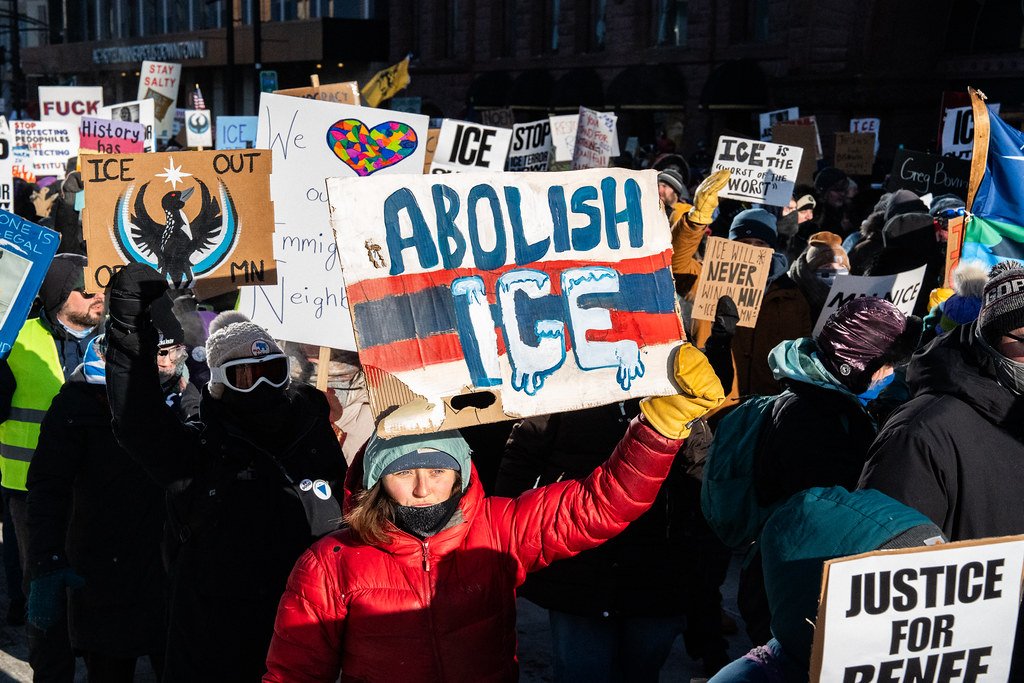

Yesterday, at the end of a dramatic hearing at which a federal judge revealed improper prosecutorial conduct, the government dismissed charges against four protesters arising out of an incident outside of a Immigration and Customs Enforcement (ICE) holding facility in Broadview, just outside of Chicago. It was the final twist in a case that was both highly unusual and yet emblematic of the Trump administration’s troubles in trying to make criminal charges against its antagonists stick.
This is the story of that case, from birth to death.

Operation Midway Blitz and the Broadview Protests
On Sept. 6, 2025, President Trump posted on Truth Social a picture titled “Chipocalypse Now,” with imagery evoking the 1979 movie “Apocalypse Now.” Trump wrote “I love the smell of deportations in the morning”—another dark nod to the classic film, in which Colonel Kilgore’s beloved morning aroma is napalm. “Chicago about to find out,” Trump added, “why it’s called the Department of WAR 🚁🚁🚁.”
Two days later, the Department of Homeland Security announced Operation Midway Blitz had begun. Federal agents fanned out across the Chicago area to pick up anyone they believed was not lawfully present in the U.S. As in other cities, the Department of Justice was quick to bring criminal charges against anyone it alleged was getting in the way of enforcement efforts.
Detainees were sent for initial processing to the Broadview facility, which quickly became a flashpoint for protests. As chronicled in a lacerating 233-page opinion by Judge Sara Ellis of the U.S. District Court for the Northern District of Illinois, federal agents frequently lobbed flashbang grenades, tear gas, and pepper balls at protesters without warning, and similarly targeted journalists. (As also chronicled in the opinion, these agents later went on to inaccurately describe their actions in court.) On one occasion, agents pushed people to the ground and laughed about it while blood oozed from a person’s ears.
On Sept. 19, agents reportedly hurled tear gas, pepper balls, and flash-bangs against protesters who were trying to block vehicles from entering and exiting the building. One masked federal agent dressed in camouflage picked up and tossed to the ground Kat Abughazaleh, a 26-year-old former media researcher with a hefty social media following who was running for the Democratic nomination for the 9th Congressional District of Illinois.
“This is what it looks like when ICE violates our First Amendment rights,” she tweeted. In response, White House Deputy Press Secretary Abigail Jackson wrote, “Obstructing law enforcement (which is what you just posted a video of yourself doing) isn't a First Amendment right. It's a crime.” A clip of the incident went viral on social media.
On Sept. 26, the protesters returned and blocked a street leading to the facility. After a vehicle turned in the direction of the facility, according to the Chicago Tribune, “[p]rotesters surrounded the vehicle, banging on the windows, throwing plushy toys and yelling ‘shame!’ as the driver pushed slowly through the crowd and agents let off a volley of pepper balls into the street.” Protests lasted for four hours; two arrests were made. One protester, per the Tribune, “wore a Snow White costume with silver Doc Martens rationalizing that federal agents might think twice about firing on someone dressed as a Disney princess.”
Perhaps seeing a campaign advantage in continuing to attack ICE, Abughazaleh returned to Broadview the following Friday, Oct. 3, where she slammed Department of Homeland Security Secretary Kristi Noem for “crimes against humanity.” In response, department spokesperson Tricia McLaughlin called Abughazaleh “[d]ishonest, desperate and demonizing law enforcement to try to get 5 minutes on MSNBC and some fundraising cash.”
The Indictment
At the end of October, the Department of Justice announced that on Oct. 23 a grand jury had handed up an indictment of six Sept. 26 protesters, including Abughazaleh. Other political figures were also charged: Brian Straw, a trustee of the village of Oak Park; Catherine Sharp, chief of staff to Alderman Andre Vasquez and a candidate for a Cook County Board seat; Michael Rabbitt, a Democratic committeeperson in the 45th ward; and Abughazaleh’s deputy campaign manager, Andre Martin. (The sixth was Joselyn Walsh, a researcher and musician who, at another point in that day, had an ICE-fired rubber baton round smash through her guitar.)
The Justice Department’s press release linked to a video purportedly depicting the scene at the protest. The video shows people thronging a vehicle as it approaches a gate, slowing it to a crawl.
The six were charged with conspiracy to injure or impede an officer in violation of 18 U.S.C. § 372 and forcibly impeding, intimidating, and interfering with a federal officer in violation of 18 USC § 111(a)(1). According to defense counsel, this was the first § 372 charge ever brought by the U.S. Attorney’s Office for the Northern District of Illinois. The statute was first enacted as part of the Ku Klux Klan Act of 1871; the Department of Justice’s Office of Legal Counsel noted in 1977 that the statute “has been infrequently used” and that “[m]ost reported cases have involved internal revenue agents whose efforts to track down tax-evading operators of illegal stills met with resistance.” Section 111, by contrast, has become this administration’s favorite charge against those protesting immigration enforcement.
The indictment alleged that the defendants, “and others”:
among other things, banged aggressively on the Government Vehicle’s side and back windows, hood, and other vehicle body parts; crowded together in the front and side of the Government Vehicle and pushed against the vehicle to hinder and impede its movement; scratched the body of the Government Vehicle, including etching a message into the body of the vehicle, specifically the word ‘PIG;’ broke one of the Government Vehicle’s side mirrors; and broke a rear windshield wiper off the Government Vehicle.
Had the case gone to trial, defense counsel would likely have suggested that the ICE officer recklessly turned his vehicle into the crowd of protesters, who then reacted in self-defense. The government did not specifically accuse any defendant of causing damage to the vehicle.
The case was assigned to Judge April Perry, a Biden appointee confirmed shortly after the 2024 election who made headlines in October 2025 when she enjoined Trump’s deployment of National Guard troops to Illinois, a decision that the administration unsuccessfully asked the Supreme Court to overturn. Before ascending to the federal bench, Perry had hoped to become the U.S. Attorney for that district, but in 2023 was blocked by then-Senator J.D. Vance, who had placed a hold on all Department of Justice nominees to protest the department’s prosecution of Trump.
Pre-Trial Developments
Over the ensuing months, the defense lost two key motions. Yet the case significantly narrowed all the same.
Like many of their predecessors during the Trump administration, the defendants alleged that they were being prosecuted selectively and vindictively, in violation of their due process rights. In a March 13 motion, they sought to compel the government to disclose any communications that might support a motion for selective and vindictive prosecution. Noting the White House’s and Department of Homeland Security’s attacks on Abughazaleh, the defendants argued that Trump and his administration had “repeatedly and openly taken steps to improper [sic] bend the Department of Justice toward his personal and political interests”—illustrating their point with a photo of the huge banner of Trump recently draped outside Department of Justice headquarters. The motion also noted that the defendants had not used force against or threatened the agent, nor had they damaged the vehicle. Rather, the “one commonality” among the several defendants (who, as discussed below, had gone from six to four) is that they were all “outspoken critics” of the administration and involved in government, either holding public office, running for office, or working for a political campaign. “The actions of these four Defendants were some of the most minimal actions depicted in the videos of the incident, yet their voices against the Trump Administration were some of the loudest.”
The government responded to the motion with surprising anger, calling it “the product of fevered paranoia and delusional speculation, not to mention grossly disingenuous and thoroughly irresponsible.” Giving their thesaurus a workout, they slammed defendants for “whingeing” and “caterwauling,” as well as “pusillanimously” not alleging any animus by the line prosecutors. The government insisted that all decisions in the case had been based on the law and the facts, and that some persons were not charged because they were all masked and could not be identified (which the defendants disputed in their reply brief). By contrast, “the government faced no comparable difficulty in identifying the original six defendants, each of whom was unmasked and several of whom made public statements proclaiming that they were at the Broadview facility during the incident.” The government said that “there are no communications of any nature from, to, or with anyone outside the USAO (other than the local FBI investigators assigned to the case) regarding any investigatory or charging decisions.”
In light of the government’s statement, Judge Perry denied the defendants’ motion to compel. She was unimpressed by the defendants’ occupations, noting that “public officials being charged is the bread and butter of the U.S. attorney’s office” and that such status is “always considered a plus factor.”
On March 16, the defendants moved to dismiss the § 372 count on First Amendment grounds. Defendants argued that the “spontaneous conspiracy” that prosecutors alleged would criminalize the defendants’ mere assembly and speech. Because they were engaging in a protest at the time they committed their alleged acts, they argued, “mere proximity and parallel conduct” by the defendants should not suffice to allege a felony conspiracy charge under § 372. Judge Perry rejected that motion at an April 29 hearing (about which more below) because, she concluded, it would have required her to resolve factual disputes about the defendants’ conduct. What the defendants portrayed as First Amendment issues actually, in the judge’s view, turned on whether the defendants had engaged in criminal conduct or “whether the defendants were merely present while others engaged in criminal conduct.” Taking the facts alleged in the indictment as true, as she had to when adjudicating a motion to dismiss, Judge Perry determined that “the indictment is not seeking to punish protected speech.”
And yet, despite winning on those two issues, the prosecutors found themselves limping to trial. What happened?
First, on March 12, the government dismissed the indictment of Sharp and Walsh without explanation, reducing the “Broadview Six” to the “Broadview Four.” The dismissal came too late for Sharp’s Cook County Board candidacy, which she suspended in early January due to her “hugely stressful” criminal case.
Second, the following day the government reduced the scope of the § 372 charge. The indictment had charged that the defendants
conspired with one another and others, known and unknown, to prevent by force, intimidation, and threat, Agent A, a United States law enforcement officer, from discharging the duties of his office, and to injure him in his person or property on account of his lawful discharge of the duties of his office, and while engaged in the lawful discharge thereof, and to injure his property so as to interrupt, hinder, and impede him in the discharge of his official duties.
On March 13, however, the government notified the court that it intended to prove only that the four remaining defendants “[c]onspired with one another and others, known and unknown, to prevent by force and intimidation, Agent A, a United States law enforcement officer, from discharging the duties of his office.” As revised, the case no longer involved any “threat” against the officer or effort to “injure” him or his property. This came weeks after the government stated at a Feb. 26 hearing that it had no evidence of any prior coordination among the defendants or with anyone else in relation to the conspiracy; rather, it was a “spontaneous conspiracy.”
Four days later, Abughazaleh came in second place in the March 17 congressional primary. At first considered a long shot, her campaign had taken off over the fall and winter—perhaps aided by her confrontations with ICE and her pending prosecution. But she fell just short, losing by 3 percent to Evanston mayor Daniel Biss.
In light of the revision to the § 372 charge, the defendants moved on April 8 for disclosure of portions of the transcripts of the proceedings before the grand jury that related to the explanation of that count. The defendants noted that § 372 actually describes several different conspiracy crimes:
The § 372 conspiracy statute can be violated through three distinct types of agreements that require proof of, among other things, (1) an agreement to prevent by force, intimidation, or threat an officer from discharging the duties of his office; (2) an agreement to injure an officer in his person or property while carrying out his duties; or (3) an agreement to injure property so as to interrupt, hinder, impede, or obstruct an officer in the discharge of his official duties.
Now that the government had limited itself to proving only the first of these crimes, the defendants wanted to check whether the grand jury had been properly instructed on its elements. The defense feared that the “the Grand Jury may not have been properly instructed that each § 372 clause constitutes a distinct, separate offense with its own elements, and/or that the Grand Jury did not indict on the first clause of § 372.” The defense suggested that “the Grand Jury may not have had the elements of the first clause of § 372 correctly described to them, or had elements of each of the three clauses incorrectly blended together.”
The judge ordered that the government (which did not object) submit by April 23 the relevant portions of the grand jury transcripts for the judge to review and determine whether to disclose the pages to the defense. A hearing was set for April 29.
To everyone’s surprise, at that hearing the lead prosecutor, William Hogan, addressed the grand jury transcript issue by saying “I think that we’re going to find that that issue is moot” because “we’re going to move to dismiss” the § 372 count. Later that day, the government filed a superseding information that dropped the § 372 charge. The government did not say why it was dropping the charge, which seemed to lend credence to the defendants’ suspicion that the grand jury was, in fact, improperly instructed. Despite dismissal of the § 372 charge, the defendants still wanted the grand jury instructions. As the defendants noted in a motion, the prosecutors had redacted the grand jury transcript that they provided to the judge. “Redacting portions of a transcript only being viewed by a federal judge in camera and ex parte raises numerous red flags,” they argued, “especially after months of the government fighting the disclosure of the transcripts at all.”
The defendants also found it highly suspicious that the government happened to dismiss the felony charge when it did.
This remarkable about-face, abandoning a high-profile indictment rather than submit to scrutiny its conduct before the grand jury comes at a time of mounting national distrust in the Department of Justice’s use of the grand jury process. The timing is likely no coincidence. In just the past few weeks, the government has secured indictments against a former FBI Director based on an Instagram photograph of seashells on a beach, and against a notable civil rights organization. These actions only underscore the growing concern that the grand jury is being wielded not as an instrument of justice, but as a tool of unchecked prosecutorial power meant to persecute any perceived enemies of the current White House.
The defendants surmised either that prosecutors misinstructed the jury on the law, failed to instruct the jury on the law, or that there were “interactions between the AUSA and the grand jury which [were] otherwise improper or prejudicial.” On May 18 Judge Perry agreed to review the full unredacted grand jury transcripts whose disclosure the defendants sought.
Things Fall Apart
On May 20, with the trial set to begin in just six days, Judge Perry issued an unexpected order: “Any AUSA who participated in the decision to redact portions of the grand jury transcripts, whether on the trial team or at the supervisory level, is ordered to appear in person” the following day for a hearing on the defendants’ motion for the transcripts’ disclosure. What was going on?
The prosecutors showed up the following day as ordered. So did defense counsel. Judge Perry started off by saying that she believed the grand jury had been accurately instructed. Her concerns lay elsewhere. “I was incredibly shocked by the redactions that were made,” she said. “I have never seen the types of prosecutorial behavior before a grand jury that I saw in those transcripts,” despite having read “hundreds, if not thousands,” of grand jury transcripts
Perry noted several problems based upon her review of the unredacted transcript. First, prosecutors had engaged in improper “vouching” to the grand jury, in which the prosecutor “put[] her personal credibility and trustworthiness on the line in support of the charges.” Second, she found “improper prosecutorial communications of a substantive nature with the grand jurors outside of the grand jury room.” Third, the prosecutor “excus[ed] grand jurors who disagreed with the government's case from the deliberations.”
What does this mean? “Vouching” is when prosecutors tell jurors, essentially, to trust them rather than to rely on their independent assessment of the evidence or of witness credibility. It is especially pernicious in the grand jury context, where defense counsel is absent. Talking to grand jurors about a case outside of the grand jury room is self-evidently wrong—as is kicking out grand jurors who disagree with you. As to the latter issue, it appears that after the first day’s presentation the grand jury voted not to indict. The prosecutor then apparently told grand jurors who had “made up their minds already,” in the judge’s words, not to participate the next day.
And the judge noted one further concern:
Which brings me to problem Number 4, which is the fact that all of this was redacted out of the versions of the transcripts that I got. And frankly, it is that that I find the most problematic. Mistakes happen. They happen to all of us. But as I tell my children, you own it. You admit to it. You apologize for it, and you move on. What you do not do is hide it.
Perry noted her earlier refusal to grant defendants discovery that might support their claim of vindictive prosecution had been based on the lack of evidence that anyone outside the U.S. Attorney’s Office had acted improperly. But now she had evidence that persons inside the prosecutor’s office had done so. She said she would allow defendants to brief the issue again if they so chose. She also noted the possibility of “sanctions for prosecutorial misconduct and for potential ethical violations, including lack of candor to the Court.”
Next week’s trial date was off. Counsel discussed how much time would be needed to brief anticipated defense motions—including a motion to dismiss. The judge announced her intention to release the transcript of the day’s hearing (later in the day a reporter posted it).
After a brief recess, the government returned with the chief lawyer of the Northern District of Illinois, U.S. Attorney Andrew Boutros. He stood up as soon as court was called into session—and moved to dismiss the case with prejudice. The judge granted the motion immediately. For the second time in a month, prosecutors had taken a knee: first dismissing the felony count, and now the misdemeanor. By now it was clear that prosecutors had dismissed the felony count in a failed effort to bury the misconduct that led to the dismissal of the misdemeanor count. Boutros didn’t say why he now pulled the plug entirely, but given the judge’s ire and possible sanctions against his office, he may have figured that it was best to sacrifice what had shrunk to a misdemeanor case to avoid having defense counsel also at his throat.
Even so, Boutros could not resist taking one further dig at the defendants. The “conduct that took place at Broadview,” he said, was “unacceptable in a civilized society.” The judge was underwhelmed. “You are significantly undercutting your mea culpa here,” she said, “by standing behind the charges and continuing to vilify these particular defendants.”
The case was over—at least for the defendants. “Hopefully,” Judge Perry said, “they will never have to come back to this building again unless it's voluntarily so.” For the prosecutors, facing possible sanctions, the hardest part of the case might lie ahead.
Other Operation Midway Blitz Prosecutions
The Broadview case is not the only Operation Midway Blitz prosecution to collapse. According to a Chicago Sun-Times tracker, prosecutors have accused 27 others of nonimmigration crimes related to the operation, almost all involving alleged incidents of interfering with federal law enforcement. All but three cases, of which one is solely a misdemeanor, and another was just filed yesterday, have been resolved. Of the 24 completed cases, 14 were dismissed outright by prosecutors. An additional three—charged in connection with a protest at Broadview one day after the Broadview Six’s protest—were dismissed after a grand jury refused to hand up indictments. (According to a federal magistrate judge in Chicago, such refusal by a grand jury “was virtually unheard of in this district until Operation Midway Blitz. The last and only one the Court can remember was from the early part of this century.”) Another four cases resulted in deferred-prosecution agreements, pursuant to which charges will be dropped if over the next six months the defendants abide by the law, perform community service, and fulfill other minimal conditions. The only case to have gone to trial—an indictment for soliciting the murder of Gregory Bovino—resulted in an acquittal.
Only two of the 24 cases so far completed have resulted in convictions: one man, originally accused of firing upon Border Patrol agents, pleaded guilty to illegal firearm possession; another, originally charged with a felony violation of § 111, pleaded guilty to essentially the same facts but to a lesser crime, misprision of felony, and is reportedly expected to avoid prison. (In the latter case, the judge has deferred acceptance of the plea agreement until she can review the presentence report.)
The most egregious case may have been that of Marimar Martinez, a 30-year-old Chicago schoolteacher who, while observing Border Patrol operations on Oct. 4, allegedly struck agents and then attempted to block their car from leaving. An agent then shot her five times. The Department of Homeland Security immediately put out a release calling her a “domestic terrorist”; the Department of Justice filed § 111 charges against her the next day. But on Nov. 20, prosecutors dropped the case completely, without explanation. Over the government’s objections, the judge subsequently ordered the release of videos from the agents’ body-worn cameras. The videos indicated that the agents’ accounts were not accurate, that Martinez was not responsible for contact with the government vehicle, and that there was no basis for the shooting. Martinez is now pursuing a Federal Torts Claims Act case against the government; the agent who shot her was placed on administrative leave.
The court tallies tell a very different story from the one then-Deputy Attorney General Todd Blanche told when he visited the FBI’s Chicago field office two weeks before a grand jury indicted the Broadview Six. Blanche said that Chicago is “a kind of ground zero in an escalating assault on law enforcement." He added that “what we were seeing is a tremendous effort, an organized effort, by domestic terrorists to actually injure and hurt folks in this room, the men and women on the streets that were just doing their jobs."
But prosecutors’ record in court suggests nothing of the sort. In fact, it looks like Chicago became—as would Minneapolis soon afterwards—more like “a kind of ground zero” for a government assault on the rule of law.
* * * * *
“I do believe deeply in the presumption of regularity and that most government attorneys are doing the best they can to do the right thing,” Judge Perry said yesterday. “That trust has been broken.” She appeared to be talking only about this specific case, but her words resonated more broadly. As the Department of Justice faces unparalleled headwinds around the nation due to politicization gone wild, the presumption of regularity is far less likely to adhere to its decisions. And when, as here, prosecutors make bad choices, it is likelier that those decisions will be ascribed to politicization as opposed to laziness, overwhelm, or a simple desire to win at all costs.
The Broadview case began as a warning shot—proof, the government insisted, that no one was above the law when it came to interfering with federal officers. But it ended as proof of something else entirely: that when the Justice Department bends itself to political purpose, the rule of law it claims to defend is the first casualty.