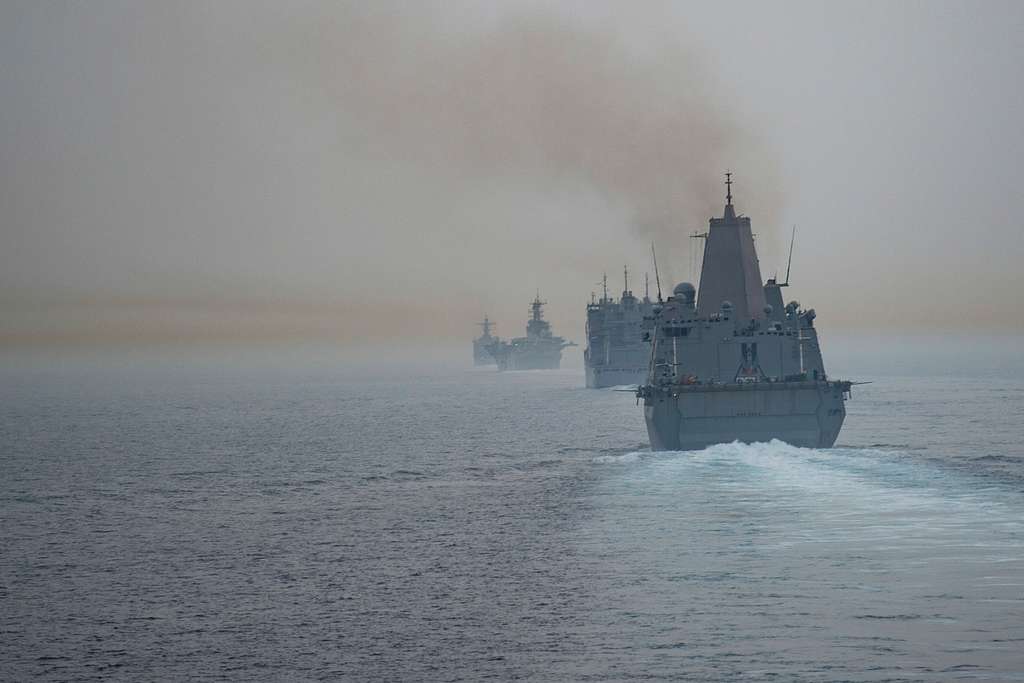
Revenge of Rumsfeld’s Fourth Quadrant—Closing the Strait of Hormuz


In my 2021 Lawfare article, “The Fourth Quadrant—the Unknown Knowns,” I argued for expanding Donald Rumsfeld’s famous knowledge matrix to include a category he conspicuously overlooked. Recall that in a 2002 press briefing about Iraq, Rumsfeld organized knowledge into three useful bins: known knowns (known answers to questions we know are relevant), known unknowns (questions that we know are relevant but for which we do not yet have answers), and unknown unknowns (the true blind spots that we have no reasonable way of anticipating and appear as a total surprise).
My article pointed out that he omitted the fourth quadrant—unknown knowns—things known in some institutional, analytic, or experiential sense that nonetheless fail to inform decision-making when they should. Unknown knowns are not gaps in data; somewhere in the system, their informational content exists. Rather, they arise from human psychological and organizational frailties: wishful thinking, organizational silos, desensitization to repeated warnings, hierarchical filtering, and the seductive comfort of narratives that tell us what we want to hear.
The Trump administration’s operational surprise at Iran’s recent closure of the Strait of Hormuz offers a stark and deeply instructive illustration of this phenomenon unfolding before our eyes in real time. The crisis reveals a core pathology of unknown knowns: treating a low assessed probability as license to skip preparation. How that pathology operated—and what it cost—is the subject of this article.
A Plannable Scenario, Regardless of Predictability
The Strait of Hormuz has long been the poster child for asymmetric vulnerability in global energy security. Since the 1980s Tanker War, when Iranian forces mined the Persian Gulf’s waters and attacked oil tankers during its war with Iraq, U.S. Central Command has gamed Iranian asymmetric tactics—including games with swarms of speedboats, limpet mines affixed by divers, and shore-launched anti-ship missiles—that could halt a significant fraction of the world's seaborne oil trade through a 33-kilometer-wide chokepoint. Authoritative analyses have catalogued economic shocks from such disruptions in the strait for decades: oil spiking above $100 per barrel, supply chain spasms rippling across Europe and Asia, and recessionary pressures even for a United States buoyed by shale production.
Iran, for its part, has advertised this capability. Islamic Revolutionary Guard Corps (IRGC) commanders have showcased the Hormuz threat in public exercises, official statements, and parliamentary speeches across Iranian administrations. Tehran has threatened to close the strait since the 1980s. Think tank reports, Congressional Research Service analyses, and unclassified defense studies going back decades recorded these threats in meticulous detail.
An Iranian attempt to close the strait was therefore a contingency that should have been plannable based on Iran’s documented capability and stated intent. Note that planning for contingency X does not depend on an expectation that X will happen. Closing the Strait of Hormuz is one in a class of contingencies that demand preparation precisely because they combine genuine uncertainty about occurrence with catastrophic consequences if they materialize. Preparing for such scenarios is not about prediction; it is about prudence.
The Timeline
Operation Epic Fury began on Saturday, Feb. 28, 2026. Within 24 hours, traffic in the strait dropped by 70 percent as the IRGC cautioned ships to avoid the area, announcing that the “passage through the strait is currently unsafe.” On March 8, oil prices exceeded $100 per barrel for the first time since July 2022. On March 11, the Trump administration authorized the release of 172 million barrels of crude oil from the Strategic Petroleum Reserve (SPR) as part of an effort to stabilize oil prices, and on March 16, the release began.
The Scrambling: Evidence of Preparation Failure
When Iran mined the strait and paralyzed tanker traffic in retaliation for the joint U.S.-Israeli strikes on its leadership apparatus, its conventional military capacity, and its nuclear program, the Trump administration’s response revealed not merely surprise at Iranian decision-making, but the absence of operational readiness for a thoroughly documented and highly anticipatable contingency. The evidence remains circumstantial rather than documentary—no leaked contingency plans or official acknowledgments exist. But multiple independent indicators converge:
- The president reportedly asked the chairman of the joint chiefs why the strait could not simply be “reopened”—a question that he would not have had to ask had he known about or been prepared in advance about operational plans, timelines, and resource requirements.
- Officials appear to have had to explain basic operational realities to Trump, including that mine-clearing in contested waters is slow and dangerous, that Iranian shore-based missiles complicate naval operations, and that allied cooperation is essential but not guaranteed.
- Allies have balked at urgent U.S. calls for naval escorts, with European partners likely concerned about operational risks and harboring political resentments for being excluded from prestrike deliberations. This points to another preparation failure, despite decades of awareness that multilateral consequence management might be necessary after unilateral U.S. action. Tellingly, Trump—who routinely criticizes allies for failing to honor commitments—has not accused Europeans of reneging on preexisting agreements, suggesting no such agreements existed in the first place.
- Former officials described being “dumbfounded” that such a well-anticipated contingency was not gamed out to executable specificity. Lawmakers, summoned to classified briefings, berated officials over the absence of an executable plan for restoring traffic.
- The eight-day lag between the $100 per barrel spike and the release of oil from the SPR suggests improvised coordination rather than execution of preplanned releases with established trigger conditions and predelegated authorities, which would have enabled action within hours.
These indicators collectively confirm a pattern more substantial than any single data point would suggest: The United States had no executable, tailored plan ready when Iran acted.
Three Distinct Levels of Failure
Of course, the White House doesn’t see it this way. Administration spokesperson Anna Kelly stated that “[t]hrough a detailed planning process, the entire administration is and was prepared for any potential action taken by the terrorist Iranian regime.” It is worth examining why this may be true in a narrow sense yet false in the operationally meaningful one.
Three types of failure are distinct:
- Type 1: failure of prediction. The Wall Street Journal reported that Trump knew there was a risk of Iran blocking the strait but believed Tehran would capitulate before doing so. This was not entirely unreasonable—Iran has threatened closure for decades but acted rarely, even under severe provocation. A judgment of unlikelihood, though subsequently proved wrong, could have been defensible based on available intelligence, historical patterns, and even Iran’s own predecision uncertainty. A Type 1 failure is an incorrect prediction—in this case, that Iran would capitulate rather than act. While real, a Type 1 failure is the least damning in this story.
- Type 2: failure of preparation. This means not having executable contingency plans despite Iran’s well-documented capacity and repeatedly advertised threats to close the strait. The critical distinction is between executable contingency plans and on-the-shelf plans: The latter almost always require tailoring to specific circumstances to turn them into the former. A generous reading of Kelly’s comment is that there were (and are) many on-the-shelf plans for contingencies involving Iran. But the sudden lifting of sanctions on Iranian oil already in tankers, the failure to secure allied cooperation before Feb. 28, and the delay in the SPR’s release all indicate that no such tailoring had occurred to generate an executable contingency plan.
- Type 3: failure of process. This is dismissing the need to develop executable plans for outcome X because the probability of X seems low. This pathology of the unknown known allows organizations to rationalize: “We know X is possible and have on-the-shelf contingency plans in case X happens, but low odds mean we have no need to customize them.” Correcting the pathology flips the script: “X is unlikely, but if it occurs, consequences are dire—so prepare executable plans,” and this is what the Hormuz scenario demands.
Even if Kelly is correct that the administration had prepared for any potential Iranian action, the observable evidence indicates that officials behaved like people without executable national plans in place. An executable military plan appears to be in motion now—indeed, a former commander of U.S. Central Command has discussed a plan being executed now in response to Iranian efforts. That plan almost certainly addresses kinetic operations such as mine-clearing tactics, force protection, and generation of target lists. Such a plan—for military operations—could well have been formulated in advance, with any gaps filled using the Pentagon’s adaptive planning capacity even without pretailored preparation.
But a Department of Defense plan is not a national all of government plan, and it cannot provide all the nonmilitary elements that require interagency coordination and allied buy-in: economic stabilization measures, coalition frameworks for convoy operations, and diplomatic consequence management. The Pentagon is capable of improvising regarding targeting; it cannot improvise when it comes to allied cooperation or authorities under the Treasury Department or the Department of Energy.
Why didn’t the U.S. have a national plan for these things in advance? The administration threatened military action for weeks and deployed additional naval forces—so the concern that news of the operation might leak cannot explain the failure. Nor can resource constraints affect planning. While it would be impractical to update every plan on the shelf continuously, contingency planning for responses when positioning for military action in a given theater is not a competing priority but the core planning requirement. The more likely explanation is that a president determined to demonstrate decisiveness prioritized speed of action over consequence management, treating delay for preparation as weakness rather than prudence.
How “Unlikely” Becomes “No Need to Plan”
The transformation of Hormuz from known vulnerability to operational surprise reveals the mechanisms through which unknown knowns operate. Three pathologies are visible.
First, narrow deliberation excluded consequence-focused voices. Prewar planning reportedly marginalized the Department of the Treasury’s and the Energy Department’s inputs on global ripple effects, treating economic analysis as secondary to kinetic targeting. Trump’s reliance on a tight circle of advisers curtailed the interagency friction that normally surfaces dissenting views and stress-tests assumptions. Crucially, no officials with organizational responsibility for energy security had standing to insist on contingency readiness, and thus that mission-critical perspective never became part of the operational requirements.
Prior administrations—whatever their flaws—institutionalized processes pulling subject-matter experts into worst-case exercises before committing to operations. The result was not always perfect preparation, but it created organizational memory and bureaucratic constituencies for contingency planning. Here, those processes were truncated, and the organizational mechanisms to convert knowledge into readiness did not engage, either because they were dismantled (think Elon Musk’s Department of Government Efficiency?) or were bypassed simply in favor of rapid action.
Second, the administration’s wishful thinking metastasized from prediction to preparation. Senior officials presumed Iran would never close the strait—that the harm would be too significant to Tehran’s own oil revenues. This analysis was not baseless, as Iran depends on Hormuz for oil exports. But a regime facing existential obliteration of its nuclear program and leadership is unlikely to perform standard cost-benefit calculations on export revenues. Failure to recognize this point is what underlies a Type 1 failure.
The more dangerous error, however, was allowing this probability judgment to become permission to skip preparation. The administration’s logic became, “Iran won’t do this, and therefore we don’t need operational plans for if they do.” This conflated two entirely separate questions: (a) Will this happen? and (b) What do we do if it does? Intelligence uncertainty about the first question should have increased, not decreased, urgency around the second.
History offers cautionary precedents that could have informed the administration’s thinking. Japan attacked Pearl Harbor in 1941 despite the apparent strategic futility of war with the United States, choosing escalation over the slow strangulation of an economic embargo. Egypt launched the 1973 Yom Kippur War despite an unfavorable military balance because Anwar Sadat’s regime survival demanded action to break the unsustainable post-1967 stalemate. In both cases, the parties facing existential pressure chose escalation that appeared irrational under standard frameworks of rational cost-benefit calculation. The administration was quite explicit about wanting the Iranian people to rise and overthrow the existing regime—it should have recognized that desperate nations sometimes do desperate things, and it should have planned for that contingency.
The psychological mechanism underlying these historical cases is well established. Prospect theory holds that framing a situation as a gain or loss fundamentally shapes risk tolerance. Actors prefer small, guaranteed gains to risky, large ones, but they would also rather gamble with uncertain outcomes rather than face a certain but painful loss. A regime reckoning with the destruction of its nuclear program, the killing of its supreme leader, and the prospect of popular uprising is not calculating expected utilities, such as its oil revenues, from a position of strength; it is facing near-certain loss, where the psychology of desperation is likely to override conventional cost-benefit logic. Iran’s closure of the strait—economically self-destructive by a rational cost-benefit one—was entirely predictable under a loss-framed perspective.
Third, desensitization converted a planning requirement into background noise. Warnings about the strait were issued so many times, over so many administrations, with so little Iranian follow-through, that the scenario acquired the status of ritualized concern: It was often mentioned in testimony and war plans but was apparently insufficient to drive resource allocation (e.g., for minesweepers) or operational readiness (e.g., to obtain allied support for minesweeping operations) at the moment of need. Analysts and planners who drafted Hormuz contingencies years ago moved to other assignments; institutional memory was not erased but deprioritized into irrelevance. New officials inherited generic frameworks but not the organizational muscle memory of regular exercises, updated protocols, and maintained relationships both for the domestic interagency planning process and with allied governments.
This dynamic helps transform known knowns into unknown knowns—repeated warnings, unaccompanied by consequences, breed the complacency that allows on-the-shelf contingency plans to stay on the shelf rather than moving to the active and urgent inbox.
What Operational Readiness and an Executable Plan Would Have Looked Like
To be clear about what the U.S. missed: If the administration had maintained readiness for the Hormuz closure, the following would have been in place when Iran acted:
- Pre-positioned assets: mine countermeasure vessels, surveillance platforms, and escort capabilities in theater or ready for rapid deployment, with preplanned logistics and command structures.
- Frameworks for allied support: burden-sharing arrangements with European and Asian partners for convoy operations and political-military coordination, negotiated and secured before the crisis rather than improvised during it.
- Coordinated economic measures: strategic petroleum reserve release schedules at the ready, coordinated with partners in the International Energy Agency, with preidentified trigger conditions and plans for how to communicate with the American people about what would be happening.
- Public communications: prepared messaging for domestic and international audiences explaining the situation, response timeline, and economic mitigation measures.
The operational signature of readiness is immediate execution of customized contingency plans when trigger conditions are met: Assets deploy to preplanned positions, allies activate prenegotiated protocols, economic measures trigger automatically, and leadership communicates rather than haphazardly discovering constraints as the scenario unfolds. Instead, the observable facts reveal that even if the relevant planning documents were in the Pentagon’s filing systems, the necessary nonmilitary elements either did not exist or existed only in generic form, untailored to the operational and political context of this particular scenario. This is the failure of preparation, and it was preventable.
Why Unknown Knowns Demand Different Remedies
It is worth asking why preparation failures are more treacherous than prediction failures, and why the fourth quadrant demands remedies distinct from Rumsfeld’s other categories.
Prediction failures such as misjudging an adversary’s intentions prompt natural responses: better intelligence, improved analytic methods, or red-team exercises. These are valuable, but they operate within a paradigm of reducing uncertainty—and some uncertainties, such as adversary decision-making under existential pressure, involve irreducible unpredictability.
Preparation failures are different. They require organizational commitment to readiness for high-consequence scenarios regardless of assessed probability. The remedy is not more intelligence or better analysis but, rather, institutional discipline: contingency plans maintained in executable form, exercised regularly, and updated as circumstances change, even for scenarios judged unlikely.
Rumsfeld believed that unknown unknowns are the most difficult category in his triad of knowledge because they involve surprises we cannot anticipate. But they prompt a certain institutional humility—a recognition that the world may surprise us, which motivates investment in adaptive capacity and rapid-response capabilities.
Unknown knowns do the opposite. They generate false confidence: We have plans; we know the risks; we have been here before. That false confidence collapses the distinction—established in the Type 2 discussion above—between on-the-shelf plans and executable ones, foreclosing the rigorous preparation the situation demands.
The standard required to maintain daily readiness for immediate execution exists elsewhere in national security planning. For example, the nuclear war plan, once known as the single integrated operation plan and now the operations plan (OPLAN) 8010, calls for a significant portion of U.S. strategic forces to remain on alert at all times and ready for immediate and/or near-immediate use and continuously refined targeting based on inflows of real-time intelligence. This readiness requirement obtains, despite nuclear war being far less probable than the strait’s closure. Operational plans to defend the Korean Peninsula (OPLAN 5015, successor to OPLAN 5027) are exercised biannually in large-scale combined exercises, maintain pre-positioned forces and logistics on the peninsula, and enable U.S. and South Korean forces to execute immediately in the event of North Korean aggression.
That we can execute these plans today if need be underscores that it is possible to maintain daily operational readiness for high-consequence scenarios regardless of how likely they will occur on any given day. While not all on-the-shelf contingency plans need to stay ready for prompt execution, the Hormuz contingency warranted exactly such attention, especially since an existentially threatening move by the U.S. in the wake of the killing of Gen. Qassem Soleimani would likely trigger Iran’s closure of the strait.
The Uncomfortable Lesson
The administration judged that preventing an Iranian nuclear breakout and destroying its conventional military capabilities justified accepting the risk of Hormuz’s closure. The strategic calculus leading to that judgment could have been defensible. What is not defensible is accepting that risk without maintaining operational readiness for the consequences. Risk acceptance demands contingency preparation; it does not excuse its absence.
For national security practitioners and policymakers, the lesson is uncomfortable but unavoidable: Failures to prepare for the well-documented risk scenarios can be as disastrous as failures to predict the unpredictable. Dangerous surprises are not only the ones we never imagined. They are also the ones we imagined, documented, modeled, and then quietly stopped preparing for because we convinced ourselves they wouldn’t happen. It’s not the black swans that are at issue here; it’s forgotten and buried canaries from the allegorical coal mine—the ones we acknowledged, filed away, and then failed to keep alive through the disciplined work of maintained readiness.
Rather than the usual fixes of more analyses or collecting more data, the existence of unknown knowns suggests the value of well-known and often recommended organizational and cultural prophylactics. Mandated devil’s advocates, enforced historical reviews, bias-auditing protocols, and decision logs to track sidelined insights could collectively reduce the risk of preparation failures such as this one. Most of all, unknown knowns require national institutions to act to fulfill the roles for which those institutions were originally created—to preserve and to insert into national planning processes the knowledge for which they have paid so dearly.