Terrorism’s Second Act


On Nov. 4, 2025, Abdulrahman El Bahnasawy pleaded guilty to stabbing a corrections officer with a weapon he fashioned from a jailhouse desk. A written note law enforcement found shortly after the attack stated plainly, “This is a terrorist attack for the Islamic State.” El Bahnasawy, with a documented history of untreated mental health issues, was already a decade into a previous conviction of 40 years for plotting attacks in New York City on behalf of the designated terrorist organization. According to prosecutors, El Bahnasawy has never wavered from his violent ideology. He's not alone among convicted terrorists in refusing to renounce his fervent, violent beliefs—but he is one of the few.
Movies and television shows often portray hardened extremists, committed to their ideology until their very last days of incarceration and first days back in society. But, in the real world, recidivism among those who are convicted of terror offenses in the United States isn’t just low—at less than 4 percent, it’s rare.
Despite the low rate of convicted terrorist recidivism, recent events suggest that this trend may be on the path to quietly inching higher in the coming years as more and more convicts are being released.
To name a few examples: In July, a 21-year-old German man killed a woman and injured another 29 people after he was released from a brief stint in detention for attempting to join the Islamic State. In France, a man who had been recently released early on a 17-year prison sentence for a terror-inspired stabbing of two Belgian police officers was killed in February during an attempted knife attack on gendarmeries at the Arc de Triomphe. And in March, 36-year-old Mohamed Jalloh killed an instructor with the Reserve Officers’ Training Corps (ROTC) at Old Dominion University, a decade after he was convicted of attempting to provide material support to ISIS.
These cases suggest the problem isn’t simply recidivism rates, but rather a haphazard and nearly nonexistent reintegration system that conflates disengagement from violence with actual deradicalization. With dozens of convicted terrorists soon to be released in the coming years, the United States lacks any uniform standard for how, or whether, they’re tracked.
‘This Case Kept Me Up At Night’
Ten years before Jalloh walked into a classroom filled with ROTC cadets in their senior year with a handgun, he was a member of the U.S. Army National Guard facing grievous allegations of attempting to join the Islamic State and assist an attack in the United States inspired by the brutal terror group. Born in Sierra Leone in September 1989, Jalloh’s adolescent years, according to his one-time attorney, were marred by war, sexual abuse, trauma, and displacement. After fleeing Sierra Leone as a refugee and moving between several family members’ homes, Jalloh moved to the United States with his mother, who was later deported.
He first enrolled at Old Dominion University in February 2007, but Jalloh’s intended major, psychology, and other classes didn’t pan out. Jalloh joined the National Guard two years later, but it wasn’t enough to stop his grades from slipping. For the 2010 spring semester, university administrators placed him on academic suspension. Jalloh applied several times to be readmitted to the university, located on the Virginia coast near Naval Station Norfolk and which draws approximately 28 percent of its 17,000-student body from the U.S. military.
According to an after-action report produced for the university by the white-shoe law firm Cooley LLP, Jalloh later gained readmission in November 2024 while still incarcerated in federal prison. He began classes the following fall after his release.
Jalloh, as his then-attorney wrote in 2017, hit rock bottom around 2015. His girlfriend of six years had dumped him and messaged him risque photos of her with another man; he was unable to return back to the United States amidst the Ebola virus after traveling to see his ailing father in Sierra Leone; and soon after, he came into contact with Islamic State recruiters online.
With the recruiters’ encouragement, Jalloh left his father in September 2015, hopping into the back of a truck that would take him and other Islamic State supporters from Nigeria to territory under the terror group’s control in Libya. But Jalloh’s nerves kicked in during the journey; he escaped from the truck, returning to his father and eventually back to the United States. His communications with ISIS recruiters, however, did not stop. Soon, Jalloh began sending hundreds of dollars to several recruiters.
In April 2017, Jalloh met a man in Virginia whom the online recruiters had introduced him to that was helping plan an attack in the U.S. Unbeknownst to the recruiters and Jalloh, the man turned out to be a confidential source for the FBI. A criminal complaint later stated Jalloh told the man he thought about conducting a Nidal Hassan-style attack—who killed 13 people at Fort Hood in 2009—“all the time.” Jalloh also reportedly called Mohamed Yousef Abdulaziz, another man who killed five U.S. service members during an attack in 2015, a “very good man.” Jalloh later wrote to the undercover source that he just wanted “to live a good Muslim life and die as a Shaheed,” an Arabic term that translates to martyr.
But Jalloh was noncommittal about actually participating in the attack himself. He offered to help the confidential source acquire AK-47s and to send money to support an attack. He drove down to North Carolina in June 2016 to buy an AK-47, but the seller rebuffed him. The FBI arrested him for attempting to provide material to support the Islamic State several weeks later, on July 3, 2016, the day after he purchased an AR-15. In the days before, he had searched the name of the Pulse Nightclub shooter, “which kinds of rounds should I use for maximum damage,” and “4th of July Veterans Parade” on Google.
Jalloh pleaded guilty in October 2016, facing up to 20 years in prison. At sentencing, federal prosecutors asked for the 20-year max. Jalloh’s attorney, citing a chorus of support from several of his fellow service members and his early childhood trauma as mitigating circumstances, urged the judge to deliver a 78-month sentence.
Speaking to the court, Jalloh called his support of the Islamic State the “most devastating” mistake he had made in his life. “I want to say, every time I see any atrocities that ISIS commits, I am disgusted by it because I know this is not what I want to be a part of,” he told the judge.
Jalloh was sentenced to 132 months in federal prison, with credit for time served in pretrial detention. An FBI agent who was involved in the investigation of Jalloh said the case was the one that “kept me up at night.”
He was released on Dec. 23, 2024, after completing a substance abuse treatment program that allowed him to shave off part of his sentence. (The Bureau of Prisons no longer allows people serving terrorism convictions to receive a sentence reduction for the program.) Jalloh’s last contact with his probation officer was in November 2025. The probation officer was next scheduled to meet with him in April.
Campus Attack
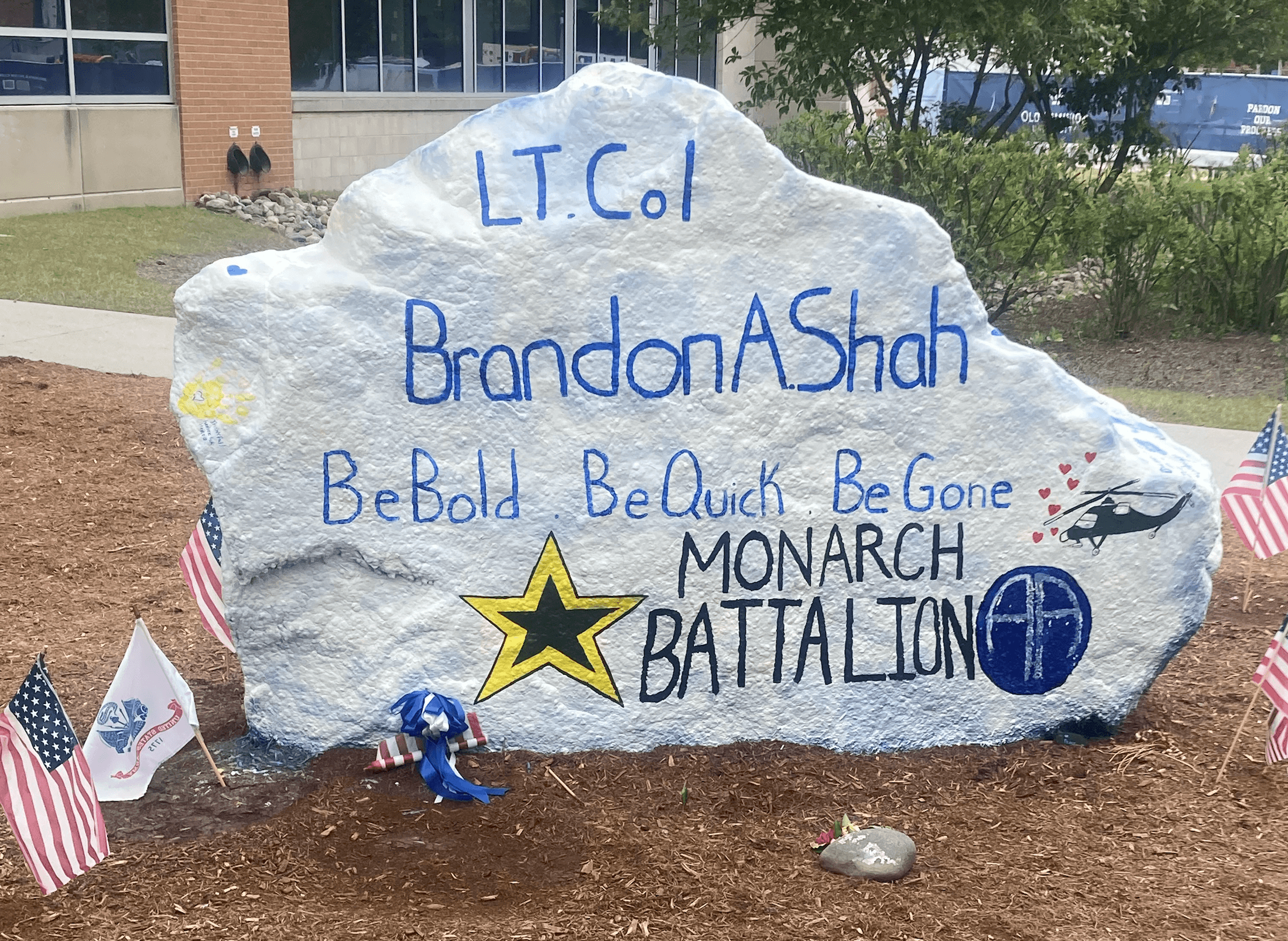
Fourteen months later, on the morning of March 12, Jalloh approached a lecture hall on Old Dominion University’s campus, lingering outside the classroom for 13 minutes in a puffer jacket and backpack. At 10:41 am, he entered the classroom, immediately drawing the attention of Lt. Col. Brandon Shah and the ROTC cadets. Jalloh asked whether the students were there for an ROTC class. When the students and Shah said yes and that there were only four minutes remaining in class, Jalloh shouted “Allahu Akbar” and began shooting from a Glock 44 semi-automatic pistol.
Shah reacted instantly, moving to disarm Jalloh, as the ROTC cadets took cover. Jalloh shot Shah several times. A small group of cadets heroically tackled Jalloh, armed only with two pocket knives. Another cadet was shot in the abdomen in the process. Jalloh was killed in the struggle. Campus and local police responded within minutes. The cadets rushed Shah, who was still conscious, to an ambulance, but his multiple gunshot wounds were too severe. He passed away at a hospital that afternoon.
Cooley’s post-action review found that Old Dominion University was unaware of Jalloh’s terrorism conviction, hamstrung in part by a state law barring Virginia’s public colleges and universities from requiring applicants to disclose criminal convictions. The post-action report concluded that Jalloh likely would not have been readmitted if administrators had been aware of his past support for the Islamic State. The report also faulted Jalloh’s probation officer overseeing his supervised release for not notifying the university of Jalloh’s legal history.
University officials, campus police, and the Norfolk Police Department, according to the report, all had a close-to-perfect response to the shooting. What the report didn’t answer was how a man who had served eight years in federal prison for a terrorism conviction came out just as radicalized as before, and why officials failed to see the writing on the wall.
What the Data Shows
It seems counterintuitive, but understanding which former extremists are likely to hang on to their violent beliefs has been hampered in part by the success of their own self-deradicalization.
According to new research by the National Counterterrorism Innovation, Technology, and Education Center at the University of Nebraska Omaha, more than 280 individuals have been federally charged for ISIS-related activity since 2014, when its then-leader Abu Bakr al Baghdadi announced the so-called caliphate’s formation. Jalloh fit squarely within that group, 74.28 percent of whom were similarly charged with material support. Among the 227 individuals who have been sentenced for Islamic State-related activity, the average sentence was roughly 13 years, and a majority received less than 200 months—below the 240-month statutory maximum for material support. In the last two years, dozens of ISIS convicts have been released from prison, with many more on the way.
Decades of academic research have identified several factors contributing to criminal recidivism, including age, criminal history, family environment, and substance use. Researchers have also examined the efficacy of reentry and rehabilitation programs, finding that these efforts can reduce the likelihood of future offending. These programs are particularly successful in addressing offender needs rather than just applying blanket assistance. For most criminal offenders, what makes someone recidivate is relatively clear. For terrorism offenders, the picture is murkier.
Because so few terrorists commit another terrorism offense, researchers have struggled to build the same consistent body of evidence that exists for traditional crime. What little evidence does exist suggests that some of the same old patterns hold, with older generations being less likely to reengage, but ideology and continued engagement with extremist networks appear to play a much larger role. While academics have been applying lessons from broader recidivism work to terrorism, they caution that extremist offenders don’t follow the same pathways as traditional criminals.
Realities of Reintegration
When you leave federal prison after a stint for terrorism, everyday things can trip you up.
A Chicago-based ISIS convict was benchslapped for downloading an app on his phone, a direct violation of his probation. He was reportedly trying to install Tinder to get back into the dating pool. The 23-year-old man was sent to a halfway house for violating his parole.
A New York Ivy League graduate who spent months in Syria working for ISIS and returned disillusioned with his experience and convicted of material support charges asked if terrorism scholars would consider writing a letter of support to a judge so he could legally change his name. Every time a potential suitor googled his name before a date, the first result would be his terrorism conviction. The dates were always quickly cancelled.
Another Illinois man convicted of material support for al-Shabaab told us how he struggled to find a mosque to pray at after being released; no religious institution in his area wanted to be associated with him and was worried that having a convicted terrorist as a congregant would bring law enforcement scrutiny. He found himself praying at a mosque that practiced a different strain of Islam, a haphazard solution that still brought him some peace from the religious rituals’ familiarity.
When asked what his biggest regret was, an American member of al-Qaeda who spent time in Afghanistan fighting for the terror group told us that his back hurt. What he meant, after some prodding, was that while he still supported the extremist organization, his advancing age made it impossible to fire a rocket-propelled grenade—clearly, a man who was disengaged from violence, but not deradicalized from the ideology. For many law enforcement and First Amendment advocates, that distinction is enough.
Research has shown that extremists disengage from violence as their social role and sense of identity evolve. As extremists, their beliefs are intertwined with an urge to act, and taking action is part of who they are. Someone who takes pride in doing everything and anything for a cause doesn’t want to be accused of sitting on the sidelines. But when former extremists find a different identity—through education or employment opportunities, new relationships, or social circles—it provides an opening, allowing them to self-justify disengaging: ‘Why carry out a terrorist attack when I just got a new girlfriend or hired for a job with great coworkers?’
The opposite is true when strong stigma exists against a former extremist, because it reinforces the role of a terrorist as their place in society. When relationships and opportunities spurn someone, they’re likely to shift back to what they found comfort in before, even when it’s as extreme as supporting a violent ideology.
However, when extremists successfully disengage from violent extremism through socialization, disengagement often follows. New experiences and interactions begin a process of disillusionment, in which these experiences conflict with the extremist’s violent beliefs, driving them away from the past ideology.
In most cases, terrorist recidivism has been the dog that didn’t bite. That fact is of no comfort to the victims of the small but nevertheless deadly number of those who did relapse into violent extremism.
There are some low-hanging opportunities to address how the U.S. reintegrates people convicted of terrorism back into society. First, imprisonment offers a unique opportunity to attempt novel deradicalization and disengagement programs without the sticky legal concerns that readily apply to individuals whom a court has not found guilty of a terrorism offense. With proper funding and oversight, prison officials could test pilot a holistic deradicalization, or at the very least, disengagement program.
Second, the government could implement uniform probation requirements for individuals convicted of material support to a foreign terrorist organization. As it stands now, each judge can dictate the terms without recommended guidelines. Some convicts, such as the Chicago man who found himself in hot water for downloading Tinder, have their electronics supervised for the rest of their lives. Others, such as American Taliban fighter John Walker Lindh, have much shorter probationary timelines.
Congress has occasionally shown interest in this issue. Individual senators on both sides of the aisle have issued oversight letters and encouraged the executive branch to take this issue seriously. Without a sustained focus, however, it will likely be ignored.
Further, the FBI should review the findings in the Cooley report and how it assesses former extremists’ reintegration. A plain reading of the bureau’s internal bible, the Domestic Investigations and Operations Guide, could argue that once someone has served their time in prison for terrorism offenses, they no longer qualify for ongoing monitoring. Many field offices take that view, and others may quietly disagree but lack the personnel and resources, which are increasingly being pulled away from terrorism investigations to other administration priorities, to address it.
Nevertheless, the FBI’s assessment will matter little to the public and Congress if a future convicted American terrorist commits yet another act of violence. The bureau should review the parameters for opening a law enforcement investigation post-conviction. It should also establish clear standards for how long and with what resources agents should continue to assess individuals with a history of concern.
A beloved Old Dominion University instructor is dead. A room full of college kids prevented an even more tragic event that day. The response to the coming release of dozens of convicted terrorists should not rest solely on heroic acts by the public, as the government’s current plan for addressing extremist recidivism rests largely on the hope that the convicted terrorist finds a change of heart entirely on their own volition.