The Counterterrorism Toolkit for Cutting the Cartels’ Arms Pipeline
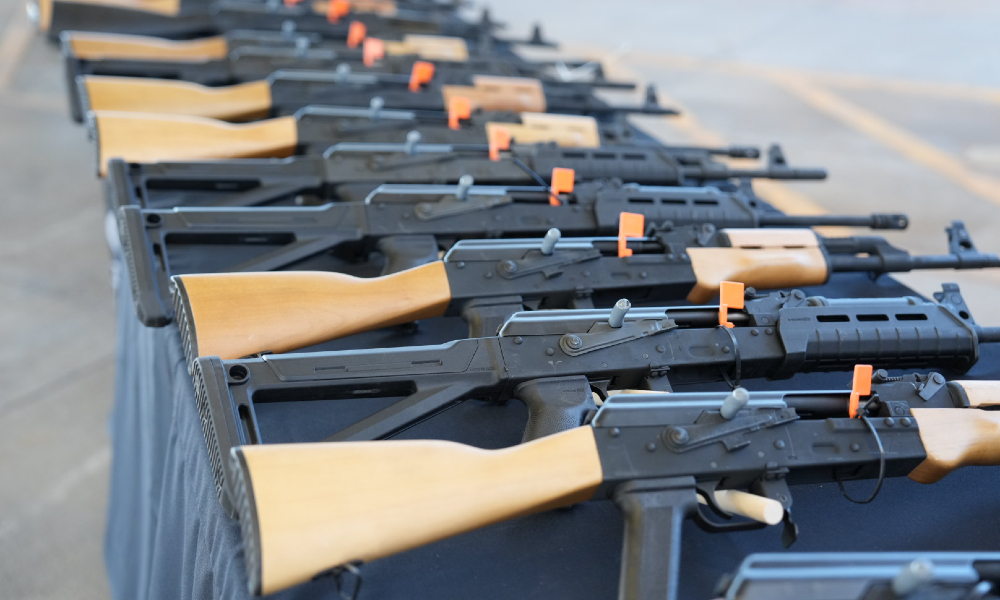

Editor’s Note: The Trump administration has pressed Mexico to crack down hard on cartel activity. My Center for Strategic and International Studies colleague Henry Ziemer argues that the United States could weaken the cartels’ military power by cracking down on the flow of high-powered weapons going from the United States to Mexico.
Daniel Byman
***
“Cartels that operate in this hemisphere are the ISIS and al-Qaeda of this hemisphere and must be treated just as ruthlessly,” White House Deputy Chief of Staff Stephen Miller proclaimed in an address to assembled Latin American and Caribbean leaders on March 5. His comments were echoed two days later by President Trump at the inaugural Shield of the Americas summit, where he exhorted the rest of the Western Hemisphere to wage war on narcotrafficking and organized crime.
This is more than just empty rhetoric from the United States. Since January 2025, the U.S. government has designated 15 criminal organizations in the Western Hemisphere as foreign terrorist organizations (FTOs). Ongoing lethal strikes against alleged drug boats in the Caribbean and Eastern Pacific have killed at least 161 people and persisted in the face of congressional opprobrium and outcry from human rights defenders in the United States and the region. U.S. officials claim that such strikes are having a deterrent effect on drug trafficking and that illicit boat launches have decreased by as much as 97 percent in the region.
Whether such claims are true or not, transnational criminal organizations (TCOs) are nothing if not adaptable, and will employ violence, intimidation, and corruption to preserve their illicit revenues. But for all its rhetorical bluster, the Trump administration appears to be dragging its feet when it comes to taking action against one of the most important pillars of cartel power: arms trafficking. If the United States is serious about dismantling these groups and their power structures, it should first get serious about damming the iron river of guns that flows from the United States into cartel hands.
The Scope of Firearms Trafficking
Firearms trafficking, by its clandestine nature, is difficult to estimate with any degree of accuracy. In a failed lawsuit against U.S. gun manufacturers, the Mexican government alleged that half a million arms are trafficked across the Rio Grande each year. A May 2025 analysis proposed a more moderate estimate of 135,000 firearms smuggled from the United States into Mexico in 2022. Based on data from the U.S. Bureau of Alcohol, Tobacco, and Firearms (ATF), 67 percent of the 144,986 guns submitted by Mexico to its firearms trace program between 2019 and 2024 were U.S. sourced. This figure itself is almost certainly an undercount, as some guns couldn’t be successfully traced back to a country of origin.
To be sure, the United States is not the only source of cartel arms, and diversion from government arsenals within Mexico remains a major challenge. Mexico’s Secretariat of National Defense reported that between 2006 and 2018, 15,592 firearms were lost or stolen from federal security forces, including several FX-05 Xiuhcoatl assault rifles manufactured for the Mexican military. In 2024 alone, however, the ATF traced 18,249 guns to U.S. sources, suggesting that the United States still stands head and shoulders above other founts of illicit firearms.
While U.S. firearms dominate in terms of quantity, they are also significant qualitatively for sharpening Mexican cartels’ tactical edge. These groups are in a constant arms race with one another for control of strategic territory and illicit economies, which include drug trafficking but also increasingly illegal mining, logging, and extortion. Intracartel violence, like the ongoing Sinaloa Cartel civil war, adds fuel to the fire as groups need better and better weapons to overwhelm their rivals.
While the cartels engage in arms races with each other, local police forces in Mexico are being left behind. They are now woefully outgunned and dependent on the armed forces and National Guard to match the cartels’ firepower. However, with the cartels exercising territorial control over a third of Mexican territory, military forces have also found themselves stretched thin.
These pressures have made maintaining a steady supply of firearms a matter of existential importance for Mexican TCOs. This has led to a disturbing trend documented in a recent New York Times investigation: Cartels are increasingly paying for arms with drugs directly, without any money changing hands. This both complicates efforts to trace illicit economies and drives up violence because the TCOs must now recoup their profits down the barrel of a gun.
Long arms like AR- and AK-pattern rifles are increasingly in demand by cartels, as are .50 caliber sniper rifles, prized for their range and penetrating power. These weapons are capable of punching through police cars, walls, and the up-armored trucks used by rival groups. They also play a vital role in cartels’ improvised air defenses, taking down a Mexican police helicopter in Michoacán in 2016, and being used to fire on police and military aircraft during the 2023 raid that captured Sinaloa kingpin Ovidio Guzmán. A recent investigation reported that 47 percent of all .50 caliber ammunition seized by the Mexican government can be traced back to a single plant, the Lake City armory in Kansas City, Missouri. Lake City’s primary client is the U.S. military, but it is allowed to sell .50 caliber rounds on the civilian market as well to maintain a steady production line.
Although the United States has surged forces to the southwestern border, these forces have been more concerned with stopping south-to-north flows of drugs and migrants and inspecting the movement of arms and ammunition running the other way. According to U.S. Customs and Border Protection data, between February 2025 and January 2026, the number of handguns and long arms seized while outbound from the United States has fallen by nearly 50 percent compared with the equivalent period from 2024 to 2025 (Figure 1). The quantity of outbound ammunition seized has fallen by nearly 70 percent (Figure 2). Arms seizure incidents are also down, reaching a four-year low in January 2026. Reports that ATF personnel have been reassigned from trafficking investigations to focus on immigration enforcement cases further suggest that the United States still fails to grapple with its own role in the Western Hemisphere’s criminal ecosystem.
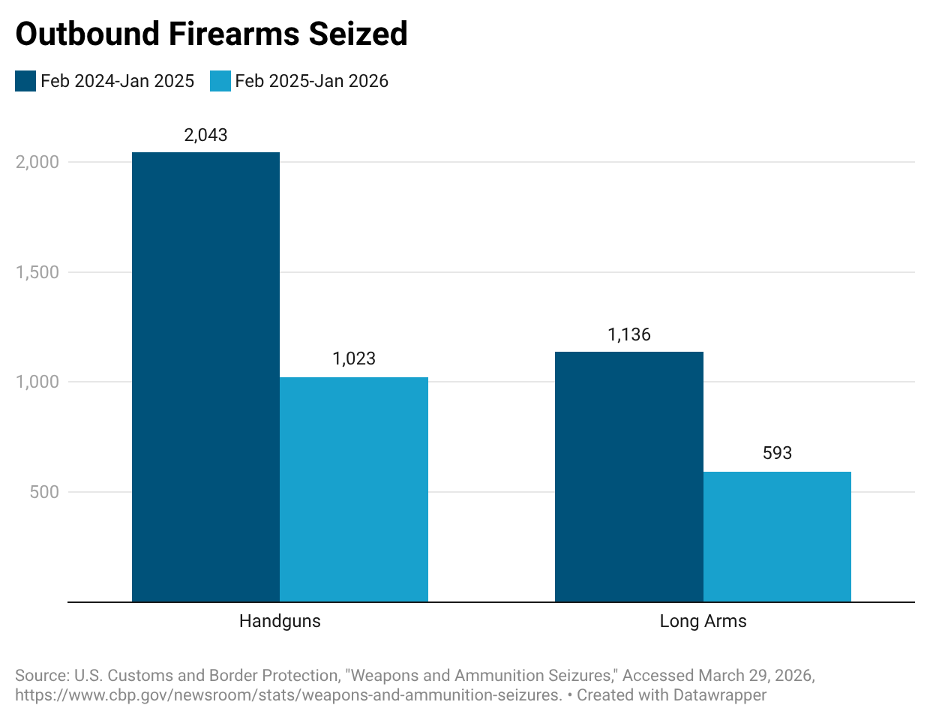
Figure 1. Outbound handgun and long arm seizures, 2024 and 2025.
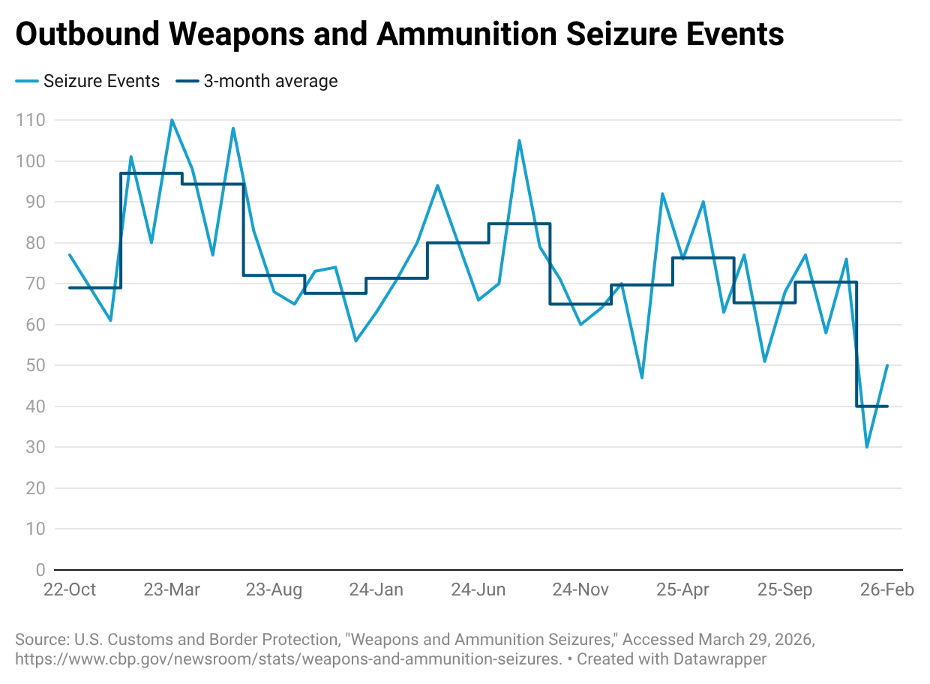
Figure 2. Outbound weapons and ammunition seizure events, October 2022 to February 2026.
What FTO Designations Offer
The United States could take a major step toward curtailing the cartels’ ability to arm themselves simply by prosecuting the individuals responsible for proffering weapons to these groups. According to the ATF, from 2017 to 2021, about 41 percent of illicit firearm purchases were from private individuals, while 39.5 percent were so-called straw purchases from licensed dealers by individuals able to pass a background check. A small number of “bad apple” gun dealers also play a disproportionate role in the arms trade, reporting guns as missing or stolen and selling them off the books or knowingly overlooking suspicious patterns from straw purchasers, like buying multiple arms of the same type at once. Prosecuting these cases is difficult, as unscrupulous gun dealers can hide behind a veil of plausible deniability in the case of straw purchases and it is challenging to build a strong evidentiary paper trail on private arms sales. The highly politicized nature of gun ownership in the United States further complicates matters, resulting in policies that limit the ability of organizations like the ATF to inspect gun dealerships and banning the collection of electronic records on arms sales.
However, the Trump administration’s use of FTO designations provides a new tool for countering arms trafficking—namely, the ability to prosecute traffickers for providing material support for terrorism. Title 18 of the U.S. Code, § 2339B, criminalizes “knowingly attempt[ing] to provide, conspir[ing] to provide, or provid[ing] material support or resources to a foreign terrorist organization.” On March 17, a grand jury indicted an Arizona gun store owner on material support for terrorism, the first case to be brought against a gun dealer for facilitating arms trafficking to Mexican FTOs. Prior to this, a father and son duo was indicted in May 2025 for allegedly providing material support in the form of money laundering for the Sinaloa Cartel. Thus far, material support charges have been used relatively sparingly, but if more aggressively enforced, they could provide a new tool for targeting gun runners.
The history of § 2339B prosecutions is fraught. Famously, in the 2010 Holder v. Humanitarian Law Project case, the Supreme Court held that providing training on international law and dispute resolution aimed at deescalating conflicts still constituted illegal material support. In the case of Mexico, the embeddedness of organized crime with legitimate commercial activity has raised concerns among the business community. The tentacles of FTO-designated cartels permeate the avocado, lime, and tortilla business, oil and natural gas, as well as hotels and real estate, to name just a few sectors. Fear of getting slapped with § 2339B charges could exert further downward pressure on investment in Mexico and raise compliance costs for U.S. firms that do business on both sides of the border.
These are thorny challenges, and the U.S. government should do more to clarify its stance on material support for terrorism as it pertains to TCOs-cum-FTOs and their penetration of the licit economy. In the case of arms trafficking, however, it should be possible to articulate a relatively straightforward standard that increases penalties for entities facilitating the transfer of weapons of war across international borders. A material support lens also allows for greater cooperation between the intelligence community and law enforcement to connect Mexico-based FTOs back to their U.S.-based arms sources. Entities like the newly established Joint Interagency Task Force-Counter Cartel could serve as the fusion center for such efforts. Applying § 2339B charges more proactively does not stop gun dealers from selling their wares to law-abiding citizens, but it does raise the costs for unscrupulous “bad apple” dealers. The United States in this way can limit the supply of firearms to cartels without significantly impeding the rights of its own citizens to own firearms.
Other Tools
Material support charges alone will not stem the flow of firearms into criminal hands. Closer coordination between the United States and Mexico in particular is needed to boost arms interdiction. Fortunately, despite continued high-level tensions, the two neighbors have enjoyed success advancing quotidian priorities in the security sector. In September 2025, representatives from several U.S. agencies met with their Mexican counterparts for the inaugural U.S.-Mexico Security Implementation Group meeting. Firearms were a top priority at this meeting, and both parties agreed to increase intelligence sharing and ballistic tracing efforts to disrupt the southbound flow of guns and prosecute traffickers more aggressively. Still, more could clearly be done especially at the border to interdict illicit arms before they reach the cartels. Traffickers often move arms piecemeal, as disassembled components stored in the bellies of trucks or even duct-taped to their persons, only to be assembled once across the border by specialized cartel armorers. Installing additional scanners at border crossings can help search for these illicit cargoes more efficiently, while beefed-up customs inspections at ports and airports can help clamp down on increased trafficking by sea and air.
The issue of arms trafficking has been a persistent source of tension in the U.S.-Mexico relationship, with both sides often talking past one another. While the United States pushes Mexico to take more decisive action against criminal groups within its borders, Mexico bemoans the continued flow of arms that makes effective law enforcement astronomically more challenging. But neither country disagrees with the position that violent transnational criminal organizations should not have access to lethal weapons. The current moment presents an opportunity for Washington and Mexico City to affirm their commitment to this shared principle, and align on a set of policies to get weapons out of cartel hands, and keep them out.
-1.jpg?sfvrsn=dd1c6b99_5)