The Europeanization of Deterrence
What Macron’s Ile Longue speech means for transatlantic nuclear strategy.
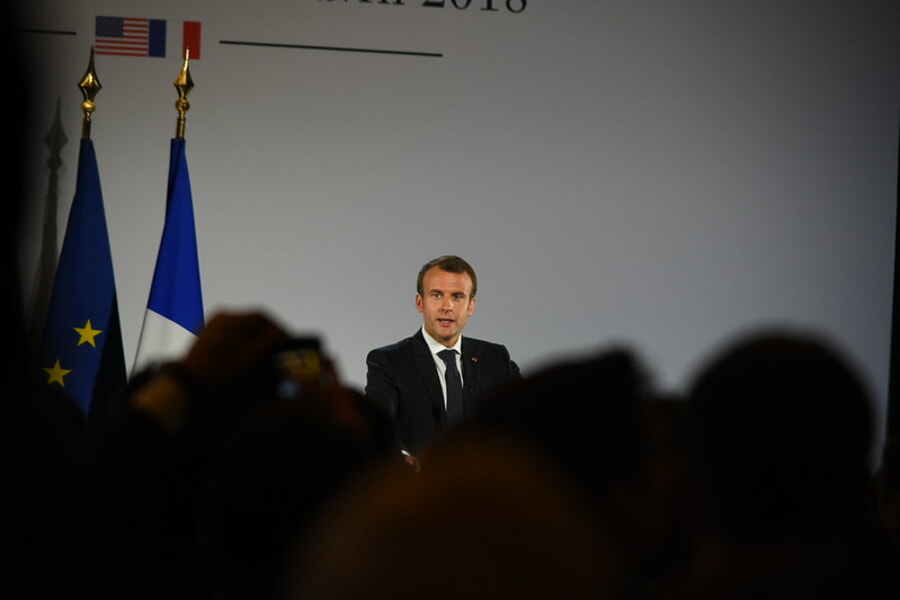


On March 2, French President Emmanuel Macron delivered much anticipated remarks on his vision for the future of nuclear deterrence in Europe. He outlined how Paris would increase its nuclear capabilities for its own national defense and what a European deterrent anchored by France’s strategic forces might look like. “Thus, to be free, one must be feared, and to be feared, one must be powerful,” Macron said against the backdrop of a French navy nuclear-armed submarine, le Téméraire, docked at the Ile Longue yards in Brittany. He described an international environment characterized by “growing and diversifying nuclear threats that are increasingly interconnected” and outlined the need for enhanced cooperation among European countries. That same day, along with German Chancellor Friedrich Merz, Macron also unveiled new steps in their bilateral nuclear cooperation in the form of a “high-ranking nuclear steering group.”
Macron’s remarks were the latest manifestation of the growing sense among the United States’ European allies that the continent needs to develop a more independent posture vis-a-vis Washington because of increased U.S. unpredictability and evolving threats from adversaries. Only two NATO allies other than the United States have nuclear weapons: the United Kingdom and France. Although both countries have provided a distinct contribution to deterrence in Europe, recognized since NATO’s 1974 Ottawa Declaration, France remains outside of the alliance’s nuclear planning mechanisms. The two countries have announced plans to deepen their nuclear cooperation. Over the past year, leaders from European countries without nuclear arsenals have floated new models for maintaining deterrence in Europe. Public debates about the need for an independent deterrent via the development of national or multinational nuclear weapons programs have also emerged, including in Sweden, Norway, and the Netherlands. And Poland has gone as far as signaling that it may eventually need an indigenous nuclear weapons program.
Although European allies have not yet concluded that the U.S. nuclear umbrella needs wholesale replacement, they are deciding how much autonomy to seek amid structural shifts in the transatlantic relationship. In a scenario where European allies look to gradually disentangle their security from Washington, they may look to several models beyond the one proposed by Macron to decrease their reliance on U.S. extended deterrence, especially if France fails to convince them of the credibility of its advanced deterrence model. While the development of an independent French model would benefit the United States by supporting existing U.S. extended deterrence commitments, new nuclear weapons programs in Europe would present significant challenges for the United States’ long-standing policy against proliferation. As a result, Washington might have to make the difficult choice of pressuring an ally to prevent proliferation or live—in increasingly unstable times—with more nuclear-armed states.
Navigating Unreliable Allies and Emboldened Adversaries
The United States will continue to play an important role in European security, but the recent U.S. National Security Strategy and National Defense Strategy highlight a shift in U.S. posture. The Trump administration has clearly articulated that Europe is no longer among Washington’s top concerns. These documents have placed the Western Hemisphere and the Indo-Pacific as higher priorities for U.S. policy. Moreover, the United States’ recent launch of major combat operations against Iran is likely to dominate attention and present new challenges for the transatlantic relationship, as is already apparent in the tensions stemming from Spain denying U.S. access to its bases for use to strike Iran and Washington’s threats to cut trade with Madrid.
Administration officials have stressed repeatedly that European allies must take over the conventional defense of Europe, while signaling their intent to downgrade U.S. military presence on the continent (although shifts in assets and personnel remain limited to date). The administration has also reportedly considered cutting back its representation within different NATO bodies—including in key areas such as intelligence and special operations. Meanwhile, U.S. officials have maintained that they will not make changes to U.S. nuclear commitments within NATO. But the Trump administration has demonstrated its intent to limit its role in the alliance while adopting a more hostile stance in other areas, such as trade or domestic politics. As a result, European governments are questioning the credibility of U.S. commitments as they navigate an increasingly tumultuous transatlantic relationship. Without the United States, Europe’s conventional capabilities would be lacking, as Washington has served as the main integrator among and supplier of Europe’s militaries, primarily via European acquisition of U.S. platforms and weapons.
Against this backdrop, Europe also faces several new or changing nuclear threats. Since its full-scale invasion in February 2022, Russia has used nuclear blackmail to attempt to deter European countries from supporting Ukraine either by providing materiel support or via peacekeeping deployments. At the same time, Europeans are preparing for the potential return of nuclear proliferation, a new arms race among nuclear-armed states, and more diversified stockpiles of nuclear weapons around the world. The last nuclear arms control arrangement between the United States and Russia, New START, expired in February, and there is currently no prospect for a diplomatic mechanism imposing new verifiable limits on nuclear weapon states’ warheads or delivery systems. Late last year, Moscow conducted tests of a nuclear-powered torpedo and a nuclear-powered cruise missile. And Washington is reportedly considering increasing the number of its deployed nuclear weapons and even the resumption of testing. Meanwhile, Beijing is continuing to grow its nuclear arsenal and fleet of submarines capable of delivering nuclear weapons. As Macron has noted, China’s nuclear modernization and other nuclear developments in Asia affect Europe.
Toward an Independent European Deterrent
Although Macron had signaled that his country will not NATO-ize its nuclear arsenal—that is, align with the alliance’s nuclear planning mechanisms—France is now willing to “Europeanize” its nuclear arsenal by expanding access for other European nations. While there had been prior discussions of multilateral nuclear projects before, their practical and legal implications remained relatively vague until Macron’s remarks at Ile Longue, though some aspects still require further refinement or elaboration.
Whether this overture marks a real break with France’s doctrine or represents a gradual shift has been the subject of debate within the French political scene. Nevertheless, the proposed revision to the French nuclear doctrine would allow its extension to the rest of or select member states within the European Union. Though not explicitly outlined by Macron, under a different version of this model, Paris could do so in cooperation with London—going beyond increased cooperation on a bilateral basis.
Vertical proliferation will underpin all of these scenarios: Indeed, the United Kingdom and France are planning to expand their own arsenals, although they are neither willing nor able to match the size of Russia’s expansive arsenal. But they do not require such numbers—as long as they maintain a nuclear capability that Moscow credibly believes will be used in the event of a conflict, they will be able to effectively deter Russia.
Since 2021, deriving from concerns about U.S. reliability, the United Kingdom has sought to increase the size of its nuclear force and has made minor changes to its declaratory posture. For its part, France is in the process of modernizing its nuclear forces, including a new class of nuclear-armed submarines and an increasing stockpile that Macron unveiled in his Ile Longue speech. Ongoing modernization projects in both legs of the French dyad (air- and sea-launched nuclear weapons) include that of the Rafalefighter and a fourth-generation air-to-surface hypersonic missile being introduced by the middle of the next decade. These measures are accompanied by a budget increase, although a major expansion of its warhead stockpile could take a decade or more. Presently, 13 percent of the approximately 57 billion euro 2026 French defense budget is allocated to the country’s nuclear weapons program. According to Catherine Vautrin, minister of the French Armed Forces, the government will be seeking a supplemental of 36 billion euros to augment the 413 billion euros appropriations for 2024-2030. Both countries still face budgetary pressures given their current fiscal environments, which they will have to manage as they contemplate a nuclear buildup.
Importantly, nuclear deterrence discussions will advance alongside European states’ efforts to increase their conventional capabilities. The Trump administration has repeatedly stressed the need for greater defense investments as a priority, but European countries have also been increasing their spending as a result of Russia’s full-scale invasion of Ukraine. In fact, while announcing his concept of “advanced deterrence,” Macron highlighted the importance of enhancing “our conventional capabilities in all of their dimensions,” pointing specifically to early warning systems, air defense, and deep precision strikes. What Macron did not say, however, is that nuclear and conventional capability development may require trade-offs between each other in a tight budgetary environment.
Europeanizing the French Deterrent
One path forward for an independent European deterrent would reside in what Macron characterized as “the European dimension” of France’s deterrence, with a variation including cooperation with the United Kingdom. His proposed model would offer “an evolution” that stands up to contemporary challenges. This dimension would be additive to—not a replacement for—NATO’s strategic mission “to preserve peace, prevent coercion and deter aggression,” at least in the short term. As the only remaining EU member state with nuclear weapons following Brexit, France is the natural leader for a new independent European deterrence vision relying on a quasi-extended deterrence model.
While implementing this model would allow for European nations to benefit from an independent deterrent separate from the one provided by the United States with fewer obstacles relative to other models (legal, logistical, and pertaining to command and control), several political and practical challenges could stymie these efforts. And as Macron has estimated, if adopted, this initiative would likely take five to 10 years to materialize, which is beyond what is left of his tenure as president. Implied in his speech was also the notion that this construct may evolve over time, for example, by potentially including the deployment of certain elements of French strategic forces on allied territories à la NATO in the future. This will present challenges as France’s doctrine of strict sufficiency requires it to maintain the smallest arsenal possible to sustain its own deterrence. Thus, they cannot be deployed outside of France without degrading their deterrent value. Critically, Paris needs to convince other European countries of the credibility of its advanced deterrence, which in turn requires both the capability to hold Russia at risk and the political will to do so on their behalf. While the former will require adjustments that will take time to implement, the latter may reveal even more challenges.
To maintain the credibility of its deterrent, France might view it as necessary to increase the number of its warheads, as Macron has indicated it would. He further announced that his country would no longer publicize the number of its nuclear weapons. To be effective, France cannot simply rely on increasing the size of its arsenal; it also would need to expand the types and missions of its nuclear weapons—Macron noted clearly that his country would not develop tactical nuclear weapons, only strategic ones. He also highlighted the fact that France possesses only two legs of the nuclear triad (having foregone the third leg, ground-launched missiles, at the end of the Cold War) and implied that his country would not be making any changes to its overall nuclear force structure.
Therefore, any efforts at Europeanization would require a change in France’s nuclear doctrine, although Macron did not specify how. The French president, however, is already shaping this doctrine by characterizing France’s “vital interests” as having a “European dimension.” The concept of strict sufficiency, if maintained, will limit how France can Europeanize its deterrent—short of extended deterrence. Paris will need to revise this concept as it begins to operationalize Macron’s vision through relevant changes to force posture, declaratory policy, and other areas.
To fully realize Macron’s vision, training and joint exercises—similar to the ones NATO already conducts—will be important. Paris has already floated incorporating allies into strategic exercises to provide conventional support. Thus far, eight European nations across the continent have agreed to participate: Belgium, Denmark, Germany, Greece, the Netherlands, Poland, Sweden, and the United Kingdom. Discussions to include others in the construct are ongoing (as is the case with Norway). The existing NATO nuclear-sharing model can be useful as the Europeans explore this pathway. Moreover, the operational support infrastructure underpinning this model will need to be further developed, including enhanced intelligence-sharing and communications systems and procedures.
Beyond logistical, practical, and doctrinal challenges, this project will also certainly face political obstacles. Chief among these is that Macron’s term will end in 2027, and having served two consecutive 5-year terms, as mandated by the French Constitution, he cannot seek reelection. Currently, polls indicate that the far-right National Rally (RN) would be poised to win the presidential elections if they were held today, and Macron’s numbers have been on a downward trajectory since the beginning of his second term. The RN is both Euroskeptic and more favorably disposed toward Russia. It follows that the RN should be disinclined toward engaging a French provision of a nuclear umbrella to other nations.
From the RN’s perspective, even before his latest remarks fleshing out his vision for European deterrence, Macron had already started to chip away at the credibility of France’s strategic forces with his overtures to Europe. In the past, RN leader Marine Le Pen said that she was “fundamentally opposed” to nuclear sharing arrangements. Perhaps to get ahead of potential political backlash, Macron carefully framed the first half of his remarks around his vision for enhancing France’s nuclear deterrent unilaterally before discussing the implications for other European countries. Crucially, he explained what advanced deterrence would not entail given the constraints imposed by the French Constitution. He highlighted that the command and control of French strategic forces, strategic planning, and execution would not be shared with allies.
These caveats helped assuage some concerns, with politicians across the political spectrum expressing cautious approval of the broader plan. Even RN leadership noted that Macron had preserved the “national characteristic” of the country’s strategic forces. They nonetheless voiced some reservations and amendments to the concept. For example, Le Pen signaled a willingness to consider Macron’s approach, but only as long as France got “something in return” from European allies hosting a French deployment. She specifically called out allies who are continuing to buy American platforms while looking to France for protection. As she put it, “to go and put our nuclear weapons in countries that are buying American F-35 ... there is a major contradiction there.” Potential opposition is not limited to the far right, with critics on the traditional right and left parts of the political spectrum also questioning Macron’s overtures.
But unless Macron can make significant advances in this space over the next year—which would be difficult given all the challenges laid out here—progress toward the goal will be more difficult after 2027. Should the RN win, it may forgo the multilateral elements of Macron’s vision, thus providing an additional incentive for European countries to consider developing their own nuclear weapons programs. That said, a complete reversal of the policy—as has become the norm in American politics—remains less likely in France if the initiative is already well underway by then.
The U.K. Dimension
A variation on this approach may include participation from the United Kingdom. Since summer 2025, the governments of France and the U.K. have laid out the foundations for such increased cooperation. Senior U.K. officials attended—for the first time since Paris acquired a nuclear weapon—the French strategic air exercise “Poker” in September 2025 and participated again in the iteration held on March 16 and 17. In December 2025, the two countries also held the first iteration of their bilateral Nuclear Steering Group. For now, however, Franco-British nuclear cooperation is not likely to serve as the anchor for European deterrence. It is more likely to serve as an additive bilateral arrangement because of practical constraints that would limit the depth and breadth of these initiatives. For example, Britain’s modernization program has not gone as smoothly as its leaders may have hoped, including because of the failure of two successive tests of the Trident sea-launched ballistic missile and shortfalls in personnel needed to meet deterrence requirements.
There are also bilateral U.S.-U.K. and U.K.-EU considerations that cast a shadow over such cooperation. Since Brexit, London has become even more reliant on Washington and is often less inclined to assert its independence in international affairs and national security issues. In particular, Trident missiles are built and maintained by the United States, creating a dependency that London must manage while considering alternative deterrent constructs. Additionally, swaths of the British political system do not want to become reentangled with the European Union—even as public sentiment has become more pro-EU. Labour Prime Minister Keir Starmer faces significant political challenges, and the prospect of a far-right, Euroskeptic government is looming in Britain. Therefore, the likelier course of action, at least in the near term, is a tightening of the bilateral cooperation between the sides of the English Channel, while France serves as the node for EU deterrence.
Proliferation Pressures
In both his remarks at Ile Longue and his joint announcement with Merz, Macron highlighted his country’s nonproliferation credentials and the guardrails incorporated into his proposed initiatives via a continued commitment to the Treaty on the Non-proliferation of Nuclear Weapons (NPT). Given France’s long track record of strong nonproliferation advocacy, the construct proposed by Macron would not itself present a proliferation challenge. However, its failure may lead states to consider their own nuclear weapons options—which Paris, as a long-standing nonproliferation advocate with a vested interest in regional stability, would actively oppose.
If the construct proposed by Macron fails or countries assess the threat picture as dire enough, one or several European nations may decide to take steps to build their own indigenous nuclear weapons capabilities. As mentioned above, Warsaw has already floated the notion of an independent deterrent most clearly. Though unlikely, such a scenario would play out in a longer time horizon as any European country seeking a nuclear capability would need to overcome a number of political, legal, and technical obstacles.
Many domestic constituencies within Europe would be opposed to their countries acquiring nuclear weapons. Not only would such a move lead to their potential isolation from the international community, but historically, populations across Europe have been disinclined toward nuclear weapons (a sentiment that often extends to nuclear energy). And while the majority of Germans, for example, favor a European deterrent, they remain opposed to their own country acquiring the capability, according to polls. Instead, they are likely to double down on growing their conventional capabilities.
Several European nations possess an infrastructure that they could adjust to acquire a nuclear weapon, albeit with significant investments in time and resources. These include the front end of the nuclear fuel cycle or uranium enrichment, delivery vehicles they could adapt, and well-developed science and technology sectors (in some cases experience with nuclear technology via nuclear reactors). Technical constraints—including sourcing fuel—and financing challenges will also shape decision-making, especially as many European countries are also considering expanding their conventional capabilities, which could require trade-offs.
Importantly, these countries are in good standing with their commitments under the NPT, which prohibit the acquisition of a nuclear weapon, and have submitted their nuclear energy programs to verification and monitoring under safeguards agreements with the International Atomic Energy Agency. Moreover, many of these obligations are formalized or prescribed in EU law, adding an additional constraint on an EU member’s ability to proliferate. Any step toward proliferation would likely lead to intra-Europe divisions, in addition to intensifying intra-NATO tensions.
European attempts at proliferation
Implications for U.S. Policy
Macron’s remarks at Ile Longue present a concept he has been publicly developing gradually over the course of his presidency and that builds on some of his predecessors’ proposals: that of a more independent European deterrent, anchored by his country. Despite the constraints it faces, the Macron model is additive to—not a replacement for or challenge to—U.S. extended deterrence. In a world where France alone provides a new deterrent model for Europe, Washington must consider whether to actively support and enable Macron’s approach before the 2027 election window closes, or whether the current administration’s posture makes that politically impossible, even if it makes strategic sense. In a variant where the United Kingdom participates, the United States has leverage to influence the development of a European deterrent given the U.K.’s Trident dependency. Absent a major shift in the U.K.’s nuclear policy, it will remain tethered to the United States via these dependencies, offering a way for Washington to ensure that a Europeanized deterrent fits into the United States’ broader extended deterrence architecture.
The most likely near-term outcome, however, is neither full success nor outright failure, but a partially institutionalized architecture perhaps with eight or more nations participating in exercises and a functioning Franco-German steering group, but no RN successor to Macron willing to extend the deterrence commitment explicitly. Here, U.S. leverage matters the most (though it is not guaranteed given the current political environment) because the architecture is fragile enough that U.S. engagement or disengagement could determine whether it consolidates or dissolves. The recent establishment of a bilateral U.S.-France Deterrence, Strategic Stability, and Non-proliferation Dialogue may be a step in this direction.
In a future where European states begin to develop their own nuclear weapons programs, U.S. policymakers should identify what tools remain available given that a core driver of potential proliferation is diminished U.S. credibility. Threatening to withdraw security guarantees from a state that is proliferating—one of the main tools used by the United States when facing this problem in the past—precisely because it doubts those guarantees is not a coherent deterrent. Finally, proliferation in Europe will likely have ripple effects elsewhere: Allies in Asia, adversaries, and others around the globe may see that as the latest sign that nuclear weapons are once again the centerpiece of international security and choose to acquire them.