The Insurrection Act Is No Exception to the Troops-at-Polls Ban
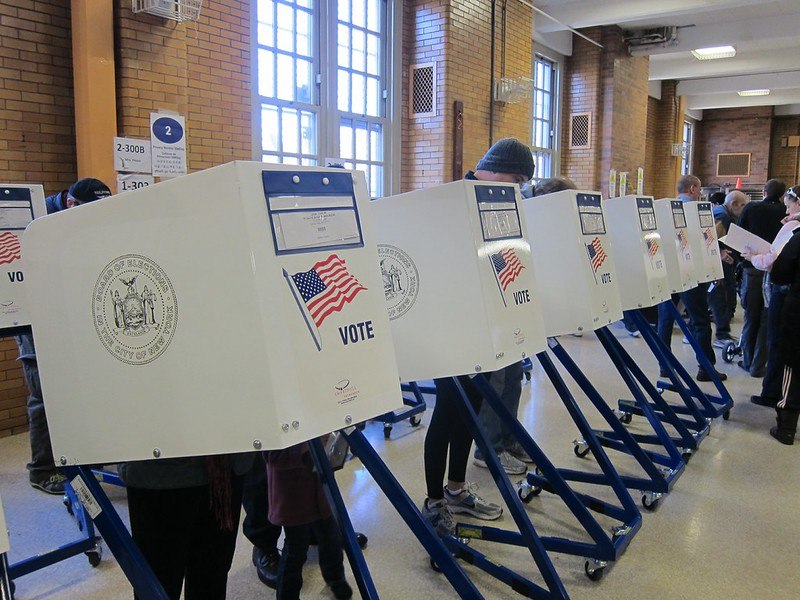


For more than 160 uninterrupted years, federal law has prohibited troops wherever an election is held, with very limited exception. The statute, now codified at 18 U.S.C. § 592, is unequivocal and comprehensive: Neither military officers nor civilian federal leaders may deploy troops to polling locations. In fact, it’s not just about military personnel—it covers both “troops” and “armed men.” (In that sense, the statute’s name, Troops at Polls, is actually misleading.) There has been only one narrow exception to this rule since 1909: if “such force [is] necessary to repel armed enemies of the United States.”
On first glance, the Insurrection Act, now codified at 10 U.S.C. §§ 251-253, may appear to contemplate § 592’s exception. For example, modern-day § 253 provides that the president shall “take such measures as he considers necessary” to “suppress” the enumerated types of conduct: “insurrection, domestic violence, unlawful combination, or conspiracy.” But that power is circumscribed by the types of conduct which the president can suppress and also by additional specific conditions set forth in the law. None of those additional conditions in the Insurrection Act maps onto the condition required for establishing the exception to § 592—namely, that deploying troops is “necessary to repel armed enemies of the United States.” Put simply, satisfying the requirements for invoking the Insurrection Act does not equate to establishing the exception to § 592.
In other words, § 592 and the Insurrection Act are not inconsistent; neither statute suggests that the Insurrection Act’s grant of authority to the president can supersede § 592’s prohibition on armed people at the polls. The best reading is that although the Insurrection Act authorizes the president to act in limited circumstances, § 592 restrains the president from deploying armed personnel to polling locations. And a review of the historical context in which the statutes were passed supports that reading.
Statutory Language
The statutory language of both § 592 and the Insurrection Act is clear, specific, and does not conflict with one another.
The “Troops” and “Armed Men” at Polls Restriction
Today’s § 592 Troops at Polls statute provides, in pertinent part:
Whoever, being an officer of the Army or Navy, or other person in the civil, military, or naval service of the United States, orders, brings, keeps, or has under his authority or control any troops or armed men at any place where a general or special election is held, unless such force be necessary to repel armed enemies of the United States . . .
The statute allows for violators to be subject to fines, imprisonment, or both. Additionally, § 592 states that violators will (not may) be “disqualified from holding any office of honor, profit, or trust under the United States”—a penalty that underscores the enacting Congress’ sense of the severity of the crime.
The original version of § 592, passed in 1865 in the thick of the Civil War, included nearly identical language, with one important difference: The statute contained two exceptions to the prohibition on troops and armed persons at the polls. In addition to “unless it shall be necessary to repel the armed enemies of the United States,” the 1865 version also excepted situations where it was necessary “to keep the peace at the polls.” As further described below, the later omission of that second exception was not only intentional; it was the product of a determined, uphill effort by Congress.
§ 592’s original statute also had a number of other restrictions on military members, which today make up 18 U.S.C. § 593 and a civil provision, 52 U.S.C. § 10102, such as that the military shall not determine voter eligibility; shall not prevent qualified voters from voting; shall not direct or interfere with election officers; and shall not set regulations for administering elections.
The Insurrection Act
The Insurrection Act refers to a series of statutes that authorize the president to use the armed forces domestically under limited circumstances. Congress passed the statutes pursuant to its constitutional “Calling Forth” powers, which are defined in Art. I, Section 8, as permitting Congress to “call forth” the militia for three purposes: executing the laws of the union, suppressing insurrections, and repelling invasion.
The modern Insurrection Act allows the president to call into service members of the military under three statutory regimes: § 251 covers situations in which the legislature or governor of a state requests assistance due to an insurrection; § 252 covers situations in which “the ordinary course of judicial proceedings” are insufficient to enforce the laws of the United States from “unlawful obstructions, combinations, or assemblages, or rebellion”; and § 253 covers situations in which “any insurrection, domestic violence, unlawful combination, or conspiracy” hinders executing state and federal laws to such an extent that the laws cannot be executed or people’s rights are deprived.
That third provision—10 U.S.C. § 253—is the only one whose predecessor was passed after § 592’s prohibited troops and armed persons at polling sites. More specifically, § 253 provides:
The President, by using the militia or the armed forces, or both, or by any other means, shall take such measures as he considers necessary to suppress, in a State, any insurrection, domestic violence, unlawful combination, or conspiracy, if it—
(1) so hinders the execution of the laws of that State, and of the United States within the State, that any part or class of its people is deprived of a right, privilege, immunity, or protection named in the Constitution and secured by law, and the constituted authorities of that State are unable, fail, or refuse to protect that right, privilege, or immunity, or to give that protection; or,
(2) opposes or obstructs the execution of the laws of the United States or impedes the course of justice under those laws.
In any situation covered by clause (1), the State shall be considered to have denied the equal protection of the laws secured by the Constitution.
Congress originally passed this provision as part of the 1871 Ku Klux Klan Act (also known as the Third Enforcement Act); notably, only six years after the first iteration of what is now § 592. In other words, the Congress that passed this piece of the Insurrection Act was undoubtedly aware of the statute it had recently passed prohibiting armed persons at polling sites—and did not draft § 253 to supplant the specific protection for elections.
Statutory Analysis
A close reading of § 592 alongside the Insurrection Act underscores that the two statutes do not need to conflict. For the plain text analysis and other reasons, there is little basis for interpreting the Insurrection Act as superseding § 592’s restrictions on placing armed personnel at the polls. The president can retain the power the Insurrection Act grants him without compromising the prohibition on troops or armed persons at the polls.
Looking first to the plain language of § 592, the Troops at Polls statute, the text provides a specific prohibition on activity with one explicit exception— when it’s necessary to “repel armed enemies of the United States.” Other exceptions to when the president can deploy armed personnel at the polls should not be read into § 592, particularly because Congress actually modified the statute in 1909 to remove the prior second exception for “keep[ing] the peace at the polls.”
The Insurrection Act seemingly provides the president with a broad authority to respond to certain situations by “using the militia or the armed forces, or both, or by any other means.” The act, however, includes a number of important limitations.
Above all, the Insurrection Act’s authority to use the military applies only when specified forms of insurrection, rebellion, domestic violence, unlawful obstruction, or other collective activity meet specific statutory conditions. By contrast, the exception to § 592 that allows troops at polls applies only when troops are necessary to repel “armed enemies of the United States.”
Second, the Insurrection Act’s grant of authority is triggered only when the text’s specific conditions are met. For § 253, the only provision passed after the Troops at Polls statute, those conditions are (a) state or federal law is so hindered by the named conduct that protected persons are deprived of their constitutional rights and state law enforcement is unable or unwilling to protect them; or (b) the named conduct is “oppos[ing] or obstruct[ing] the execution” of U.S. law or “impedes the course of justice under those laws.” Again, the exception to § 592 is significantly different: Troops or armed persons are only allowed if necessary to “repel armed enemies of the United States.”
Basic canons of statutory interpretation confirm these readings of both statutes. Statutory construction governing specific versus general statutes generally means that a specific statute, such as the Troops at Polls statute, which constrains specific behavior only at polling sites as elections occur, will not be controlled by a general statute, such as the authority given under the Insurrection Act, unless Congress indicates that result. The Insurrection Act does not have such language.
Additionally, the principle of “expressio unius est exclusio alterius” means that mentioning one thing in a statute implies the exclusion of another. Applied to the Troops at Polls statute, the specific mention of a narrow exception for repelling armed enemies of the United States implies that no other exceptions are allowed. In comparison, the 1879 stand-alone bill on the military at the polls that President Hayes vetoed provided an explicit Article IV carveout for domestic violence. So it is clear Congress knew and contemplated a similar exception to § 251 of the Insurrection Act, which requires a state request, but did not overcome its veto.
Likewise, the harmonization principle, which requires courts to interpret statutes in a manner that gives effect to all provisions and avoid conflict where possible, supports this textualist reading. There is one exception to § 592. The terms of that exception—“repel armed enemies of the United States”—are not disturbed or superseded by any terms in the Insurrection Act. To interpret § 592 as including an unstated second exception created under an entirely different statute would defeat that principle by reading a provision into the text where none exists.
This reading of the statutes is further supported by reviewing modifications to the Insurrection Act’s text over its history. As further discussed below, certain pieces of the modern-day Insurrection Act (§§ 251 and 252) predated modern-day § 592. That means Congress passed the stringent restriction on troops and armed men at polls while accounting for existing provisions of law granting the president authority to suppress insurrections.
The Insurrection Act’s only provision that was passed a few years after the Troops at Polls statute, Section 3 of the Ku Klux Klan Act now codified at § 253, is also persuasive: that law included language providing that it should not be construed to supersede or repeal any former law except if it was “repugnant thereto.” Nothing in the Troops at Polls statute was “repugnant” to the language of § 253 or its predecessor because the laws could coexist. That means that the two laws should be understood to operate together, allowing the president to exercise § 253 Insurrection Act authority without placing troops or armed persons at polls.
Statutory History and Legislative Purpose
Historical evidence indicates that Congress took the prohibition on troops at the polls extremely seriously.
First, its framers intended for this criminal statute to apply to any federal government official, including the president. Sen. L.W. Powell (D-Ky.), who introduced the bill, argued in a Senate floor speech that “[h]e who attempts to interfere with this most inestimable right, whether he be President, major-general, or citizen, is an enemy to the public and deserves the harshest punishment.” Sen. J.M. Howard (R-Mich.), who opposed the bill, had the same understanding: “If this bill shall pass, it will be a penal offense for the President of the United States.”
Second, Congress intended for the law to apply even in the most contentious of circumstances. Recall that the law was passed in 1865, when the United States was at war with itself. The historical context is detailed in a report by the Senate Committee on Military Affairs and the Militia. Its account provides direct evidence that the Senate was well aware of the fraught circumstances under which the law would prohibit military deployments. The report analyzed military deployments to election sites in the Union states of Kentucky, Maryland, Missouri, and Delaware during the 1862-1863 elections. The committee report referenced President Lincoln’s decision to overrule Gen. Robert Schenck’s orders for troops to arrest those engaged in or supportive of the rebellion if they were at or heading towards poll sites. Lincoln reversed the order, directing officers instead to “prevent all disturbance and violence at or about the polls.” The committee report described this order as “simply convert[ing] … the military into a police for the polls.”
Contemporary accounts raised concerns not only about military exclusion and coercion, but also about voters being deterred from attempting to vote. In testimony discussed during the Senate debate, a Maryland election judge described soldiers guarding the ballot window and accepting only the yellow Creswell ticket, while other men were intimidated from voting. Such accounts were disputed, but they illustrate the concern: Distinctive party ballots could expose a voter’s political preference to soldiers stationed at the polls, and the prospect of intervention could discourage voting before any individual confrontation occurred.
The Senate committee report argued that military intervention was justified to protect the “purity of elections” and that the “elective franchise is intended for the benefit of the friends of the government,” not enemies. It further stated that the military should be able to use “all the means necessary” to make the war successful, whether they use “the bayonet or the ballot.” In Kentucky, the committee declared that a general did not need to ask what Kentucky law allowed because his law-of-war authority superseded the need to follow state law.
The statute’s ultimate passage reflects a clear and considered legislative intent to prevent voter intimidation and ensure the integrity of elections, even if doing so meant the military was unable to prevent Confederate supporters from voting. The Congress that debated, drafted, and passed the law had analyzed situations in which military deployment could serve a valid purpose and determined that only the exceptions provided for in the text outweighed the risk that such deployments could intimidate voters. There were only two narrowly-drafted exceptions: to “keep the peace” at the polls and to “repel armed enemies of the United States.” (The former exception would later be removed.)
Historical practice further supports that the prohibition was understood as a sweeping constraint on presidential deployment authority. In the wake of the contested election of 1876, Congress took steps to scrutinize his use of troops. President Grant had deployed troops in certain states, and Congress demanded to know exactly what he had ordered them to do. Grant defended his actions as consistent with the law, saying that he had not kept troops at the polls, but rather stationed some in the vicinity “where they would be available to prevent riot” if a marshal or deputy marshal called on them. Grant even addressed the then-present exception for “keeping the peace” at the polls, noting that even though he understood it to permit him to send troops for that purpose, he had not done so. His response suggests that he not only understood the statute as constraining his presidential deployment authority but also maintained that his deployments complied with it.
In that same letter to Congress, Grant also outlined his understanding of the predecessor of today’s Insurrection Act. He explained that he had invoked the act to deploy troops in order to “enforce the execution of the laws and preserve the peace and sustain the authority of the State and of the United States.” Grant does not explicitly discuss how the Insurrection Act interacts with the Troops at Polls statute. But the omission is itself telling because he expressly acknowledged the polling-place prohibition and the textual keep-the-peace exception while separately invoking the Insurrection Act as authority for some of his deployments, as well as a separate civil-rights enforcement authority that authorized military deployment (now repealed Revised Statutes § 1989). He did not suggest that invoking either deployment authority displaced the former, and he implies he treated the prohibition as continuing to apply.
A few years later, Congress and the president clashed again over § 592’s predecessor. This confrontation, too, supports the proposition that the statutes should be read as consistent rather than in conflict—and that the Insurrection Act does not supersede the prohibition on troops or armed persons at the polls.
In 1879, Congress passed two bills attempting to modify what is now § 592. The first, a rider to a military appropriations bill, would have removed the exception for military deployment to the polls to keep the peace, leaving only the exception of necessity to “repel armed enemies of the United States.” Hayes vetoed the bill, describing it as affecting “the right of the United States Government to use military force to keep the peace at the elections for Members of Congress.” By then, the predecessors of all three substantive provisions of today’s Insurrection Act—10 U.S.C. §§ 251, 252, and 253—were already in force, with the most recent enacted eight years earlier, in 1871. His veto and accompanying message make clear that he understood the proposed removal of the “to keep the peace” exception as a substantial restriction on federal authority at election sites. Hayes did not suggest the Insurrection Act gave him an alternative to the polling place prohibition.
After Hayes’s veto, Congress passed a second, stand-alone bill that removed the keep the peace exception and replaced it with an exception “to enforce section 4, Article IV, of the Constitution of the United States [the Guarantee Clause] and the laws made in pursuance thereof, on application of the legislature or executive of the State where such force is to be used.” But Hayes vetoed this bill as well. He believed this existing prohibition applied to him and wrote, “[n]o soldiers, either of the Union or of the State militia, should be present at the polls to take the place or to perform the duties of the ordinary civil police force. There has been and will be no violation of this rule under orders from me during this Administration.”
Additionally, Hayes’s veto message analyzed the effects of Insurrection Act predecessors on the bill, concluding the Insurrection Act would not supersede the bill’s prohibition. In fact, he read the bill as doing just the opposite: Hayes wrote that modifying the exceptions to the Troops at Polls law would “abrogate … [the Insurrection Act] on certain days and at certain places”—that is, the Insurrection Act would be inoperable on election days at polling sites. He concluded that “Under the sweeping terms of the bill the National Government is effectually shut out from the exercise of the right and from the discharge of the imperative duty to use its whole executive power whenever and wherever required for the enforcement of its laws at the places and times when and where its elections are held.”
One notable difference in the standalone bill from the Troops at Polls statute is that it included a repeal clause for inconsistent laws. Therefore, it is telling that Hayes believed the Insurrection Act predecessor would only be abrogated at polling sites on election days. While Hayes's analysis is not for the existing Troops at Polls statute, it is for a very similar, though not identical, bill. He is clear that he thought a specific troops-at-polls restriction would limit otherwise available federal deployment authority.
In both cases, Congress could not overcome the president’s veto. Thirty years later, in 1909, as part of a broader effort to codify the penal code, legislators removed the “keep the peace” exception from the Troops at Polls statute. The conference report makes clear the reason for the change: “the omission of the words ‘or to keep peace at the polls’ leaves the section as a prohibition against keeping armed men at a place where an election is held unless such force be necessary to repel armed enemies of the United States.”
The conference report went on to justify removing the “to keep the peace” exception, stating that the “provision for keeping peace at the polls is inoperative, as there is no provision anywhere in the law authorizing the keeping of troops for that purpose. The omission of these words therefore does not in any sense diminish the force of existing law.” At the time, all Insurrection Act predecessors were on the books, but the report identified no statutory authority that authorized deploying troops at the polls to keep the peace. That key change from 1909, which clarified that the military’s only legally permissible presence at election sites was when “necessary to repel the armed enemies of the United States,” has remained unchanged since.
Another historical data point bears mentioning: an 1968 opinion from the Justice Department’s Office of Legal Counsel that concluded § 592 did not restrict the president’s authority under the Insurrection Act. The opinion considered the issue in the context of the next day’s election. A question had apparently arisen as to whether § 592 restricted the president’s authority to “use federal troops to quell any civil disturbances which might occur at the polls tomorrow, as the result of planned demonstrations or otherwise, and get beyond the control of local authorities,” a power the memo identified as derived from 10 U.S.C. §§ 331-334 (now codified at §§ 251-253). The opinion is unpersuasive for several reasons, including because it relies on “explicit legislative history” without providing it, and because it characterizes it in a manner inconsistent with contemporaneous sources.
* * *
The text, legislative history, and subsequent amendment of the Troops at Polls statute indicate a deliberate congressional effort to constrain the military's use in election contexts, even in situations when the Insurrection Act might otherwise apply. Congress prohibited the bringing or keeping of troops at election sites, then removed the express exception for keeping the peace. There is strong support for reading the Insurrection Act and § 592 as operating together: the former authorizes military action in specified circumstances, while the latter restricts deployments at election sites. Although courts have yet to weigh in on how the two laws interact, there is strong support for reading the Troops at Polls statute as a prohibition with one explicit exception provided in the text; therefore, the Insurrection Act does not authorize military deployment to polling sites.