
The Jan. 6 Pardons: How Many Clemency Recipients Have Faced Other Charges?
The real count is much higher than the public knew.
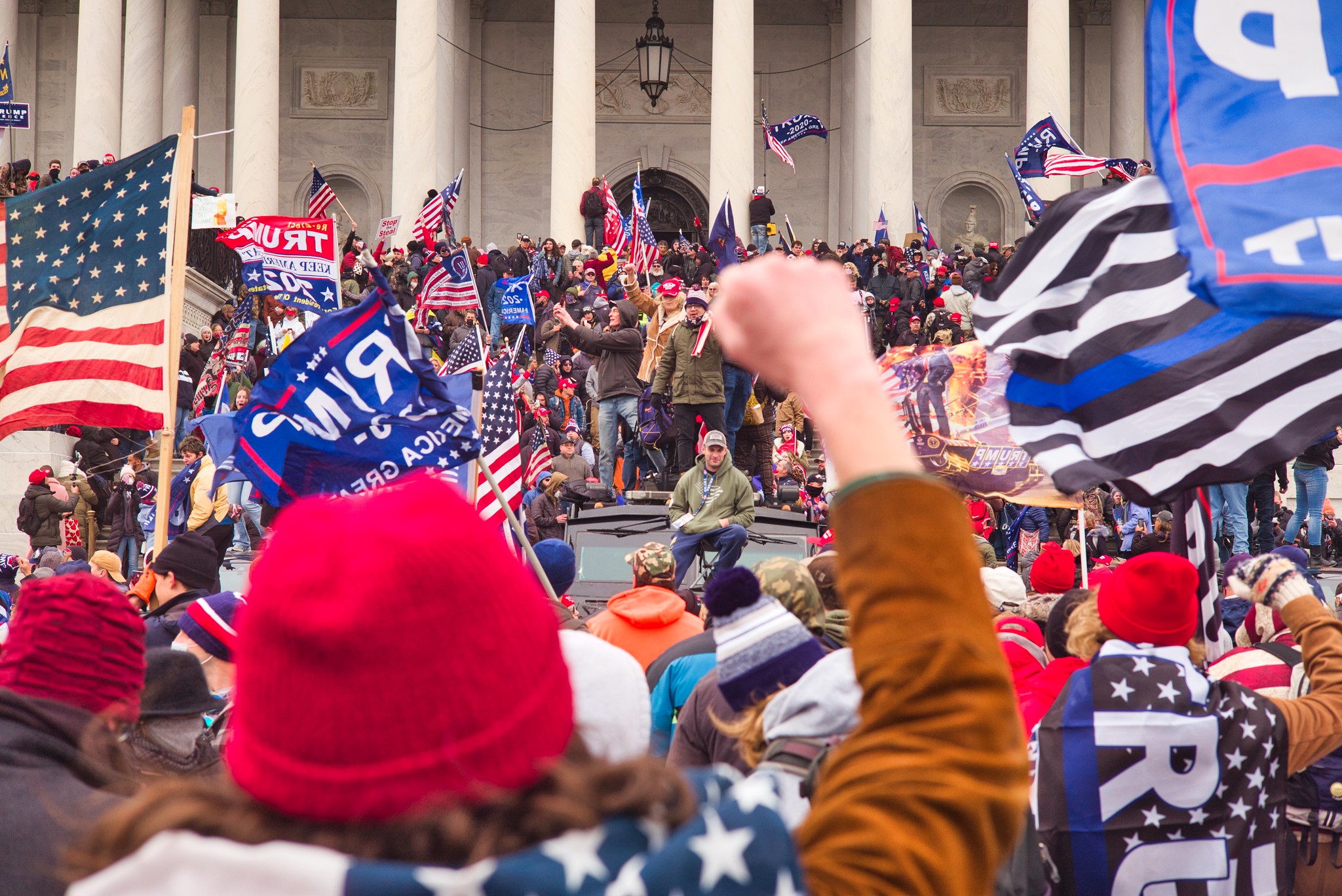
At least 97 of the more than 1,500 individuals granted clemency by President Trump for their roles in the January 6 Capitol attack have been arrested for, charged with, or convicted of crimes separate from Jan. 6 since their participation in the Jan. 6 riot.
A Lawfare study reveals that almost one in 16 insurrectionists subject to the president’s clemency order has been arrested for and charged with—and in the vast majority of cases convicted of—other crimes, at least some of which were actively enabled by the clemency actions.

The alleged crimes by Jan. 6 defendants since Jan. 6, 2021, run the gamut from relatively low-grade offenses like property damage, possession of drug paraphernalia, and trespassing to serious felonies like grand larceny, stalking, planning to assassinate law enforcement officials and prominent politicians, and defrauding government agencies. One Jan. 6 pardonee was convicted in February 2026 of child molestation and sentenced to life in prison. Another was convicted in 2025 of reckless homicide.
At least 14, meanwhile, have been charged with sex crimes or crimes related to child sexual abuse material (CSAM), and at least six have faced domestic violence charges. Others have faced charges for physical assaults, illegal firearms possession, or other violent crimes. At least 20 have been charged with driving under the influence (DUI) of alcohol or drugs or public intoxication.
Perhaps most strikingly, five recipients of presidential clemency were arrested in connection with conduct that occurred at least in part subsequent to Trump’s freeing them from prison—meaning that Trump’s clemency order on the first day of his second term may have actively facilitated criminal conduct. These include:
- Andrew Paul Johnson, who was freed from prison as a result of the pardon in 2025, was convicted of five charges, including child molestation, in February 2026, and sentenced to life in prison. The criminal conduct for which he was convicted took place both before and after his pardon.
- Zachary Alam, who was convicted of felony charges of grand larceny and burglary just months after his pardon.
- Ryan Nichols, who was charged with deadly conduct and harassment on May 10, 2026, after allegedly threatening a person with a gun in a church parking lot.
Another defendant’s charges are still pending. And still another, Enrique Tarrio, was arrested for simple assault in March 2025, but the then-interim U.S. attorney for the District of Columbia ultimately declined to bring charges.
On May 18, the Trump administration announced the creation of a $1.776 billion fund—entitled the “Anti-Weaponization Fund”—to “provide a systematic process to hear and redress claims of others who suffered weaponization and lawfare.”
Acting U.S. Attorney General Todd Blanche—appearing before the Senate Committee on Appropriations—reportedly said that he would not rule out allowing pardoned Jan. 6 defendants convicted of assaulting police officers during the attack to seek compensation from the fund on the basis of claims they were politically targeted by the Biden administration. Sen. Chris Van Hollen (D-Md.) also questioned Blanche about whether Johnson—who law enforcement alleged promised to buy his victims’ silence with funds from a Jan. 6 restitution payment from the federal goverment—would be eligible for a payout from the fund.
Blanche, in response, deflected and accused Sen. Van Hollen of lying. But the senator was not lying about Johnson and actually raised a compelling question. Would pardoned Jan. 6 defendants who have been charged with—or even convicted of—other crimes since their participation in the attack be eligible for a payout from the Justice Department?
That question may now be moot, as the Justice Department—facing strong pushback even from Republicans on the subject—is backing off plans to establish the fund. But if the Jan. 6 pardonees are not going to receive payments, they are still free to commit further crimes. A great many more of them have done so than has been previously reported.
On March 31, the New York Times Editorial Board published an editorial entitled “The People Trump Pardoned Are on a Crime Spree.” The Times counted 39 Jan. 6 defendants who had committed other crimes after participating in the Capitol attack—12 of whom the paper characterized as “serious recidivists,” meaning they had been convicted of “serious crimes, including child molestation, assault, harassment, murder plots and charges related to a vicious dog attack.” The Times editorial board drew on the work of the Citizens for Responsibility and Ethics in Washington (CREW), which in December 2025 identified 33 individuals pardoned by Trump that have “been rearrested, charged or sentenced for other crimes” since the Jan. 6 attack on the U.S. Capitol. A staff report by House Judiciary Committee Democrats—which also draws on the CREW report—identified 33 individuals as well.
These all miss more than half of the Jan. 6 pardonees who have been arrested, charged with, or convicted of other crimes—unrelated to the riot—in the years since Jan. 6.
What follows is an attempt at a more comprehensive summary of those cases. It is still very likely not exhaustive. Lawfare is likely missing cases too. It is, however, the most comprehensive study yet of the crimes alleged against Jan. 6 pardonees in the years since their prosecutions for the insurrection.
The universe of these crimes—alleged and proven—is tricky to identify, first, because the pool of possible perpetrators is quite large. On the first day of his second term, as he promised he would, President Trump signed a proclamation entitled “Granting Pardons and Commutation of Sentences for Certain Offenses Relating to the Events at or Near the United States Capitol on January 6, 2021.” The order was sweeping and immediate, affecting the convictions, sentences, and ongoing trials of nearly 1,600 people. Hundreds of prosecutions and the “biggest federal investigation in U.S. history” were undone with a single signature.
Trump’s order was controversial. Multiple major outlets reported who exactly was pardoned for what and whose sentences were commuted—especially for higher profile individuals and groups such as the Proud Boys and the Oath Keepers. But over time—and as members of the Trump administration attempt to rewrite the history of Jan. 6—the Capitol riot, and those who executed it, have slowly faded from public consciousness.
So it is perhaps unsurprising that so little is known about what became of the hundreds and hundreds of people Trump pardoned or whose sentences he commuted. That is not accidental. Unlike parolees, pardoned individuals are not subject to monitoring, reporting requirements, or oversight of any kind. The only way to know what becomes of them is to look.
The result is that the fate of any given pardoned individual can easily escape notice—particularly when so many of them are granted clemency in bulk with no individual process. Under normal circumstances, there is an official process in place to consider who deserves a pardon and why. There is even an official at the Justice Department—the pardon attorney—fully dedicated to managing that process. Under normal procedures, after a minimum five-year waiting period, defendants must submit a notarized petition disclosing all prior arrests, charges, debts, lawsuits, and unpaid taxes, along with three notarized character affidavits from non-family members. The Office of the Pardon Attorney then conducts a detailed investigation—interviewing the applicant, references, neighbors, and employers—and, where applicable, notifies victims and allows them to submit comments. The attorney general reviews the findings and sends a written recommendation to the president, who alone makes the final decision.
Pardon decisions are sometimes controversial, but past presidential administrations usually made them with much consideration and forethought. Trump, by contrast, made his decision to follow through on a political promise within hours of taking office. There was no pardon attorney review, no investigation into individual cases, and no victim notification. There was no pretense of having carefully weighed the merits or the risks of putting individuals back on the streets. And there is no evidence that the administration considered factors like a convict’s likelihood of recidivism or danger to the community. It’s not clear, for example, that anyone affirmatively determined that individuals convicted of violent crimes—including the brutal assault of law enforcement officers—did not pose a threat if released, even though some had committed violent offenses while on pretrial release.
So it is perhaps unsurprising that numerous pardonees did, in fact, go on to commit other crimes, or have been arrested and criminally prosecuted for other crimes.
Another reason it is difficult to determine the exact number is that unlike with parolees, there are no means of tracking these individuals, many of whom have common names and end up in routine criminal proceedings in county-level courts with no reference to their participation in Jan. 6. And more recently, this problem has been compounded by the Department of Justice’s deletion of Jan. 6 defendant records, which Lawfare has worked to restore and archive.
Evaluating Trump’s decision thus requires manually researching individual names—then reading news reports, monitoring social media, mining dockets (if those are even publicly available), and calling county clerk’s offices. Many state-level dockets, in particular, are difficult to access remotely and often require deep expertise in navigating individual court systems, since filing rules, case numbering conventions, and public access policies vary widely by jurisdiction.
The 97 cases this study uncovered are, thus, almost certainly an incomplete universe of crimes by Jan. 6 defendants. Other Jan. 6 defendants may have been charged with or convicted of crimes since the riot but simply escaped media attention—or their cases may simply have eluded Lawfare’s detection. That said, this account is dramatically more thorough than prior studies.
Alleged Criminal Conduct Facilitated by Trump’s Pardons
Start with perhaps the most dramatic group—those for whom the president’s clemency action actually facilitated future alleged crimes. In these five cases, the president’s action set free an incarcerated or detained man who then proceeded to allegedly commit another crime within the period he would still have been in prison but for Trump’s action. The crimes allegedly committed by this group include child molestation, grand larceny, and deadly conduct. These thus represent the crimes or alleged crimes most clearly attributable, at least so far, to the president’s decision to grant clemency en masse to a large group of felons.
The Jan. 6 clemency recipients in the attached infographic are grouped according to timing and type of the alleged crime, and they are listed by declining severity within each group. Some pardonees are members of multiple groups. The infographic entries link to other news stories and to underlying court records as appropriate. With respect to each detainee, it notes where charges remain pending—and thus have not yet been proved—where charges were dropped, and where other circumstances have prevented adjudication of alleged criminal acts. In this first group, for example, three people have been convicted, one still has charges pending, and one, though arrested, was never charged.
Violent Crime
The Jan. 6 clemency recipients also include 41 people charged with and/or convicted of violent crimes in the years since Jan. 6. While "violent crime" does not have a universal definition across state and federal criminal codes, the federal definition is instructive. According to 18 U.S.C. § 16, the term “crime of violence” is defined as
(a) an offense that has as an element the use, attempted use, or threatened use of physical force against the person or property of another, or
(b) any other offense that is a felony and that, by its nature, involves a substantial risk that physical force against the person or property of another may be used in the course of committing the offense.
The conduct of those included in this category falls squarely within the government’s definition of violent crime. The individuals who were arrested for, charged with, and/or convicted of these crimes include one man who threw his juvenile daughter to the ground and punched her repeatedly in a hotel room, one who picked up a 12-year-old boy by the neck and slammed him to the ground for criticizing President Trump, one who sexually assaulted a child, and one who allegedly beat, sexually assaulted, threatened, and choked a victim for more than 12 hours.
Sex Crimes
The cohort also has no shortage of other sex crimes. Four of the Jan. 6 clemency recipients have been charged with possession of child pornography, as well as crimes such as online solicitation of a 15 year old, secretly filming naked women in tanning beds, and sending explicit images to a 13 year old online.
Gun Crimes
In 28 cases, Jan. 6 convicts have gotten in additional trouble because of guns. Several of these cases have involved law enforcement finding caches of weapons in the defendant’s possession during searches related to the Jan. 6 investigation. And in some cases—though not all—defendants have managed to convince either judges or the new administration that the charges are sufficiently related to Jan. 6 that if not quite covered by the pardon, they should be dropped anyway. In other instances, such cases have survived.
“Other” Crimes
Finally, 51 cases involve something other than sex offenses, guns, or violence. At the low end, a large number of these cases involve intoxicated driving or some other misconduct associated with public drunkenness. At the more serious end are charges of child endangerment, conspiring to defraud the U.S. government, or stalking.
* * *
Cases involving criminal activity by Jan. 6 pardonees continue up to the present day. Most recently, one Jan. 6 pardonee was charged in Colorado Springs for allegedly shooting and killing a man on the side of the road. Suspect Tim Arvidson—according to reporting from the Colorado Times Recorder—had previously “boasted multiple times about taking part in the Jan. 6, 2021 riot,” which included social media posts of himself driving to the riot, uploading a video of himself participating in the riot on Capitol grounds, and alerting his friends on Facebook that the “FBI came and knocked on [his] Door!” after his “younger FAT, Childless, Manless, Woke Sister” alerted investigators to the fact that Arvidson was at the Jan. 6 attack with his wife. The day after President Trump issued widespread pardons, on Jan. 21, 2025, Arvidson posted on Facebook that he felt as if a “‘Dark Cloud’ had been lifted.” A search of federal D.C. court servers turns up no record of Arvidson’s prosecution for his participation in the riot. Remember, Trump’s executive order granting widespread clemency also directed the attorney general to “to pursue dismissal with prejudice to the government of all pending indictments against individuals for their conduct related to the events at or near the United States Capitol on January 6, 2021.” In other words, if the Justice Department had been investigating and planning to indict Arvidson for any crimes he may have committed on Jan. 6, 2021, the president’s directive ordered that any such plans be curtailed.
This study features only those Jan. 6 participants who were formally charged and prosecuted by the Justice Department. Hence, Arvidson does not appear in the infographic below.
But his case shows another sense in which even the 97 cases identified here are likely an underestimate of the true extent of subsequent criminality by Jan. 6 participants. More than an estimated 10,000 individuals are believed to have participated in the assault on the Capitol that day. Arvidson is like many others in that he was never charged, or had not yet been charged, when President Trump’s clemency order came down.
Accountability doesn’t begin and end with a federal, state, or local docket number—and the absence of a prosecution is not the same as the absence of a crime.
View the tracker in a new browser window here. Find specific Jan. 6 pardonees by using the "Search by Name" bar, or filter by category by clicking on "Facilitated by Pardon," "Violent Crimes," "Sex Crimes," "Gun Crimes," or "Everything Else."


_enforcement_and_removal_operations'_(ero)_from_baltimore-_maryland__ride_along__on_2_august_2023-1.jpg?sfvrsn=50aeaecc_5)
