
The Law of Going to War with Iran, Redux
The Trump administration’s attack on Iran pushes even the executive branch’s generous understandings of the President’s legal authority to their limits.
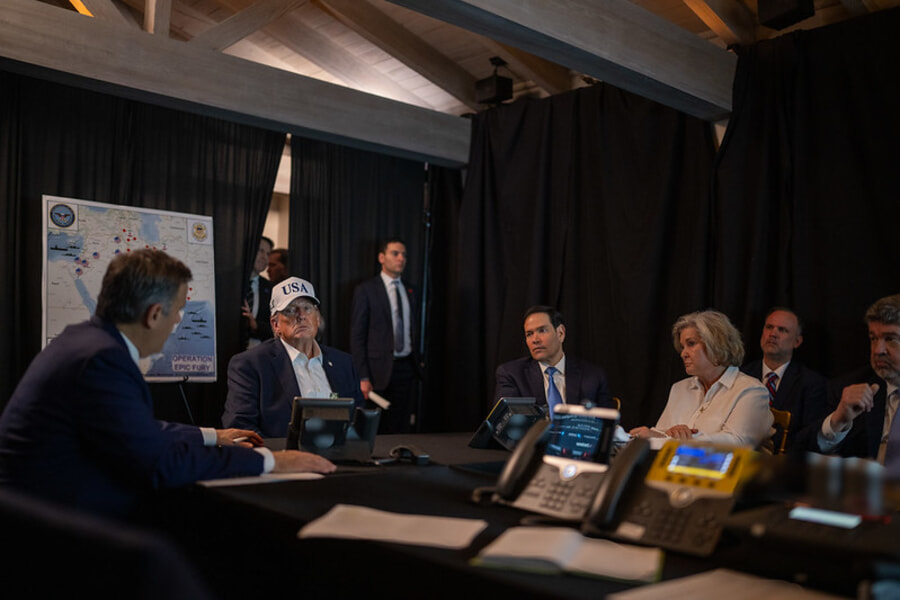

For the second time since returning to the White House, President Donald Trump has gone to war with Iran. But unlike the last time—when the United States targeted three Iranian nuclear facilities only to then pressure Israel into a ceasefire—he now appears to be playing for keeps.
Trump has repeatedly stopped short of directly targeting the regime in Tehran in the past. But after concluding that ongoing negotiations with the Iranians over their nuclear program had reached an impasse last week, he and Israeli leaders decided to make that their opening salvo. On Feb. 28, in one of their opening attacks, the U.S. and Israel reportedly adjusted military plans to be able to target a meeting of senior Iranian leaders taking place in Tehran. The resulting strike killed Supreme Leader Ayatollah Ali Khamenei and more than 40 of Iran’s senior national security officials. Since then, Israel has continued to target other Iranian political and military leaders while it and the United States have aggressively sought to diminish Iran’s various military capabilities. Iran, meanwhile, has responded with a steady stream of reprisals against civilian and military targets throughout the region, inflicting casualties in a number of nearby countries. Both Trump and Iran’s new interim leadership have reportedly expressed a willingness to resume negotiations. But far from winding down, the Trump administration has warned that the military campaign may last for several more weeks, if not longer, with many more casualties than the half dozen U.S. servicemembers who have already lost their lives.

On March 2, the Trump administration issued a statutorily required war powers report giving the first official account of the domestic and international legal basis for its actions, stating:
United States forces conducted precision strikes against numerous targets within Iran including ballistic missile sites, maritime mining capabilities, air defenses, and command and control capabilities. These strikes were undertaken to protect United States forces in the region, protect the United States homeland, advance vital United States national interests, including ensuring the free flow of maritime commerce through the Strait of Hormuz, and in collective self-defense of our regional allies, including Israel.
Later, the same report makes clear that President Trump ordered these actions “pursuant to [his] constitutional authority as Commander in Chief and Chief Executive to conduct United States foreign relations.” Yet this account leaves nearly as many legal questions as it answers.
This past June, I wrote a piece in Lawfare that anticipated and critiqued the legal arguments that the Trump administration ultimately put forward to justify its decision to join Israel’s earlier military campaign and strike Iran’s nuclear sites. Many of those arguments are now being deployed once again, but in a different context to justify a far more ambitious military campaign. This article updates my prior analysis to this new reality, both to shed more light on how the Trump administration appears to be justifying its recent actions and to situate those arguments against broader historical practice.
All told, Trump’s decision to use such broad military force against Iran pushes against the legal limits on his authority in almost characteristic fashion. His apparent international legal arguments lean heavily on permissive U.S. interpretations of when states may resort to the use of force, while his domestic legal arguments seem likely to focus narrowly on the limited risks to U.S. servicemembers without constraining how the president may use military force beneath that high threshold. While neither set of arguments are entirely without precedent, prior presidential administrations have generally approached their limits with a degree of caution; Trump and his advisors are instead leveraging them to the hilt. As in so many other areas, the end result is a clear vision of a president with few hard legal constraints, so long as he does not feel obligated to exercise his legal authority in good faith. Only here, the most severe consequences of these actions are not being felt by Americans, but by individuals in Iran and across the broader Middle East now caught in their wake.
International Law
While the Trump administration’s March 2 war powers report does not say as much expressly, its assertions that the United States is acting “to protect United States forces in the region” and “in collective self-defense of our regional allies, including Israel[,]” suggest that it is justifying the U.S. military intervention in Iran as an act of self-defense. This is not surprising, as Article 51 of the U.N. Charter identifies “the inherent right of individual or collective self-defence” in response to “an armed attack” as the only exception to what is otherwise a blanket prohibition on the use of force between states (outside of U.N. Security Council authorization), ensconced both in the U.N. Charter and in customary international law. Both the United States and Israel in turn embrace a broader view of this inherent right of self-defense than many others in the international community. As I described in my earlier analysis:
When it comes to the international law rules regarding the lawfulness of resorting to the use of military force (called the jus ad bellum), most authorities agree that the inherent right of self-defense discussed in the U.N. Charter extends to threats of imminent armed attacks as well as actual ones. But this is about where the agreement ends, at least where the United States (and Israel) are concerned. As articulated by the International Court of Justice, much of the international community maintains that the right of self-defense applies only to actual or threats of imminent armed attacks that surpass a certain threshold of scale and effects and that, to satisfy requirements for necessity and proportionality under international law, any responsive use of force must be a last resort and narrowly tailored to removing other threats of imminent armed attack. The United States, however, has long dissented from these views. It generally maintains that “any illegal use of force” can trigger the right to self-defense and that assessments of imminence should incorporate a variety of factors, including the “nature and immediacy of the threat” and “whether the anticipated attack is part of a pattern of continuing armed activity.” Moreover, the United States has argued that the use of force is a permissible response so long as a state has explored reasonably available alternatives and that the necessity and proportionality of any military response should be evaluated in line with what is required to address the overall threat posed by a hostile actor. The sum effect of these U.S. arguments is to give states far more leeway in using military force in response to various types of threat. Notably, Israel has generally been closer to the U.S. position on most of these issues than that of the broader international community.
Importantly, if a state is engaged in sustained hostilities that rise to the level of an ongoing armed conflict, international law generally accepts that it does not need to limit its military actions to circumstances where it is responding to an actual or imminent armed attack. Instead, it can act pursuant to military necessity so long as it does so in a manner consistent with the jus in bello rules governing conduct in warfare. That said, to comply with jus ad bellum requirements, continued participation in an ongoing armed conflict that is premised on the inherent right of self-defense must still be necessary and proportional to the threat posed by the other party.
In justifying the U.S. military action against Iran’s nuclear program this past summer, the Trump administration argued that it was acting in collective self-defense with Israel, essentially exercising what it viewed as Israel’s legitimate right of individual self-defense on its behalf and at its request. Israel, in turn, argued that it was in a years-long international armed conflict with Iran, as evidenced by direct hostilities between Israel and Iran as well as hostilities between Israel and various Iranian proxies, like Hamas and Hezbollah. Within this context, Israel framed its military campaign against Iran as a necessary and proportional response to the threats posed by Iran’s nuclear and ballistic missile programs, which it viewed as valid military targets in their ongoing armed conflict. Israel also argued that its actions would have been justified under the jus ad bellum even if it were not involved in an ongoing armed conflict, as Iran’s purported rapid acceleration of those programs presented an imminent and existential enough threat—particularly in light of the Iranian regime’s threats to Israel’s existence and past pattern of hostility—to trigger the inherent right of self-defense on its own.
Both Israel and the United States seem likely to deploy similar arguments to justify their current military campaign. Despite accepting a U.S.-backed ceasefire this past summer, Israel has made clear that it views its armed conflict with Iran as ongoing. Statements at the outset of military operations by both President Trump and officials in the Israeli Defense Forces similarly emphasized Iran’s efforts to resume work on its nuclear weapons and ballistic missile programs as the main impetus for the military campaign. Trump’s remarks strongly suggest that the United States is invoking individual self-defense as well, as he specifically discussed the “objective” of “defend[ing] the American people by eliminating imminent threats from the Iranian regime” without clarifying exactly what those threats may be. Similarly, U.S. Central Command has described the official goal of U.S. military operations as “dismantl[ing] the Iranian regime’s security apparatus [while] prioritizing locations that posed an imminent threat[,]” suggesting an individual self-defense rationale. (Later confused statements by senior administration officials suggest that the United States became aware that Iran planned to hit U.S. targets in the region in the event of Israeli military action, and that this “imminent” threat is what led the United States to join the Israeli military campaign in the first place. But this account is hard to square with even the flexible manner in which the United States has generally conceived of imminence.)
The problem with these legal arguments, however, is that they are hard to square with the facts available to the public. Both Israel and the United States described Iran’s nuclear and ballistic missile capabilities as severely diminished following this past summer’s military campaign, suggesting that any threat they may pose had, if anything, become substantially less imminent in recent months. Iran was actively engaged in ongoing negotiations with the United States at the time of the strikes that third-party facilitators described as making progress, drawing into question the extent to which a military response was clearly necessary. Intelligence agencies had also reportedly assessed that Iran had not yet made a decision to resume the pursuit of a nuclear weapon. Nor had Iran been as active in engaging in direct or indirect hostilities against Israel or the United States in recent months, in part because so much of its military capacity (and that of its proxies) has been degraded through other recent military engagements with Israel. In short, many of the factors that might have supported the lawfulness of Israeli and U.S. military action this past summer seem far less persuasive today. Perhaps there is more compelling information available to U.S. officials through intelligence or other sensitive channels. But if not, the case is far from compelling.
Further complicating any international justification is the fact that both Trump and Israeli Prime Minister Benjamin Netanyahu have repeatedly called for regime change. Both U.S. and Israeli official statements have generally stopped short of describing regime change as an official military objective; instead, they have generally observed that their actions create an opportunity for a change in government that they hope the Iranian people will take up. But this distinction does little to assuage concerns that other purported justifications are simply pretext for removing Khamenei and his supporters from power. The fact that Israel has repeatedly targeted Iran’s senior political leadership—including Khamenei—no doubt contributes to this concern, even though Israel has generally justified this practice by arguing that these political leaders’ roles in directing and orchestrating Iranian military activities makes them valid military targets. Notably, the United States accepts this possibility in theory as well, though it appears to be less involved in directly targeting Iran’s leadership in practice. (The United States has, however, reportedly provided Israel with intelligence in support of such attacks, which means it may share international legal responsibility for them.) Regardless, if Israel or the United States were to pursue military action with the objective of triggering regime change, this would not only raise major questions about whether doing so is a necessary and proportional way to address whatever threat Iran may present, but would also raise the prospect of unlawful interference in Iran’s internal affairs.
This is all before one even considers the fact that many other states do not embrace the broad, permissive view of necessity, proportionality, and imminence advanced by Israel and the United States. The conventional view of international law—reflected in the holdings of the International Court of Justice and many legal scholars, if not always in state practice—is that acting in self-defense requires evidence of an impending armed attack so immediate and overwhelming as to not allow for any alternative response. Even then, the military response must be narrowly tailored to addressing that threat. Neither Israel nor the United States have put forward facts that come close to meeting this standard.
For these reasons, it should perhaps not be surprising that a number of traditional allies have signaled discomfort with this latest military operation—a sentiment no doubt amplified by Trump’s clumsy and ultimately unsuccessful recent effort at bullying Europe into ceding control of Greenland, including through the lightly veiled threat of the use of force in clear violation of international law. This past summer, the G7 expressed support for the Israeli-led military campaign through a joint statement “affirm[ing] that Israel has a right to defend itself.” This time around, only Australia and Canada have endorsed the campaign as a means of bringing about an end to Iran’s nuclear program. France, Germany, and the United Kingdom, while noting their concerns with Iran’s nuclear weapons program and other behavior, have avoided commenting on the legality of the campaign and instead called for “a resumption of negotiations[.]” The United Kingdom reportedly even declined a U.S. request to use U.K. military bases, on the grounds that they believed the U.S. military operation was likely in violation of international law.
Beyond the G7, global reactions have similarly been mixed at best. China, Russia, and a number of aligned countries have condemned the attacks as violations of international law, as have countries like Turkey as well as U.N. Secretary General Antonio Guterres and officials from the Arab League. Many other governments have crafted positions that avoid either endorsing or condemning the Israeli-U.S. military campaign and instead focus on the need to de-escalate and restore regional stability. Very few have endorsed Israeli and U.S. actions. This lack of support may not be an acute concern for Israel and the United States in the short-term. But as the consequences from their military actions (and Iran’s predictable response) ripple out into the region, it will inevitably expose them to much broader claims of responsibility. Nor are they likely to find as many willing partners to share the burden of stabilizing and reintroducing Iran into the international community, if it comes to that.
Notably, far more international consensus emerged around the illegality of Iran’s military response, which has entailed attacks not just on Israeli and U.S. military targets but also on civilian targets in Israel and a number of Gulf countries. The latter such responses in particular have been met with almost universal condemnation as violations of international law. Some states that were wary of the initial Israeli and U.S. actions have since been targeted and had to take their own defensive military action against Iranian drones and missiles—or, in the case of the United Kingdom, have even agreed to cooperate with the United States on future defensive actions against Iran responding to such attacks. Ironically, if Iran continues its indiscriminate and unlawful campaign of reprisals, it may ultimately provide a much more persuasive international legal case for military action in individual and collective self-defense against Iran moving forward, by a far broader array of states.
Domestic War Powers
Whatever one’s views of the international legal merits of the U.S. intervention in Iran, President Trump does not appear to see them as much of a restraint on his legal authority. In a recent legal memorandum justifying the capture of Nicolás Maduro, his administration made clear that it adopts a longstanding (if controversial and heavily contested) executive branch legal opinion that maintains that the president’s domestic legal authority to use military force is not constrained by customary international law or non-self executing treaties, including the U.N. Charter and related prohibitions on the use of force between states. Instead, the only substantive legal constraints that Trump recognizes on his authority to use military force are those that arise directly from the Constitution. In this case, the March 2 war powers report makes clear that the president is relying on his own authority under Article II of the Constitution to act against Iran, not any statutory enactment like the 2001 Authorization for Use of Military Force (“AUMF”), which some officials floated as a possible legal basis for action against Iran during the first Trump administration. (I have previously written about the concerning degree to which the 2002 Iraq AUMF could have been used to authorize U.S. military action against Iran, but it was fortunately repealed last year, per my recommendation.)
I described the contested and often unclear parameters surrounding the president’s inherent authority to use military force without congressional under authorization in my earlier analysis:
How the Constitution allocates authority over the conduct of war has not been firmly resolved by the federal courts, which have often resisted weighing in on such issues. As a result, except where superseded by Congress, the executive branch’s understanding of the law in this area is generally the one that informs U.S. military operations.…
The executive branch has—over frequent objections by legal scholars—long maintained that the president has substantial independent constitutional authority to direct the use of military force against foreign adversaries. While some presidents have claimed a near plenary ability to pursue such action, most recent presidential administrations—including Trump’s during his first term—have generally described this authority as extending, “at least insofar as Congress has not specifically restricted it,” to situations where the president determines (a) military action would “serve sufficiently important national interests” and (b) the “nature, scope, and duration” of anticipated military operations will not “constitute a war requiring prior specific congressional approval under the Declaration of War Clause.” In addition, during his first term, Trump’s Justice Department suggested that the president “has the constitutional authority to take defensive measures to protect U.S. persons” in a manner not subject to these same constraints, but the exact scope of this national self-defense exception remains unclear.
Congress has “specifically restricted” this authority in one regard: As part of the 1973 War Powers Resolution, it requires that, once U.S. armed forces are “introduced … into hostilities or into situations where imminent involvement in hostilities is clearly indicated by the circumstances[,]” the president must “terminate” the use of those forces within 60 days (extendable to 90 days in certain circumstances), unless Congress has “enacted a specific authorization for such use[,]” extended the time period by statute, or is physically unable to meet. While some past presidents have suggested that this restriction is unconstitutional, more recent executive branch assessments have generally disagreed, at least outside the context of the national self-defense exception.
Notably, since I wrote this, the Trump administration has released an opinion by the Department of Justice’s Office of Legal Counsel that provides a domestic legal justification for the U.S. military operation that captured Venezuelan leader Nicolás Maduro. This opinion confirms that the second Trump administration accepts the two-part test applied by recent prior administrations, and has not embraced the even broader claims of presidential authority made by several of his predecessors (at least not yet). But the opinion also sheds light on how permissively this test will likely be applied moving forward, including in regard to the current Iran operation.
The first “national interest” prong of the executive branch’s two-part test is relatively straightforward, as Iran’s nuclear weapons and ballistic missiles programs—the official targets of the U.S. and Israeli military operations, alongside other elements of Iran’s security apparatus—have been longstanding points of bipartisan concern for the United States (among other countries). The risk that military action could destabilize Iran or trigger a regional backlash obviously weighs in the other direction and could lead some to reasonably conclude that, on the whole, the proposed operations are contrary to U.S. interests in the region. However, as the Maduro opinion reflects, recent executive branch legal opinions have only asked whether “the President could reasonably determine that the action serves important national interests[,]” a highly deferential standard that gives credence to the president’s views so long as there is any reasonable basis for reaching them. It is hard to conclude that such a basis does not exist with Iran, even if there are also grounds on which someone might reasonably—and perhaps even more persuasively—disagree. In short, the intent of the legal standard is not to second-guess the president’s policy judgment, but just to ensure it is not baseless.
The second “nature, scope, and duration” prong, however, raises some harder questions. From the outset, Trump himself has described this latest round of military operations—which was preceded by one of the largest regional military build-ups in recent memory—as “massive and ongoing,” with the potential to last for weeks and involve a substantial number of U.S. fatalities. Perhaps more importantly, pursuing strikes on Iran raises a clear and well-recognized risk of escalating into a broader regional conflict, which may now be manifesting across the region. Given that presidents most often use their Article II authority for more limited U.S. military actions, these descriptions should give one pause as to whether undertaking such a broad action is truly within the president’s sole constitutional authority.
Yet the Maduro opinion sheds light on how the Trump administration will likely argue that it is. First, the opinion maintains that the scale of U.S. military deployment necessary to qualify as a war for constitutional purposes is a high one, and specifically points to the precedent of the 20,000 U.S. personnel deployed in Bosnia and Haiti in the 1990s as a relatively permissive baseline. Second, in evaluating whether the risk of escalation into a broader conflict could give rise to a war for constitutional purposes, the opinion identifies U.S. casualties in the Vietnam War and the second Iraq War as points of reference for determining where the possible constitutional threshold might lie. The opinion specifically asserts that, even if the entire team of U.S. military personnel involved in the Maduro operation were somehow killed, this would not be substantial enough by itself to raise constitutional concerns. The fact that the Iran operation primarily involves air power, not ground troops, is another factor the Maduro opinion suggests weighs strongly in favor of its constitutionality, as such operations pose less risk to U.S. military personnel. And while past executive branch legal opinions have often cited that a military operation might result in regime change as a factor weighing in favor of a need for congressional authorization, the Maduro opinion expressly rejects the authorization requirement if the proposed operation is limited and remains unlikely to involve U.S. military forces in “substantial and sustained hostilities[.]”
The end result is an extraordinarily narrow focus on the threat that a planned military operation may present to U.S. military personnel as the primary variable for determining whether congressional authorization is required. In some ways, this reflects a broader trend in recent executive branch legal opinions, which have focused on this risk consideration over others. But it’s not how the anticipated nature, scope, and duration test was originally intended to operate. Earlier opinions were clear that this assessment “turns on no single factor” and incorporated various other considerations, including the scale of expected casualties by the United States and whether a proposed military action is defensive in nature. Among other considerations, this holistic approach reflects the fact that the Framers gave Congress the authority to declare war (among other war-related powers) in order to not just limit casualties among U.S. service members, but to serve as a check on a president’s overseas adventurism.
Instead, by embracing a narrow focus on the threat to U.S. service members, the Trump administration has rendered the nature, scope, and duration test highly permissible. So long as the president can colorably assert that the scale of potential harm to U.S. soldiers will remain below that of a major armed conflict—something that can often be readily accomplished against weaker states by, for example, using air power or special operations personnel that capitalize on superior U.S. military capabilities—the president can claim that nearly any military operation is within his sole legal authority to direct, no matter the other consequences for the United States or the rest of the world.
All that said, even the Trump administration’s legal framework is not entirely without limits on the president’s authority. The Maduro opinion does still recognize constitutional constraints on the president’s authority to deploy substantial ground troops into hostile circumstances for extended periods without prior congressional authorization, though exactly where it believes the lines should be drawn is unclear. Yet, the fact that the Trump administration now refuses to rule out aground troop deployment suggests that this limitation may not stay a hypothetical. Of course, if these outer Declare War Clause limitations on the president’s authority become too restrictive, the Trump administration could always change its internal legal position and embrace some of the even broader views of presidential authority put forward by its predecessors. In this sense, the executive branch’s legal views are only as binding on the president as he wants them to be.
A more immediate constraint may be the 60-to-90-day time limitation imposed by the 1973 War Powers Resolution, particularly given the Trump administration’s recent suggestions that military operations could continue for an extended period. If U.S. participation in “hostilities” continues past this fixed period without congressional authorization, the Trump administration will arguably be in violation of Congress’s explicit statutory limitation. Of course, several prior presidential administrations have interpreted the War Powers Resolution in ways that allow certain military operations to continue past this date. The most relevant to the current operation in Iran may be the Obama administration’s view—offered in relation to its military operations in Libya—that posited that the War Power Resolutions’ definition of “hostilities” did not reach certain limited air power campaigns.
None of these interpretations, however, has been subjected to judicial scrutiny. Relying on them could create a direct conflict between the executive branch’s actions and a congressional enactment in the form of the War Powers Resolution—exactly the sort of scenario in which federal courts, which are normally reticent to address the boundaries of the other branches’ war powers, have suggested that they might feel obligated to take up and address a dispute. Who the plaintiff might be for such a legal challenge is unclear. But as military operations continue, they will affect a wider range of individuals in ways that may give them the necessary standing. Hence, while the 60-to-90-day limitation is unlikely to serve as a hard limit on the Trump administration’s military operations, the risk of incurring judicial scrutiny will likely increase from that point forward, giving some incentive to the Trump administration to either wind up its operations or put them on a more stable legal foundation through statutory authorization.
Absent such a legal challenge, however, there is no clear legal mechanism for reining in the Trump administration’s actions, despite its clear tensions with how the executive branch has previously understood the president’s constitutional authority. Instead, any constraints will have to come through the actions of the other political branch, whose role in major decisions on matters of war and peace Trump (and many of his predecessors) has effectively sidelined: Congress.
Opposition in Congress
For its part, Congress has not taken the Trump administration’s actions in Iran entirely lying down. Even before military operations began, the House of Representatives and Senate were scheduled to debate a pair of bipartisan resolutions—a concurrent resolution (H. Con. Res. 38) in the House, co-sponsored by Rep. Thomas Massie (R-Ky.) and Rep. Ro Khanna (D-Cal.), and a joint resolution (S.J. Res. 104) in the Senate, co-sponsored by Sen. Tim Kaine (D-Va.) and Sen. Rand Paul (R-Ky.)—that would put limits on the Trump administration’s ability to pursue military action against Iran without congressional authorization if enacted. These votes—pushed up to early this week—have a new sense of urgency, and the proposals’ sponsors have adapted them to attempt to address the new operation. Yet history suggests that these debates are unlikely to be more than the first step in efforts to rein in the Trump administration, if that is what Congress decides to do.
While separate, the two measures set to be debated are closely related and intended to work together on a political, if not legal, level. I described how they interact in my earlier analysis, in relation to an earlier round of debate on similar resolutions:
Both resolutions are intended to take advantage of the 1973 War Powers Resolution, albeit in different ways. As originally enacted, the War Powers Resolution included a set of expedited procedures that allowed members of both chambers to introduce concurrent resolutions—a measure requiring only approval by the House and Senate, not signature by the president—directing that U.S. military forces “be removed” from situations of actual or imminent hostilities. The War Powers Resolution in turn directed the president to comply with any such concurrent resolution, essentially providing a mechanism by which Congress could direct the president to end hostilities without having to overcome a possible presidential veto. But in a 1983 decision in INS v. Chadha, the Supreme Court cast the constitutionality of such provisions into serious doubt. A few years later, Congress responded by adding another set of expedited procedures to the War Powers Resolution for joint resolutions, which do require signature (and thus risk a veto) by the president, giving them the full force of law and complying with INS v. Chadha. But for political reasons related to their enactment, the procedures adopted apply in only the Senate, not the House. …
The different procedures available to the two pending resolutions is likely to inform how the relevant resolutions are likely to be used, a pattern that previously played out in debates over military operations relating to Iran and Yemen during Trump’s first term. The concurrent resolution in the House is likely to serve primarily as a vehicle to force House-wide procedural (and potentially substantive) votes to draw attention to the issue and force members to take a public stance, potentially exposing opposition among the president’s supporters. But it’s unlikely to be taken up by the Senate as, even if it were enacted, the executive branch would almost certainly argue that it has no legal effect under INS v. Chadha. The joint resolution, meanwhile, will serve the same purpose in the Senate and, if ultimately adopted, will then become the main legislative vehicle in the House. It won’t benefit from any expedited procedures there, which may make it difficult to get it past the Republican House leadership, which can usually dictate the legislative agenda. That said, the current Republican House majority is narrow and fractious enough that it has occasionally been willing to buck its leadership on such procedural votes, disrupting the speaker’s control of the agenda. Perhaps the debate over the concurrent resolution will succeed in priming the pump enough to make passage a serious possibility.
Of course, even if both chambers pass the joint resolution, this is unlikely to be the end of the road. If intent on military intervention, Trump will almost certainly veto. This will in turn require the support of two-thirds of both chambers to override, a threshold that is likely to be extraordinarily difficult to meet in today’s Congress.
Even a vetoed joint resolution—or an enacted concurrent resolution that lacks the force of law—would stand as evidence that the “the expressed or implied will of Congress” is opposed to the president’s actions, a factor that generally weighs against the president’s legal authority to undertake actions in areas of shared or uncertain constitutional authority like war powers. An unequivocal statutory prohibition, however, would put the president’s actions into clear conflict with Congress, circumstances in which presidential authority is supposed to be at its “lowest ebb” and subject to the greatest constitutional scrutiny. Importantly, such interbranch conflict also creates the scenario in which some federal courts have suggested they would have an obligation to overcome their usual reticence over war powers and reach the merits of a dispute, increasing the risk that the executive branch’s legal positions will be subjected to judicial review. That said, unless such measures can secure the support of a substantial supermajority in both chambers, any such statutory limits are unlikely to be installed by the joint resolution being debated this week.
Without a supermajority-level of support, statutory restrictions on the president’s military operations are likely to require a different legislative vehicle that can bypass a presidential veto. The most common strategy for doing so is to incorporate relevant proposals into omnibus legislation that provides something the executive branch needs, making it too costly to veto. The usual candidates in the national security space are the annual defense authorization and appropriations bills, but these are not set to be debated until much later this year. In the short term, a more viable possibility may be the hotly debated legislation to fund the Department of Homeland Security.
Of course, there are also other uses to which Congress could put the War Powers Resolution’s expedited procedures. Past precedent makes the procedure (for joint resolutions, at least, and probably for concurrent resolutions as well) subject to germane amendments, which can add certain substantive provisions to the baseline resolution calling for the termination of hostilities eligible for the procedures in question. If a majority in each chamber wished to do so, they might be able to use this procedure to bring a concurrent resolution to the floor—potentially bypassing opposition from House leaders as well as Senate filibuster rules that might otherwise complicate the process—and then amend it to take various related actions that are within Congress’s own authority and do not require legislation. The clearest example would be to authorize a lawsuit challenging the constitutionality of the president’s actions on behalf of Congress, which could argue that Trump’s decision to act without seeking a declaration of war effectively nullified its vote on the matter, potentially giving it standing to pursue a lawsuit as an institution. (The House and Senate may also be able to individually authorize litigation on their behalf as well through simple resolutions, but their standing argument is likely weaker.)
Indeed, just debating joint and concurrent resolutions can itself help build momentum and support for proposed restrictions. The War Powers Resolution’s expedited procedures allow critics of the administration to force public votes on such proposals, which can in turn compel members of Congress to take a stance on the Trump administration’s actions. This can help reveal the extent to which members of Congress—including members of his own party—do not support Trump’s actions. During the extended congressional debate over the first Trump administration’s Yemen policies, this strategy not only built enough support to enact certain statutory limitations on the president’s actions through annual defense legislation, but the political fallout from such visible opposition among congressional Republicans eventually pressured the Trump administration to shift some of its policies in ways not compelled by legislative action. Two sponsors of the current Iran-related resolutions—Sen. Kaine and Rep. Khanna—were at the forefront of those efforts as well. I doubt the lessons are lost on them.
Implications for the Future
In June 2025, I concluded my analysis of the legal basis for the Trump administration’s (then hypothetical) participation in Israel’s military campaign against Iran by noting that certain actions were not hard to square with past U.S. legal practice. “[T]he conventional legal views of the executive branch make it easier to accommodate military action like a limited air strike on a [nuclear] facility[,]” I argued. “They are much more skeptical (though not necessarily prohibitive) of the sort of broader military campaign that may be required to force an outcome like regime change, at least absent some statutory authorization.” The Trump administration’s latest military campaign against Iran is exactly this sort of broader military campaign. And in undertaking it, President Trump is testing the outer limits of what even the executive branch has argued he can do on his own authority as president.
For some, the fact that the president can initiate such dramatic and legally questionable military action is itself a sign that the law is irrelevant. I respectfully disagree. Even where it does not impose hard limitations, the shape of the law—including the past views of the executive branch and legal significance given to the practice of prior presidents—makes some military actions easier for presidents to undertake than others. The fact that the June 2025 strikes on Iran’s nuclear facilities were limited in scope and narrowly targeted at a program that many credibly saw as a real and serious threat to a close U.S. ally contributed to the fact that it ultimately proved relatively uncontroversial, both at home and overseas.
Now that Trump has chosen to strike out in a broad and highly destabilizing fashion that puts both the U.S. and our allies at serious risk, his actions will leave him more isolated and subject to greater scrutiny. The resulting pushback will be as much political as legal and thus will likely depend at least in part on the speed and efficacy with which Trump can accomplish (or abandon) his purported objectives, as well as the broader contours of how Trump manages his domestic political constituencies and the United States manages its international relations. But this is simply a reflection of the fact that in war powers, as in many areas of law that are not readily subject to clean judicial enforcement, the two are not so easily separated. It doesn’t mean that the law doesn’t matter; it just means that law isn’t the only thing that matters.
More importantly, this permissive legal structure is still not a permanent characteristic of our constitutional system. As I wrote in June 2025, “Congress could enact stricter statutory limitations on the executive branch and, while the executive branch may contest their constitutionality and seek to act beyond them, doing so may finally force the federal courts to intervene and weigh in on the proper allocation of war powers under the Constitution”—a legal fight “there is ample reason to think that Congress will ultimately win.” Perhaps the controversy over Trump’s actions in Iran will finally compel Congress to take such steps. Regardless, if it does not, then Trump has now proven himself more than willing to test the outer limits of his war powers as president. Hence, more such controversies likely lie on the horizon over the next three years—and the rest of the world is likely to bear the worst of the consequences.
Editor's Note: This article was made possible in part by a grant from the Carnegie Corporation of New York. The statements made and views expressed are solely the responsibility of the author.
-(1).jpg?sfvrsn=af0bd5fc_5)
