
The Strait of Hormuz and the Limits of Maritime Law
The legal regimes governing attacks on shipping in the Strait of Hormuz and economic warfare as an act of self-defense.
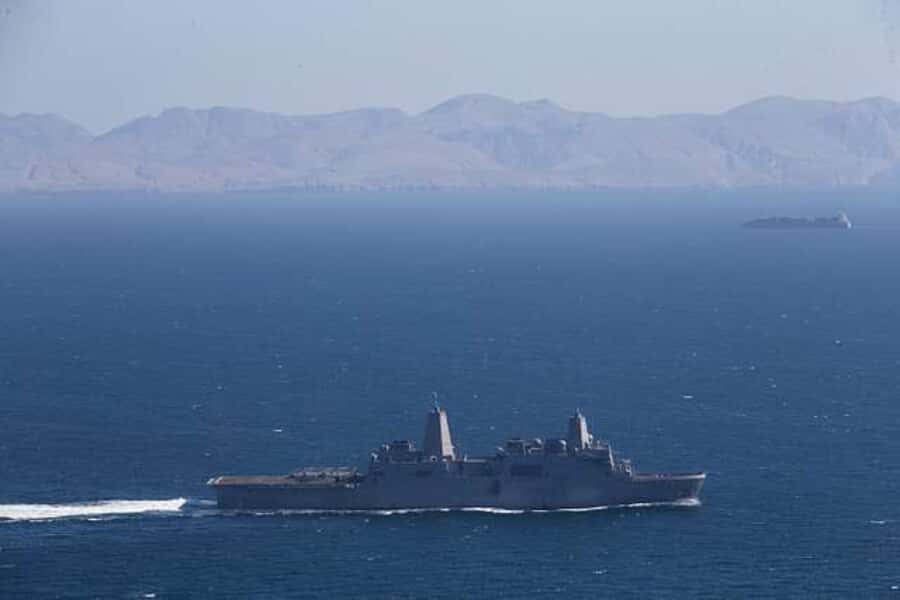

For over 40 years, the Strait of Hormuz has been a geopolitical pressure point. Today’s war, however, has prompted a broader question that extends beyond the conflict: whether international law can regulate economic warfare at sea in an era of globalized commerce. The crisis in the Strait of Hormuz demonstrates how the legal frameworks governing maritime chokepoints face limits when military coercion targets the infrastructure of global trade.
As a result of the war, commercial navigation through the strait has ground to almost a stop, with tanker transits down to zero on some days and hundreds of vessels remaining outside the strait, unable to reach ports. Multiple attacks by Iran have deterred merchant vessels from navigating the strait, with Iran announcing that the strait will “be under control of the Islamic Republic.” These attacks include Shahed drone attacks, missiles, and mines, and even an Iranian attempt to use a remote-controlled boat laden with explosives to target a tanker.
This combination of attacks on shipping and threats to restrict passage is not new. Similar strategies appeared during World War I, when the United Kingdom imposed a sweeping naval blockade in 1914, intercepting merchant shipping bound for German ports in an effort to weaken Germany’s war economy. Similarly, during the Iran-Iraq “Tanker War” of the 1980s, both sides attacked hundreds of oil tankers in the Persian Gulf as part of a strategy to disrupt the other’s energy exports. During the Tanker War, Iran also used mines to threaten commercial shipping lanes—similar to its mining tactics in the Strait of Hormuz today.
Today, the navigation crisis in the strait has an even greater impact than in those 20th-century wars, because it occurs in a global economy, where even minor disruptions in supply chains affect people far beyond the battlefield. Global energy markets are more integrated than they were during earlier maritime conflicts, and even a single shipping corridor being interrupted can ripple through supply chains, affecting dozens of economies. In the case of the strait, disruptions of shipping directly implicate neutral states that depend on the route for energy imports and trade. Major importers in Asia and Europe, as well as developing economies reliant on fuel shipments, can experience supply shocks even when they are not parties to the conflict. These disruptions translate into higher fuel and food prices, with downstream effects on civilian populations far from the battlefield, particularly in energy-importing states, such as major oil importers in Asia (China, India, South Korea, and Japan), as nearly 90 percent of the strait’s oil flows to Asian markets.
Attacks in the strait are also part of a broader campaign of economic warfare in the conflict, as both sides target energy infrastructure in an attempt to maximize the costs of continuing the war. The U.S. and Israel have struck Iranian oil depots, refineries, and fuel storage facilities. Meanwhile, Iran has targeted civilian infrastructure and transport routes across the Persian Gulf, including commercial ships. It has struck fuel storage tanks and oil facilities in Fujairah and other locations in the United Arab Emirates and at the Salalah port in Oman. None of these pressure points, however, compares to the strait’s strategic leverage over the world’s oil trade, with nearly one-fifth of globally consumed petroleum liquids traveling through it.
The attacks are clear-cut instances of “economic warfare,” using military means to disrupt commerce to weaken the adversary’s will to fight, by both sides. So far, international humanitarian law has never fully prohibited economic warfare, and classic naval warfare doctrine, as reflected in the 1994 San Remo Manual, a highly influential nonbinding restatement of treaty and customary international law governing armed conflict at sea, permits blockade as a lawful method of war if it meets certain criteria. But the situation in the strait raises a deeper question: whether these doctrines—developed largely in an earlier era of maritime conflict—are capable of addressing the modern forms of economic warfare that can disrupt global markets rather than merely weaken an adversary’s ports or trade.
The Transit Passage Regime
The first instrument relevant to whether Iran can close the strait under international law is the law of the sea, largely codified in the United Nations Convention on the Law of the Sea (UNCLOS). Part III of the treaty, particularly Articles 37 through 44, governing “Straits used for international navigation,” holds that all ships and aircraft have a right of transit passage, “which shall not be impeded,” and that “there shall be no suspension of transit passage” through a strait. The logic is that when much of global trade depends on a narrow corridor, the bordering states are not allowed to use that corridor as leverage.
The Strait of Hormuz is generally seen as one such “international strait.” It is so narrow that large ships must pass through the border states’ territorial waters. The strait essentially operates like a highway, with shipping organized through a traffic separation scheme created by the International Maritime Organization. Major maritime powers have also restated their commitment to leave transit passages unimpeded in their own operational-law restatements, which are nonbinding military manuals that interpret and apply international law to real-world operations, such as the U.S. Navy Commander’s Handbook on the Law of Naval Operations or Germany’s Law of Armed Conflict Manual.
Iran signed the UNCLOS in 1982 but never ratified the treaty. When it signed, the Iranian government declared that certain parts of the UNCLOS, including its transit passage, were “quid pro quo” bargains for treaty parties, rather than codifications of existing customary international law. Iran interprets itself as not being bound by the aforementioned “transit passage” regime, which Iran has codified into its own domestic laws. For example, a 1993 law, “Law of Marine Areas of the Islamic Republic of Iran in the Persian Gulf and Oman Sea,” allows Iran to suspend the passage of foreign ships in its territorial waters and requires prior authorization for the passage of warships, submarines, and vessels carrying “dangerous or harmful materials with respect to the protection of the environment.” This latter category can encompass commercial oil tankers, which carry bulk petroleum and are widely treated in maritime law as posing environmental and navigational risks. As a result, both foreign naval vessels and commercial energy shipments transiting the strait fall within categories that Iran claims authority to regulate.
Iran is not alone in asserting legal rights broader than what the UNCLOS provides. Oman, for example, which sits on the southern side of the Strait of Hormuz, is a party to the UNCLOS but has made similar declarations requiring warships to seek “prior permission” to pass through its territorial waters.
But the UNCLOS is not the full story. Even before the UNCLOS, international law considered certain straits as special from ordinary territorial waters. Notably, in the 1949 Corfu Channel case, the International Court of Justice rejected Albania’s attempt to require authorization from the United Kingdom prior to when its warships moved through the Corfu Channel, which overlaps with Albania’s territorial waters. The court held that when a strait between two parts of the high seas is used for international navigation, ships enjoy unrestricted passage during peacetime, so long as the transit does not threaten a coastal state’s security. Coastal states may take steps to prevent this passage only in exceptional circumstances. The Corfu decision laid the foundation for the later transit passage framework, which reaffirmed that straits that are essential to international navigation should remain open. Today, many international law scholars and states argue that the transit passage regime is part of customary law.
Major maritime powers have tracked coastal-state claims over passage waters and challenged them as contrary to international law. For instance, the U.S. Freedom of Navigation program, through which the United States challenges excessive maritime claims, treats the UNCLOS transit passage regime as reflective of customary international law, even though the United States itself has not ratified the treaty. The program lists both Iranian and Omani restrictions as “excessive maritime claims,” conducting naval operations, known as freedom of navigation operations. By navigating the strait under the transit passage regime, the U.S. is making operational assertions against Iran’s rejection of the transit passage regime, generating state practice to crystallize the regime into customary international law.
Self-Defense Regime and the Law of Naval Warfare
Under Article 51 of the UN Charter, which allows a state to act in self-defense “if an armed attack occurs,” Iran can make a self-defense claim to justify its attacks in the strait. The law of self-defense is protected at sea through instruments such as the San Remo Manual. Iran has not consistently framed its actions in terms of referring to a legal regime but instead uses rhetoric and bluster to assert control over the strait and use that control as leverage in the current war.
However, Iran can argue that any actions to close the strait are taken in self-defense. But these self-defense claims come with their own restrictions under international law. The action taken in self-defense must be necessary to repel the armed attack and proportional to the threat. Additionally, states must ensure they do not target civilian objects or civilians—a provision with which Iran does not comply when it attacks commercial oil vessels and other civilian ships.
The effects of closing the strait, however, are not limited to the attacking state, in this case, the U.S., which raises the question of the closure’s proportionality. Article 51 defines proportionality as the force reasonably required to repel or prevent further attacks by the aggressor. This force calculation focuses on both the attacking and defending states. Here, the effects will largely reverberate past the attacking state and onto third parties, creating a doctrinal gap.
International law provides other doctrines that partially address the problem. The law of naval warfare—reflected in frameworks such as the 1907 Hague Convention XIII and the San Remo Manual—allows for blockades as tools of economic warfare, but conditions this on certain requirements, including a formal declaration, notifying other states, enforcing to the degree that it is actually effective (which is difficult because prolonged closure would probably trigger countermeasures by other naval powers), and applying it impartially to all vessels. These principles have been largely reemphasized in the 2023 Newport Manual, a nonbinding but influential restatement of customary international law on naval warfare, which builds on the San Remo Manual. The Newport Manual largely restates the San Remo framework while highlighting the obligation to protect neutral shipping and avoid undue interference with international navigation—requirements that are increasingly difficult to reconcile with large-scale economic warfare in maritime chokepoints.
Additionally, the blockade cannot impede neutral states from reaching their own ports or coastlines. Note that not all modern states, including Iran, Israel, and Oman, are party to Hague Convention XIII, but its rules are generally codified in customary international law instruments such as the San Remo Manual. Given that Iran is indiscriminately restricting access to the strait—and therefore restricting access to neutral coastlines—it is likely violating that rule.
Legality of Measures That Would “Close” the Strait
The primary way by which Iran can “close” the strait is to attack ships passing through it to deter other ships from attempting to pass.
If Iran engages in mine warfare on the strait, it may run into complications under international law. The 1907 Hague Convention on mines prohibits states from laying mines “with the sole object of intercepting commercial shipping” and requires precautions to protect peaceful shipments. Although not all states, including Iran, are parties to the Hague Convention, many of its rules are widely regarded as reflecting the customary principles that govern mine warfare. Customary international law restatements, written by international law scholars and naval practitioners, also emphasize that the state laying the mines must take due regard of neutral shipping, by “inter alia, providing safe alternative routes for shipping of neutral States,” and prohibit impeding transit through international straits unless safe and convenient alternatives exist.
The Strait of Hormuz’s geography, however, means that a meaningful alternative safe shipping route is impossible. Oil could reach the Red Sea but only through limited-capacity pipelines rather than an equivalent sea route. Furthermore, even these partial alternatives are fragile: shipping routes through the Red Sea have been obstructed by attacks from Iran-backed actors in previous conflicts, including the Houthis, and these attacks are likely to recur in the current war. Acting through proxies also does not insulate Iran; it may instead increase the state’s international legal exposure by extending economic warfare to additional chokepoints and neutral shipping.
Iran has so far enforced the closure by attacking oil tankers. Under the law of naval warfare, as reflected in customary international law and restated in the San Remo Manual, neutral merchant vessels generally have protection from attacks unless they meet certain conditions, such as engaging in belligerent acts, refusing to stop after a warning, or carrying contraband, which can either be absolute contraband, including inherently military objects like weapons, or conditional contraband that are civilian goods that could have military use. Even if the merchant vessels belong to the adversarial state, the ships are targetable only if they qualify as military objectives as defined in Article 52 of Additional Protocol I to the 1977 Geneva Conventions. By default, merchant vessels are presumed to be civilian objects, unless shown otherwise. The point of these international agreements is to prevent naval warfare from becoming a string of indiscriminate attacks against civilian commerce.
Where Does This Leave the Strait of Hormuz Today?
There are three legal regimes vying for supremacy in the case of the strait. The UNCLOS’s transit passage regime is supposed to keep such chokepoints open. The law of naval warfare, as reflected in the Hague conventions and customary international law, allows a blockade, but only under certain conditions that are likely difficult for Iran to fulfill. Finally, self-defense, established by the UN Charter, is another option for Iran, but it comes with limitations on both the targets and the scale of force used.
Iran can continue to pursue economic warfare in Hormuz—mining the strait, declaring exclusion zones, or striking neutral tankers—but it exposes itself to international legal vulnerability. Even if Iran relies on the self-defense doctrine, contestably its strongest argument, the scale of third-party harm and the legal protections surrounding international straits would likely make a broad closure of the strait legally impermissible.
Previously, the three doctrines could work together because naval warfare was more geographically limited and directed primarily at enemy ports. Blockades were imposed against clearly identifiable belligerents, and neutral shipping vessels could often avoid contested waters. Today, however, hostilities in a chokepoint such as the Strait of Hormuz demonstrate tensions between the governing legal regimes: The transit passage legal regime assumes uninterrupted navigation through international straits, while the law of naval warfare permits interference with shipping during armed conflict. At the same time, the law of self-defense evaluates proportionality in relation to the adversary state, even though disrupting a chokepoint can impose economic costs on dozens of neutral countries that depend on the route.
International maritime law, despite its many rules, is not equipped for today’s globalized world and chokepoints. While the current article focuses on the Strait of Hormuz, the issue is much broader and can repeat in locations such as the Strait of Malacca, Bab el-Mandeb, or the Danish Straits. The issue is not simply whether particular actions in the strait violate existing international law, but whether the legal architecture governing maritime conflict is capable of regulating economic warfare in a deeply interconnected global economy.
-(1).jpg?sfvrsn=af0bd5fc_5)
