The Military’s Social Media Purge

U.S. Army Col. Amy Nieman is no snowflake. Her military career provides evidence to rebut the argument that judge advocate general (JAG) officers are not real soldiers. She was on the ground during initial combat operations in Afghanistan in 2001 and then again in Iraq in 2003. The right sleeve of her Army uniform displays nine stripes, each representing six months of service in a combat zone. She wears the senior parachutist badge, indicating her completion of the Army’s rigorous jumpmaster school. She raises her children with her husband, a retired special forces officer who lost his leg to an improvised explosive device in Afghanistan. She served in numerous airborne infantry and special operations assignments, and last year she became the top legal adviser for the Army’s storied 101st Airborne Division at Fort Campbell, Kentucky.
That was, until recently, when Nieman was suspended from her job with the 101st and placed under investigation for a social media post in the wake of the assassination of right-wing media personality Charlie Kirk earlier this year. Her offense was sharing, on her private Facebook account, her frustration about uneven outrage to instances of political violence in the United States. The post did not celebrate Kirk’s death, incite violence, or violate any military standards. An unknown colleague sent a screenshot of the post to a political influencer on X, where it drew significant attention, including from some who called for her to be raped and tortured. The uproar on X was enough for the military to temporarily remove her from her position and begin an investigation into potential wrongdoing.
Nieman’s story illustrates an emerging trend of the military’s policing of social media. Normally, military members enjoy broad First Amendment rights to share their views, limited only when the speech conflicts with military duties. But the past few months have seen a “Kirk Purge” in which those standards have been abandoned for newer decrees that seek to punish military members for their viewpoints. These new standards inject uncertainty about which viewpoints are disfavored, which tends to broadly chill otherwise protected expression.
The Kirk Purge is not unprecedented. It’s reminiscent of the mood following the attack on the U.S. Capitol on Jan. 6, 2021, a national event that, like Kirk’s assassination, felt personal for many. In the aftermath, a conservative soldier made social media posts about the Capitol attack that were, at worst, in poor taste. For this, he received a career-killing reprimand from a general who was eager to take action. Time cooled this zeal, and the punishment was rescinded. It was a lesson that military leaders can sometimes be tempted to control expression that is otherwise protected, especially during political controversies.
This piece explains the contours of free expression rights in the military. The pertinent court cases seek to balance robust First Amendment protections with military necessity. But this speech-friendly framework can crumble in times of crisis. After describing the crackdown on online military speech following Kirk’s assassination, the piece examines how arbitrary and vague new guidance enabled military leaders to punish unpopular views and purge politically unreliable members from the ranks.
Free Speech in the Military
The First Amendment’s Free Speech Clause promises robust protection against government speech regulation: “Congress shall make no law … abridging the freedom of speech[.]” But that “no law” absolutism is not absolute, and free speech jurisprudence today recognizes numerous limitations and exceptions. For example, not all Americans enjoy the First Amendment’s most robust protections. Restrictions are authorized for what constitutional law expert Erwin Chemerinsky calls “speech in authoritarian environments.” There are three. Prisons can limit free expression by prisoners if the restrictions relate to a legitimate penological interest. Schools can restrict student expression when necessary to uphold the authority of teachers. And the military can punish expression when needed to instill obedience and maintain military discipline.
Military members give up some freedoms during military service. For one, they become subject to the Uniform Code of Military Justice (UCMJ), which includes restrictions on speech and conduct that would not be crimes for civilians. They cannot utter contemptuous words against senior civilian officials, disrespect or disobey their superiors, or fail to obey certain orders and regulations. Active-duty military members can be punished for infractions even when they are off duty and anywhere in the world.
These restrictions are not controversial. Nobody wants a military where malcontents are free to agitate for resistance against military leaders, especially during missions when the need for discipline and obedience is paramount. The more controversial restrictions come from the code’s vague and overbroad provisions. Officers can be punished for “conduct unbecoming an officer” (Article 133), and military members are subject to a “general article” that allows for punishment of “all disorders and neglects to the prejudice of good order and discipline” or “all conduct of a nature to bring discredit upon the armed forces” (Article 134).
Ordinarily, the First Amendment strongly disfavors vague and overbroad government regulations, such as prohibitions on racist expression or an airport’s ban on “all First Amendment activities.” Such laws leave everyone to wonder what conduct is actually prohibited, and they permit the government to engage in arbitrary enforcement. All of this tends to chill protected expression.
Articles 133 and 134 were at issue in the 1974 case Parker v. Levy. There, the U.S. Supreme Court reviewed the conviction of an Army doctor for sharing his antiwar views with soldiers he was training. Capt. Howard Levy’s statements included:
I would refuse to go to Viet Nam if ordered to do so. I don’t see why any colored soldier would go to Viet Nam: they should refuse to go to Viet Nam and if sent should refuse to fight because they are discriminated against and denied their freedom in the United States, and they are sacrificed and discriminated against in Viet Nam by being given all the hazardous duty and they are suffering the majority of casualties.
In reviewing the conviction, the Court affirmed that the military is a “specialized society separate from civilian society.” The Court acknowledged that service members are not excluded from the First Amendment’s protections but that the military’s character “requires a different application of those principles.” Here, because Levy “could have had no reasonable doubt that his public statements urging Negro enlisted men not to go to Vietnam if ordered to do so,” the Supreme Court rejected the challenge to his conviction. In other words, Parker holds that military speech can be regulated when it may “undermine the effectiveness of response to command.”
Parker is supplemented by a series of cases from the military’s highest court emphasizing that speech enjoys strong protections unless it undermines the performance of military duties. When there is no connection between speech and military duties, speech enjoys robust protections. The default, expressed in 1970 in United States v. Gray, is that military members, like civilians, “are entitled to the constitutional right of free speech.”
This was reinforced last year in United States v. Smith when the highest military court reviewed a conviction of an off-duty airman for communicating a threat at a gas station. He yelled, “[T]ell that pretty boy motherf[***]er in there, he needs to watch his a[**], there are some hard-hitting guys in the street.” The Court ruled that this statement “in no way interfered with the military mission and had no nexus to the military environment”and, therefore, was protected.
Even speech regulated by the two general articles requires a military connection; authorities do not have a license to police unpopular views. The highest military court in United States v. Wilcox in 2008 considered an Article 134 conviction of a soldier who, while off duty, identified himself as a white supremacist who did not support the U.S. government. The Court ruled that a conviction can be sustained only if there is a direct connection between the speech and military duties. Otherwise, “the entire universe of servicemember opinions, ideas, and speech would be held to the subjective standard of what some member of the public, or even many members of the public, would find offensive.” Thus, the two general articles, while broad, are not unlimited.
Military Regulation of Social Media
In addition to the punitive provisions of the UCMJ, military members are bound to follow lawful orders and regulations, including rules regulating online conduct.
Service members have considerable expressive freedom. Department of Defense Directive 1344.10 gives general guidance on permitted expression. Military members on active duty can join a partisan political club and attend meetings when not in uniform, write letters to the editor expressing personal views on public issues or political candidates, display political bumper stickers on their vehicles, and participate in partisan fundraising events and activities as spectators when not in uniform. Military members are allowed to “carry out the obligations of citizenship.”
Department of Defense Instruction 5400.17, most recently amended in February 2025, lists the Defense Department’s standards for official and personal social media usage. It requires that personal social media usage not create the appearance that it is official. Military members should not disclose nonpublic information or engage in partisan political activities while on duty.
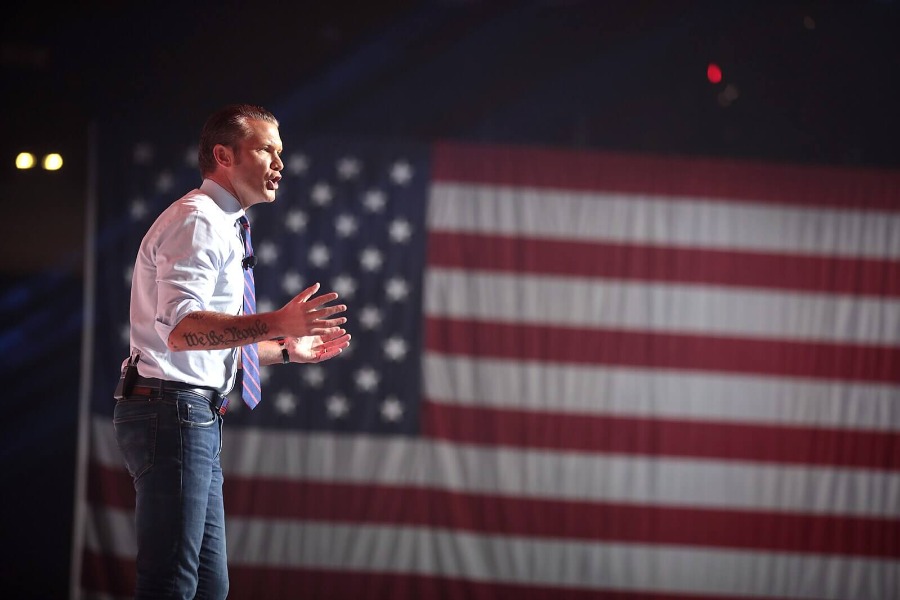
The rules above broadly allow for private political expression by military members. Senior leaders have also spoken out in favor of military free speech and expression. Earlier this year, President Trump vowed in Executive Order 14149 to take measures to ensure that the government would not “unconstitutionally abridge the free speech of any American citizen.” Defense Secretary Pete Hegseth vowed, “No more walking on eggshells!” in his speech to senior military officials in September.
Speech Rules Modified: The Kirk Purge
After Kirk’s assassination, many Americans expressed their opinions online. It did not take long for military political appointees to share their displeasure that some service members had spoken out in ways they perceived as being against Kirk. Hegseth wrote, “We are tracking all these very closely—and will address, immediately. Completely unacceptable.” Stephen Simmons, a deputy assistant secretary of defense, said Hegseth “knows (as do we all) that this cancer that desecrates the constitution—and the people for whom it was written—must be neutralized.”
Other leaders quickly joined the crackdown. Air Force Secretary Troy Meink urged commanders to use “all tools available” to investigate and punish those out of step with social media guidance. Navy Secretary John Phelan tweeted that the Navy and Marines would deal “swiftly and decisively” with anyone who acts in a manner that brings discredit upon the Navy, including those who made posts “displaying contempt toward a fellow American who was assassinated.”
The “Kirk Purge” included hasty responses that were downright clumsy. U.S. Coast Guard Vice Adm. Thomas Allan Jr. issued guidelines on “unacceptable behavior” that included “celebrating or approving the death of any individual.” This would mean that any service members who cheered the death of Osama bin Laden, as many did, could face Allan’s threat of adverse action. Military officials were expected to move quickly to police viewpoints or face consequences of their own. After one Air Force member’s post about Kirk circulated on X, Air Force Undersecretary Matthew Lohmeier instructed senior leaders “to read the member his rights, and place him and his entire chain of command under investigation” (emphasis added).
The zeal to punish disagreeable speech showed results: The Army recently announced that it suspended 12 soldiers, and the Pentagon announced that 128 service members and 158 nonuniformed personnel were put under investigation for their social media activity. Those numbers were announced in October; current figures are likely higher.
Consequences of Speech Infractions
Military members can face a range of consequences for allegations of misconduct, including social media violations. At the low end of the scale are corrective measures. Military members who post in ways that violate military standards, but are not considered serious offenses, can be reprimanded, require extra training, and be told to remove the offending posts.
For more serious allegations, military members can be suspended or removed from their positions. An analogy to this suspension-and-removal process is a starting pitcher on a baseball team. The manager can remove the pitcher at any time for any reason, or for no reason at all. Like the pitcher, most military members hold no ownership over a certain position. Also, like the pitcher, the removal can happen instantaneously by superiors without much (if any) due process. Just as the starting pitcher remains a member of the team when pulled from a game, the military member retains their rank and active-duty status if suspended or removed.
Military officials are authorized to conduct investigations. The lion’s share of these are called “administrative investigations” because, unless they deal with serious crimes, they usually fall short of the purview of the military’s criminal investigators. The dividing line is not always precise, and varies somewhat by service, but would generally involve administrative investigations for minor offenses and criminal investigations for posts with evidence of a more serious offense, such as a threat. Administrative investigations gather facts and make recommendations for a commander’s consideration.
The military can easily inflict lasting punishments through other administrative measures that lack the procedural protections of courts-martial. Military leaders can impose nonjudicial punishment, issue permanent reprimands, or initiate separation proceedings. Still, these processes contain some due process measures to guard against erroneous deprivations and consider First Amendment claims.
Serious cases could result in court-martial. There, the military member would be assigned a free military counsel and also have the opportunity to hire a civilian counsel. The charges would be reviewed at a preliminary hearing with a nonbinding recommendation. Cases that survive the preliminary hearing and a legal review are referred to a court-martial where they fall under the supervision of a military judge. Defendants there would have the opportunity to file motions, including First Amendment defenses and allegations of unlawful influence against any leaders alleged to have pressured the independent discretion of the military justice process.
Back to Col. Nieman’s case. (Disclosure: The author provided an expert declaration for Col. Nieman for this investigation.) The Army’s investigating officer found that her post compromised her standing as an officer and ability to provide principled legal counsel, but did not articulate how this conclusion was supported by established standards. The investigator did not consider that the private post became notorious only when it was surreptitiously screenshotted and shared with an influencer on X. This is akin to placing a letter in a mailbox that is later stolen and widely disseminated: It’s true that the dissemination caused noise online, but that is not the fault of the letter writer. Nieman’s private conduct seemed to comport with the requirements of Defense Department Directive 1344.10 and Instruction 5400.17, which give wide latitude toward personal expression. By the precedents of cases such as Parker, Wilcox, and Smith, this was protected expression as there was no evidence that the speech undermined the military mission or bore any connection to it. This investigation is still pending.
Other cases are similarly weak, often involving private expressions of personal belief that were then surreptitiously screenshotted and shared with political influencers and military officials. Most of these investigations have tended to settle out at a low level: Of the hundreds brought so far, 26 resulted in reprimands and three were sent to nonjudicial punishment. It would not be surprising if none of the investigations resulted in a court-martial. There, the prosecution would have a difficult time proving an adverse and direct impact on the military mission (a la Parker) or that the ad hoc social media guidance during the Kirk Purge meets the high First Amendment standards of Wilcox or Smith. It may be that investigators on these cases feel pressure to reach findings that they assume are favored by top officials.
But the weakness of many cases currently under investigation feels beside the point. The threshold is low to suspend a military member from their duties while an investigation is pending, and these suspensions and investigations are their own punishment. A suspension alone can wipe away a military member’s career trajectory even if they are later vindicated. As professor Rachel VanLandingham notes, “It’s a chilling effect—the damage is already done.” With a high degree of unpleasantness that comes from facing adverse administrative action, some might choose to leave the service on their own if they have the chance and not seek to fight their cases on the merits. With this sidelining, the Kirk Purge seems to be more about punishing viewpoints than ensuring military discipline.
Conclusion
It is hard to put the toothpaste back in the tube and tell military members that they enjoy the First Amendment’s robust protections when hundreds of investigations during the Kirk Purge reveal otherwise. Unpopular speech that is fully protected by the First Amendment might be punished anyway. The most natural consequence is that military members will self-censor and not express their views. This could have effects on military retention and recruiting, as the military regards social media use as a key component of its recruiting efforts. The uncertainty about what private speech might trigger an investigation is likely to cause well-meaning military members to stop sharing their military stories with their friends, family, and the public.
This social media purge could have an impact beyond the active-duty military. Reserve and National Guard members may be more likely to keep their opinions to themselves even in their civilian capacity, for fear their opinions might be used against them when in uniform. There are roughly 2 million military retirees who are also subject to the UCMJ. Though rare, it is possible for these retirees to be threatened with military justice. This happened recently when Secretary Hegseth ordered an inquiry into whether Sen. Mark Kelly (D-Ariz), who is a retired Navy captain, committed military offenses when he appeared in a video about lawful and unlawful military orders. While it would be surprising to see widespread policing of retiree speech by ordering more retiree recalls for military justice, the action against Kelly is of a nature to chill retirees—those whose viewpoints may be highly valued in public discourse about national security.
Some well-meaning people might cheer military members hunkering down and staying quiet, especially those who think professional soldiers should keep their feelings to themselves and reduce their social media activity. But the stakes now feel higher than policing manners. The U.S. military has never had an ideological litmus test other than loyalty to the Constitution. The military’s social media purge could be a move away from that ideal.