The Monroe Doctrine Was Never a Blank Check for Presidential War
Trump’s “Donroe Doctrine” in Latin America inverts a policy that, properly understood, abided by and reinforced constraints on unilateral presidential force.
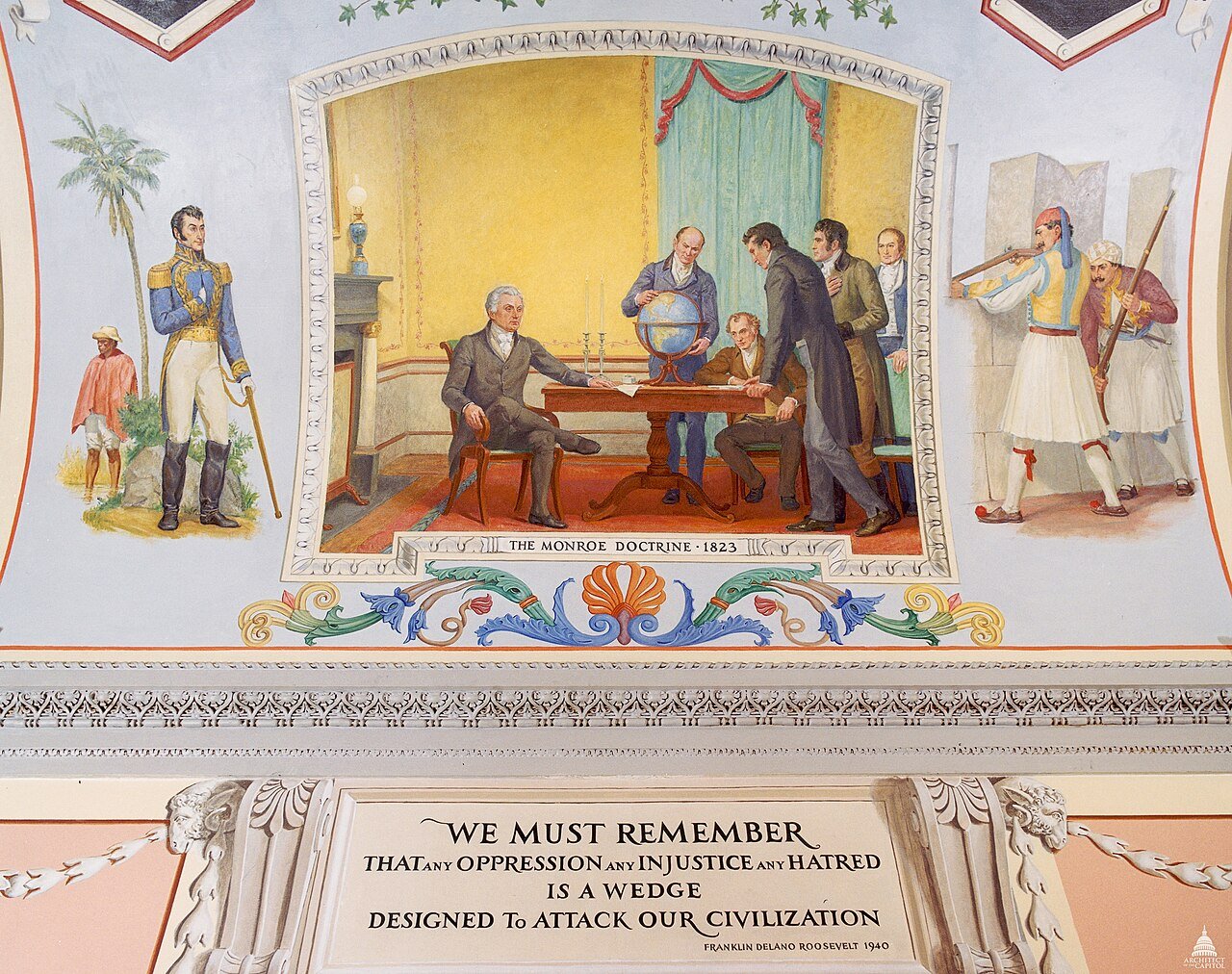

Over the past few months, the Trump administration has ratcheted up its pressure on Cuba. Secretary of State Marco Rubio described the island nation as “one of the leading sponsors of terrorism”; the Department of Justice indicted its de facto leader, Raúl Castro; and President Trump joked that the U.S. military will be “taking over almost immediately.” This escalation comes on the heels of congressionally unauthorized hostilities in Ecuador and Venezuela, as well as an ongoing military campaign targeting civilians suspected of smuggling cocaine on the high seas. These threats and interventions have spurred public interest in the so-called Donroe Doctrine—Trump’s supposed revitalization of the Monroe Doctrine, a cornerstone of U.S. policy in the Western Hemisphere dating back to 1823.
In Trump’s view, and that of the Monroe Doctrine’s detractors on the progressive left, the long-standing policy supports U.S. dominance over Latin America and the use of military force to achieve political and economic goals. That view, however, misreads the Monroe Doctrine’s purpose and ignores its history. The historical record instead supplies strong precedents for war powers constraints, not presidential aggrandizement in matters of war.
The Monroe Doctrine has its origin in an address to Congress that President James Monroe hoped would ward off European intervention in the hemisphere. At the time, many Americans feared that Europe’s “Holy Alliance”—a monarchist coalition of Austria, Prussia, and Russia—would attempt to take over Latin American states that had only recently won their independence from Spain. The reassertion of colonial rule south of the border was a daunting prospect that Americans worried might threaten the United States. Thus, Monroe declared that the United States would consider European “interposition for the purpose of oppressing” the new Latin American states as “dangerous to our peace and safety.” Monroe’s message, in short, was one of nonintervention.
Those who seek to aggrandize presidential power or to critique the Monroe Doctrine often note that the message does not foreclose U.S. intervention, as opposed to European intervention, in Latin America. But this glosses over the message’s disavowal of U.S. adventurism and its recognition of Latin American independence based “on just principles.” It also overlooks the well-established position of Monroe’s secretary of state and the architect of the Monroe Doctrine, John Quincy Adams. Two years earlier, Adams had famously proclaimed that the United States “goes not abroad in search of monsters to destroy.” He lauded the U.S. policy of nonintervention, crediting it with keeping the nation out of wars that would “usurp the standard of freedom,” “insensibly change [U.S. policy] from liberty to force,” and transform America into “the dictatress of the world.”
Moreover, the Monroe Doctrine had no bearing on the distribution of war powers between Congress and the president. Nowhere in his message did Monroe cast doubt on Congress’s constitutional primacy in matters of war or on the founders’ concern that the president was “not safely to be trusted” with the power of war.
Accordingly, the newly independent states of Latin America welcomed Monroe’s proclamation, sought U.S. security guarantees, and had to be reminded by the Monroe administration that Congress, not simply the president, would have to authorize the provision of military assistance. Reviewing a security request from Colombia, Monroe acknowledged that “[t]he Executive has no right to [compromise] the nation in any question of war.” Secretary of State Adams then explained to Colombia’s minister that the Monroe Doctrine would be implemented by “recommending to the Legislature the adoption of measures exclusively of their resort” if the Holy Alliance launched an attack.
Throughout the 19th century, a litany of Latin American nations from Chile to Ecuador to Venezuela requested U.S. military assistance under the auspices of the Monroe Doctrine. Generally these requests were denied, with secretaries of state again explaining to their southern counterparts that “[o]ur constitution is not an imperial one, and does not allow the executive government to engage in war except upon the well-considered and deliberate decree of the Congress.” Even when President James K. Polk wanted to intervene in Mexico, to assist Hispanic elites in their “civil war” with the indigenous Maya peoples, he refrained from doing so when Congress withheld its approval.
Respecting Congress’s constitutional role did not render the Monroe Doctrine a dead letter. To the contrary, President Grover Cleveland’s collaboration with Congress resulted in one of the policy’s most significant successes: the resolution of a decades-long border dispute between Venezuela and British Guiana. In the face of repeated British encroachments onto Venezuelan territory, and growing concern that the British might “take[] possession of the territory of one of our neighboring Republics against its will,” Cleveland requested that Congress establish a U.S. commission to delimit the border and then authorize him to “resist by every means” any “willful aggression” by the British. Congress unanimously established the commission. Sensing the strength of American resolve and wary of conflict down the road, the British quickly agreed to submit the border dispute to legal arbitration—as Venezuela had long urged.
These historical precedents stand at odds with the Trump administration’s approach to Latin America and to the exercise of war powers more broadly. Administration officials have justified the campaign against gangs and cartels in the region, as well as hostilities elsewhere, as an exercise of the president’s inherent power to undertake “collective self-defense” of “friendly foreign nations.” But as Monroe acknowledged, and an independent Latin America came to understand, the president has no such power under the Constitution. While the president is constitutionally empowered to “repel sudden attacks” against the United States, he must go to Congress for authority to defend foreign nations.
The Trump administration has also justified its threats and interventions as a response to the brutality of Cuba’s Castro and Venezuela’s Nicolás Maduro. In the administration’s legal memorandum for Trump’s bombing of Venezuela and military capture of Maduro, Office of Legal Counsel attorneys wrote that “force may be necessary to protect civilians both in Venezuela and abroad.” They cited Venezuela’s poverty rates, food insecurity, and labor abuses, as well as crackdowns on political dissent, as part of the legal justification for invading the country.
Humanitarian crises, however, provide no basis for bypassing Congress. Polk’s proposed campaign against the Maya peoples would have, in his words, intervened in “a war of extermination against the white race.” In seeking congressional authorization, Polk cast the Hispanic elites’ situation as “a case of human suffering and misery which can not fail to excite the sympathies of all civilized nations.” But Polk’s view was not that of Congress, and Trump’s may not be either. Only Congress, through democratic debate and with public accountability, can determine whether and when a humanitarian crisis warrants U.S. military intervention.
To be sure, presidents did at times deploy the military and use force in Latin America without prior congressional authorization after the announcement of the Monroe Doctrine. But these early exercises almost always involved the protection of U.S. citizens abroad or the suppression of piracy—actions that fell within inherent presidential power. In 1885, for instance, the United States landed a force in present-day Panama after a rebellion had led to the destruction of the U.S. consulate there, as well as the capture of a U.S. diplomat and other citizens. The Navy secretary instructed that the force’s “sole duty” was protecting U.S. lives, property, and treaty rights and that the U.S. military had “no part to perform in the political or social disorders” of the country.
On rare occasions, presidents of this early era overstepped their power. These exceptions, however, prompted congressional rebuke and reaffirmed that the Monroe Doctrine was not a grant of presidential war-making authority. For example, while negotiating a treaty of annexation with the Republic of Texas, President John Tyler promised the fledgling nation military protection and deployed U.S. forces to that end. Once the Senate caught wind of Tyler’s unauthorized collective self-defense, it passed a resolution demanding that the White House turn over “all communications” on the subject. Senators then voted down Tyler’s treaty of annexation, with one lawmaker explaining that the pledge to engage in unilateral military action was the “greatest of all objections” to its ratification. Some years later, Polk deployed U.S. forces to territory contested by the United States and Mexico, provoked an attack, and then proclaimed that Mexican forces had “invaded our territory and shed the blood of our fellow-citizens on our own soil.” Through this gambit, he secured Congress’s declaration of the Mexican-American War. When Congress eventually uncovered Polk’s deception, none other than Abraham Lincoln led the charge to censure him for “unnecessarily and unconstitutionally” launching the war.
Not until the 20th century did presidents attempt to transform the Monroe Doctrine into a license to undertake unwelcome and unauthorized interventions across the hemisphere. In 1904, President Theodore Roosevelt proclaimed to Congress that he would wield an “international police power” to address “wrongdoing or impotence” in the region. But this proposed interventionism, which became known as the “Roosevelt Corollary” to the Monroe Doctrine, faced opposition in Congress and in Latin America, prompting Roosevelt to recant in 1905 and again in 1906. In his subsequent addresses to Congress, he suggested that there had been a “misunderstanding” of his approach and reaffirmed that the Monroe Doctrine was no “excuse for aggrandizement on our part at the expense of the republics to the south.”
Subsequent presidents, however, moved forward with Roosevelt’s initial inversion of the doctrine. During the Cold War, the policy was reframed as vigorous opposition to the “establishment in this hemisphere of any government dominated by the foreign rule of communism.” President Dwight Eisenhower and his successors combined this new “Monroe Doctrine” with new theories of presidential war powers to launch undebated and unauthorized coups, proxy wars, and full-scale invasions across Latin America. Although these presidents cited the Monroe Doctrine, their subversion of Latin American self-determination and U.S. constitutional principles had little to do with the policy as originally conceived.
U.S. leaders should draw on the actual words and wisdom of the Monroe Doctrine, as announced in 1823 and practiced by presidents and lawmakers for roughly a century. As then-Secretary of State (and future Supreme Court Chief Justice) Charles Evans Hughes wrote in 1924, that means “respect[ing] the territorial integrity of the Latin-American Republics” and rejecting any “policy of aggression” in the Western Hemisphere. It means respecting constitutional limits and seeking congressional approval for hostilities that go beyond repelling a sudden attack against the United States or U.S. citizens abroad.
Trump’s contrary approach has led to half a dozen War Powers Resolution votes; dissent among military lawyers; the unprecedented departure of a top military commander; regional condemnation of U.S. military operations; and allies’ withdrawal from long-standing intelligence-sharing and military cooperation arrangements. Far from reviving Monroe’s “Era of Good Feelings,” Trump’s uses of military force have strained relations with Congress and U.S. allies alike—the very outcomes the Monroe Doctrine’s framers, and a century of practice under it, were designed to avoid.
_transits_the_caribbean_sea_(36534339183).jpg?sfvrsn=ac022da4_5)