The Legal Framework for Accession


What began as one of President Trump’s most ridiculed foreign policy ambitions during his first term—a “large real estate deal” to acquire Greenland—has resurfaced during his second term as a genuine possibility. As the Trump administration floats the prospect of acquiring Greenland, a straightforward question lurks beneath the geopolitical drama: Could the U.S. actually do it, and if so, how? The Constitution says nothing about how a country, an island, or a territory becomes part of the United States. Yet it has happened dozens of times—through purchase, conquest, referendum, and negotiation—and the legal machinery for doing it again is still very much in place.
Forms of Association With the U.S.
There is no single legal pathway into the United States—and there never has been. Remember, the Constitution is silent on the topic of accession. In Vermilya-Brown Co. v. Connell, the Supreme Court stated that “determination of [American] sovereignty over an area is for the legislative and executive departments.” But the Court has never prescribed a particular procedure for accession. Nor has it described permissible forms of sovereignty over a jurisdiction. As a result, jurisdictions have joined the U.S. in a range of manners and to differing degrees. Under international law, self-determining entities can choose between integration, free association, or independence. Historically in the U.S., the federal government has generally recognized three categories of special relations with the nation: (a) territorial status, (b) free association, and (c) statehood.
Territories
Definition of a Territory
The Supreme Court has held that the term “territory” has different meanings in different contexts, and the federal government has given this designation to 13 unincorporated insular areas.
One statutory definition of the term is “a portion of the country not included within the limits of any state, and not yet admitted as a state into the Union, but organized under the laws of Congress with a separate legislature, under a territorial governor and other officers appointed by the President and Senate of the United States.”
The Department of the Interior operates under a more detailed definition. The agency separates “commonwealths” from “territories” and then further separates “territories” into “incorporated” and “organized” territories. The agency defines a “commonwealth” as “[a]n organized United States insular area, which has established with the Federal Government, a more highly developed relationship, usually embodied in a written mutual agreement.” Insular areas are jurisdictions that are “neither a part of one of the several States nor a Federal district.”
The agency defines “territories” as either unincorporated or incorporated. A “territory” is “[a]n unincorporated United States insular area,” that is, an “area in which the United States Congress has determined that only selected parts of the United States Constitution apply.” A “Terrority” (capital T) is an “incorporated United States insular area” in which “the United States Congress has applied the full corpus of the United States Constitution as it applies in the several States.” Incorporation is interpreted as “perpetual” and, once incorporated, “the Territory can no longer be de-incorporated.”
The differentiation between incorporation status came from the Insular Cases—a series of early 20th-century U.S. Supreme Court rulings establishing that constitutional rights do not automatically extend to inhabitants of “unincorporated” U.S. territories such as Puerto Rico, Guam, and the Philippines, and that only “fundamental” constitutional guarantees apply. Although the Supreme Court has not defined which parts of the Constitution are fundamental, it has identified certain rights as fundamental on a case-by-case basis. The cases have been widely denounced—including by Justices Neil Gorsuch and Sonia Sotomayor for being based in “racial stereotypes” and “odious and wrong” beliefs—though never overturned. The Insular Cases referred to the inhabitants of territories as “alien races” and “savage tribes.”
In addition to incorporation, the Department of the Interior also differentiates between organized and unorganized territories. An “organized territory” is a “United States insular area for which the United States Congress has enacted an organic act”—that is, a “body of laws that the United Congress has enacted for the government of a United States insular area” usually including “a bill of rights and the establishment and conditions of the insular area’s tripartite government.” An “unorganized territory” does not have an organic act. American Samoa, for example, is an unorganized territory that lacks an organic act from Congress and instead operates under a constitution that was approved by the U.S. secretary of the Interior.
In all, under the Department of the Interior’s operating definitions, all commonwealths are territories, but not all territories are commonwealths. And territories are organized with different decrees of proximity to U.S. constitutional and statutory law.
The United States’ Current Territories
Approximately 4 million people live in U.S. territories today, a population equivalent to that of Maine, New Hampshire, and Rhode Island combined. The vast majority of this population—more than 3 million people—lives in Puerto Rico.
The U.S. currently has 14 territories. There is only one incorporated territory in which the entirety of the U.S. Constitution governs: the Palmyra Atoll. The remaining 13 territories are unincorporated, meaning that only parts of the U.S. Constitution govern them.
Of the 13 unincorporated territories, four are organized. These territories are Guam, the U.S. Virgin Islands, Puerto Rico, and the Northern Mariana Islands. Individuals born in these four territories are American citizens. Individuals born in the territory of American Samoa—which is not an “organized territory” under U.S. law—are U.S. nationals and can permanently reside in any U.S. state or territory, but they must apply for citizenship in order to become an American citizen. The remaining territories are largely uninhabited and consist of Navassa Island, Baker Island, Howland Island, Jarvis Island, Johnston Atoll, Kingman Reef, Midway Atoll, and Wake Atoll. Many of these islands function as wildlife refuges or limited-use military and scientific sites, with no permanent civilian population
How Territories Become Territories
The history of territories is complex and interwoven with the history of slavery and colonialism.
British law created and governed colonies as “territorial” entities. At the Continental Congress, delegates fought about whether the United States could likewise possess its own legal territory, or whether all land must instead belong to one of the individually component states. The Constitution established the permissibility of territories, holding in Article IV, Section 3, Clause 2 (the Territories Clause) that “Congress shall have Power to dispose of and make all needful Rules and Regulations respecting the Territory or other Property belonging to the United States[.]” However, the Constitution did not specify how a territory could become a territory.
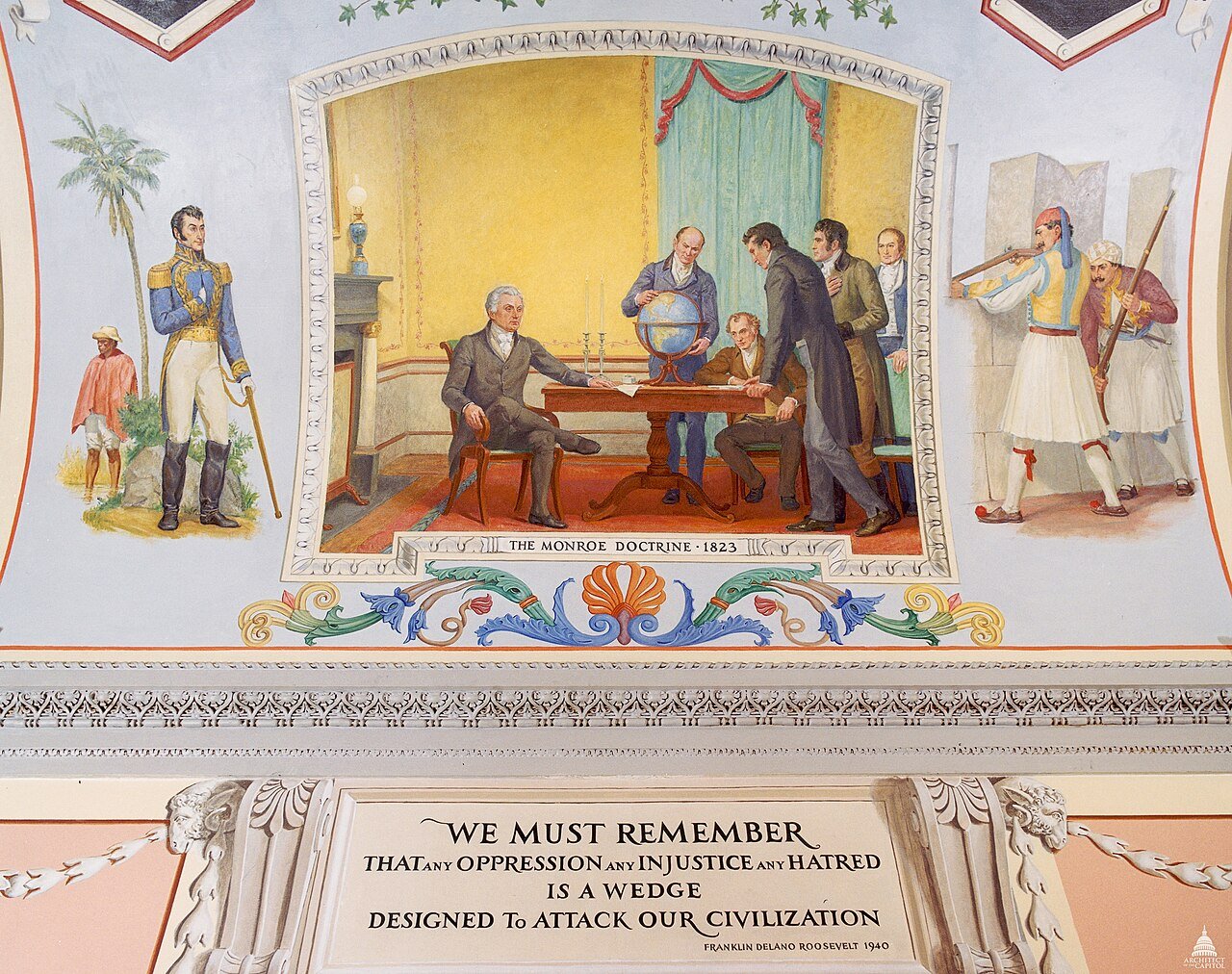
The country’s first acquisition of territory was through purchase. In 1803, while considering what would become the Louisiana Purchase, President Jefferson believed that, due to the Constitution’s silence on territorial acquisition, a constitutional amendment might be necessary to enlarge the Union. Jefferson, a strict interpreter of the Constitution, proposed a Louisiana-specific amendment. But when Napoleon Bonaparte threatened to take back the offer, or so the story goes, Jefferson acquiesced to a treaty. His administration negotiated a treaty for purchase with France, and the Senate consented to the ratification of the treaty.
The importance of the legislative power in territorial accession was affirmed years later by the Supreme Court in Fleming et al. v. Page:
The United States, it is true, may extend its boundaries by conquest or treaty, and may demand the cession of territory as the condition of peace, in order to indemnify its citizens for the injuries they have suffered, or to reimburse the government for the expenses of the war. But this can be done only by the treaty-making power or the legislative authority, and is not a part of the power conferred upon the President by the declaration of war. His duty and his power are purely military. As commander-in-chief, he is authorized to direct the movements of the naval and military forces placed by law at his command, and to employ them in the manner he may deem most effectual to harass and conquer and subdue the enemy. He may invade the hostile country, and subject it to the sovereignty and authority of the United States. But his conquests do not enlarge the boundaries of this Union, nor extend the operation of our institutions and laws beyond the limits before assigned to them by the legislative power.
In other words, the U.S. can gain territory through war, but only Congress or a treaty can officially add the territory to the United States. Presidents can conquer land militarily, but they cannot permanently expand U.S. borders or extend U.S. law on their own.
In the years that followed the Louisiana Purchase, the U.S. acquired new territories through a range of other means. For example, the U.S. acquired California through occupation. The U.S. seized it during the Mexican-American War. The U.S. acquired Alaska through cession. Russia sold it to the U.S. and transferred it through treaty in 1867. The U.S. also acquired the Panama Canal Zone through leasing. Panama granted the U.S. control of the Canal Zone under the 1903 Hay-Bunau Varilla Treaty.
In 1986, the Northern Mariana Islands became the most recent U.S. territorial acquisition. The islands were part of the United Nations Trust. Northern Mariana Island voters approved joining the U.S. in a referendum in 1975, and the Ford administration and the islands then negotiated a covenant to enter into a political union. Congress approved the covenant in 1976. Pursuant to the terms of the covenant, President Reagan then issued a proclamation terminating the trust and establishing the islands as part of the U.S. in 1986.
Free Associations
The second category of association with the United States is free association.A Compact of Free Association (COFA) is an agreement between an independent sovereign and the United States. A COFA allows an entity to retain international sovereignty and prescribes an exchange of some nature—often economic aid in exchange for military access. The United States has COFAs today with three sovereign, self-governing nations—the Republic of the Marshall Islands, Federated States of Micronesia, and Republic of Palau.
Definition of Compacts
Compacts are more formal than a normal bilateral agreement. The Constitution differentiates “Compact[s]” from “Agreement[s]” in the Compact Clause by listing them as separate terms. The Supreme Court has held that, while the terms are similar, compacts are often more “formal and serious engagements” than agreements.
COFAs are more legally binding on the U.S. than normal bilateral agreements. Bilateral agreements are generally negotiated by the president under Article II of the Constitution, subject to the advice and consent of two-thirds of the Senate, and then executed by the president. Importantly, the president can elect whether or not to execute the final agreement. Once executed, the treaty becomes binding on the U.S. as a matter of international law but can require accompanying domestic legislation to become binding as a matter of U.S. law (such that the agreement could be judicially enforceable in U.S. courts).
By contrast, the authority to engage in compacts stems from both the president’s Article II power and Congress’s Article I and IV powers. The executive branch negotiated the COFAs, which were then approved by voters in the foreign nations and by the U.S. Congress with the last one being ratified in 1993. But the compacts became effective and enacted into federal law upon congressional approval—rather than the executive execution of typical bilateral agreements. Further, unlike most bilateral agreements, the compacts can be terminated only by mutual agreement and an act of Congress rather than through unilateral executive action.
History of Compacts
The Marshall Islands, the Federated States of Micronesia, and Palau were districts of the former U.S.-administered United Nations Trust Territory of the Pacific Islands. The UN Security Council established the trust after World War II. In the 1970s, negotiations about the future political status of the islands began in earnest under President Nixon and Henry Kissinger. The Reagan administration continued these negotiations in the 1980s, following a decision to terminate the trusteeship. In the resulting negotiations, the Marshall Islands, the Federated States of Micronesia, and Palau rejected the option of U.S. territorial status. Instead, the islands opted for compacts.
In 1982, the U.S. and the Federated States of Micronesia reached an agreement on a 15-year compact. In 1983, the U.S. reached a similar agreement with the Marshall Islands. The compact was approved by voters in both countries and by Congress, and was enacted into law in 1986. Palau, in turn, opted for a 50-year compact. The U.S.-Palau compact was approved by Congress in 1986 and 1989 and ratified in Palau in 1993. President Reagan issued Executive Order 12569 to support the implementation of the compacts. The compacts were extended in the early 2000s. In 2024, Congress passed the Compact of Free Association Amendments Act of 2024, which extends the agreements for another 20 years.
Under the compacts, each of the new freely associated states (FAS) became self-governing and responsible for their own foreign affairs. All FAS became members of the United Nations, and the FAS’s relationship with the U.S. became a subject of international affairs. As a result, the U.S. secretary of state became responsible for U.S. relations with FAS, rather than the U.S. Department of the Interior.
However, despite their self-governance, the United States and the FAS remain close under the compacts. The governments and citizens of the FAS receive direct services of U.S. federal domestic programs—including programs of the departments of Health and Human Services, Education, and Commerce. The compacts also allow FAS citizens to serve in the U.S. armed forces and to live, work, and study in the U.S. as lawful nonimmigrants. The U.S. is obligated to defend the FAS against attack or threat of attack. In return, the FAS grant the U.S. the ability to operate military bases on their soil, block FAS government policies that the U.S. deems inconsistent with its duty to defend the FAS (known as the “defense veto”), reject the strategic use of—or military access to—the FAS by third countries (the “right of strategic denial”), establish military facilities in the FAS (including nuclear testing facilities), and make other decisions that affect mutual security.
Statehood
The third category of association with the United States is statehood.
Definition of Statehood
The Supreme Court has defined states as separate political entities that “share” their sovereignty with the federal government. Practically, this means that each state has constitutionally guaranteed governing authority over its own territory, population, and affairs. The national government simultaneously exercises authority over the same people and land through a principle known as dual federalism, a system in which the federal government and state governments derive power from the Constitution in distinct spheres. In this system, the federal government exercises external sovereignty among states and handles matters of national and external concern, while states retain broad internal police powers over local affairs. States participate in federal decision-making through elected representatives and senators that wield voting representation in Congress, unlike their territorial counterparts, which lack voting representation in Congress and are instead represented, at most, by nonvoting delegates or resident commissioners.
How States Become States
The Admissions Clause (Article IV, Section 3, Clause 1 of the Constitution) outlines the process for admitting new states. The clause prescribes that “New States may be admitted by the Congress into this Union; but no new State shall be formed or erected within the Jurisdiction of any other State; nor any State be formed by the Junction of two or more States, or Parts of States, without the Consent of the Legislatures of the States concerned as well as of the Congress.” As interpreted historically, the Admissions Clause grants Congress complete discretion in admitting new states but does not dictate a specific method for doing so. Instead, historical precedents have shaped various pathways to statehood, including territorial petitions, congressional enabling acts, and negotiated annexation.
Territorial Petitions
One of the most common historical pathways for statehood is territorial petition. Territorial petitions were a standard model for westward expansion, and they are how states including Tennessee, Ohio, Indiana, and Wisconsin joined the Union.
The Northwest Ordinance, passed in 1787, a year before the Constitution was ratified, provided the first territorial petition pathway for admitting new states. Under the ordinance, divisions of the Northwest territories could petition for statehood once certain population and governance criteria were met. These criteria were set in advance by Congress. Once the territory petitioned for statehood, Congress would pass an Admissions Act—authorizing admission of the territory as a state— which the president would either approve or deny.
In recent years, the “Tennessee Plan”—named for Tennessee’s petition for statehood—has attracted renewed attention. The Tennessee Plan method generally involves the would-be state initiating the statehood process, often by sending a delegation to Washington to lobby for statehood. In 1795, the Southwest territory (which would come to include the state of Tennessee) conducted a census of free adult males, asking whether the territory should be admitted as a state. Upon approval, the governor called for a constitutional convention, which ultimately created and approved a state constitution. In 1796, Sen. Rufus King of New York reported a statehood bill, which was passed by the Senate and House with amendment, before President Washington signed the bill, bringing Tennessee into the Union. Some statehood advocates view this method as a historical avenue for jurisdictions to initiate the statehood process without congressional invitation.
Congressional Enabling Acts
Another pathway to statehood is enabling act legislation, that is, petitions for statehood initiated by members of Congress. Congressional enabling acts were common in the later 1800s and early 1900s. States that joined the Union through enabling acts include Nevada, Colorado, Washington, and New Mexico.
For example, in 1887, Sen. Charles F. Manderson of Nebraska introduced 50 S. 185, a bill to “enable the people of North Dakota, South Dakota, Montana, and Washington to form constitutions and State governments and to be admitted into the Union.” In 1889, the House and Senate passed the Enabling Act, which President Cleveland signed. Voters in the states then drafted and approved the state constitutions, and the president issued a proclamation declaring the states’ admission into the Union.
Negotiated Annexation
A third method for obtaining statehood came from negotiated annexation. This method was common with states that were independent or quasi-independent sovereigns. Examples include Vermont, Texas, and Hawaii, among others.
In the case of Texas, the Independent Republic of Texas separated from Mexico after the Texas Revolution of 1836. Eligible voters ratified the republic’s constitution and voted in favor of Texas joining the United States. Congress passed a resolution to annex Texas, which President Tyler signed. A convention of delegates then met to consider the joint resolution offered by Congress and voted to accept the offer. State delegates then drafted and signed a state constitution, and, in a popular referendum, Texas voters approved annexation. The House Committee on Territories reported a joint resolution, 29 H.J.Res. 2, “for the admission of the State of Texas to the Union.” The House approved, the Senate passed, and the president signed the resolution admitting Texas into the Union.
In the case of Hawaii, the most recent state to be admitted to the U.S., Congress annexed the then-Republic of Hawaii by joint resolution in 1898 and created the territory of Hawaii. In January 1959, Sen. James E. Murray of Montana introduced 86 S. 50, a bill to admit Hawaii as a state. The Senate and House passed the bill, and President Eisenhower signed it into law. Hawaii voters endorsed statehood in a three-part referendum, and in August 1959, the president issued Proclamation 3309, formally admitting Hawaii as the 50th state.
In the case of Vermont, the territory functioned for years as a quasi-independent sovereign known as the Vermont Republic, after declaring independence in 1777 amid border disputes with New York. Vermont adopted its own constitution and operated with an independent legislature and courts. After negotiations with New York resolved competing land claims, Vermont formally petitioned for admission to the Union. An act of Congress approved Vermont’s admission as the 14th state in 1791, the first admitted after the original 13 colonies.
Statehood and Citizenship Today
The question of territorial statehood is increasingly salient today because of consistent renewed efforts to overturn the Insular Cases and because the legal meaning of citizenship has come under heightened scrutiny. Questions surrounding citizenship, who qualifies for it, when it attaches, and what constitutional protections it entails have reemerged as central issues during the second Trump administration. Until now, the dominant understanding of the Citizenship Clause of the 14th Amendment has been that persons born “in the United States” and subject to its jurisdiction are entitled to birthright citizenship. This understanding, however, has faced increasing ridicule. The pending case of Trump v. Barbara, is one such example. This case seeks to overturn or otherwise substantially limit birthright citizenship. If the Citizenship Clause were to be narrowed or erased, the implications would extend beyond immigration policy and could reinvigorate long-standing questions about the relationship between territorial status, national membership, and the constitutional rights of individuals living under U.S. sovereignty.
In the context of Greenland, this may have an effect on support in the semi-autonomous Danish territory. Greenlanders already overwhelmingly reject the prospect of American annexation. This is due in part to Greenland’s comprehensive welfare state, which employs many universal welfare benefits such as universal health care and social security not afforded in the U.S. If birthright citizenship were stripped away, and Greenlanders were instead treated as U.S. nationals without full constitutional citizenship, similar to American Samoa, annexation would appear even less attractive. Greenlanders would undoubtedly view the prospect of the territory being incorporated into the U.S., without any guarantee of equal political membership or full constitutional protections, as taking a step backward, especially given that their Self-Government Act leaves open the possibility of their own independence from Denmark.
* * *
While more than 40 years have passed since the last major accession to the U.S. federal system, American law provides various precedents for entities seeking to integrate into the U.S. system. But the various legal pathways also show two important considerations: the importance of self-determination and the importance of congressional power over accession.
_transits_the_caribbean_sea_(36534339183).jpg?sfvrsn=ac022da4_5)