Measuring Congressional Sentiment Toward the Maduro Strike



On Jan. 3, U.S. military forces captured Venezuelan President Nicolás Maduro in a military operation involving more than 150 military aircraft and the Army’s elite Delta Force. The early-morning raid ordered by the Trump administration followed months of a military buildup in the Caribbean, approximately 35 lethal strikes leaving at least 115 dead, and extensive intelligence collection on Maduro’s whereabouts. The risky mission—followed by the Trump administration’s pronouncements that the U.S. would “run” and “coerce” Venezuela for the near future—evidently came as a surprise not only to Maduro but also to many members of Congress, who constitutionally hold the power to declare war.
What, then, are Congress’s feelings about military intervention in Venezuela? And what can the episode tell us more broadly about the current state of interbranch relations over war? Applying artificial intelligence (AI) techniques to thousands of legislator messages across a range of channels, we trace the evolution of expressed congressional sentiment regarding the use of force in Venezuela in the lead-up to, and in the immediate aftermath of, the operation. The picture that emerges is of a vocally polarized Congress—with important caveats. An overwhelming majority of Democrats have steadily opposed the use of force in high volume. GOP lawmakers who have spoken up have mostly—but not entirely—supported force. While Republicans control both houses of Congress, their overall expressed support appears less voluminous than Democrats’ opposition. Solid support for strikes against purported drug-transporting boats narrowed to more limited support for the Maduro raid, and even less support was expressed for extended ground action in South America. It appears that the higher the financial investment and risk to American soldiers, the less congressional support.
Trump has enjoyed the support of a majority of his own party but seemingly deceived its most concerned members to avoid a negative vote. The episode, then, perhaps further demonstrates the administration’s broader disregard for transparent interbranch relations. Yet it also highlights the administration’s concern with the political risks of overriding an explicit congressional prohibition of force. This suggests that congressional Republicans interested in constraining the administration in future military ventures are capable of doing so—if they take action.
The Road to Maduro’s Capture
In recent months, the congressional debate over Venezuela has focused primarily not on authorizing the use of force, but on prohibiting it. Between September—when the Caribbean and Venezuelan crisis began in earnest—and the raid, Congress held four votes (two in the Senate and two in the House) over whether to constrain Trump’s ability to wage war in these environments. All four attempts failed, further enabling the president’s unilateral approach.
Congress’s restraining maneuvers prior to Jan. 3 evidently failed in part due to administration efforts to reassure concerned lawmakers. Perhaps the most important congressional vote was S.J.Res.90, debated in the Senate in early November. The resolution would have specifically prohibited “hostilities within or against Venezuela.” In light of some Republican concerns, it was widely reported that the key to maintaining moderate Republican support against the bill was repeated, explicit assurances from the administration that an attack in Venezuela proper (as opposed to boat strikes in international waters) was not in the works. Secretary of State Marco Rubio and Secretary of Defense Pete Hegseth reportedly “reassure[d] lawmakers that the strikes were not a prelude to more direct attacks aimed at regime change in Venezuela.” The Washington Post reported at the time:
Ahead of the vote, the administration made a concerted push to reassure potential GOP defectors, walking back Trump’s repeated threats of escalation and sharing with them more details about its aggressive activities to disrupt the Latin American drug trade. Crucially, it appears, Secretary of State Marco Rubio and Defense Secretary Pete Hegseth … provided a classified briefing for select members of Congress where they indicated that the administration is not currently preparing to target Venezuela directly and didn’t have a proper legal argument for doing so.
President Trump’s chief of staff also said in early November that military “activity on land” would at a certain point require congressional authorization. From a pragmatic political perspective, administration insiders reportedly thought that “Trump was reluctant to approve operations that may place American troops at risk or could turn into an embarrassing failure.”
The January strike seemingly contradicts the administration’s assurances from two months prior. Hence, several lawmakers now allege that the administration actively lied to Congress. In a briefing to the Gang of Eight congressional leaders after the operation commenced, the administration argued that the president’s Article II powers legitimized the operation and that its sensitive nature obviated their ability to communicate details about the use of force. While previously seeming to suggest it lacked authority to operate military forces in Venezuela, between November and January the administration apparently shifted to a different legal rationale. It has since claimed that the operation was a law enforcement mission, relying in part on a 1989 Office of Legal Counsel opinion by William Barr that was previously utilized in the U.S. intervention in Panama that same year.
Evolving Congressional Opinion
Votes and legal theories tell only part of the story. To more broadly catalog the universe of expressed congressional sentiment toward striking Venezuela, we turn to large-scale data and computational techniques. Using real-time data on the universe of legislator messaging (press releases, Facebook posts, tweets, committee hearing statements, and floor speeches) and AI classification models, we demonstrate how expressed congressional opinion about a direct American strike on Venezuela evolved over the period between early September and early January. To maximize accuracy, each congressional communication was classified by three different large language models, or LLMs (OpenAI’s GPT-4o, Anthropic’s Claude 4 Sonnet, and Google’s Gemini Flash 2.5); we used the majority assessment. To our knowledge, this is the richest existing empirical account of expressed congressional opinion on the escalating crisis with Venezuela.
Figure 1 presents legislator position-taking toward directly striking Venezuela, by day, since Sept. 9, 2025. Each dot represents a specific legislator’s aggregate expressed sentiment over the prior seven-day period, with blue dots representing Democrats and red dots representing Republicans. We average the expressed stance of legislators who issued more than one statement in a given week—that is why some dots appear between outright positions. We include three smoothed lines that depict average expressed sentiment among Republicans (red), Democrats (blue), and Congress overall (black). We also include vote shares toward several war powers resolutions receiving floor votes over the past four months. Taken together, our empirics provide a “snapshot” of congressional sentiment regarding the use of military force in the crisis.
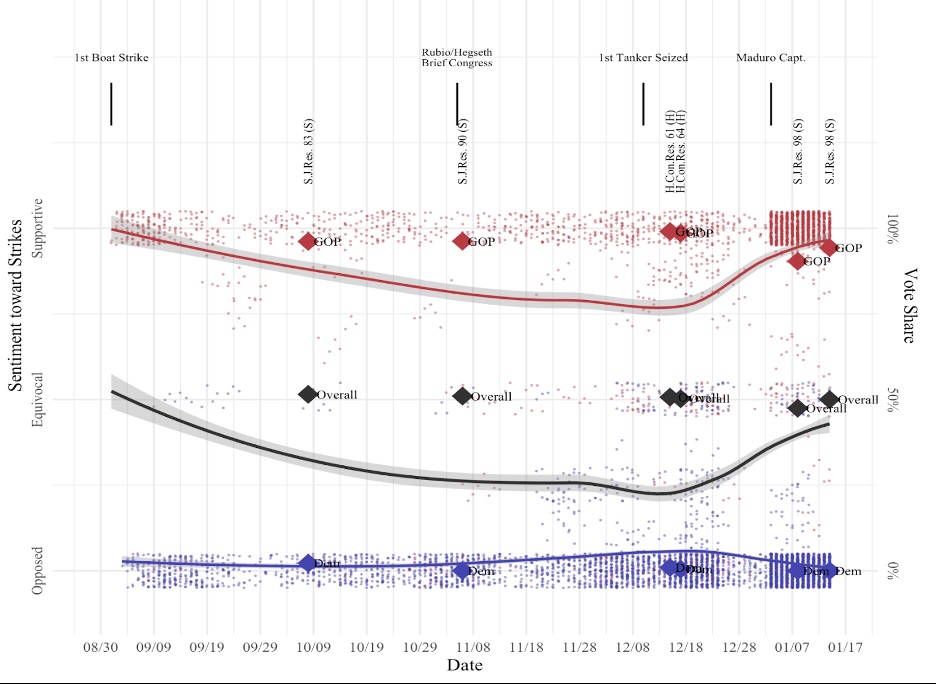
Figure 1. Lawmaker sentiment toward attacking Venezuela (fall 2025). Note: Dots represent individual legislator positions averaged over a 7 day period. Trend lines show average sentiment by party, and for Congress overall, over time. Diamonds indicate vote share of key votes.
As Figure 1 illustrates, Republican members of Congress have largely (but not universally) stood by the president, while Democrats have mounted a vociferous and united opposition. Importantly, Republicans control both houses of Congress, and the Republican leadership in both houses has virtually uniformly supported Trump’s approach to Venezuela over the past several months. In the run-up to Maduro’s capture, however, what lawmakers said and how they voted at times diverged.
Republican legislators overwhelmingly supported the president in prior votes in the lead-up to the strike, but their sentiment indicated more reluctance, at least among several members, in two respects. First, as reflected by the reduced frequency of red points in Figure 1, Republican legislators were not as actively engaged in messaging about Venezuela as Democrats. It was not until late November that an increasing share of Republicans vocalized their sentiments. Even then, Democrats far outpaced them. Figure 2, which shows the weekly counts of messaging by party over time, shows these differences in overall volume more directly.
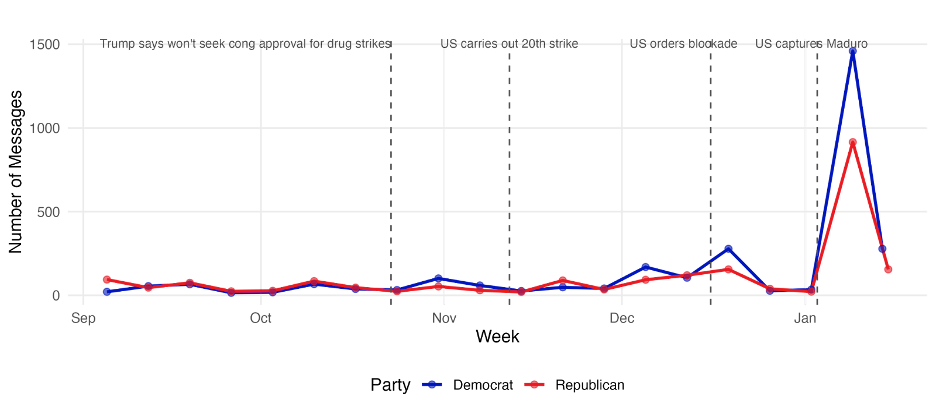
Figure 2. Congressional messaging volume on using force in Venezuela, by party. Note: Dots indicate weekly counts of tweets, press releases, and speeches over time.
Second, while Republican speech aligns with the president’s agenda (especially after Maduro’s capture), it was somewhat more equivocal in aggregate in the lead-up to the land strikes. This level of hesitation, though driven by a minority of the caucus, stands in contrast to their near-universal positive sentiment for the recent Iran strikes.
Active opposition from Republicans has emerged from usual suspects, such as Sen. Rand Paul (R-Ky.), Sen. Lisa Murkowski (R-Alaska), and Rep. Thomas Massie (R-Ky.), as well as others not seeking reelection, including Rep. Marjorie Taylor Greene (R-Ga.) and Rep. Don Bacon (R-Neb.). Sen. Susan Collins’ (R-Maine), for her part, expressed frustration that the administration did not consult Congress ahead of time. On Jan. 8, five Senate Republicans—Sens. Todd Young (R-Ind.), Murkowski, Josh Hawley (R-Mo.), Collins, and Paul—joined all Senate Democrats to advance the motion to discharge S.J. Res. 98, which seeks to remove unauthorized U.S. forces from hostilities with Venezuela. Table 1 lists key examples of Republican dissent and equivocation prior to and after Operation Absolute Resolve (OAR).
Table 1. Examples of Limited Republican Opposition and Hesitancy Toward Military Action in Venezuela
| Pre-OAR (Jan. 3) | Post-OAR (Jan. 3) |
| “There are very serious concerns in Congress about the attacks on the so-called drug boats down in the Caribbean and the Pacific, and the legal justification has been provided. But this is completely outside of anything that has been discussed with Congress, and there is an ongoing investigation.” —Rep. Mike Turner (R-Ohio), Face the Nation, Nov. 30, 2025 “If this was happening, with this level of insight, under the Biden administration, I’d be apoplectic .… We’re not his [Trump’s] opponent on this [Caribbean strikes], we are an ally in this to be able to solve it, but we need to be able to have a voice on it as a coequal branch.” —Sen. James Lankford (R-Okla.), C-SPAN, Oct. 24, 2025 “As the phrase goes, the definition of insanity is doing the same thing over and over, expecting a different result. That is very much like Washington and its perpetual compulsion toward regime change across the globe: Iraq. Libya. Syria. Now Venezuela. The result is always chaos, cartels, terrorism, and endless war.” —Sen. Rand Paul (Ky.), X, Nov. 6, 2025. “People voted in 2024 against foreign intervention and foreign regime change as we have seen far too many times how that’s turned out, it’s not good, and people are so sick of it.” —Rep. Marjorie Taylor Green (Ga.-14), X, Dec. 22, 2025 | “Wake up MAGA. VENEZUELA is not about drugs; it’s about OIL and REGIME CHANGE. This is not what we voted for.” —Rep. Thomas Massie (R-Ky.), X, Jan. 4, 2026 “Late last year, I voted to proceed to debate on two resolutions that would have terminated the escalation of U.S. military operations against Venezuela absent explicit authorization from Congress. I took these votes because I believed the administration failed to provide Congress with the information necessary to fully evaluate the legal basis for these escalating actions. That was true then, and it remains true today.” —Sen. Lisa Murkowski (R-Alaska), X, Jan. 3, 2026 “I think what the president was trying to communicate [about Venezuela] is hopefully facilitating a peaceful transition of power …. I don’t know how you do that without boots on the ground. And I don’t support boots on the ground.” —Sen. Thom Tillis (R-N.C.), Press Comment, Jan. 6, 2026 “A drawn-out campaign in Venezuela involving the American military, even if unintended, would be the opposite of President [Donald] Trump’s goal of ending foreign entanglements.” —Sen. Todd Young (R-Ind.), Statement, Jan. 8, 2026 |
As political science research would anticipate, congressional polarization toward the Venezuela strike is reflected in public opinion. According to December polling from Quinnipiac, a majority of Republican voters supported both the attacks against boats in the Caribbean (83 percent) and military action inside Venezuela (52 percent), in contrast to single-digit levels of support from registered Democrats. Polling from Economist/YouGov in late December indicated that only 22 percent of U.S. respondents—and 44 percent of Republicans—supported overthrowing Maduro with military force. In the immediate aftermath of Maduro’s capture, the Washington Post found that 74 percent of Republicans supported the military operation, in contrast to only 29 percent of Democrats. The Economist/YouGov’s Jan. 2-5 poll similarly found majority Republican support for military action and even noted an 18 percent decrease in the percentage of Republicans who believed Trump required congressional authorization for such a mission.
In recent weeks, the administration has sought to use Maduro’s capture as a warning to others: In the words of Secretary of State Rubio, “If you don’t know, now you know.” The White House has issued implicit (or not-so-implicit) threats to Colombia, Mexico, Cuba, and others. Rubio stated, “If I lived in Havana and I was in the government, I’d be concerned.” Greenland, additionally, appears to be of interest to the administration.
Implications for Interbranch Relations
What, then, can we glean from this episode about the Trump administration’s approach to interbranch relations on the road to force? In late September, the White House reviewed a draft bill from a sympathetic legislator that would broadly delegate authority to the president to use force against “narco-terrorists” and associated nations. The administration, however—like many of its predecessors—never sought the proposed affirmative authorization from Congress. It instead confined itself to fending off attempts to prohibit the use of force, an effort that seemingly included misleading legislators about its intentions in Venezuela.
But perhaps counterintuitively, the administration’s efforts to deceive legislators in order to prevent an earlier vote prohibiting military action suggests it cares about formally expressed congressional opinion. Overriding an explicit congressional prohibition of the use of force would seem to be a bridge too far, even for this administration. Doing so might entail serious domestic political costs for the president, as well as for the Republican Party more broadly. Trump, after all, has a strong interest in maintaining GOP control of Congress. The voice of Congress on matters of war may still shape administration decision-making regarding military interventions.
The Senate’s recent War Powers Resolution-related efforts further illustrate the administration’s sensitivity. Trump was reportedly infuriated by the Republican dissent, and launched a pressure campaign that ultimately led Sens. Young and Hawley to reverse course on Jan 14, blocking S.J. Res 98 with help from a tie-breaking vote from Vice President J.D. Vance. The intensity of administration efforts to flip the senate vote is especially revealing considering Trump would have been able to veto it should it pass, preventing it from becoming law. This highlights the administration’s concerns with political risks should Congress go “on the record” against unilateral intervention in Venezuela, even absent a legally binding measure.
Moreover, the absence of American casualties in Venezuela should not be overlooked: Consistent with Trump’s previous dramatic uses of force (the 2017 and 2018 strikes in Syria, the 2020 strike killing Qassem Soleimani, and the 2025 Iran strikes), the operation came at the cost of no American lives—a point the administration has emphasized repeatedly. It remains to be seen whether the president would be willing to sustain American soldiers on the ground in Venezuela over an extended period of time without clear congressional support.
Overall, the Maduro capture suggests that the Trump administration is (perhaps remarkably) sensitive to Republican opposition towards military intervention overseas. This provides congressional Republicans with meaningful leverage. But what is not clear is whether meaningful numbers of Republicans would be willing to use it, defying the president on the road to war.
_transits_the_caribbean_sea_(36534339183).jpg?sfvrsn=ac022da4_5)