The Serious but Not Literal Blockade

“Effective immediately, the United States Navy, the Finest in the World, will begin the process of BLOCKADING any and all Ships trying to enter, or leave, the Strait of Hormuz.” So wrote President Trump in a Truth Social post on Sunday, April 12, that was then also posted to the White House’s official X account. Despite floating the idea earlier that the U.S. would enter into a joint venture with Iran to charge tolls, Trump, in the same post, “instructed our Navy to seek and interdict every vessel in International Waters that has paid a toll to Iran.” He continued, “No one who pays an illegal toll will have safe passage on the high seas.” Trump had previously stated that he was thinking of charging tolls on ships for safe passage through the Strait of Hormuz as a joint venture with Iran.
Later that day, U.S. Central Command (CENTCOM) announced that it would begin a blockade of “all maritime traffic entering and exiting Iranian ports on April 13 at 10 a.m. ET in accordance with the President’s proclamation.” Approximately 14 hours later, Trump posted again, stating that the blockade would apply only to ships entering or exiting Iranian ports, mirroring the CENTCOM announcement and seemingly walking back his earlier, much broader announcement. This brief article examines several of the legal issues related to the U.S. blockade of Iran. It does not analyze whether the U.S. use of force against Iran was lawful in the first instance, or, as my colleague Mark Nevitt discussed recently, if the blockade legally ends the ceasefire.
Freedom of navigation is the U.S. Navy’s founding principle. After being disbanded following the Revolutionary War, the U.S. Navy was reestablished in 1794 specifically to protect U.S. maritime commerce and freedom of navigation. Previously, it would have been unthinkable to allow any state to control access through a strategic chokepoint such as the Strait of Hormuz. Ensuring freedom of navigation through the strait is a vital national interest of the U.S., so much so, that the U.S. executes dozens of freedom of navigation operations every year to challenge excessive maritime claims. While a total blockade of all maritime traffic through the Strait of Hormuz would violate international law, a blockade of maritime traffic to and from an enemy state during an international armed conflict has a long tradition and is lawful provided certain conditions are met.
Blockades as a method of naval warfare are as old as naval warfare itself, and the law governing how they should be conducted has evolved over centuries. The purpose of a blockade is to prevent a foe from receiving supplies, as well as to prevent the export and sale of products that would sustain the enemy state’s military capabilities. Obviously, a blockade would also likely prevent the importation of food, medical supplies, and other materials essential for the civilian population’s survival. More on that later.
A blockade can be implemented and enforced by a belligerent state only against an enemy belligerent state during an armed conflict. It cannot impede neutral vessels sailing to and from neutral ports. For a blockade to be lawful, it must be announced, it must be implemented impartially, and it must be effective.
While Trump’s initial social media post on April 12, and its reposting by the White House on X, announced the intent to establish a blockade, it was overly broad, threatening to block all shipping through the strait. It now appears that, as noted by Salena Zito in 2016, Trump’s post was meant to be taken seriously but not literally. The subsequent U.S. Central Command announcement narrowed the terms and set forth requirements for a lawful blockade, stating that the freedom of navigation of neutral vessels transiting the strait to and from neutral ports would not be impeded.
There is no specific format for a blockade announcement, but it must be official and include the date the blockade will begin, the location of the blockade, and how it will be enforced. Typically, a blockading state will also publish formal notices to mariners and aircrews, if aircraft are also subject to the blockade, with more detailed information about the locations and required responses to the blockade. The initial April 12 CENTCOM announcement mentions that a formal notice would be provided. U.S. Naval Forces Central Command (NAVCENT) publicly released an advisory note on April 16 that provided this required information.
A blockade must also be impartial. That is, it will be enforced against all vessels entering or leaving blockaded ports and waters, regardless of the country where they are flagged. Any ship, whether Iranian flagged or not, is subject to the terms of the blockade. The CENTCOM announcement of April 12 highlights that the blockade will be enforced impartially. One development to monitor is whether the U.S. enforces the blockade against Chinese-flagged oil tankers and other commercial vessels, or vessels flagged in neutral states transporting oil to China. China would face the largest effect from a blockade of Iranian oil exports. Should the blockade drag on, there may be attempts to reach a deal with Trump to allow the transit of Iranian oil tankers bound for China or, possibly, even attempts to have Chinese warships escort tankers headed for its ports. While the latter would risk serious escalation, the former would render the blockade unlawful. Given Trump’s own belief in his deal-making prowess, he may use the blockade as leverage in relations with other countries in addition to China. If he was willing to work with Iran to collect safe passage tolls, the possibility of “selling” passage through the blockade to other states is likely.
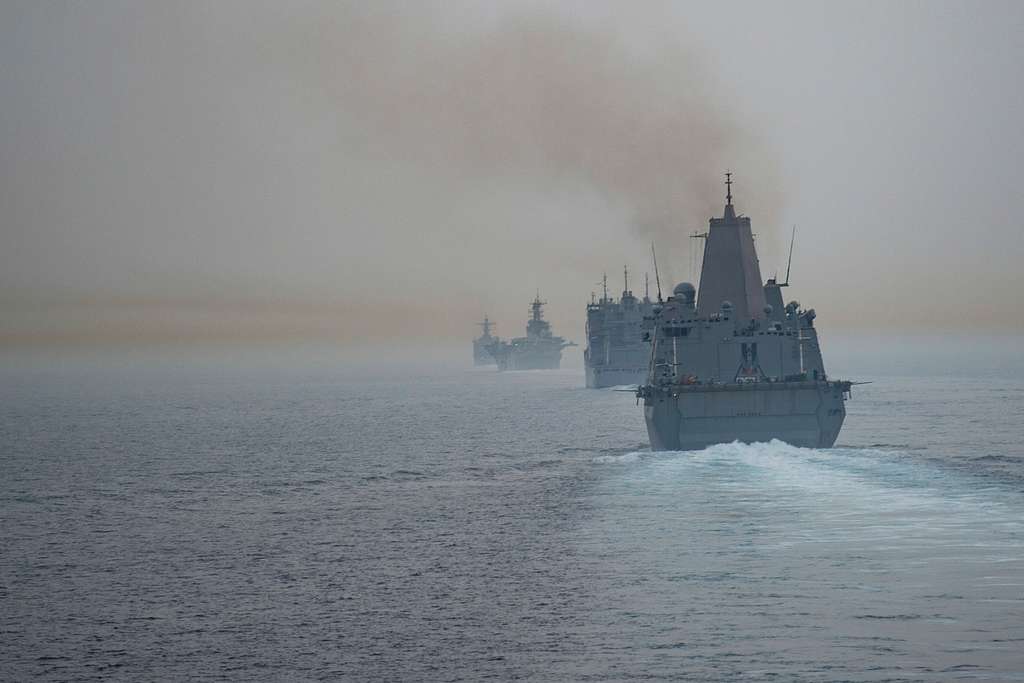
Finally, the blockade must be effective. This requirement was developed in customary law during the 18th and 19th centuries to avoid uncertainty that “paper” blockades created for neutral shipping. To be effective, the blockading state need not intercept and capture every vessel attempting to evade the blockade, but there must be a sufficient likelihood that such vessels will be detected and captured. The blockading state may use all military forces to enforce the blockade, including surface warships, submarines, military aircraft, unmanned maritime vessels, and cyber capabilities. The U.S. currently has more than 10,000 personnel on 15 warships and more than 100 manned and unmanned aircraft enforcing the blockade.
At this point, the blockade appears to be effective. In an April 14 statement, the CENTCOM commander, Adm. Brad Cooper, claimed that the blockade has been fully implemented and that the U.S. has “completely halted economic trade going into and out of Iran by sea.” As of early April 16, 13 ships had been challenged and directed to return to Iranian ports by the U.S.—all complied. Other sources report that several ships that had been in Iranian ports did make it past the blockade after its implementation. It’s also been reported that 10 ships transited the strait on April 14, presumably all having left from neutral ports in the Persian Gulf. Opening the strait to its prewar level of traffic while still maintaining the blockade will be challenging. The longer the blockade lasts, the more likely it is that some ships, particularly those in the “shadow fleet,” may attempt to run the blockade, possibly “spoofing” their Automatic Identification System transmissions to mask their true identification and location. So far, the vessels that left Iranian ports after the blockade was implemented have complied with directions to return to an Iranian port and did not attempt to run the blockade.
How would the U.S. Navy enforce the blockade against a noncompliant ship? A blockading state can intercept, divert, capture, and condemn those ships that attempt to run a blockade. Force can be used against vessels that resist capture or diversion. It appears that the U.S. will carry out enforcement actions in the Gulf of Oman and the Arabian Sea. This makes sense, as trying to operate and take action against ships inside the Strait of Hormuz would unnecessarily expose U.S. forces to possible Iranian attack. In a press conference on April 16, the chairman of the Joint Chiefs of Staff, Gen. Dan Caine, said that the U.S. blockade of Iran applied to all ships heading to and from Iran, clarifying that the blockade was not only the Strait of Hormuz. He also stated that the U.S. would pursue all Iranian-flagged ships as well as vessels attempting to provide support to Iran. This would be an exercise of the broader, belligerent right to visit and search merchant vessels, both enemy and neutral, to ensure they are not transporting contraband to Iran, but could occur only on the high seas. The U.S. NAVCENT advisory notice of April 16 published a list of items that are considered contraband.
A vessel that ignores warnings to return to port or divert from its intended destination inside the blockade area will likely be boarded by U.S. forces. U.S. Marines attached to the U.S.S. Tripoli, currently operating in the Arabian Sea, are trained to conduct such boardings and continue to train for these missions. Additionally, U.S. special operations teams are trained and available to conduct both opposed and unopposed boardings. Once U.S. forces have captured the ship, it would be searched, and a decision would be made to either return the ship and its cargo, if not contraband, to the owner or to seek condemnation of the vessel as a prize. Rooted in admiralty law, prize law requires a capturing belligerent state to seek adjudication over its claim by a domestic court authorized to make determinations as to whether the capture of the vessel and cargo was lawful. If the capture was lawful, the belligerent state may take ownership of the vessel and/or cargo. In the U.S., district courts have exclusive jurisdiction to hear prize cases.
As mentioned earlier, a blockade of any significant length will affect Iranian civilians. The U.S. NAVCENT notice stated that “humanitarian shipments including food, medical supplies, and other goods essential for survival of the civilian populations will be permitted, subject to inspection.” Allowing humanitarian shipments may seem obvious. However, some scholars dispute whether there is a legal requirement to allow the passage of humanitarian shipments while recognizing that a blockading state may allow it. Similarly, the Department of Defense’s Law of War Manual takes the position that a blockading state should allow neutral vessels and aircraft to deliver humanitarian supplies, subject to inspection.
Another point of disagreement when it comes to the lawfulness of a blockade is whether it must comply with the principle of proportionality under the law of armed conflict. The principle of proportionality prohibits attacks where the expected incidental harm to the civilian population is excessive in relation to the expected military advantage to be gained. Both the Department of Defense’s Law of War Manual and the San Remo Manual on International Law Applicable to Armed Conflicts at Sea take the position that the principle of proportionality does apply to blockades and that the expected incidental harm to the civilian population may not be excessive in relation to the expected military advantage from the blockade. The authors of the Newport Manual on the Law of Naval Warfare take the opposite view, reasoning both that a blockade does not qualify as an attack and that no history exists of states applying the proportionality principle to blockades. While interesting and important, this issue is beyond the scope of this article. The Newport and San Remo manuals are not definitive statements of law but, as the collective views of a group of maritime experts, are persuasive and influential. Interestingly, the Department of Defense’s Law of War Manual is not the entire U.S. government’s view but, rather, is a statement of only the Defense Department’s view of the law.
Finally, the above discussion is centered on international law. There is one domestic legal issue worth examining. Domestically, Trump and his supporters in Congress continue to claim that no congressional action is necessary to continue the conflict, presumably including the blockade. While the Justice Department’s Office of Legal Counsel has yet to release an opinion on the use of force in this conflict, past opinions have concluded that uses of force that are limited in nature, scope, and duration, and that further an important national interest, do not require congressional authorization. Meanwhile, today’s open-ended blockade involves more than 10,000 personnel, dozens of aircraft, and as many as 16 warships, in a conflict that has already seen 13 U.S. military members killed and dozens of others wounded. Not to mention, an operation in Iran that involved more than a hundred special operators, and where four U.S. military aircraft were destroyed, falls far outside of a limited conflict that is not a “war in the constitutional sense.”
As is common, Trump’s over-the-top social media posts, which often foreshadow that he is about to take some unlawful action, were reined in prior to execution. It’s too soon to tell, though, whether the application of the current blockade will remain within the bounds of the law of naval warfare.