Why Gaza’s Aid Effort Will Fail Without Cash

Like winter, the deadline was—and is once again—coming. The banking waiver that indemnifies Israeli banks to transact with their Palestinian counterparts in the Occupied West Bank was set to expire on Dec. 14, if not renewed. Following past trends for this waiver, Israel’s far-right finance minister, Bezalel Smotrich, let this decision come down to the wire, and even then only extended it for another two months. It will now be up for renewal yet again in mid-February 2026. The survival of the West Bank’s economy is contingent on this waiver. As are Palestinian lives.
This is the point for Smotrich; in June 2024, he extended the banking waiver for four months, using it as a quid pro quo political bargaining chip, ultimately punishing Palestinians. Israel was rewarded with five illegal Israeli settlement expansions in the Occupied West Bank and sanctions on the Palestinian Authority; Palestine was rewarded with their economy not completely collapsing.
In November 2024, following a one-month extension, Israel renewed the banking waiver for one year, but only after more intense political bargaining. Among the reported trade-offs? As the U.S. administration under former President Biden pushed Israel to extend the waiver for a longer time period, fearing the Palestinian Authority’s collapse in its absence, Smotrich negotiated. He would extend the waiver only if Washington agreed to a U.S. veto on Palestinian statehood at the UN Security Council. This is what enforced financial control looks like in an apartheid system. Not outright denial, but permanent precarity, where economic survival is contingent on obedience. Further, in June 2025, Smotrich threatened to cancel the waiver in response to sanctions on him and Israel’s ultranationalist national security minister, Itamar Ben-Gvir, imposed by five western states. The threat only fueled uncertainty amid Israel’s systemic economic repression. In making these threats and continuously reducing the length of extensions, economists warn “Israel has signalled intent to hold the West Bank’s financial system in suspense, creating a cascading effect that depresses investment and business activity.” The Occupied West Bank’s economy has already faced severe impacts due to Israel’s continued financial restrictions; in 2024, the gross domestic product per capita regressed to its level in 2008, losing $2.3 billion. The consequences of further decline are almost unfathomable.
This is the financial reality in the Occupied West Bank, where economic and governance functions are determinant on the banking waiver, and thus forced into a state of consistent precarity. In Gaza, even money has been decimated.
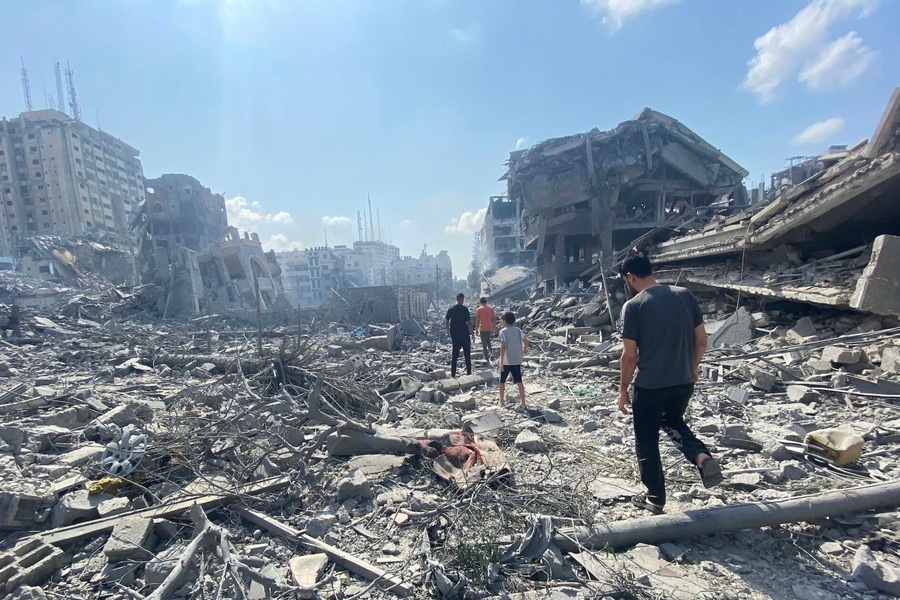
What little currency remains is worn, brittle, and fading from over-circulation. When bills do exchange hands, they come at a cost: up to 40 or 50 percent surcharge, if civilians can find an informal, equally desperate broker willing to part with the cash. The vast majority of banks—98 percent—and nearly all ATMs are destroyed. Digital wallets such as PayPal and JawwalPay have nearly vanished with the destruction of digital infrastructure and electricity grids. In this economy of absence, cash itself is a commodity. And those who need it most—to survive, to feed their children, to rebuild—cannot access it.
There is no denying that Gaza’s humanitarian sector has imploded. But the conversation remains trapped in the visible: border crossings, fuel supplies, and aid trucks. Although pivotal, these conversations miss one of the roots of the crisis. In Gaza, people cannot access what they need because most physical financial infrastructure has been demolished by Israel’s relentless military assault, while Palestine’s greater financial system remains under Israeli control, with severe restrictions that make choice, dignity, and economic life near impossible.
Gaza faces not only a liquidity collapse but a political one. The U.S.-sponsored reconstruction plan, adopted by the UN Security Council via Resolution 2803 on Nov. 17, introduces an International Stabilization Force and leaves Palestinians with little substantive role in governing the “day after.” Leading Palestinian civil society organizations have warned that the framework functions as a new form of custodial control, undermining the right to self-determination. The plan risks entrenching, rather than resolving, the structural conditions driving Gaza’s economic erasure.
Israel’s dominance over monetary levers ensures that Palestinian liquidity remains conditional on political will—and often whim. Clearance revenues, or collected taxes meant for the Palestinian Authority to pay civil servant’s salaries and function as a governing authority, are held hostage. Instead of Israel transferring these clearance revenues to the Palestinian Authority, they are diverted to a Norwegian trust account and their release is subject to Israeli permission. Furthering the financial crisis, Israeli transfer limits have resulted in an excess of shekels in Palestinian banks. Palestine does not have its own currency and has only four currencies that are legally permitted to be in circulation. It does not even have anything beyond a stand-in for a Central Bank.
Despite the current dire economic state, there is hope, momentum, and viable solutions to reverse course. The proposals set forth and endorsed by the UN General Assembly in the New York Declaration, the outcome document from the High-level International Conference for the Peaceful Settlement of the Question of Palestine and the Implementation of the Two-State, provide a way forward. The determinations for a “sovereign and economically viable State of Palestine” advance proposals to end reliance on the banking waiver by ensuring sustained and long-term correspondent banking channels and relations; revise the 1994 Paris Protocol on Economic Relations; integrate Palestine in a holistic manner within the International Monetary and Financial System; promote Palestinian trade facilitation, engagement with the private sector, and economic development; increase financial support to the Palestinian Authority, including through an international meeting of donors; create Palestinian control of taxation via development of a new Palestinian clearance revenues transfer framework; and release the Palestinian clearance revenues and remove access and movement restrictions.
The implementation of these proposals by states and regional multilateral bodies who co-chaired the High-level Two-State Solution Conference and associated Working Groups would enable the international community to start addressing Palestine’s manufactured economic collapse and financial crisis with the urgency required. Palestine should lead these efforts and the decision-making therein, with the international community playing a substantial, but supportive, role.
A Currency of Control
The current liquidity crisis is not some recent form of logistical neglect. It is the final expression of a longer strategy—one that traces back to Israel’s earliest project of economic colonialism.
In 1948, in one of its first acts after declaring statehood, Israel ordered all banks to freeze the accounts of Arab Palestinian clients. The new Israeli government enforced compliance under threat of license revocation. Essentially over night, Palestinians lost access to their life’s savings. This act set the foundation for a coercive financial order that persists to this day.
In the decades since, this order has evolved, but its function has remained constant: to sever Palestinian financial autonomy and bind the economy into a structure of dependency. Because Palestine does not have its own currency, people living in the occupied territories are forced to rely on the Israeli shekel. Every transaction—from the payment of salaries to the purchase of bread—ultimately flows through a system controlled by the occupying power.
Since Oct. 7, this architecture of dependency has grown more entrenched. In addition to the complete destruction of Gaza’s financial infrastructure, Israel has blocked new cash inflows, meaning financial institutions and banks have not been able to bring any new cash in, creating a cash shortage and exacerbating the liquidity crisis. Israel has withheld at least $1.23 billion in the clearance revenues meant for the Palestinian Authority. International alerts from Israel’s Ministry of Justice, purported to raise the alarm on terrorism financing, have created a chilling effect among financial institutions supporting transactions in and to Palestine, contributing to bank de-risking and account closures. Requirements around due diligence have increased, with aid groups facing flagged or blocked transactions, often with no accompanying reasoning provided.
These actions of economic warfare result in hyperinflation and economic incapacitation. With Palestine’s financial system in the hands of an occupying power that has the final say over the banking waiver the economy depends on for survival, the consequences are dire. Food parcels arrive, but Israel’s restrictions on new inflows of cash into Gaza and the limited cash in circulation in literal tatters, means no one will accept the bank notes to buy fuel to cook them with. Hygiene kits are distributed, but Israel’s rejection of aid and relief materials means these are insufficient and inadequate. Families are deprived, because the one thing they need to completely meet their needs—cash—has been systematically removed from the equation.
While Gaza’s liquidity has evaporated, the Occupied West Bank is hurtling toward the same fate. Tax revenues meant for the Palestinian Authority’s employees in Gaza remain locked in a Norwegian trust, inaccessible without Israeli approval. The Israeli government suspended work permits for over 100,000 Palestinians, drastically slashing their incomes. At the heart of the crisis is Israel’s continued refusal to allow Palestinian banks to offload surplus shekels. Local Palestinian banks are flooded with excess currency they cannot transfer, choking the financial system. As of June 2025, the Palestine Monetary Authority has warned that the situation is untenable. Officials are now studying alternatives—including a formal shift away from the shekel. However, this move could very well be blocked by Israel.
Humanitarian Response Cannot Survive in a Cash Vacuum
Gaza is often framed as an aid crisis, which it is. But aid is not a substitute for an economy. The fact that Palestinians are trading their ID cards—which make them eligible for humanitarian aid—for cash, only underscores the need for the latter even at the height of the crisis. Without cash, there is no dignity. Palestinians have been forced to trade goods they need for other goods they need even more: coats for diapers, a baby’s clothing for onions, lentils for flour, bleach for rice. Items needed for daily survival are impossible to procure without cash. Bartering feels like begging.
Financial access is not a downstream concern, or a wayward agenda item for the “day after.” It determines whether humanitarian staff are paid, whether goods can be obtained, whether families can live. When liquidity collapses, so too does the entire scaffolding of aid. There is no path to humanitarian recovery that does not include liquidity restoration. No amount of donor pledges or truck convoys can overcome the absence of a functioning monetary system. And as the Occupied West Bank slides deeper into economic paralysis while Gaza’s liquidity crisis reaches its crescendo, the lesson is clear: Without intervention, this collapse will not remain contained. The Palestine Donor Group convening on Nov. 20 in Brussels did not yield concrete financial commitments or even address finances, but the upcoming follow-up Egypt conference is anticipated to raise funding for reconstruction efforts in Gaza. This group consists of many affluent countries that can provide financial resourcing to help stabilize the economy and restore dignity. This, and addressing the long-standing economic control that has led to the current economic crisis, must happen with urgency.
States with influence like France, which co-chaired the High-level Two-State Solution Conference, and Qatar, which co-chaired the Conference’s “Narratives for Peace” Working Group and has both political will and resources, must urgently push Israel to extend the banking waiver for at least another year. France, Germany, and the United Kingdom (the E3) called on Israel to extend the banking waiver by a minimum of one year in November 2024, and they must do so again in early 2026. Even former U.S. Treasury Secretary Janet Yellen urged Israel to extend the waiver in October 2024, expressing disappointment with limited extension periods. The U.S. Treasury Department must reengage and hold Israel to account on the banking waiver.
Financial access is not a technicality. It is the difference between survival and starvation. Between economic life and economic erasure.