Are Trump’s “Fallback” Tariffs Legal?
After his loss at the Supreme Court, President Trump turned to other statutes to recreate his tariffs. Will they fare any better in court?

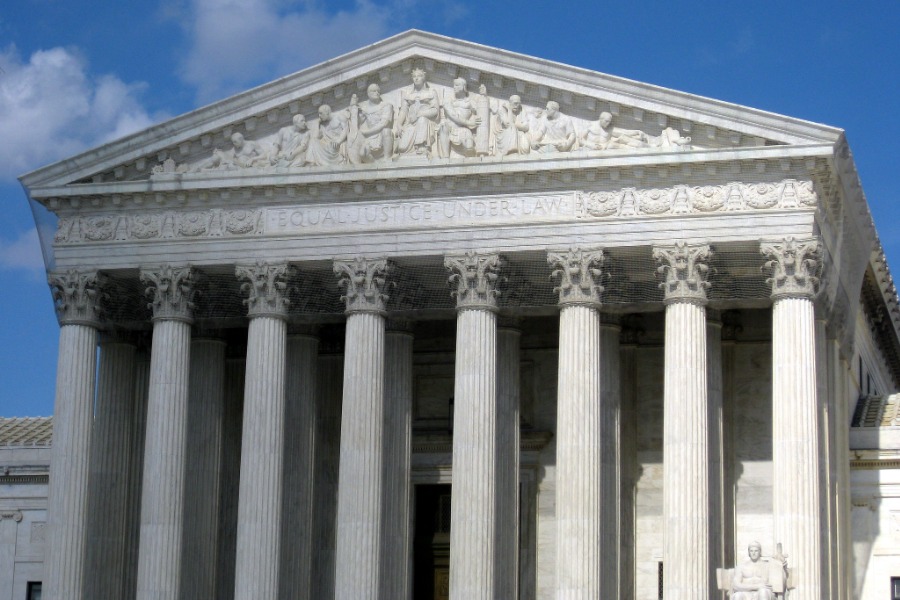
The Supreme Court last week issued a conclusive ruling against President Trump’s use of the 1977 International Emergency Powers Act (IEEPA) to impose tariffs starting in February 2025. In Learning Resources v. Trump, a six-justice majority held that IEEPA does not contain a tariff power. The decision invalidated Trump’s “universal and reciprocal” tariffs, such as his 15 percent tariff on the European Union, South Korea, and Japan, among other countries, as well as his “fentanyl” tariffs on Canada, Mexico, and China. The Learning Resources ruling also deprives Trump of the authority to use IEEPA to impose “secondary tariffs” as a geopolitical tool.
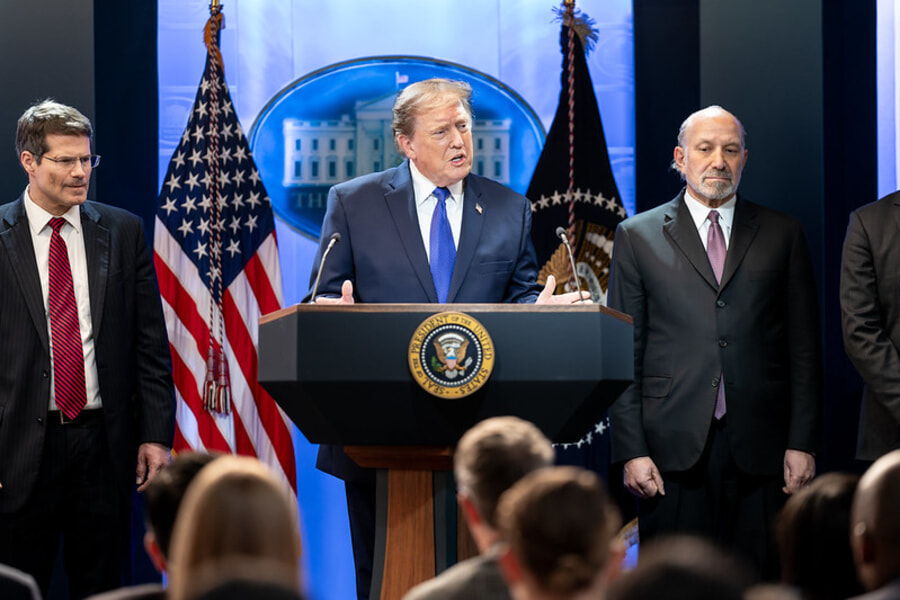
President Trump quickly pivoted to reimpose the tariffs under other legal authorities. Within hours of the decision, Trump signed a proclamation under Section 122 of the Trade Act of 1974 imposing a new 10 percent tariff on U.S. imports of many goods. (He subsequently announced on social media that he would raise the rate to 15 percent, although the tariffs came into force at the original 10 percent rate.) Trump’s U.S. Trade Representative (UTSR), Jamieson Greer, issued a statement announcing new investigations under another provision of the same statute, Section 301, which authorizes the USTR to impose tariffs and other restrictions on countries that engage in unfair trade practices. The USTR statement also noted that Section 232 of the Trade Expansion Act of 1962 remains in force to impose tariffs on a wide range of products, such as steel and cars.
The Trump administration’s tariff fallback options almost by definition rest on a sounder basis than Trump’s IEEPA tariffs. Unlike IEEPA, which does not contain the word “tariff” and which no previous president had used to impose duties, Trump’s fallback options are tariff statutes that clearly authorize tariffs in at least some circumstances. However, the fallback options all require fact-finding and procedural steps, and/or impose limits on the value of tariffs that can be imposed. As a result, the fallbacks are less flexible than IEEPA prior to the Supreme Court’s ruling in Learning Resources.
This article unpacks the bounds of Sections 122, 301, and 232 and discusses the potential legal challenges that importers might bring against each of Trump’s primary tariff fallback statutes.
What the Supreme Court Held in Learning Resources
The decision in Learning Resources was both broad and narrow. It was broad in the sense that the Supreme Court concluded IEEPA simply does not include a power to levy a tariff or another tax. The Court did not try to distinguish between different types of IEEPA tariffs or hold that IEEPA might authorize at least some tariffs in certain circumstances.
Chief Justice John Roberts, writing the main opinion joined in its entirety by Justices Amy Coney Barrett and Neil Gorsuch, relied in part on the major questions doctrine to reach the conclusion that IEEPA authorizes no tariffs. Chief Justice Roberts found that Trump must “point to clear congressional authorization” for his tariffs and that, in IEEPA, “he cannot.” Justice Elena Kagan, joined in a concurrence by Justices Sonia Sotomayor and Ketanji Brown Jackson, disliked the major questions doctrine as an interpretive canon, instead finding that IEEPA’s text and history do not authorize tariffs.
Regardless of this difference in method, all six justices concluded that IEEPA does not authorize tariffs. In this way, the Supreme Court’s opinion was broader than either the U.S. Court of International Trade’s opinion from May 2025 and the U.S. Court of Appeals for the Federal Circuit’s opinion from July 2025, both of which had ruled that Trump’s IEEPA tariffs were unlawful but left the door open to at least narrow categories of future IEEPA tariffs.
The Supreme Court’s decision was narrow, however, in the sense that the majority did not limit other presidential authorities under IEEPA. Nor did the holding directly limit whatever powers the president may have to impose tariffs pursuant to trade statutes. IEEPA has long been held to authorize presidents to take a range of actions to restrict trade with U.S. adversaries, including through embargoes. Trump was likely correct in his Feb. 20 press conference following the ruling when he said that IEEPA would allow him to “even impose a foreign country destroying embargo.” The opinion also did not directly address the scope of the president’s tariff authorities under other statutes, though some of the opinion’s analysis of the major questions doctrine may be relevant to future legal challenges.
The Metes and Bounds of Trump’s Fallback Options
If Learning Resources does not implicate Trump’s power to impose tariffs under other statutes, the question Trump and his trade advisers now face is how broadly these other tariff powers sweep. The administration has indicated that it will rely heavily on two other statutory provisions to recreate Trump’s tariffs: Sections 122 and 301 of the Trade Act of 1974. The administration also expects to continue relying on Section 232 of the Trade Expansion Act of 1962, which it has used as the legal basis for its “product” tariffs, such as its tariffs on steel, aluminum, cars, and car parts.
Any challenges to Trump’s actions under these statutes must be brought in the Court of International Trade, a specialty court that Congress established to referee customs matters. Appeals from the Court of International Trade are heard by the Federal Circuit. In recent years, the Federal Circuit has been relatively deferential to the executive branch over Sections 232 and 301, but that does not mean the president can use them in an unbounded fashion or without judicial oversight.
Section 122
Trump’s invocation of Section 122 will present the courts with questions of first impression: No president has invoked the statute until now. By its plain text, Section 122 authorizes the president to impose a tariff of up to 15 percent “whenever fundamental international payments problems require special import measures” to (a) “restrict imports to deal with large and serious United States balance-of-payments deficits,” (b) “to prevent an imminent and significant depreciation of the dollar,” or (c) “to cooperate with other countries in correcting an international balance-of-payments disequilibrium.” In addition to the 15 percent cap on the rate, Section 122 specifies that the president may impose the tariffs for only up to 150 days “unless such period is extended by Act of Congress.” This is the authority that Trump used on Feb. 20 to impose a new 10 percent tariff on most U.S. imports following the Supreme Court’s IEEPA ruling.
Congress enacted Section 122 of the Trade Act of 1974 in response to President Nixon’s decision in 1971 to impose tariffs of up to 10 percent for several months to address potential balance-of-payments issues associated with his decision to withdraw the U.S. from the gold standard. In 1974, the U.S. Customs Court, the predecessor to the Court of International Trade, ruled that Nixon’s tariffs were unlawful. While a federal appeals court would later overturn the Customs Court’s decision in 1975, Congress enacted the Trade Act of 1974 on the assumption that the president lacked a lawful way to impose tariffs to deal with international payments problems. The Trade Act of 1974 gave the president the authority to do so, subject to the 15 percent rate cap and 150-day limit.
Since Trump issued his Section 122 proclamation on Feb. 20, a number of economists have argued that the U.S. does not, in fact, suffer from “fundamental international payments problems” and that a “balance of payments deficit doesn’t exist.” Certainly, the international economic context that gave rise to Section 122, a system of fixed global exchange rates, no longer exists, given that the dollar floats freely against many other currencies. However, convincing the courts to overturn Trump’s invocation of Section 122 could prove challenging.
First, the factual question of whether a balance-of-payments problem exists is distinct from the question of whether the courts will overturn a presidential determination that a balance-of-payments problem exists. The courts may decide to simply defer to the executive branch. As Chief Justice Roberts wrote in Learning Resources, “We claim no special competence in matters of economics or foreign affairs,” but rather the “limited role” of determining what the law is.
In his proclamation invoking Section 122, Trump said that his advisers had presented a variety of facts to him about the U.S. balance-of-payments position, including that the U.S. “does not currently make a net income from the capital and labor that it deploys abroad, and experiences more transfer payments, on net, flowing out of the country than into the country” and that “the annual balance on the United States primary income turned negative for the first time since at least 1960 in 2024.” Relying on this information, he found “that fundamental international payments problems within the meaning of section 122 exist.” The courts will have to begin by determining if they can substitute their own judgment on the facts, or if they should simply defer to the executive branch’s findings.
Federal Circuit case law is highly deferential to a president’s findings of fact in the area of international trade. Under relevant precedent, “there has to be a clear misconstruction of the governing statute, a significant procedural violation, or action outside delegated authority.” Moreover, “[t]he President’s findings of fact and the motivations for his action are not subject to review.”
Plaintiffs trying to overcome this deferential standard can try to argue that the president’s factual findings are a “clear misconstruction” of the text and purpose of the statute, or that the statute is ambiguous on whether the president is the ultimate finder of fact. They can also argue that the Supreme Court’s 2024 decision in Loper Bright Enterprises v. Raimondo, which overruled Chevron deference and instructed courts to “exercise their independent judgment” to adopt a statute’s “best reading,” means the Federal Circuit’s precedents directing deference to the executive branch, which date to the 1980s, should be disregarded. Plaintiffs might also argue that the statute is ambiguous about whether the president or an agency should make the factual determinations under 122, strengthening the case for judicial scrutiny,
Plaintiffs can also point back to the original litigation at the Court of International Trade and the Federal Circuit against Trump’s IEEPA tariffs, in which the courts rejected the government’s assertion that the courts could not review the president’s determination under IEEPA that the “trade deficit” is a national emergency. As the Federal Circuit wrote in V.O.S. Selections v. Trump, it was “not prepared to say that compliance with [IEEPA’s] unusual-and-extraordinary-threat requirement is wholly unreviewable, as a political question or otherwise.” The Court of International Trade and the Federal Circuit may take a similar approach to Trump’s Section 122 determination, concluding that it is reviewable albeit under a highly deferential standard.
The difficulty of persuading the courts to actually overturn Trump’s determination under some highly deferential standard, however, will be compounded by the fact that last year the Court of International Trade appeared to endorse the president’s use of Section 122, albeit only for 150 days and capped at a 15 percent rate. The Court of International Trade cited Congress’s enactment of Section 122 as part of the CIT’s basis for ruling against Trump’s “reciprocal” tariffs under IEEPA, holding in V.O.S. Sections v. U.S. that Trump’s reciprocal tariffs “responds to an imbalance in trade—a type of balance-of-payments deficit—and thus falls under the narrower, non-emergency authorities in Section 122” (emphasis added).
While the Supreme Court overturned IEEPA tariffs on different interpretative grounds, the Court of International Trade’s holding suggests that at least some judges are open to interpreting Section 122 to address trade deficits. This may be true despite the fact that the Department of Justice conceded in a brief when it was defending the IEEPA tariffs before the Federal Circuit that “[n]or does [Section 122] have any obvious application [to Trump’s tariffs], where the concerns the President identified in declaring an emergency arise from trade deficits, which are conceptually distinct from balance-of-payments deficits.”
Moreover, even if plaintiffs persuade a court to engage in a substantive review of Trump’s Section 122 determination, litigants will still have to persuade the court that the executive branch is wrong. Here, the government may benefit from a battle of the economists: Even if many economists argue that there is no serious balance-of-payments problem, that view is not universal. Brad Setser, for example, has argued that “In my view there is a reasonable case the US does have a large and serious ... balance of-payments deficit” and has explained the rationale for his view. The lack of consensus will almost certainly reinforce a court’s inclination to simply defer to the executive branch.
One area where plaintiffs are likely to succeed in challenging Section 122 is if Trump tries to use the authority for more than 150 days. Here, the statute is clear: The president can declare tariffs “for a period not exceeding 150 days (unless such period is extended by Act of Congress).” Even if Trump tried to proclaim a second, subsequent Section 122 immediately after the current one lapses in July, the courts would likely reject it, given Congress’s clear intention to set a limit on the duration of the tariffs.
Section 301
The next part of the Trump administration’s fallback strategy is Section 301, which authorizes tariffs if the USTR, following an investigation, determines that foreign trade partners are engaging in unfair trade practices that harm the United States. Section 301 served as the basis for Trump’s first-term tariffs on China. The USTR has already announced it will initiate new Section 301 investigations following the Supreme Court’s decision in Learning Resources.
Depending on how the USTR uses Section 301, there is potential for a foundational challenge against the statute. The Federal Circuit upheld Section 301 against past challenges under both the major questions doctrine and the nondelegation doctrine in the context of the first Trump administration’s tariffs on China. But past challenges to Section 301 have involved the use of specific tariffs against specific countries and, in the case of China, a country that engaged undeniably in unfair trade practices.
Using Section 301 to impose sweeping tariffs on the entire globe, however, could present a different question. The text and legislative history of Section 301 are clear that Congress intended the statute to be used in limited circumstances as a tool to negotiate with foreign governments to resolve trade disputes, not as a tool to impose permanent tariffs on a global basis. Should Trump try to transform Section 301 into a statute that allows him to impose permanent global tariffs, Section 301 might present the type of “major question” that at least Justices Roberts, Gorsuch, and Barrett found important in Learning Resources.
Beyond a foundational challenge that Section 301 cannot be used to impose permanent global tariffs, plaintiffs can also raise arguments against specific Section 301 actions.
Section 301 sets out a variety of procedural requirements that the USTR must meet prior to imposing a tariff, including the requirement to conduct a factual investigation; a maximum (albeit not a minimum) timeline for investigations; a requirement to consult with the foreign government that is the subject of an investigation; an opportunity “for the presentation of views by interested persons, including a public hearing if requested by any interested person;” and consultation with the USTR’s trade advisory committee. The USTR can impose remedies prior to consultations with the public and the trade advisory committees if “expeditious action” is required, but must still conduct consultations after the fact. Plaintiffs may find opportunities to litigate Section 301 investigations on procedural grounds, depending on whether and to what extent the USTR complies with the procedural requirements in the statute.
Section 301 has two operative pieces: 19 U.S.C. § 2411(a), which directs “mandatory actions” when the USTR finds that a foreign government has violated the terms of a trade deal or where an act “is unjustifiable and burdens or restricts United States commerce;” and 19 U.S.C. § 2411(b), which authorizes “discretionary actions” whenever the USTR determines that “an act, policy, or practice of a foreign country is unreasonable or discriminatory and burdens or restricts United States commerce.”
With respect to “mandatory” actions, Section 301 requires that any tariffs imposed be “in an amount that is equivalent in value to the burden or restriction being imposed by that country on United States commerce.” This language seems to limit the value of tariffs imposed to the economic costs of the harm that the USTR finds from a foreign trade practice. Should the USTR rely on this provision to impose tariffs, it will find itself limited by the value of the harm the country’s unfair trade practices impose on the U.S.
However, no such proportionality requirement applies to the “discretionary” prong of 301, which authorizes the USTR to take “all appropriate and feasible action authorized … subject to the specific direction, if any, of the President … to obtain the elimination of [the unfair] act, policy, or practice.” Authorized actions specifically include imposing tariffs and restrictions on services.
Beyond Section 301’s procedural requirements, these provisions make clear that the statute imposes at least two substantive limitations on any tariffs: (a) that Section 301 tariffs be related to a foreign trade practice, which is the entire basis for the statute, and (b) assuming that Trump relies on “discretionary” tariffs under Section 301, that the tariffs be “appropriate.” (If the USTR instead relied on mandatory tariffs, it would have to meet the proportionality requirements.) These provisions will put meaningful constraints on the USTR’s use of the statute.
First, the requirement that a Section 301 tariff follow an investigation into an unfair foreign trade practice and be imposed to address some unfair foreign trade practice means that Trump cannot lawfully use Section 301 to threaten tariffs for geopolitical purposes. There is just no plausible way to argue, for example, that Denmark refusing to hand over Greenland to the United States is an unfair trade practice that burdens U.S. commerce. Similarly, it would be challenging to argue that a foreign country’s trade with Iran, or oil sales to Cuba, is an unfair foreign trade practice that burdens U.S. commerce, regardless of whether trade with Iran or Cuba might impair U.S. national security interests. The Supreme Court’s decision in Learning Resources means that Trump will have to rely on sanctions or other national security tools, not tariffs, to deal with those sorts of geopolitical matters.
Second, the Federal Circuit has held that 19 U.S.C. § 2411(b)’s “appropriateness” requirement means that a Section 301 tariff must be “one that can end or reverse the investigated conduct.” While the Federal Circuit found that this is a “broad” power and “within USTR’s discretion to determine, subject to the President’s direction,” the “appropriateness” requirement does mean the tariff power is not unbounded.
In particular, the Federal Circuit has defined an “appropriate” action to be one that “can end or reverse” the unfair foreign trade practice. This will raise questions about Trump’s ability to use ongoing 301 tariffs, particularly on countries that have agreed to trade deals with Trump.
Trump has entered into preliminary trade deals with nearly 20 countries, ranging from the European Union to Japan. Of these 20 deals, seven have been reduced to finalized text. In these deals, Trump has agreed to cap U.S. tariff rates, often at 10, 15, or 20 percent, in exchange for the trade partners agreeing to end various purported unfair trade practices. As a matter of logic, if the foreign governments have agreed to end unfair trade practices as part of a trade deal, it will be difficult for a Section 301 tariff to continue to meet the statute’s “appropriateness” requirement. A tariff that has succeeded in convincing a foreign country to stop treating the U.S. unfairly is presumably no longer needed. This reading of the statute is also consistent with Congress’s intent in enacting Section 301, which was to give the USTR an authority to compel countries to stop engaging in unfair trade practices, not to give the USTR an authority to implement permanent tariffs.
The USTR will likely try to defend permanent tariffs, even on countries that have agreed to trade deals, as allowed by the statute. It could argue, for example, that countries have not fully remedied the trade harms, and so tariffs should be allowed at the very least to continue for several years (beyond the end of Trump’s term). Or perhaps the USTR will simply present U.S. trade partners with an unmeetable list of demands in order to ensure that the foreign countries cannot actually address them. The extent of 301’s scope is an issue that will almost certainly land in the courts.
Section 232
Finally, Trump plans to continue relying on Section 232 of the Trade Expansion Act of 1962, which authorizes tariffs following a Commerce Department investigation into whether imports of an “article” “threaten to impair the national security.” It is used to impose tariffs on products such as steel and cars.
The courts have tended to defer to the president over Section 232 tariffs ever since the Supreme Court upheld a president’s authority to impose tariffs pursuant to the statute in 1976 in Federal Energy Admin. v. Algonquin SNG, Inc. In 2020, the Federal Circuit again upheld Section 232 against a nondelegation challenge. In 2021, the Federal Circuit found that the president can modify Section 232 tariff rates even if beyond the statute’s initial procedural timelines. In 2022, the Federal Circuit found that the Commerce Department has substantial discretion in determining whether imports do, in fact, threaten to impair U.S. national security. This makes it unlikely that courts will second guess the Commerce Department’s finding that, for example, imports of wood products threaten U.S. security, even if commentators argue that Trump’s Section 232 tariffs on upholstered furniture are far removed from U.S. national security interests. And in 2023, the Federal Circuit upheld a broad authority to modify tariff rates on “derivative products” that contain a material subject to a Section 232 tariff (e.g., products made of steel, and not just raw steel).
However, depending on Trump’s approach to Section 232, aspects of the tariffs may be challengeable. In its 2023 case on the modification of tariff rates on derivative products, for example, the Federal Circuit held that while the president may modify tariff rates well beyond an initial Section 232 investigation, “a different question might be presented where the underlying finding or objective has become substantively stale.” Litigants who show that Trump relied on a Section 232 investigation that is no longer factually operative may have more success in court.
Moreover, Trump has vastly expanded the list of products he views as derivative products subject to Section 232 tariffs. For example, the Trump administration has determined that imports of canned beer are “derivative” of aluminum and subject to Section 232 tariffs. What can and cannot be a “derivative product” is not well defined in the statute and has not been litigated in court. Plaintiffs may be able establish limits to the types of products that Trump can tariff as derivatives. A claimant could argue that a “derivative product” must be made up of some minimum percentage of underlying material that is subject to Section 232 tariffs, rather than simply containing trace amounts of a tariffed product. One of the primary definitions of derivative, for example, “is a chemical substance related structurally to another substance and theoretically derivable from it.” Canned beer may require a can to be imported, but beer in cans is not theoretically derivable from aluminum.
Procedural challenges to Section 232 tariffs may also be possible. Trump has established a Section 232 “inclusions process” in which companies can request that products be tariffed as derivatives. There may be potential challenges to the manner in which specific products were added. Despite the deference courts have accorded Section 232 in recent years, it, too, will likely face more judicial scrutiny as the Trump administration continues to expand its application.
Much Will Depend on What Trump Does
Beyond the questions of law, there is the practical reality that courts are aware of a president’s actions, and that awareness colors how they rule. The seemingly unbounded nature of Trump’s IEEPA tariffs appeared to weigh on Chief Justice Roberts, who noted in Learning Resources that “[t]he President asserts the extraordinary power to unilaterally impose tariffs of unlimited amount, duration, and scope.” Roberts almost certainly wrote or edited those words at a time when Trump not only imposed trade-related tariffs on U.S. allies but also threatened to issue additional tariffs to pressure other countries to support his bid for the U.S. to obtain control over Greenland. Had the president used IEEPA tariffs more sparingly, or conceded some bounds to their use, the courts may have reached a different conclusion on the tariffs’ legality. Trump would be well advised to keep that in mind as he deploys his fallback tariff options, and to refrain from deploying them in ways that might invite more judicial oversight than, judging from his sharp reaction to Learning Resources, he appears to care for.