Will the New Export Controls Shake the Foundations of the U.S. AI Industry?
Washington’s misplaced assumptions around export control and domestic regulations pose strategic risks to national stability.


Editor’s Note: AI breakthroughs are creating excitement and fear—and posing difficult challenges for the policy community. Stanford’s Alvin Graylin and Jon Rosenwasser of Four Corners Analysis argue that the United States cannot stop the spread of frontier AI through export controls but that, like China and European states, it can better regulate AI at home without stifling competition.
Daniel Byman
***
On the evening of June 12, the Commerce Department’s Bureau of Industry and Security directed Anthropic to deny all foreign nationals access to its two most capable artificial intelligence (AI) models, Fable 5 and Mythos 5, citing a possible “jailbreak” of the models’ cyber guardrails. Unable to sort the national origins of its users in real time, the company pulled the models for everyone. It was the first time the United States applied export controls to an AI model rather than to the semiconductor chips that train it.
The market’s reply came the next day when Chinese lab Z.ai released GLM-5.2 under a permissive MIT license, marketing it on the promise of borderless access that any enterprise can download and run on its own hardware. A day later, Rio de Janeiro’s city government published its own open model, built on Alibaba’s Qwen. Even Japan is jumping on the bandwagon; its leading AI lab released their Sakana “Fugu Ultra” model, which it touts as having “frontier capability without the risk of export controls.” None of this was coincidence. All three announcements were responses intended to highlight how each actor’s solutions can help customers maintain technology sovereignty in the face of aggressive U.S. policies.
Even with the reversal of the Commerce Department’s decision to ban Fable 5, the incident has created a loss of trust among AI users globally that will be difficult to repair. Ironically, U.S. defense contractor Palantir has even issued a post advocating that their customers around the world seek AI sovereignty by leveraging open weight models so they can “control their fate.”
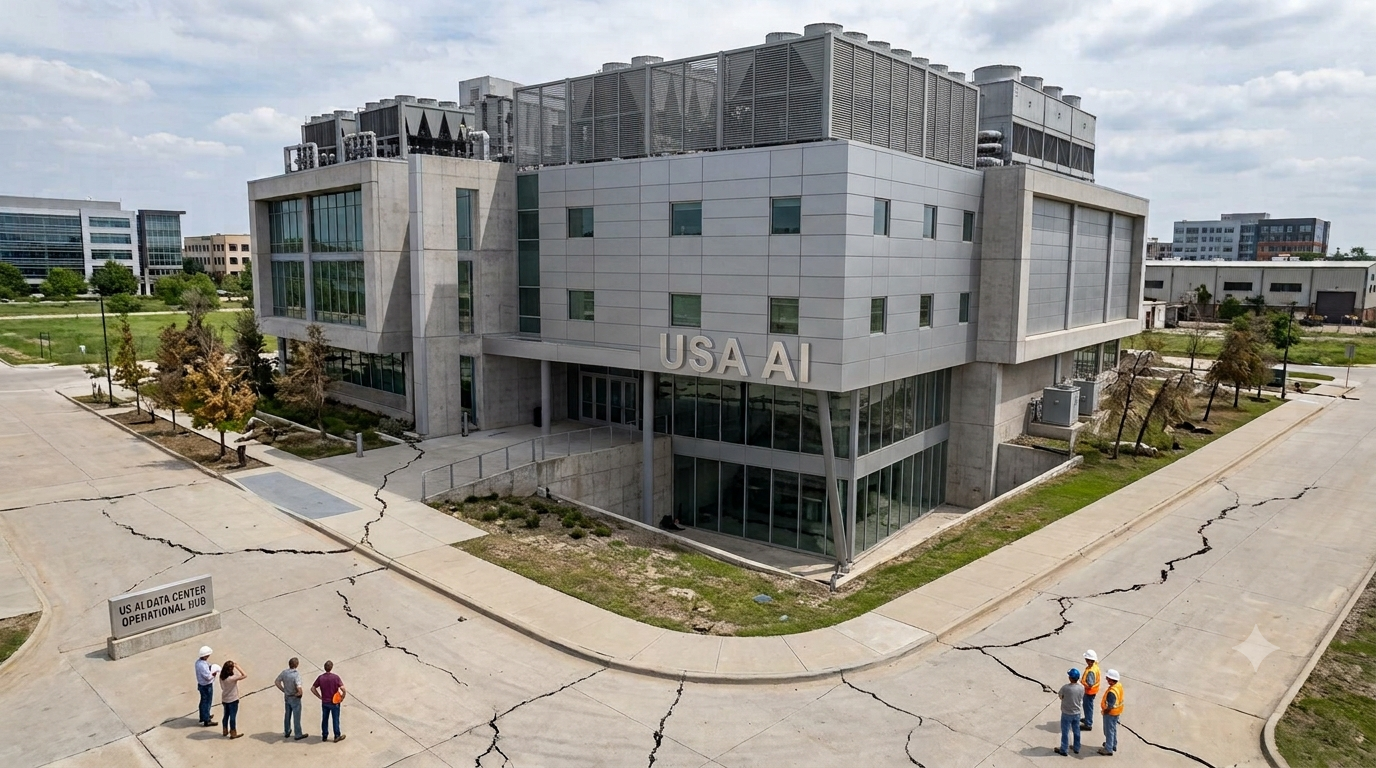
We have argued, including in the Cipher Brief, that U.S. policy rests on two load-bearing assumptions, and that both are misguided. The first is that the United States can capture the lion’s share of the AI economic windfall by reserving its best models for itself and denying them to rivals. The second is that the United States cannot afford to regulate AI at home, because China will not, so any self-imposed restriction will cede the terrain to Beijing. The past two weeks offer further proof that both propositions are false. It is time to correct two seminal fallacies and provide U.S. AI policy with enduring structural integrity. Otherwise, we risk building the AI ecosystem on a foundation that will buckle under the weight of a rapidly maturing infrastructure.
The First Fallacy: Denial Keeps the United States Ahead
The instinct to apply export controls to deny rivals access to AI capabilities, while ultimately flawed, deserves a fair hearing. A Mythos-class model with strong offensive cyber capability could, if its guardrails failed, hand a hostile actor real advantages against fragile financial and infrastructure systems. Reaching for the export control policy tool, as the United States has attempted with the export of advanced microchips, could be justifiable.
But the chip controls are a cautionary tale, not a template. Three years of escalating restrictions on graphics processing units and lithography did not open a durable Chinese gap; in fact, the gap narrowed. DeepSeek, Qwen, MiniMax, Kimi, and GLM now sit at or near the frontier of AI development at a fraction of the cost. On OpenRouter, the largest model-routing platform, Chinese open-weight models climbed from less than 2 percent of token traffic in late 2024 to a majority in 2026, roughly 61 percent of usage among the top models. The effort to preserve a lead by denial may be precisely what accelerated the erosion of its positions, by forcing China to build a cheaper, open, self-sufficient stack and then give it away.
A deployed commercial AI model is not enriched uranium that can be physically contained with no consequences. It is a service on which hundreds of millions of users have built dependencies, and when Washington shows that access can vanish overnight, it teaches every other government and foreign business that depending on American AI is itself a risk. The rational response is to seek alternatives from other countries, and the most available ones are from China and open sourced. Singapore’s national model now builds on Qwen, as do the United Arab Emirates’ K2-Think and a lengthening roster of other national systems.
The ban also lands within the United States’ borders. By MacroPolo’s count, more than two-thirds of the top-tier AI researchers working in the United States were trained abroad; at the leading labs, the foreign-born share of technical staff runs up to 70 percent. A foreign-national prohibition therefore even locks most of U.S. labs’ own engineers out of their own flagship models. A policy that bars noncitizens from building the frontier does not entrench a U.S. advantage that was imported in the first place.
Finally, a strategy of denial cannot affect the part of the stack where China actually leads. Export controls govern chips and now models, but China dominates the physical layer beneath them: It refines roughly 90 percent of the world’s rare earths; leads in batteries, power generation, grid build-out, networking, and industrial and humanoid robotics; and is on track to account for about 45 percent of global manufacturing value added by 2030. The United States has no quick answer to any of that, and no export list reaches it.
The Second Fallacy: Domestic Regulation Creates Drag
Many in Washington believe that China is unwilling or unable to regulate its AI industry. Thus if the United States regulates its own industry, it would amount to unilateral disarmament. If executed blindly, the underlying argument does have some merit: Heavy-handed rules can ossify a fast-moving field and entrench incumbents. Europe’s barely existent frontier tech companies demonstrate the risks of over-regulation, exacerbated by limited access to venture capital. But the claim that China races unencumbered while the United States debates does not survive contact with the factual record.
China has regulated AI for years. Its algorithm-recommendation rules date to 2021, its deep-synthesis rules to 2022, and its generative-AI measures to 2023. Every public-facing service must pass a security assessment and file with the Cyberspace Administration of China (CAC) before deployment. By the end of 2025, more than 700 generative-AI large models had completed that filing, and products must display their model filing numbers. Whatever one thinks of the content controls, Beijing has shown that pre-deployment review can coexist with a fast-moving industry.
The clearest sign that China is not in an all-out sprint to artificial general intelligence (AGI) is in silicon. After Washington approved limited exports of H200 silicon chips, Beijing discouraged its own labs from buying the chips, even though the H200 beats the domestic parts available to them, in order to force demand toward Chinese semiconductors. A country racing to maximize domestic model capability at any cost does not refuse the better chip.
For years, the leading U.S. labs argued that they could not slow down because China would not, a point Dario Amodei and Demis Hassabis made together at the World Economic Forum last spring. That argument has collapsed. In his June 2026 essay, Amodei reversed Anthropic’s long-standing position and endorsed binding, Food and Drug Administration-style pre-release testing with government power to block unsafe releases. The administration invoked exactly that authority days later on Anthropic and has extended the restrictions on OpenAI’s GPT-5.6 model as well. If caution ever waited on China to reciprocate, the reciprocity had already been there.
Three Regional Approaches to Regulation
The contrast in regulation is easiest to see side by side across the three major regions for AI development (the United States, the European Union, and China). Most believe the European Union has the strictest regulations, but the data shows something a bit different. The pattern is consistent: China enforces regulation, the European Union is phasing in binding rules, and the United States is struggling to demonstrate a “we can’t regulate” narrative at the federal level even while momentum toward a patchwork of regulation at the state level is growing (Figure 1).
| Policy Lever | United States | European Union | China |
|---|---|---|---|
| Frontier model pre-release review | PHASING IN Voluntary 30-day pre-release cyber review under the June 2, 2026, executive order (framework due Aug. 1); CA SB 53 frontier-safety law in force Jan. 2026; NY RAISE Act 2027; IL SB 315 passed May 2026. | PHASING IN Systemic-risk general-purpose AI (GPAI) models: risk assessment, adversarial testing, and incident reporting (AI Act Art. 55); enforcement powers from Aug. 2, 2026. | ENFORCED Security assessment plus large-model filing required before any public deployment; 700+ large models filed by the end of 2025. |
| Model registration & content transparency | PHASING IN No federal registry (Dec. 2025 executive order proposes one); CA AB 2013 training-data disclosure in force Jan. 2026; CA SB 942 content provenance from Aug. 2026. | ENFORCED GPAI transparency and documentation duties apply to new models since Aug. 2025; Art. 50 deepfake watermarking from Aug. 2026. | ENFORCED Public algorithm and generative-AI registry; mandatory AI-content labeling since Sept. 2025; filing numbers shown on products. |
| Child safety & companion (anthropomorphic) AI | PHASING IN CA SB 243 (in force Jan. 2026) and NY's companion-AI law (Nov. 2025) require AI self-disclosure, suicide/self-harm crisis protocols, break reminders for minors, and a private right of action; federal GUARD Act (proposed) would bar AI companions for minors; Federal Trade Commission opened a minors-harm inquiry. | ENFORCED AI Act Art. 5 bans systems that exploit age-related vulnerabilities or use manipulative techniques (in force Feb. 2025); Digital Services Act requires platforms to mitigate risks to minors. (U.K.: Online Safety Act self-harm duties, Ofcom-enforced.) | ENFORCED Algorithm-recommendation rules mandate minor anti-addiction safeguards and a "minor mode"; generative-AI and deep-synthesis rules bar content harmful to minors and require AI labeling. |
| AI developer liability for model harms | PHASING IN No federal liability statute (the June executive order disclaims licensing); liability is emerging through litigation (Florida sued OpenAI over a "defective product"; courts rejecting Section 230 for chatbots; 42-AG probe) and state accountability laws (CA SB 53/IL SB 315 require incident reporting; Colorado imposes a reasonable-care duty). | PHASING IN AI Liability Directive withdrawn (Oct. 2025); the revised Product Liability Directive (2024/2853) treats AI systems as products under strict liability, with developers liable as manufacturers (transpose by Dec. 9, 2026); AI Act fines up to 35 million euro or 7% of turnover. | ENFORCED Generative-AI measures make the provider the responsible party for model outputs, training data, and labeling; the CAC can fine, suspend or blacklist; the Personal Information Protection Law and tort law also apply. |
| Data-center energy & ratepayer rules | PHASING IN Voluntary federal Ratepayer Pledge; NY first statewide moratorium passed June 4, 2026 (awaiting signature); IL and OH tax-incentive pauses; CA/OH/UT/FL cost-allocation laws. | PHASING IN Energy-use reporting via the AI Act plus national grid rules; no dedicated AI data-center cap. | ENFORCED Centrally steered compute siting ("east-data-west-compute"); state-directed buildout. |
| Labor impact & automated employment | PROPOSED No federal rule; Colorado AI Act (June 2026), Illinois HB 3773 (Jan. 2026), NYC Local Law 144 bias audits, Connecticut CART Act (2026-27). | PHASING IN AI used in employment is "high-risk" under AI Act Annex III; obligations phasing in through 2026-27. | ENFORCED Algorithm-recommendation worker protections in force; courts now hearing algorithmic-management disputes. |
| Social safety net/ redistribution | PROPOSED Proposals only: Sanders bill for a 50% public stake in frontier labs for sovereign fund; Musk "universal high income"; Altman universal basic income pilots. | ENFORCED Mature member-state welfare systems; universal basic income pilots under debate. | ENFORCED "Common prosperity" agenda; state equity stakes ("golden shares") in leading AI firms. |
Figure 1. AI policy levers by region and implementation stage. Color key: green = enforced, yellow = phasing in, red = proposed. Sources: June 2, 2026,executive order(CNBC); EU AI Act Arts. 5 & 55; EU Product Liability Directive (Goodwin); CAC 700+ model filings (CGTN); China algorithm rules (China Law Translate); CA SB 53 / AB 2013 (A&O Shearman); CA SB 243 companion-chatbot law (Perkins Coie); GUARD Act and FTC inquiry (Cal. Lawyers Assn.); 42-AG OpenAI probe (TNW); NY data-center moratorium S.10642; Sanders AI Sovereign Wealth Fund Act.
AI is a general-purpose technology, a foundational innovation like electricity that enables widespread improvements across many industries and applications. National success will be decided by how widely and safely it diffuses into industry, not by which lab crosses an ill-defined finish line first. This is why the image of an AGI “windfall” that one nation can pocket is, as Graylin has argued, a mirage: commoditization, open-source access, and deflationary forces can push the gains outward.
Given the risky nature of the AI industry, the larger hazard to the country is not over-regulation. It is the bet itself. AI hyperscalers will spend roughly $725 billion on AI infrastructure in 2026, with total capital expenditures projected to top $1 trillion in 2027. This potential “irrational exuberance,” to borrow a phrase from late Federal Reserve chairman Alan Greenspan, flies in the face of the Fed’s declaration that AI is a systemic risk amid lagging revenues. Betting the farm at a trillion dollars a year and pumping up the stock markets on loss-making labs, while the gains diffuse outward and the physical stack tilts toward Beijing, poses far greater risk for U.S. economic stability than any potential legislative restriction on AI.
Stabilizing the Foundation
The lesson of the past two weeks is not that the United States should stop competing. It is that the two reflexes now defining U.S. strategy—walling off the world through export controls on deployed AI models and refusing to govern at home with reasonable regulation—has placed the U.S. AI economy on a very shaky foundation. Export controls demonstrate to other countries the risks of depending on AI from unreliable U.S. partners and push them to embrace Chinese open-source models. The U.S. refusal to regulate its domestic industry, when China is already regulating, strips out the trust, the diffusion, and the social shock absorbers that competitiveness now requires.
The better approach is to keep U.S. models open to the world, govern them with confidence at home, cooperate where the stakes are shared, and build the social safety net before the displacement arrives. Washington still has time to make the right policy adjustments so that when the tremors from global reactions arrive, the AI industry and the American economy can still stand strong.
All statements of fact, opinion, or analysis expressed are those of the authors and do not reflect the official positions or views of the U.S. Government. Nothing in the contents should be construed as asserting or implying U.S. Government authentication of information or endorsement of the author’s views.
Correction: This article has been updated to remove attribution of a quote to MacroPolo that could not be verified.