Enhancing Border Biosecurity in the Age of AI-Enabled Biology

Biosecurity incidents have captured national headlines over the past decade, yet the U.S.’s interdiction record remains defined more by luck than by design.
The U.S. research enterprise is now caught up in a web of systemic biosecurity vulnerabilities across U.S. transit networks, including interstate transport and ports of entry or exit (POE). For years, the Defense Department shipped live anthrax bacteria to labs in multiple states and other countries. At POEs, federal agents are confronted by illicit physical shipments of potentially dangerous biological materials. This includes importation by Chinese nationals studying at university labs in the U.S. and exportation of stolen biological materials and other proprietary information by Chinese affiliates. Locally, unlicensed biolabs have operated until uncovered by accident. These incidents reveal a troubling reliance on chance encounters rather than deliberate, active screening.
Worse yet, they reflect only classical biosecurity challenges involving traditional pathogens and standard physical constructs. Meanwhile, artificial intelligence (AI)-enabled biological design tools (BDTs) and the decentralized synthesis of deoxyribonucleic acid (DNA) have altered the threat landscape, such that relying on chance encounters at POEs or locally has become a vulnerability the United States can no longer afford.
The new threat landscape traverses three distinct vectors. The first is AI-designed and engineered biological materials exploited for malicious ends. The second is a catastrophic accident or mishandling at an accredited university’s dual-use research lab. The third is the biosecurity risks posed by legitimate researchers who intentionally circumvent transit rules to bypass bureaucratic delays that slow down their work.
When border enforcement treats biological shipments as routine customs line items rather than national security checkpoints, all three threat vectors remain unchecked.
The AI-Designed and Engineered Biological Material Angle
Advances in AI have fundamentally shifted the synthetic biology landscape. Agents with Customs and Border Protection (CBP) no longer face solely traditional, wild-type pathogens. Instead, an increasing amount of interdicted biological material will likely take the form of ordinary looking but lab-made genetic material—unlabeled samples that easily mimic routine biological materials to the untrained eye—leading to a detection and identification problem.
Autonomous AI agents will compound this because while CBP officials look for known threats, AI tools can manufacture things that match nothing we know. Biological AI agents can manage end-to-end scientific workflows—accessing design tools, querying data, and placing synthesis orders independently. Paired with generative AI models designed to generate novel viruses or engineer functional genetic traits, the threshold for creating high consequence biological threats drops precipitously—a real danger in a world where terrorists already use AI in operations, and AI agents are taking unsanctioned actions during evaluations.
Physical border controls are the only backstop against these digitally originated threats as the last point of systematic screening, but existing POE inspection methods remain blind to them. Sequences designed on a computer, innocuous or not, can be synthesized and shipped across borders without triggering a single traditional, target-specific biosecurity red flag.
The High Consequence Dual-Use Research Dimension
Routine academic work often overlaps with severe national security risks. Many pathogens, including some on the Biological Select Agent and Toxin List, have legitimate research applications in medical and agricultural countermeasure research, including vaccine and diagnostic development.
Although not a select agent, Fusarium graminearum, the fungus at the center of a recent smuggling case involving two Chinese nationals, is a potential agroterrorism agent that has historically wiped out crop yields, costing the U.S. economy billions. The two researchers told federal investigators that they intended to study the smuggled biological pathogen samples at a university lab.
Because of their dual-use nature, shipping these types of biological materials within the U.S. falls under statutory Department of Transportation standards for hazardous materials and CBP search obligations. Yet without robust real-time tracking, unmonitored transfers of dual-use research materials—whether triggered by laboratory mishandling, containment failure, or intentional illicit transfers (including researchers smuggling)—places the U.S. agricultural sector and public health infrastructure at grave risk.
When Research Urgency Trumps Compliance
Researchers operate under a publish-or-perish culture that spills over into sharing samples to maintain a competitive edge in fast-moving fields. This pressure is felt acutely by early-career scientists and foreign nationals on visas, who face intense publication demands and administrative hurdles, where a single shipping delay could jeopardize years of academic work, funding, or immigration status.
Faced with navigating complex, time-consuming regulatory demands, some researchers may perceive border controls as administrative hurdles rather than critical security measures and try to circumvent them, resorting to workarounds such as carrying undeclared vials in personal luggage, mailing unannotated genetic samples via commercial couriers, or mislabeling materials. This informal transport culture creates massive data blind spots, undermines chain-of-custody tracking, and inadvertently establishes covert pathways that malicious actors can exploit.
Addressing these threat vectors requires confronting the uncomfortable operational reality that the U.S. government has no standard, frontline plan for identifying biological materials interdicted either locally in transit or at POEs.
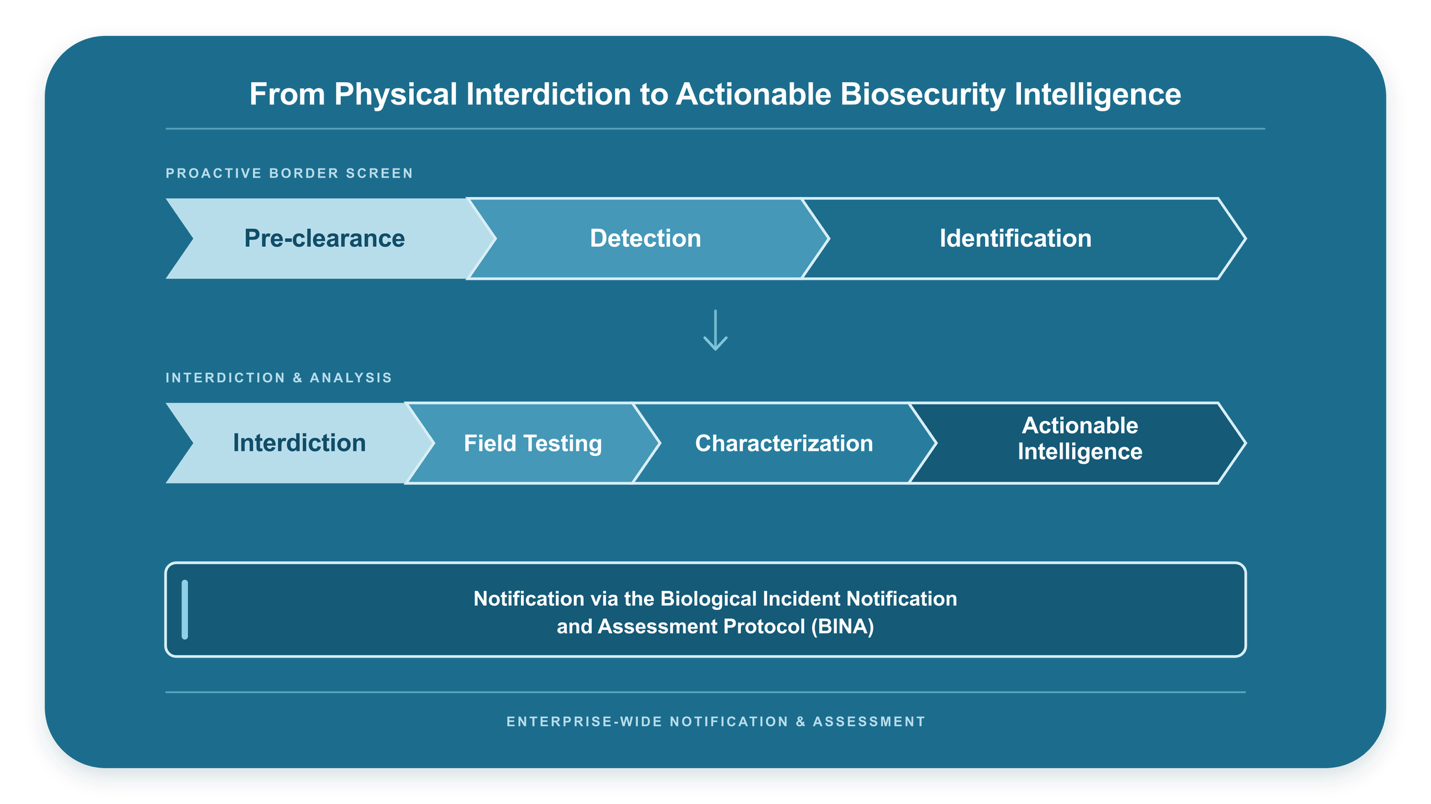
Under the Biological Incident Notification and Assessment (BINA) Protocol, the National Security Council possesses a structured mechanism for interagency notification once a threat is confirmed. However, BINA is a reactive framework that depends on prior detection. Meanwhile, it is at the identification phase—in the critical chain of interdiction, field testing, and laboratory characterization—where border biosecurity has typically collapsed, with structural bottlenecks preventing frontline agents from converting physical interdictions into actionable biosecurity intelligence.
First, while BINA improves information sharing, no standard protocol drives consistent sample testing, tracking, or reporting of test results. As a result, most of what the public knows comes from scattered media reports rather than a coordinated database. Existing interdiction procedures do not consistently ensure that suspicious biological materials are characterized, tracked, and incorporated into a national intelligence picture. Meanwhile, some actions foreclose opportunities to test interdicted material and build a better picture of the types of illicit biological agents that cross the border.
A report from the U.S. Congress Select Committee on the Chinese Communist Party found that, despite concerns that seized samples from an unlicensed community lab uncovered in California may have pointed to cross-border transport of pathogens, the Centers for Disease Control and Prevention (CDC) did not conduct confirmatory testing. Inconsistent guidance around field testing prevents law enforcement from building a comprehensive national database of test results and may let repeat offenders fall through the cracks.
Second, with limited guidance, border testing depends heavily on state, local, tribal, and territorial (SLTT) labs that often lack personnel or testing capability themselves. Only major POEs typically have access to SLTT public health resources or hazmat support. Even then, frontline border personnel must find a SLTT lab willing and able to accept a sample. Many SLTT labs hesitate to accept unknown samples without prior screening for hazards, but such information usually comes from apprehended individuals themselves and is therefore unreliable.
Finally, border personnel are not trained in biological field testing methods or biocontainment practices. POEs lack the thousands of reagents needed to test unknown biological materials, making it nearly impossible to identify interdicted materials with certainty. While some POEs may have embedded CDC employees who are microbiologists or trained to work with such materials, this is not a given, and border personnel in general are not. Unsuspecting frontline border personnel can also be exposed to potential hazards during routine contact with passengers.
Prescriptions for Closing the Gap
To close these operational gaps, the U.S. government should consider the following.
First, the U.S. government should shift border biosecurity from reactive inspections to proactive, digital preclearance. This requires expanding the CBP’s Biological Materials Checklist into a mandatory, prearrival, electronic declaration system to verify that shipments of cultured cells, diagnostic specimens, or genetic constructs are documented, labeled, packaged, and placarded in compliance with hazardous materials regulations.
By automatically cross-referencing permits through Department of Agriculture, CDC, Department of Transportation, and Commerce Department databases, an integrated platform flags anomalies and sequence discrepancies for secondary inspection. This happens before cargo or passengers ever reach a POE, helping close compliance loopholes without stifling legitimate scientific exchange and directly strengthening federal biosecurity controls.
Second, the U.S. government should fix the frontline testing bottleneck that leaves border personnel isolated during an interdiction. Frontline border personnel should not be expected to “cold call” SLTT laboratories or conduct complex biological assays without support.
Designating a lead federal agency (LFA) to coordinate POE biological testing would streamline operations and establish clear protocols for sample transfer, field testing, and characterization. This LFA should establish and manage a framework that links POE and transit hubs to regional leads within the Laboratory Response Network and the Integrated Consortium of Laboratory Networks to create a pipeline for sample identification. With this, the kind of failure that resulted in nontesting of thousands of samples of unlabeled potential pathogens in an illegal China-tied biolab will be averted in the future.
As an immediate measure, certified microbiologists should be pressed into service and embedded with the Department of Homeland Security’s Mobile Detection Deployment Program, which deploys van-based detection assets to high-volume transit hubs to conduct field screening and biocontainment oversight. This gives border personnel access to the expertise needed to safely isolate, handle, and characterize suspicious biological cargo.
Finally, the U.S. government should transform isolated interdiction events into actionable national biosecurity intelligence. Available evidence suggests testing results, seizure logs, and other interdiction information are fragmented across agencies. Establishing centralized governance over the collection, securing, and analysis of biological interdiction data will allow officials to track emerging threat patterns across transit hubs.
Implementing a tiered-access database built on standardized metadata and releasing quarterly summaries mirroring other established practices for contraband seizures, federal authorities can protect sensitive law enforcement sources while providing transparency into border biosecurity trends. This will enhance interagency coordination and build public confidence in federal biosecurity capabilities.
* * *
Repeated incidents of undeclared or illicit biological materials transiting state lines or crossing U.S. borders are warning signals of systemic structural vulnerabilities.
As technological advancements in the life sciences accelerate, the U.S. approach to border biosecurity needs to keep pace, starting with the recognition that relying on chance interdictions is an unsustainable defense posture.
By implementing an integrated electronic permitting system with automated cross referencing across agencies, formalizing frontline interagency testing networks, and establishing a centralized interdiction data architecture, the U.S. can transform passive transit and customs checkpoints into an active, intelligent biosecurity screen. This is how the U.S. government can safeguard public health, protect critical infrastructure, and fortify national security against intentional illicit transfers of biological materials.