The Situation: The Enduring Truths of the Mueller Report
There are four of them.
The Situation on Sunday considered the fact that things would suck right now even without The Situation.
Also over the weekend came the announcement that Bob Mueller died.
Mueller's death was the occasion—inevitably and of course—for unspeakably inappropriate presidential conduct. It has also been the occasion for some thoughtful remembrances and articles about the man, his remarkable history and legacy at the FBI, and for both praise and criticism of the manner in which he conducted his investigation.
Here I would like to do something a little bit different and talk about the text of the Mueller Report, the more-than-400-page document that resulted from Mueller’s investigation. The report itself has gotten strangely lost in the discussions of Mueller’s virtues, the hopes people invested in him, and his confrontation with Trump. And it’s easy to understand why: Trump won. The ship sailed. For all the votive candles and Mueller Time shirts and memes, the investigation never did generate accountability for Trump. Indeed, while Trump was later impeached twice, neither time was it over allegations that Mueller investigated.
And yet, the Mueller Report contains a number of important truths—enduring truths—about Trump, about the people around him, and about The Situation more generally. These are truths one simply cannot doubt, however much smoke gets thrown up around them, if one bothers to spend quality time with the document.
Depending on how fine a sieve one uses, there are a lot of them. But at the coarsest level of granularity, there are four essential ones.
The first enduring truth of the Mueller Report is that the Russians conducted a significant “active measures” operation on a variety of social media platforms to interfere in the 2016 U.S. presidential election. As the report puts it: “By early to mid-2016, [these] operations included supporting the Trump Campaign and disparaging candidate Hillary Clinton.”
This point is important for a few reasons. The most important of them behind the bare statement of fact lies a deep reality Americans—and others around the world—have been struggling with ever since 2016: Our information environment is not an organic development of ideas competing in a marketplace.
It is, rather, manipulated by malign actors, public and private, foreign and domestic. It is manipulated both covertly and overtly and for purposes commercial, political, ideological, and often masked. People knew this at some level before 2016, to be sure. The Russian active measures were not the first operation of their kind, by any means. But the audacity of a concerted operation to attempt to affect an American presidential election using Twitter bots was new. And it has conditioned the American information environment ever since.
The second enduring truth of the Mueller Report is that Russian military intelligence, in addition to the active measures, also conducted a campaign of hacking emails associated with the Democratic campaign and dumping them into the public domain. As the report puts it, “The release of the documents was designed and timed to interfere with the 2016 U.S. presidential election and undermine the Clinton Campaign.” The Trump campaign showed a keen interest in the release of these documents and, at times, engaged directly with the entities through which the Russians were distributing them.
This is an uncomfortable truth for those who associate MAGA with patriotism and America First: Trump got help from the Russians. Whether that help ultimately mattered we will never know. But he knew he was getting help. His people knew he was getting help. They had every opportunity to behave like patriots and eschew help from foreign malign actors. And they passed every one of them up.
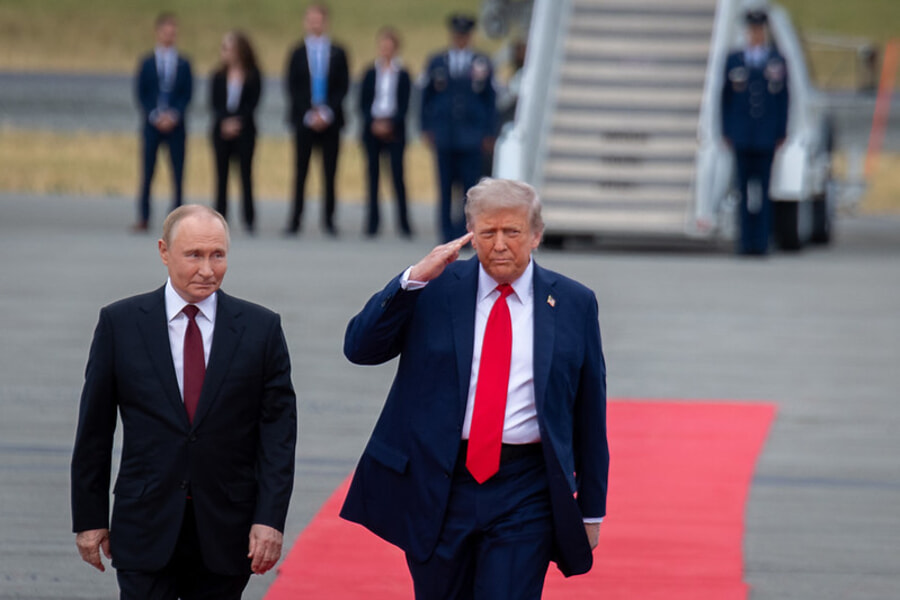
This simple truth—which Trump has not meaningfully contested to this day—hangs over every incident in which Trump tilts towards Russia in its current war with Ukraine. In the wake of the Mueller Report, Trump—with an able assist from then-Attorney General Bill Barr—crowed that the big message of the report was that there had been “no collusion.” And for criminal purposes, that was right, in a sense. Mueller and his team had been unable to find people associated with the Trump campaign who actively conspired with Russian espionage or influence operations.
And so the larger truth got lost—not because it wasn’t available and documented extensively but because it wasn’t a conclusion of law. It was just an inevitable conclusion based on reported and uncontested facts.
And what was that conclusion? Nothing more or less than that the president knowingly accepted assistance in his first campaign from a foreign intelligence service that was actively conducting espionage activities against the United States. It is a conclusion that should forever condition the way people understand every interaction his government has with that of the Russian Federation.
The third enduring truth of the Mueller Report is that there were repeated and extensive contacts between Russian entities purporting to represent the government and officials of the Trump campaign. These contacts ranged a great deal, from the direct approach in Trump Tower with an offer to senior campaign leadership of assistance to the suggestion made by a young campaign hanger-on to a foreign diplomat that the Russians had “dirt” on Hillary Clinton to protracted negotiations over the building of a Trump Tower in Moscow to Paul Manafort’s work with a known Russian intelligence operative and on a behalf Ukraine’s pro-Russian former president.
The sheer sweep of the contacts, which require more than 100 pages to detail, speaks to the magnitude of the betrayal. Some of them involved running a campaign. Some of that business involved back channel discussions with leadership. Some of them involved building buildings. Some of them involved hiring hackers to recover allegedly missing Hillary Clinton emails. I could go on. The salient point is that a man who would be president surrounded himself with people actively doing business, and very much open for business, with Putin’s Russia. He knew this. He supervised it. He participated in it. And he lied about it publicly.
The strange affinity Trump has for Putin and Russia remains hard to understand. I do not purport to have an explanation for it. But the mystery is the same one as it was then: A mesh of contacts and mixing of affairs of state and affairs of business in such fashion that one cannot tell which is which or which is driving which. And of course it has spread. Trump now engages this way with the Gulf monarchies too.
But the fundamental pattern is all laid out in the Mueller Report—and it predates Trump’s presidency by some time.
Finally, the fourth enduring truth of the Mueller Report comes from Volume 2 of the document—which covers not Trump’s dealings with Russia but his efforts to obstruct the Mueller investigation itself. That truth is that the president and the people around him behave like gangsters.
Mueller never, of course, says this quite this bluntly. He describes, rather, “potentially obstructive acts” and archly refers to “a series of actions by the President that related to the Russian-interference investigations, including the President’s conduct towards the law enforcement officials overseeing the investigations and the witnesses to relevant events.”
Volume 2, you may recall, catalogues a number of incidents in which Trump engaged in activity that raised questions under the obstruction statute—activity like dangling pardons to people who could hurt him, issuing pardons, tweeting reassurances to keep people from cooperating, attacking witnesses who cooperate, firing officials, and threats to fire officials or crack down on the investigation.
Mueller got a lot of criticism for declining to render judgment on whether the president had violated the obstruction laws. For present purposes, the more salient point is that the pattern of witness tampering behaviors he documented has persisted in Trump’s subsequent behavior. Similar conduct shows up in the New York criminal case. It shows up in the classified documents. It shows up in the Jan. 6 investigation. And it shows up, again and again, in the second term management of the executive branch—where pardons are routinely dispensed as rewards for loyalty and the hammer of the justice system comes down on enemies.
Mueller made mistakes. There is no doubt about that. That said, the Mueller Report remains the single best account we have of the relationship between Trump and the Russians and the manner in which Trump will deploy power within and from the executive branch. Little that has happened since its release should surprise those who read it carefully.
The Situation continues tomorrow.